
Tip #4: Leverage the Pro-Rata Rule for Non-Deductible Contributions
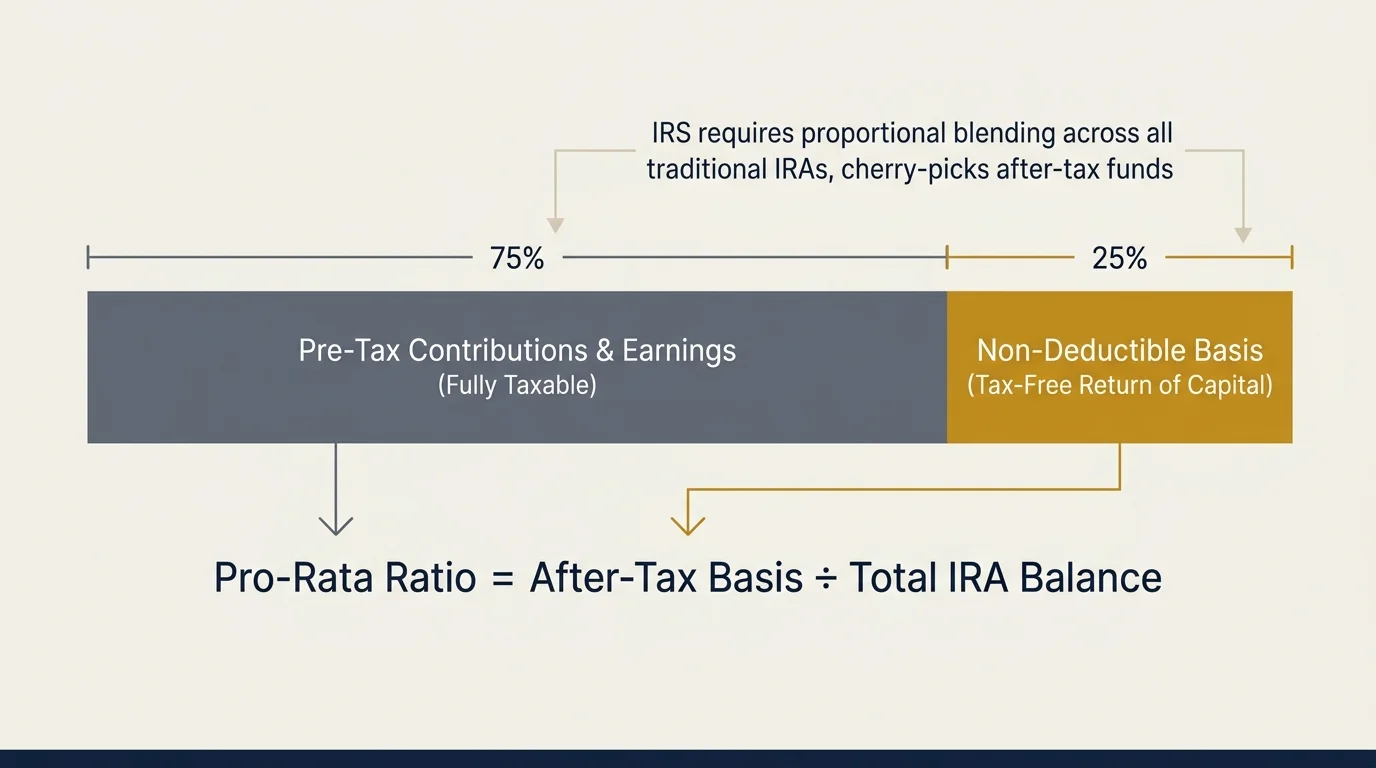
If you made non-deductible (after-tax) contributions to your traditional IRA in past years because your income exceeded deduction limits, you are not taxed twice on those specific dollars. However, you cannot simply choose to withdraw only the non-deductible portion tax-free while leaving the taxable funds behind. The IRS enforces the pro-rata rule, which treats all of your traditional, SEP, and SIMPLE IRAs as a single collective account.
To determine the tax-free percentage of your withdrawal, you must file IRS Form 8606 each year you make non-deductible contributions or take a distribution. The IRS calculates the proportion of your after-tax basis relative to your total aggregated IRA balances across all accounts. Every distribution you make will consist of a proportionate blend of tax-free principal and taxable earnings.
For example, assume you possess $100,000 across all your traditional IRAs, consisting of $20,000 in non-deductible contributions (20% basis) and $80,000 in pre-tax contributions and accumulated earnings (80% taxable). If you take a $10,000 distribution this year, exactly $2,000 (20%) is returned to you tax-free, while the remaining $8,000 (80%) is reported as taxable ordinary income. Tracking your cumulative basis accurately on Form 8606 guarantees you never overpay taxes on money you already paid tax on years ago.