
Tip #2: Master the Age 59½ Early Distribution Rules
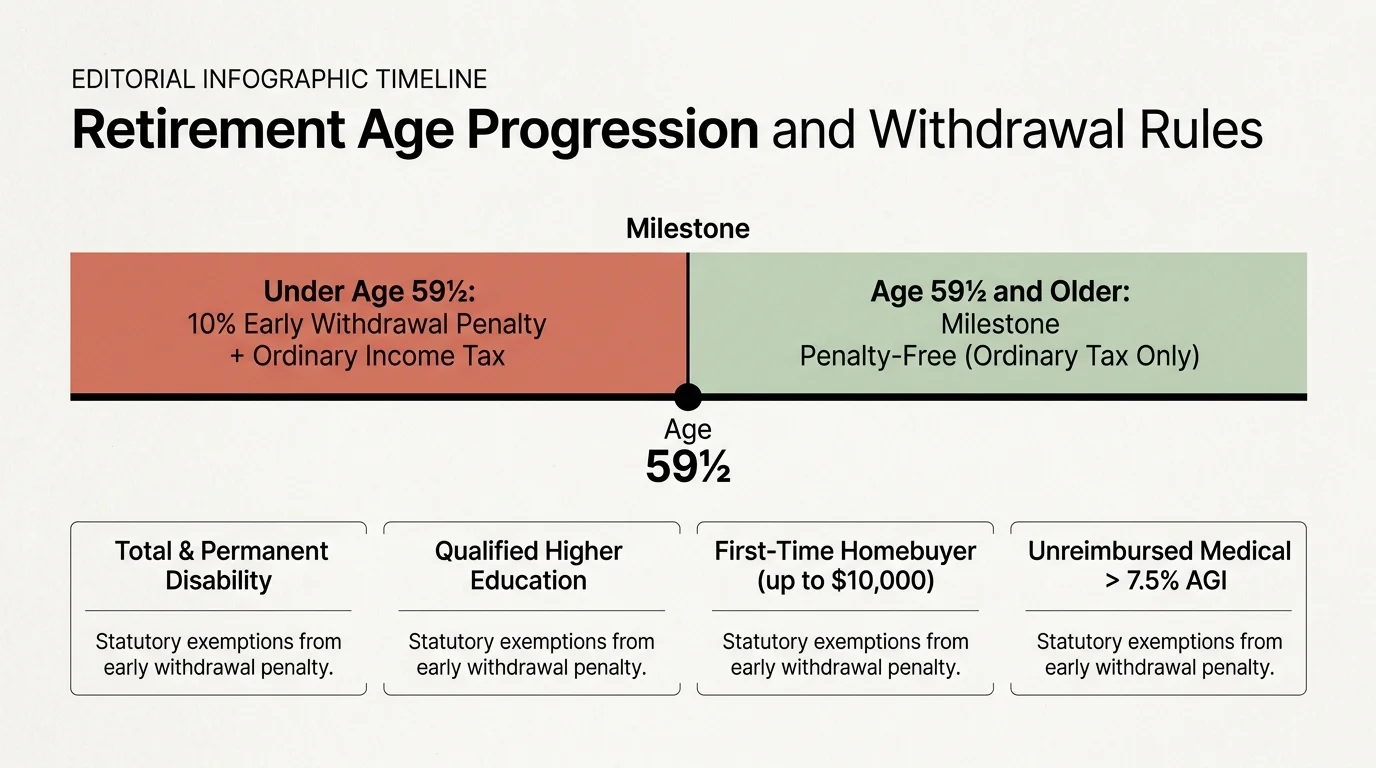
Timing your distributions correctly protects your retirement savings from preventable government penalties. The IRS established age 59½ as the official threshold for penalty-free retirement distributions. If you withdraw funds from a traditional IRA before reaching age 59½, you will generally face an IRA early withdrawal tax penalty equal to 10% of the taxable amount, assessed in addition to your standard ordinary income tax.
Consider a practical scenario: if you withdraw $20,000 at age 55 while in the 22% federal tax bracket, you would owe $4,400 in federal income tax plus a $2,000 early withdrawal penalty—surrendering $6,400 (or 32%) of your withdrawal before state taxes are even applied. Fortunately, the IRS permits several specific statutory exceptions to this penalty, including:
• Total and permanent disability
• Qualified higher education expenses for you, your spouse, or dependents
• Qualified first-time homebuyer purchases (up to a $10,000 lifetime limit)
• Qualified birth or adoption expenses (up to $5,000 per parent)
• Unreimbursed medical expenses exceeding 7.5% of your adjusted gross income (AGI)
Once you celebrate your 59½ birthday, this 10% penalty disappears entirely. You can withdraw any amount you need at any time, paying only your standard ordinary income tax rate on the pre-tax funds.