
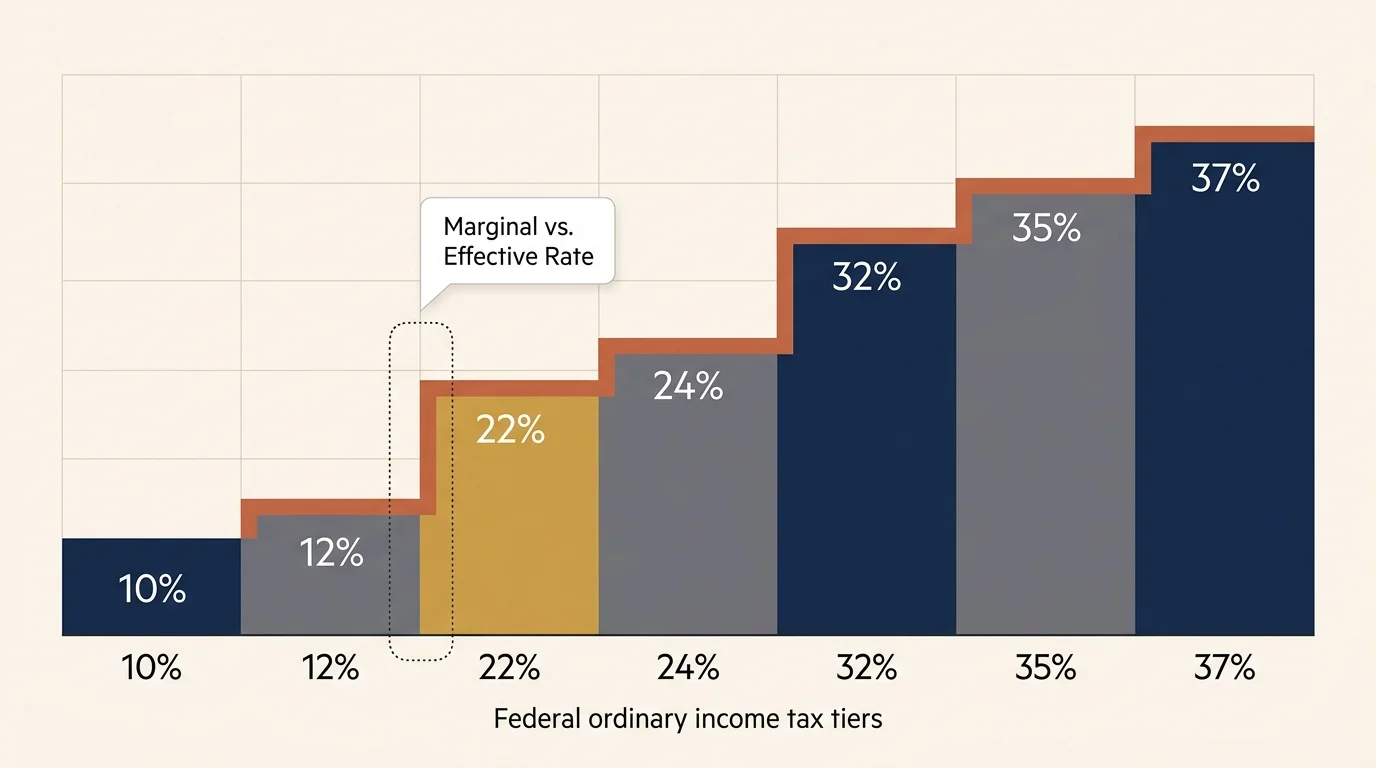
Tip #1: Understand Your Ordinary Income Tax Brackets
When you take money from a traditional IRA, the IRS treats every dollar of pre-tax contributions and investment growth as ordinary taxable income. Unlike profits from selling taxable stock held for several years, retirement distributions do not qualify for preferential long-term capital gains rates. Instead, your distribution stacks on top of your other annual revenue sources—such as pensions, wages, and taxable Social Security benefits—to determine your federal tax bracket.
The current federal income tax brackets stand at 10%, 12%, 22%, 24%, 32%, 35%, and 37%. The exact amount of tax you owe depends on your filing status and overall taxable income for the year. For instance, if you are married and filing jointly with existing taxable income sitting near the top of the 12% bracket, a large traditional IRA distribution could push a portion of your funds into the 22% bracket. This is why financial planners often evaluate both your marginal rate (the tax rate paid on your last dollar of income) and your effective rate (the overall average percentage you pay).
State taxes also play a major role in determining how are IRA withdrawals taxed. While several states levy zero income tax or offer generous tax exclusions for retirement distributions, other states tax distributions fully as ordinary income. Always account for both federal and state tax responsibilities when calculating the true net payout of your distribution.