

Navigating your financial landscape during retirement should bring peace of mind, yet changing tax rules can quickly create unexpected stress. Partnering with a skilled tax professional allows you to protect your nest egg, lower your overall tax burden, and ensure complete compliance with evolving IRS regulations. As income sources shift from traditional paychecks to Social Security, IRA withdrawals, and investments, tax planning becomes significantly more intricate. Identifying key warning signs early empowers you to make proactive financial decisions rather than reactive mistakes. By recognizing when to seek expert guidance, you safeguard your hard-earned wealth and free up valuable time to enjoy a blissful, fulfilling retirement.
Tip #1: You Are Navigating Required Minimum Distributions (RMDs)
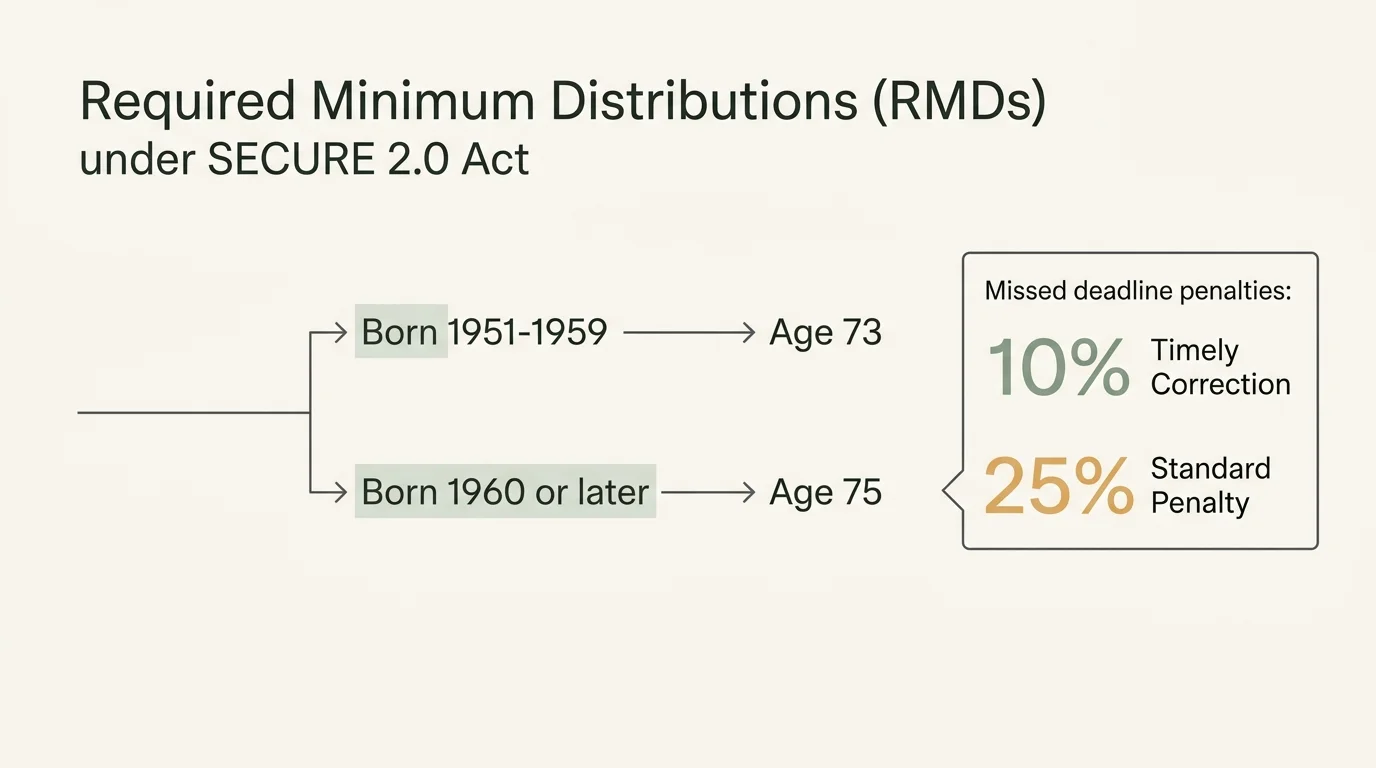
Transitioning from the accumulation phase of saving for retirement to the distribution phase of spending down your assets represents one of the most significant financial shifts of your life. Once you reach a certain age, the Internal Revenue Service requires you to begin taking Required Minimum Distributions (RMDs) from your tax-deferred retirement accounts, such as traditional IRAs, 401(k)s, and 403(b)s. Under the SECURE 2.0 Act, the starting age for mandatory withdrawals is 73 for individuals born between 1951 and 1959, and it rises to 75 for those born in 1960 or later. Calculating these distributions accurately is vital because the tax code imposes strict penalties for miscalculations or missed deadlines.
If you fail to withdraw your full RMD by the required deadline, the IRS imposes a substantial penalty tax. While the penalty was previously 50% of the unwithdrawn amount, recent legislation reduced this excise tax to 25%, and it can be further reduced to 10% if you correct the mistake within a timely correction window. Even with lower penalties, losing 10% or 25% of your required distribution to avoidable fees represents a major loss of wealth. A qualified tax professional helps you calculate accurate distribution amounts across multiple account types, coordinates distribution timing throughout the tax year, and determines which specific accounts to draw from first to minimize your overall tax bracket exposure.
Furthermore, tax advisors can help you optimize your overall income strategy so that RMDs do not unintentionally push you into a higher income tax bracket or trigger higher Medicare Part B and Part D premiums. By analyzing your entire portfolio, a tax expert transforms what could be a confusing administrative headache into a smooth, tax-efficient cash flow system for your retirement years.
Understanding how different retirement cash flows interact is critical for preserving your wealth.
Tip #2: You Are Managing Social Security Benefits Alongside Retirement Income
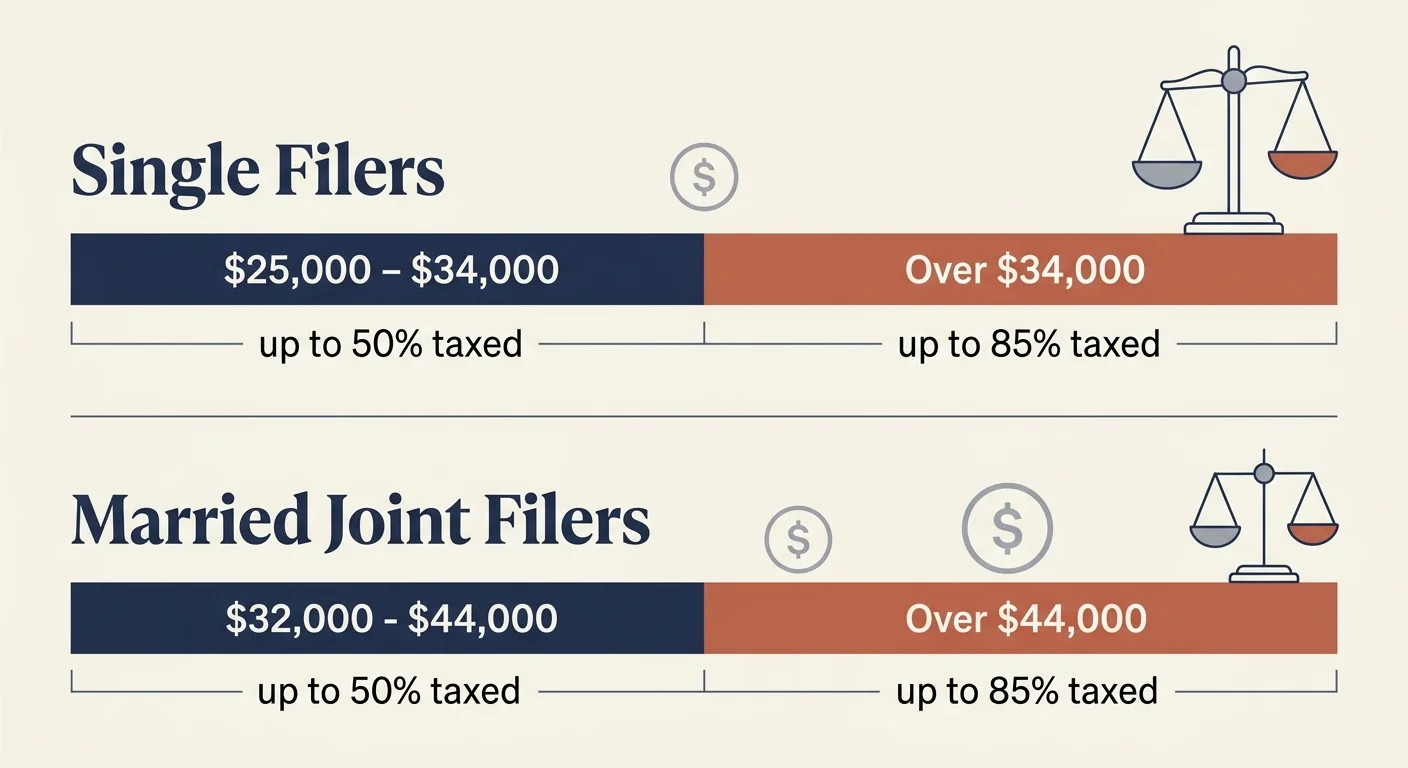
Many retirees look forward to receiving Social Security benefits under the assumption that these payouts are completely tax-free. However, depending on your total household income, a significant portion of your monthly Social Security benefits may be subject to federal income tax. The IRS determines the taxability of your benefits using a formula known as provisional or combined income, which equals your Adjusted Gross Income (AGI) plus non-taxable interest income plus 50% of your total Social Security benefits. Recognizing tax filing complexity signs in your monthly cash flow is key to preventing unexpected tax bills when filing season arrives.
Under current federal tax laws, up to 50% of your Social Security benefits become subject to federal income tax if your combined income falls between $25,000 and $34,000 for single filers, or between $32,000 and $44,000 for married couples filing jointly. If your combined income exceeds $34,000 as a single filer or $44,000 as a joint filer, up to 85% of your Social Security benefits become subject to federal income tax. Because these thresholds are not adjusted annually for inflation, more seniors find themselves paying taxes on their benefits each year as pension payments, investment returns, and account withdrawals increase.
Working with an expert allows you to orchestrate the order and timing of your retirement income. A tax advisor can structure your withdrawals from taxable accounts, tax-deferred accounts, and Roth accounts in a way that manages your provisional income. By keeping your provisional income below these key decision thresholds whenever possible, you preserve more of your Social Security earnings for your personal enjoyment and living expenses.
Life transitions often introduce fresh financial considerations that require professional oversight.

Tip #3: You Experienced a Major Life Event or Retirement Transition
Major life changes frequently alter your tax liabilities in ways that automated software or simple formulas cannot easily predict. Retiring from long-term employment, selling a primary residence to downsize, relocating to a different state, or experiencing the loss of a spouse are primary signs you need a tax professional. Each of these events carries distinct tax implications that require individualized attention to ensure you remain fully compliant while taking advantage of available relief provisions.
For example, if you sell your primary home after living in it for at least two of the five years preceding the sale, you can exclude up to $250,000 of capital gains if you are single, or up to $500,000 if you are married filing jointly. However, calculating your adjusted cost basis accurately—taking into account home improvements, capital additions, and selling expenses over decades—demands thorough records and expert accounting. Similarly, relocating to a new state in retirement can subject you to complex multi-state income tax filings, partial-year tax returns, and differing state treatment of pension income and property taxes.
Losing a spouse brings emotional pain along with immediate financial changes, including a shift in tax filing status from married filing jointly to single. This shift often results in the single filer penalty, where tax brackets shrink while income levels remain relatively constant. A tax professional offers compassionate guidance during these vulnerable moments, walking you through filing requirements, updating tax withholdings, and restructuring assets to protect your long-term stability.
Diversified income streams provide financial resilience, but they also increase the complexity of your annual tax filing.
Tip #4: You Have Multiple Income Streams or Complex Investments
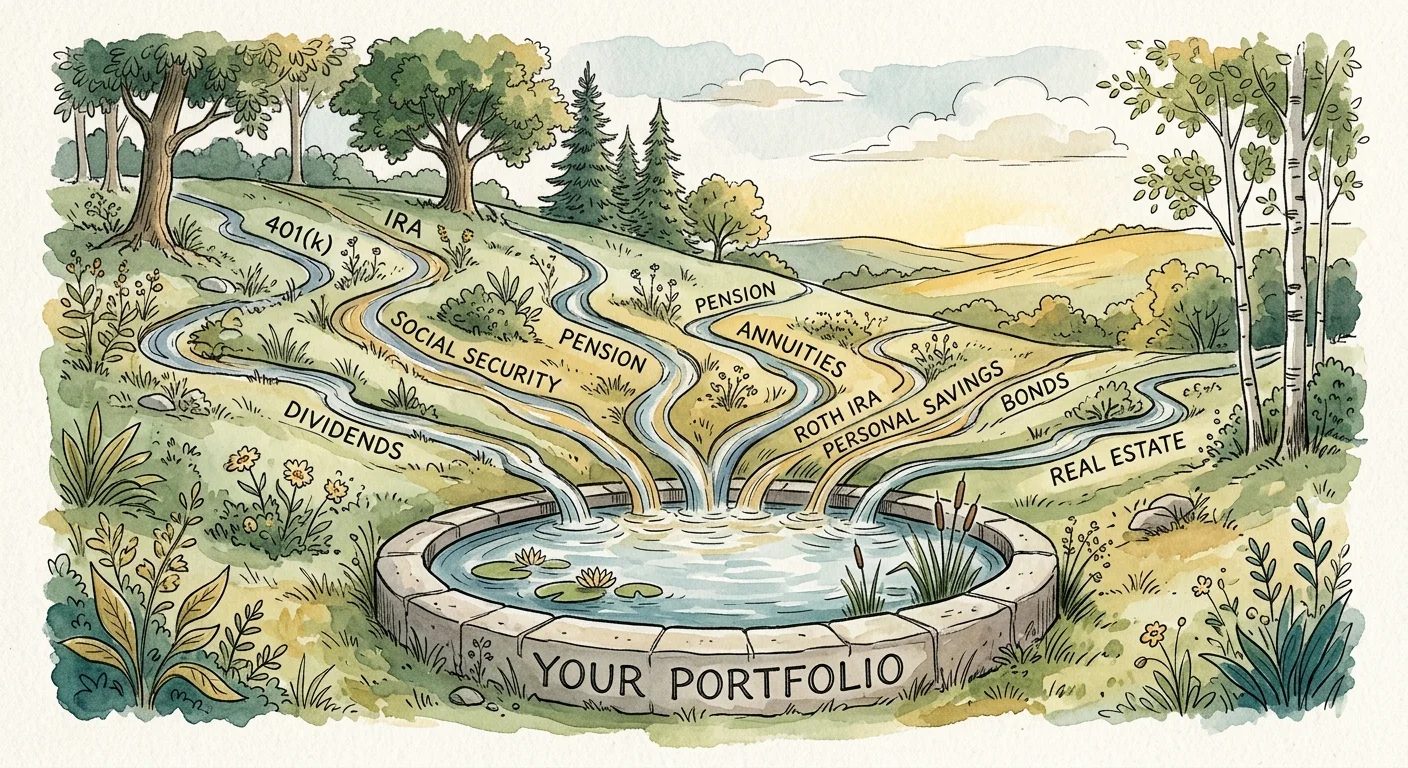
Modern retirement often looks quite different from previous generations. Rather than relying solely on a single employer pension, you may collect income from multiple sources, such as rental real estate, dividend-paying stocks, capital gains from brokerage accounts, consulting, or small business ventures. Knowing when to hire a tax advisor becomes essential as these varied streams introduce intricate reporting requirements and dynamic contribution guidelines.
If you remain actively working or perform consulting work in your 60s, you can take advantage of enhanced retirement savings rules. Under the SECURE 2.0 Act, workplace retirement plan catch-up contribution limits for individuals aged 60 to 63 increase to $11,250. However, new rules starting in 2026 require workers aged 50 or older who earned more than $150,000 in prior-year wages from their employer to make all workplace catch-up contributions on a Roth (after-tax) basis. High earners should also monitor the Social Security taxable wage base cap, which reaches $184,500 for the 2026 tax year.
Managing rental property depreciation, tracking capital gain tax rates, coordinating estimated quarterly tax payments, and adhering to high-earner retirement contribution rules create a layered web of calculations. A tax advisor harmonizes these moving parts, ensuring you pay the correct quarterly estimates, avoid underpayment penalties, and maximize deductions related to your business or real estate holdings.
Taking advantage of every tax break tailored for older adults requires knowing exactly where to look.

Tip #5: You Want to Maximize Senior-Specific Tax Deductions and Credits
The federal tax code includes targeted tax relief provisions designed specifically to support older Americans, but many eligible taxpayers miss these opportunities due to changing regulations. Partnering with a knowledgeable tax professional guarantees that you claim every senior-focused deduction and credit available to you under current legislation.
A notable update is the federal senior tax deduction enacted under the One Big Beautiful Bill Act (OBBBA) for tax years 2025 through 2028. Under this provision, taxpayers age 65 and older can claim an additional federal senior tax deduction of $6,000 per person ($12,000 for married couples filing jointly when both spouses are 65 or older). This dedicated senior deduction begins to phase out for Modified Adjusted Gross Income (MAGI) exceeding $75,000 for single filers or $150,000 for joint filers. An experienced preparer ensures your MAGI is calculated precisely so you retain the maximum possible benefit.
Additionally, seniors benefit from standard deduction add-ons. For the 2026 tax year, the basic standard deduction is $16,100 for single filers and $32,200 for married couples filing jointly. Individuals age 65 or older are entitled to an extra standard deduction amount of $2,050 if unmarried, or $1,650 per qualifying spouse if married filing jointly. A professional tax preparer evaluates whether itemizing deductions or claiming the enhanced standard deduction produces the greatest overall tax savings for your household.
Strategic charitable giving allows you to support causes you love while optimizing your tax position.

Tip #6: You Are Planning Your Estate or Making Charitable Gifts
Leaving a lasting legacy and supporting meaningful charitable organizations are top priorities for many retirees. However, making gifts without tax planning can lead to unnecessary tax burdens for both you and your beneficiaries. Recognizing tax help warning signs—such as unintended tax hits on inherited assets or missed giving tax breaks—allows you to structure your philanthropic and estate plans far more effectively.
One powerful tool available to retirees is the Qualified Charitable Distribution (QCD). If you are age 70½ or older, a QCD allows you to transfer up to $105,000 per year directly from a traditional IRA to a qualified 501(c)(3) charity. Because the money moves directly from your account custodian to the charitable organization, the distribution is excluded from your gross income. This means you do not pay income tax on the withdrawal, yet the amount counts directly toward satisfying your Required Minimum Distribution for the year. This approach provides a significant benefit over standard charitable deductions, especially if you take the standard deduction rather than itemizing.
When it comes to estate planning, a tax professional works alongside your estate planning attorney to ensure your assets pass to your loved ones in a tax-efficient manner. They help structure trusts, manage step-up in basis rules for inherited property, and minimize the impact of the SECURE Act’s 10-year distribution rule for non-spouse beneficiaries inheriting traditional IRAs. Expert tax strategy turns your generous intentions into maximum practical impact.
Evaluating the true cost of managing your taxes independently involves more than just software fees.

Tip #7: The Stress of DIY Filing Outweighs the Cost of Professional Help
For many years, preparing your own return with commercial software may have felt like a simple, cost-effective routine. However, as financial situations grow more complex in retirement, comparing a tax professional vs DIY tax software reveals clear advantages in favor of professional guidance. Spending hours wrestling with confusing tax questions, worrying about potential errors, or fearing an IRS audit can steal the joy and freedom you earned for retirement.
Understanding standard industry pricing helps you weigh the financial investment of professional support. Hiring a CPA or professional tax preparer for an individual tax return averages $250 to $800 for a standard filing. For returns involving rental properties, self-employment earnings, or complex capital gains transactions, average fees range from $450 to $1,200 or more. Ongoing tax advisory, multi-year retirement tax mapping, and holistic financial planning typically range from $150 to $400 per hour. When viewed against potential tax overpayments, missed senior deductions, or IRS penalties, professional preparation frequently pays for itself.
Beyond the direct financial return, working with a human expert provides invaluable confidence. Software cannot answer nuanced strategic questions tailored to your goals, nor can it sit beside you to offer guidance if the IRS audits your return. Delegating this complex responsibility to a trusted professional grants you complete confidence, leaving you free to focus on living your best retirement lifestyle.
Embracing financial clarity allows you to focus fully on the passions and relationships that bring joy to your post-career life.

The Takeaway: Living a More Blissful Retirement
Retirement should be a season of celebration, relaxation, and personal fulfillment, not a time spent worrying over complex tax schedules and IRS code changes. Recognizing the key signs that it is time to consult a tax professional empowers you to take control of your financial destiny. Whether you are navigating mandatory account distributions, maximizing senior-specific tax deductions, managing multiple income sources, or planning your charitable legacy, professional guidance offers both financial protection and immense peace of mind.
By partnering with a knowledgeable tax advisor, you transform taxes from an annual burden into a strategic asset. You protect your hard-earned nest egg, minimize unnecessary tax expenses, and ensure that your wealth continues to support your dreams and those of your loved ones. Take the proactive step today to reach out to a certified professional, simplify your financial life, and step confidently into a bright, blissful retirement.
Here are clear answers to the most common questions seniors ask when seeking expert tax assistance.
Frequently Asked Questions
What is the difference between a CPA, an Enrolled Agent, and an online tax software program?
A Certified Public Accountant (CPA) is a state-licensed financial professional who has passed rigorous exams and met extensive education requirements. CPAs handle broad accounting, tax preparation, and strategic financial planning. An Enrolled Agent (EA) is a federally authorized tax practitioner empowered by the U.S. Department of the Treasury to represent taxpayers before the IRS. Online software programs are automated tools that follow basic algorithms. While software works well for simple W-2 income, human experts provide personalized advice, strategic tax planning, and audit representation that software cannot match.
When during the year should I contact a tax advisor?
While many individuals wait until tax season between January and April, the best time to meet with a tax advisor is during late summer or early autumn. Year-round or fall planning allows your tax advisor to implement proactive strategies—such as Roth conversions, tax-loss harvesting, or Qualified Charitable Distributions—before the December 31 deadline closes the door on current-year tax planning choices.
What documents should I prepare for my initial consultation with a tax professional?
To make the most of your meeting, bring your tax returns from the previous two to three years, recent statements from all investment and bank accounts, Social Security benefit statements (Form SSA-1099), retirement account distribution forms (1099-R), and records of any property sales or major expenses. Having these documents organized gives your preparer a clear, comprehensive view of your current financial picture.
Are fees paid to a tax professional tax-deductible on federal tax returns?
Under current tax law through 2025, individual taxpayers cannot deduct tax preparation fees as a miscellaneous itemized deduction on their personal federal tax return. However, if you are self-employed, operate a business, or own rental properties, you can generally deduct the portion of professional tax fees directly related to preparing Schedule C (profit or loss from business) or Schedule E (rental real estate income) on your business returns.
For a wide range of resources for older adults, visit AARP and the National Council on Aging (NCOA). Health information is available from the National Institute on Aging.
Disclaimer: This article is for informational and inspirational purposes only. It is not a substitute for professional medical, financial, or psychological advice. Please consult with a qualified expert for guidance tailored to your individual needs.