

Seeing your social security deposit smaller than your benefit letter can catch you off guard when budgeting for travel, hobbies, or family outings. That gap happens because automatic deductions, tax choices, and federal rules trim your gross benefit before funds hit your bank.
Knowing exactly why your check shrinks puts you back in control of your retirement cash flow. You can spot errors quickly, appeal unfair surcharges, and adjust optional deductions to match your real tax bill.
Walk through the eight main reasons your net social security benefit drops so you can keep more money working for your retirement.
1. Automatic Medicare Part B Premium Deductions
For most retirees enrolled in Medicare, the single biggest reason for a reduced deposit is an automatic medicare premium deduction. When you collect Social Security and carry Medicare Part B, the Social Security Administration (SSA) deducts your monthly Part B premium before sending your payment.
You do not receive a separate monthly invoice for Part B because the deduction happens behind the scenes. That convenience keeps your health coverage active while you travel or spend time with grandkids, yet it directly lowers your monthly cash deposit.
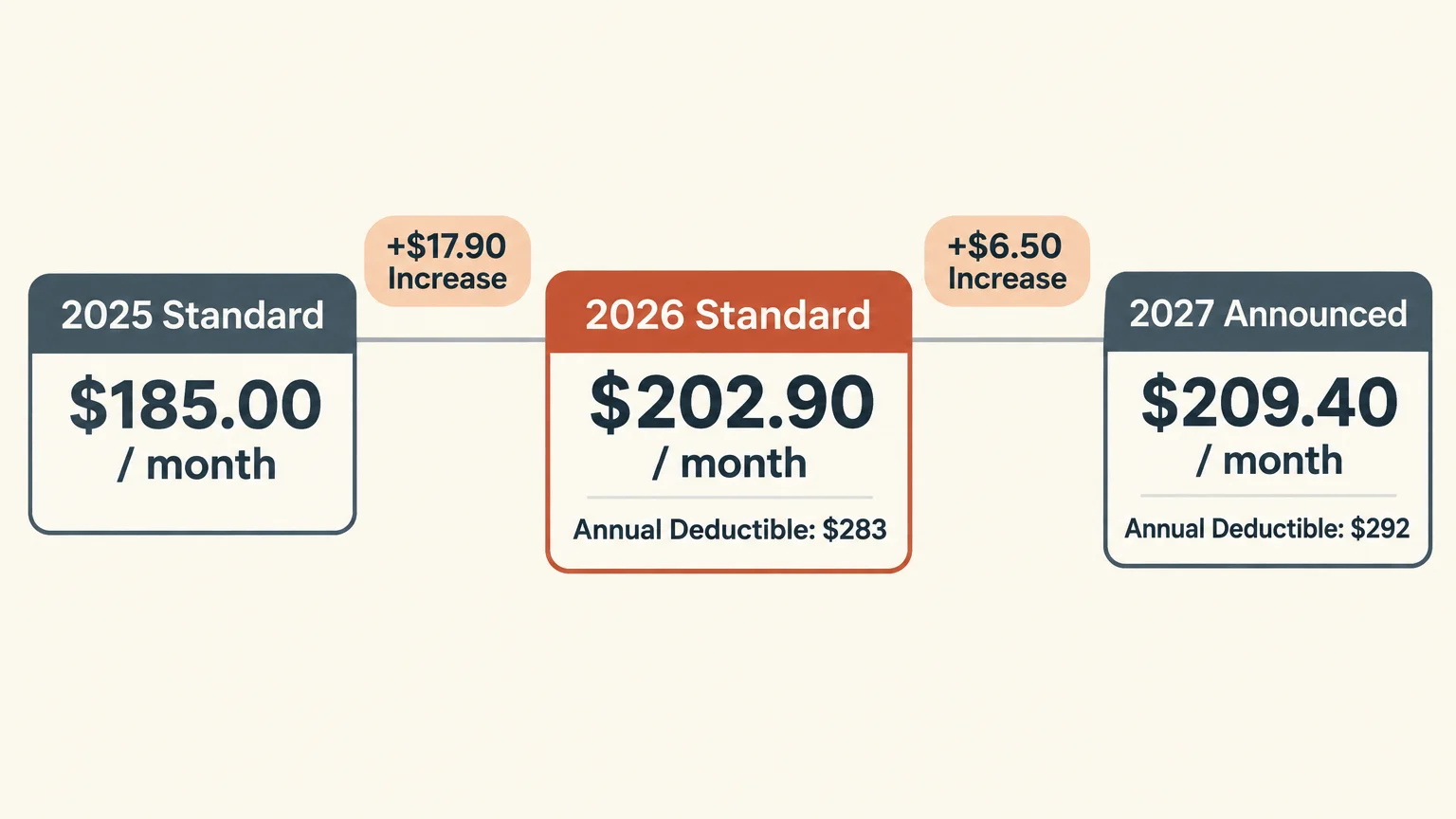
In 2026, the standard Part B deduction is $202.90 per month, reflecting a $17.90 increase from the $185.00 rate in 2025. Along with that monthly premium, standard Part B coverage carries a $283 annual deductible in 2026.
Looking ahead, the Centers for Medicare & Medicaid Services (CMS) announced on November 17, 2026, that the 2027 standard Part B premium rises to $209.40 per month. That $6.50 increase—about 3.2%—accompanies a $292 annual deductible for 2027.
Late-Enrollment Penalties and Optional Plan Deductions
Your Part B deduction can climb even higher if you delayed signing up without qualifying employer health coverage. Medicare adds a permanent 10% penalty to the standard Part B premium for every full 12-month period you waited.
Private Medicare Advantage (Part C) and Part D prescription drug base premiums work differently from Part B. SSA does not automatically withhold those base premiums by default when you enroll.
However, you can contact your private insurer to request Social Security withholding for your Part C or Part D plan. Keep in mind that starting or stopping that optional deduction can take up to three months to show up on your bank statement.
Medicare Part A hospital insurance rarely affects your monthly deposit because most people qualify for premium-free Part A with at least 40 work credits. If you do pay a Part A premium—$311 or $565 per month in 2026—Medicare bills you directly rather than deducting it from your check.
What You Can Do Today
Log into your my Social Security account and download your latest benefit verification letter to inspect every line item. Confirm whether your deposit reflects only the standard Part B deduction or includes optional Part C and Part D withholding you previously elected.
2. High-Income Medicare Surcharges (IRMAA)
If you enjoyed strong earnings before retiring—or triggered a large capital gain—your Medicare costs may include an Income-Related Monthly Adjustment Amount, known as IRMAA. This surcharge applies to both Medicare Part B and Part D coverage when your income crosses federal thresholds.
CMS and SSA calculate IRMAA using a two-year tax lookback based on your Modified Adjusted Gross Income (MAGI). Your 2026 premiums depend on your 2024 federal tax return, while your 2027 premiums rely on your 2025 return.
In 2026, IRMAA surcharges begin once MAGI exceeds $109,000 for single filers or $218,000 for married couples filing jointly. Across five income tiers, those adjustments push total Part B deductions to between $284.10 and $689.90 per month, plus $14.50 to $91.00 monthly for Part D.
For 2027, CMS raised the starting thresholds slightly to above $112,000 for single filers and $224,000 for joint filers. Total monthly Part B deductions climb to between $293.10 and $711.80—reflecting surcharges of $83.70 to $502.40—while Part D surcharges range from $15.40 to $96.40 per month.
Why Part D Surcharges Surprise Retirees
Even if you pay your Part D insurer directly every month instead of using Social Security withholding, SSA automatically deducts any Part D IRMAA surcharge from your monthly benefit. That unexpected subtraction often leaves new retirees wondering why their deposit dropped midyear.
How to Appeal an Unfair Surcharge
You do not have to accept an IRMAA bill based on an outdated high-earning year if your lifestyle recently changed. When retirement, marriage, divorce, or the death of a spouse lowers your income, you can appeal using Form SSA-44.
Gather documentation showing your life-changing event alongside a realistic estimate of your current-year MAGI. Submitting Form SSA-44 promptly can remove hundreds of dollars in monthly surcharges and free up cash for the hobbies and trips you planned.
3. How Rising Medicare Costs Eat Into Annual COLAs
Annual Cost-of-Living Adjustments (COLAs) help your retirement budget keep pace with everyday expenses. Yet your net social security benefit rarely grows by the full COLA percentage announced each autumn.
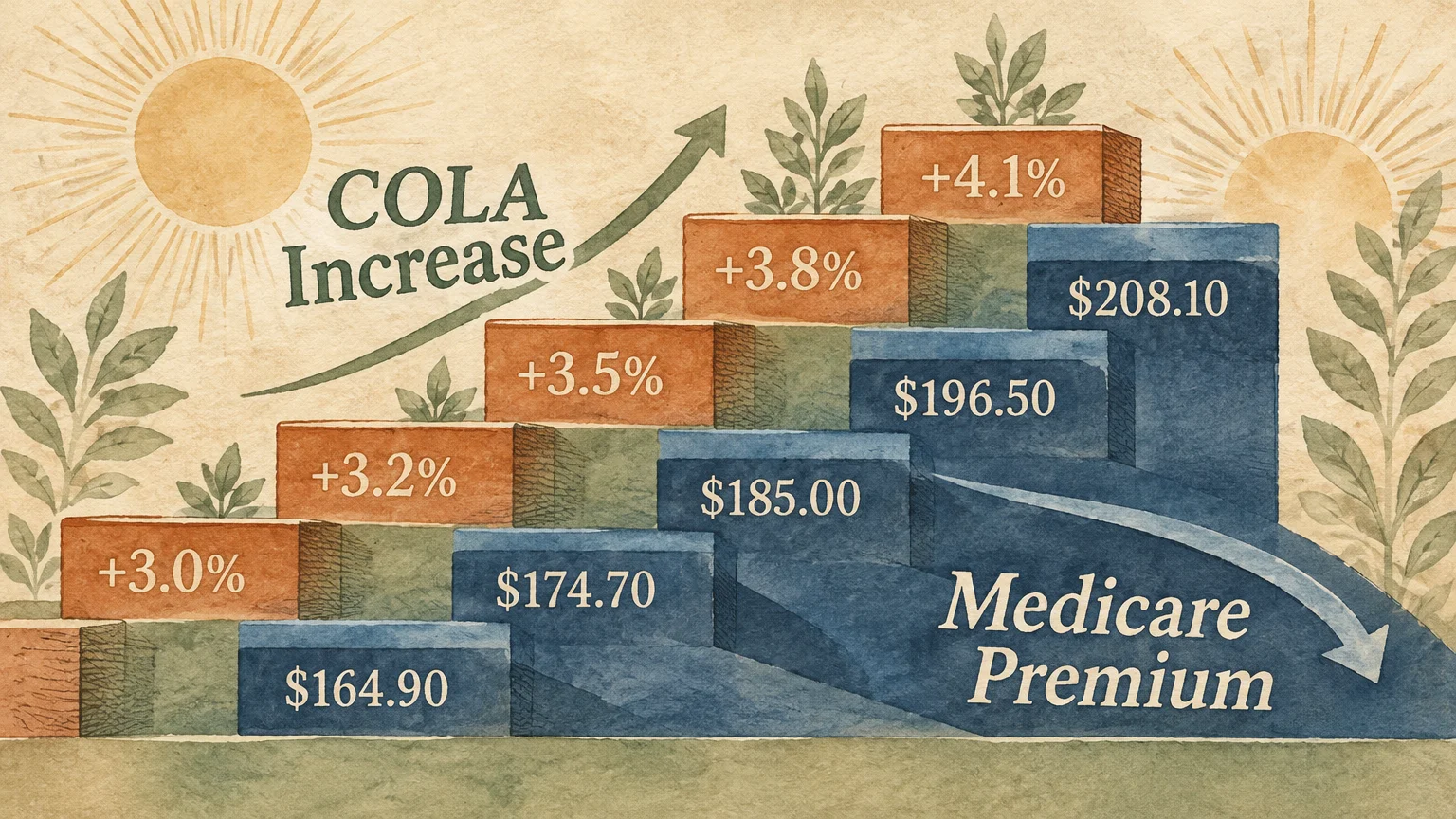
Because your Part B deduction rises alongside annual inflation updates, Medicare absorbs part of your raise before the money arrives. In 2026, for example, benefits rose by a 2.8% COLA while standard Part B premiums increased by $17.90 per month.
On October 14, 2026, SSA announced a 3.6% COLA for 2027, taking effect in January 2027 for Social Security checks and December 31, 2026, for Supplemental Security Income (SSI). That adjustment lifts the average retired worker’s gross benefit by roughly $75 per month, from $2,095 to $2,170.
Once you subtract the $6.50 Part B premium increase for 2027, that same average retiree nets about $68.50 more per month. Knowing the net gain—not just the headline percentage—helps you plan realistic budgets for road trips, dining out, or community classes.
Understanding the Hold Harmless Rule
Federal law includes a safety net called the hold harmless provision to protect smaller checks from shrinking. For most existing beneficiaries with Part B deducted from Social Security, your net deposit cannot fall solely because the standard Part B premium rose.
With a 3.6% COLA and a $6.50 Part B increase in 2027, the hold harmless rule only shields monthly benefits below roughly $180.56. Most retirees receive larger checks than that threshold, so they absorb the full premium hike out of their COLA raise.
Be aware that hold harmless protection never covers new Part B enrollees, IRMAA payers, people billed directly by Medicare, or individuals whose premiums are covered by Medicaid. If you fall into any of those groups, higher Medicare premiums reduce your check dollar for dollar.
4. Voluntary Federal Tax Withholding—and State Tax Rules
Unlike traditional paychecks from an employer, Social Security defaults to $0 in federal income tax withholding. You receive your full benefit after Medicare deductions unless you actively ask SSA to hold money back for the Internal Revenue Service (IRS).
Many retirees choose voluntary social security withholding so they do not face a painful tax bill every April. If you previously submitted IRS Form W-4V, updated your preferences in your my Social Security portal, or called 1-800-772-1213, that election trims every deposit.
Federal rules restrict Social Security tax withholding to four flat percentages: 7%, 10%, 12%, or 22%. You cannot pick a custom dollar figure or an in-between rate like 15%.
Checking Whether You Still Need Tax Withholding
Under longstanding IRS formulas, up to 50% of your Social Security benefits become taxable when your combined income—adjusted gross income plus nontaxable interest plus half your benefits—hits $25,000 to $34,000 for singles or $32,000 to $44,000 for joint filers. Above $34,000 single or $44,000 joint, up to 85% of benefits can face tax.
However, a major law signed on July 4, 2025—Public Law 119-21—created an enhanced senior deduction for tax years 2025 through 2028. Adults age 65 and older receive an extra $6,000 deduction per eligible spouse, or $12,000 for qualifying couples filing jointly.
That bonus deduction stacks right on top of your standard deduction and the existing age-65 add-on, though it phases out by 6% of MAGI above $75,000 for singles or $150,000 for joint filers. While the 50% and 85% benefit formulas remain on the books, the White House Council of Economic Advisors estimates this enhanced deduction lowers taxable income enough that only about 12% of seniors owe federal tax on benefits.
Because fewer retirees owe federal income tax on their checks, continuing an old 10% or 22% withholding election might shrink your monthly lifestyle needlessly. Review your projected tax liability with a tax professional, and submit a revised Form W-4V to stop or lower withholding if you consistently receive oversized tax refunds.
What About State Income Taxes?
SSA never withholds state income taxes from your monthly benefit, even if you ask. As of 2026, only eight states still tax some portion of Social Security benefits—Colorado, Connecticut, Minnesota, Montana, New Mexico, Rhode Island, Utah, and Vermont—after West Virginia fully exempted benefits in 2026.
If you live in one of those eight states, your smaller deposit comes from federal items, not state withholding. You will handle any state tax owed through quarterly estimated payments or your annual state return.

5. Working Before Full Retirement Age (The Earnings Test)
Retirement today rarely means sitting still, and plenty of older adults enjoy part-time consulting, seasonal work, or turning a lifelong hobby into paid income. Earning a paycheck feels rewarding, yet working while claiming benefits early can temporarily trigger steep social security withholding.
If you start benefits before reaching your Full Retirement Age (FRA)—which is age 67 for anyone born in 1960 or later—SSA applies an annual retirement earnings test. Earning above federal limits causes SSA to withhold full monthly checks until the required offset is met.
During full calendar years before you reach FRA, SSA withholds $1 in benefits for every $2 you earn above $24,480 in 2026. For 2027, that annual limit increases slightly to $25,560.
A gentler threshold applies during the calendar year you actually reach FRA, counting only earnings in months before your birthday milestone. In 2026, SSA withholds $1 for every $3 earned above $65,160, rising to $67,920 in 2027.
Why Withheld Earnings Are Not Lost Forever
Seeing entire monthly deposits paused or reduced because of a great part-time job can feel discouraging. Fortunately, the earnings test is a temporary deferral rather than a permanent tax.
The month you hit Full Retirement Age, the earnings cap vanishes completely—you can earn as much as you want with zero benefit reduction. At that point, SSA recalculates your monthly benefit upward to credit back the months your checks were withheld.
To avoid sudden cash-flow surprises, report changes in your estimated earnings to SSA early in the year. Planning ahead ensures you budget accurately while enjoying both your work income and your social calendar.
6. Overpayment Recovery (“Clawback”) Withholding
Sometimes a deposit drops sharply overnight because SSA determines it previously paid you too much. When an overpayment occurs—often due to delayed wage reporting, changing marital status, or agency calculation errors—SSA recovers the debt directly from future checks.
For retirement, survivor, and disability (Title II) overpayment notices issued on or after April 25, 2025, SSA’s default withholding rate is 50% of your monthly benefit. That steep 50% rule replaced a temporary 10% cap used from March 2024 through March 2025 and a brief return to 100% withholding announced in March 2025.
Two notable exceptions soften that rule for certain beneficiaries. Notices issued before April 25, 2025, stay at the 10% withholding rate unless a new overpayment happens, and SSI overpayment recovery remains capped at 10%.
Your Rights to Appeal or Lower the Rate
Losing half your monthly check can derail rent, groceries, and plans with friends or family, so act immediately if you receive an overpayment notice. You have 60 days from receiving the letter to file a request for reconsideration if you believe the debt amount is wrong.
If you cannot afford to repay the overpayment—and the error was not your fault—you can request a waiver at any time. Filing that waiver within 30 days of your notice pauses all collection withholding until SSA reviews your case.
Even when the overpayment is valid, you do not have to accept a 50% cut if it leaves you unable to pay essential bills. Contact SSA with a breakdown of your monthly expenses to negotiate a lower withholding rate—often 10% or as little as $10 per month based on financial hardship.
7. Garnishments, IRS Tax Levies, and Federal Offsets
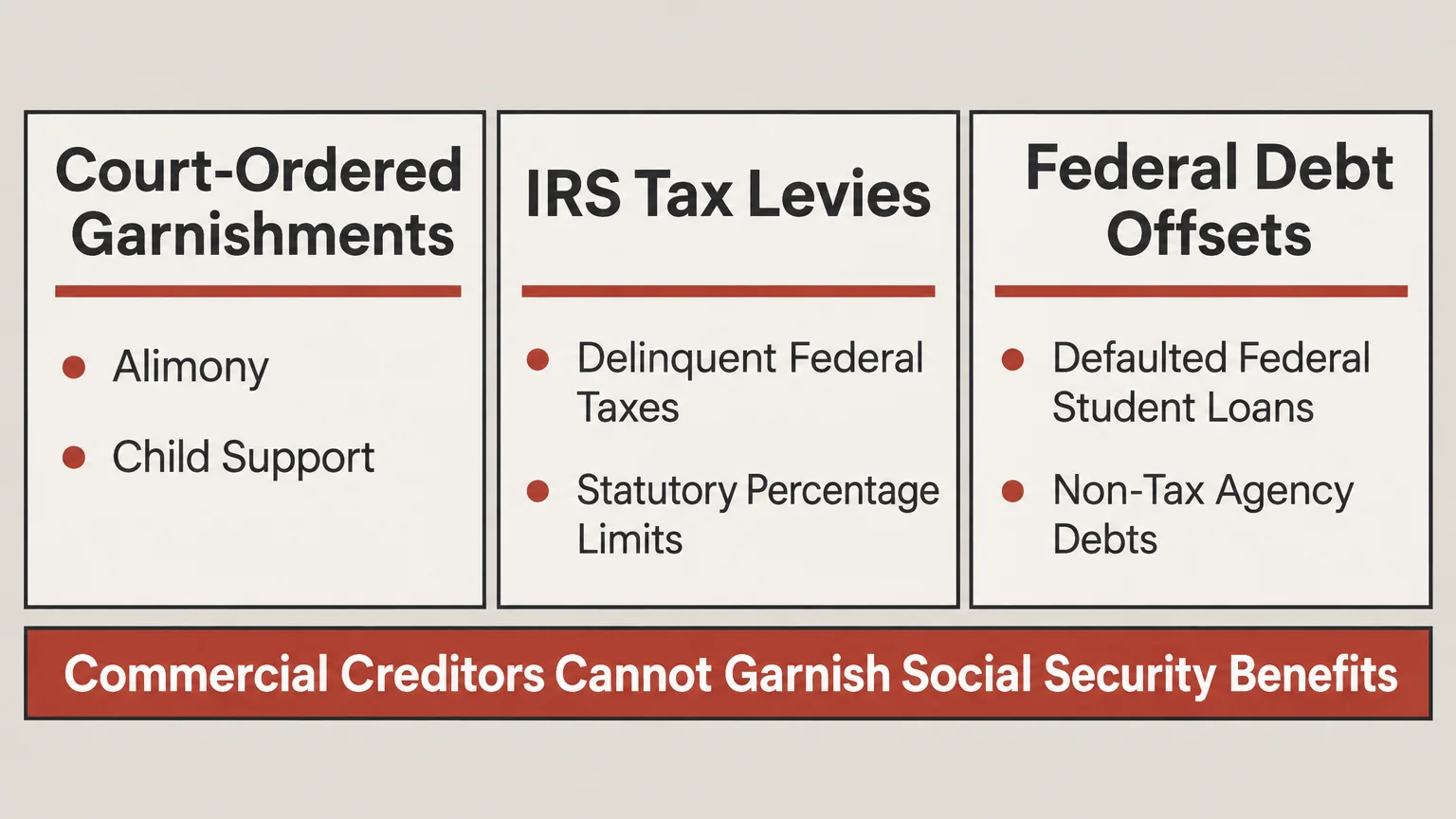
Federal law shields your Social Security income from commercial debt collectors. Under Section 207 of the Social Security Act, credit card issuers, medical billers, and personal loan lenders cannot garnish your monthly benefit before it reaches you.
Needs-based SSI payments enjoy even stronger protection and cannot be garnished or levied for any debt at all. However, regular retirement, survivor, and disability benefits remain vulnerable to a short list of government and court-ordered obligations.
Court-Ordered Family Support and Restitution
Under Section 459 of the Social Security Act, courts can order garnishment of your benefits for unpaid child support, alimony, or victim restitution. Federal Consumer Credit Protection Act limits generally cap those garnishments at 50% if you are supporting another spouse or child, or 60% to 65% depending on arrears.
Unpaid Federal Taxes
Through the Federal Payment Levy Program, the IRS can impose a continuous levy on your monthly Social Security deposit to collect overdue federal taxes. Unlike some offsets, the IRS can seize up to 15% of your monthly check with no protected minimum dollar floor.
The IRS must send a CP91 final notice at least 30 days before starting that 15% levy. Calling the number on your notice to set up an affordable installment agreement or request currently-not-collectible status can stop the levy before your deposit shrinks.
Defaulted Federal Student Loans
By statute, the Treasury Offset Program can deduct up to 15% of monthly Social Security benefits for delinquent federal non-tax debts, such as defaulted federal student loans, while leaving at least $750 per month. However, borrowers caught a major break in 2026.
On January 16, 2026, the U.S. Department of Education paused involuntary collections—including Treasury offsets of Social Security and wage garnishments—on Department-held defaulted loans. As of November 2026, that collection pause remains active with no official restart date announced.
8. Whole-Dollar Rounding, Disability Offsets, and Recent Law Changes
Even when no taxes, garnishments, or clawbacks touch your account, small statutory math rules ensure your deposit rarely matches your exact gross benefit to the penny. After applying reductions, Medicare Part B deductions, and other withholdings, SSA rounds your final monthly payout down to the next lower whole dollar.
For instance, if your calculated net payment equals $1,800.90, your bank receives exactly $1,800. Over twelve months, that rounding rule trims only a few dollars from your budget, yet it explains why you never see cents on your Social Security deposit.
Workers’ Compensation and Public Disability Offsets
If you receive Social Security Disability Insurance (SSDI) alongside workers’ compensation or certain public disability pensions, an additional federal cap may shrink your payment. Combined benefits generally cannot exceed 80% of your pre-disability average current earnings, or SSA reduces your SSDI check to stay under that ceiling.
Good News for Public-Sector Retirees
For decades, millions of teachers, firefighters, police officers, and federal workers saw their deposits slashed by the Windfall Elimination Provision (WEP) and Government Pension Offset (GPO). Those two rules penalized retirees who also collected pensions from government jobs that did not pay into Social Security.
On January 5, 2025, the Social Security Fairness Act repealed both WEP and GPO retroactively for benefits payable January 2024 and later. If a public pension once reduced your deposit, that cut is gone—making 2026 and 2027 a welcome time to review your updated statement and plan fresh ways to enjoy your extra income.

Putting It into Practice: Small Steps for Big Changes
Discovering why your deposit came up short removes the stress of guessing and gives you clear levers to improve your monthly cash flow. A single afternoon spent reviewing your statements can free up funds for weekend getaways, community clubs, or spoiling your grandchildren.
Start by downloading your latest benefit letter inside your my Social Security portal and comparing your gross amount against each deduction line. If your income fell after leaving work, submit Form SSA-44 right away so outdated IRMAA surcharges stop draining your check.
Next, check whether you still need voluntary federal tax withholding under the enhanced senior deduction for 2025 through 2028. Updating Form W-4V takes just minutes and can immediately restore 7% to 22% of your monthly check if you have been overpaying taxes.
Finally, mark your calendar every November when Medicare announces next year’s Part B rates so you can build an accurate lifestyle budget before January arrives. Staying proactive keeps your retirement finances steady and leaves you free to focus on staying active, connected, and curious.
For resources on retirement living, travel, and finance, visit AARP. Official information on Social Security is available at SSA.gov.
When your budget is set and you are ready to plan your next trip, consult the U.S. Department of State for current travel advisories.
Frequently Asked Questions
Why did my net Social Security benefit drop in January even with a COLA increase?
A January dip usually happens when a higher Medicare Part B deduction, a new IRMAA surcharge, or an optional Part D withholding increase outweighs your annual COLA raise. Because IRMAA looks back two tax years, a one-time retirement payout or property sale two years earlier can raise your Medicare deduction sharply.
Can I pay Medicare Part B directly so my full Social Security check arrives?
No, federal rules require automatic Part B deduction from your monthly benefit if you already collect Social Security. Direct billing from Medicare is generally reserved for people who have enrolled in Part B but have not yet started claiming Social Security retirement checks.
How quickly does stopping federal tax withholding increase my monthly deposit?
Once you submit a new Form W-4V or change your preference in your my Social Security account, SSA updates your net deposit once the change is processed. Remember that stopping withholding does not erase taxes owed, so verify your projected tax return first.
What should I do if an overpayment deduction leaves me unable to pay my bills?
Call SSA at 1-800-772-1213 or visit your local office immediately to request a lower monthly withholding rate based on financial hardship. You can also file a waiver request within 30 days of an overpayment notice to pause collection while SSA reviews your situation.
Disclaimer: This article provides lifestyle suggestions for informational purposes. Financial, legal, or travel decisions should be made in consultation with qualified professionals.