

Smart retirement planning means maximizing every dollar you earned over decades of hard work. Deciding when to claim Social Security ranks among the most impactful financial choices you will ever make.
Most retirees know that delayed retirement credits stop at age 70. Yet specific legal rules, tax strategies, and career situations make delaying past this milestone surprisingly beneficial.
Understanding these unique social security at 70 rules ensures you safeguard your hard-earned wealth. Here are seven clear signs that delaying your claim past age 70 makes perfect sense for your golden years.

Tip #1: You Still Need to Accumulate 40 Work Credits
To receive traditional retirement checks, the Social Security Administration requires you to earn 40 work credits. That benchmark equals roughly ten years of covered employment in the American workforce.
If you spent decades raising children or working abroad, you might reach age 70 with fewer than 40 credits. In this situation, claiming benefits at age 70 is simply impossible under federal rules.
You can earn up to four credits each year through part-time work or independent consulting. Continuing to work past age 70 allows you to reach the required credit threshold and lock in lifetime income.
Delaying your application until you log that final credit protects all your prior financial contributions. Without those 40 credits, your previous payroll tax payments yield zero monthly retirement income.
Every covered dollar you earn pushes you closer to guaranteed financial protection. Track your earnings record through your personal online government account to confirm when you reach your goal.
Earning credits late in your career reflects your incredible perseverance and self-reliance. You transform your dedication into reliable monthly checks that will support you for the rest of your life.
Take pride in staying active in the workforce as you finish this important journey. Delaying social security past 70 to secure your eligibility turns a near-miss into a permanent financial victory.
This single strategic move ensures that decades of hard work finally pay you back. You gain lifelong security and peace of mind knowing you earned your full retirement foundation.
Tip #2: You Plan to Claim a Strategic Six-Month Lump Sum
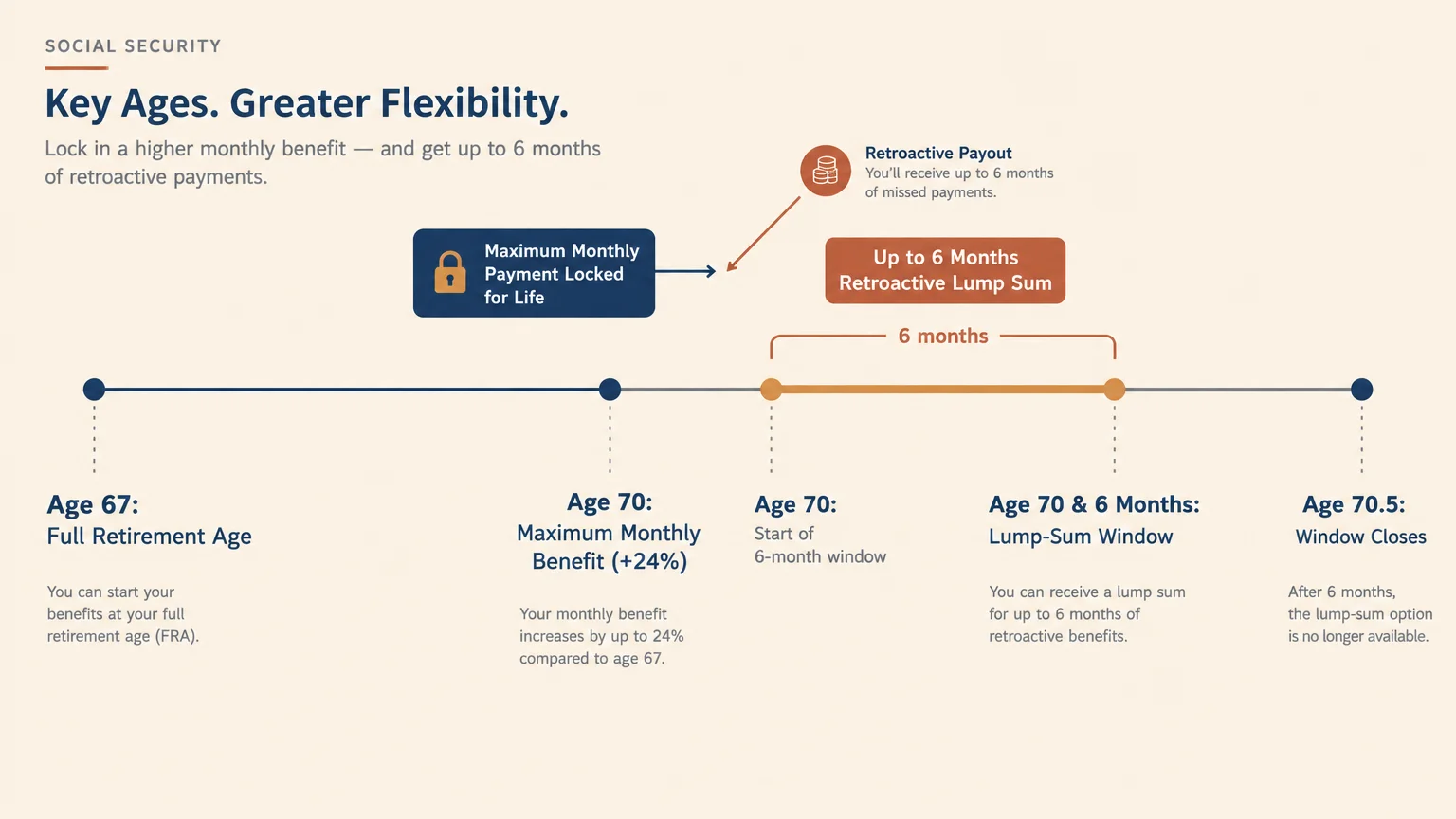
The Social Security Administration allows retirees past full retirement age to request up to six months of retroactive payments. This unique provision creates a powerful financial opportunity once you pass age 70.
Delayed retirement credits stop building the day you turn age 70. If your full retirement age was 67, you already secured your maximum 24% permanent monthly benefit increase.
By waiting until age 70 and six months to submit your claim, you can request that full six-month retroactive payout. The government then delivers a substantial cash lump sum directly to your bank account.
This lump sum does not reduce your monthly benefit going forward. You still lock in your maximum age-70 monthly payment rate for the rest of your life.
You can use this sudden influx of capital to eliminate lingering debts or upgrade your home for aging in place. Many retirees use the cash to fund dream travel or reinforce their emergency cash cushion.
Be careful never to wait beyond age 70 and six months. Any delay beyond that six-month window causes you to forfeit prior monthly benefits permanently.
Understanding this timing mechanism helps you uncover hidden benefits of delaying social security for half a year. You capture thousands of dollars in upfront cash while locking in the highest possible monthly checks.
This strategy offers the best of both worlds for retirees seeking maximum flexibility. You enjoy immediate financial breathing room alongside long-term monthly income stability.

Tip #3: You Are Completing Aggressive Roth IRA Conversions
Up to 85% of your Social Security benefits become subject to federal income taxes if your combined provisional income exceeds statutory limits. Those limits sit at $34,000 for single filers and $44,000 for married couples.
Congress established these rigid provisional income thresholds decades ago without indexing them for inflation. Adding Social Security checks on top of high taxable earnings can push you into a surprisingly harsh tax bracket.
Many proactive retirees use their early seventies to execute large Roth IRA conversions before Required Minimum Distributions begin. Under current federal law, mandatory retirement account distributions start at age 73 or age 75.
If you convert substantial traditional IRA balances at age 70, starting Social Security at the exact same moment could trigger unnecessary taxation. It could also spark costly Medicare Part B income-related monthly adjustment surcharges.
Delaying your Social Security claim by a few extra months shields your household from an avoidable tax hit. You complete your conversions cleanly while keeping your provisional income baseline as low as possible.
Once you finish your final Roth conversion, you can claim your benefits and request your retroactive payments. This clever timing protects your nest egg from excessive tax erosion.
Keeping your lifetime tax liability low leaves more wealth in your hands for travel, hobbies, and family legacy goals. Thoughtful tax coordination ensures your hard-earned savings support the vibrant lifestyle you deserve.
Consult a qualified tax advisor to run the numbers for your specific portfolio. A tailored plan ensures you navigate these complex rules with total confidence and ease.
Tip #4: You Are Eliminating the Windfall Elimination Provision Penalty
If you worked as a teacher, police officer, or municipal employee, you may receive a pension from non-covered employment. That public pension can trigger the federal Windfall Elimination Provision, reducing your Social Security retirement check.
This federal rule reduces retirement benefits for workers who split their careers between public service and private employers. Fortunately, federal law offers a permanent escape hatch if you log enough substantial earnings years.
When you accumulate 30 years of substantial earnings under Social Security, the government eliminates the Windfall Elimination Provision penalty completely. Earning between 21 and 29 years also progressively softens the reduction.
If you reach age 70 with 28 or 29 qualifying years, continuing private employment for another year makes tremendous financial sense. Delaying your claim while logging that final year permanently restores your full benefit formula.
Remember that the Social Security earnings test disappears once you reach your full retirement age. You can earn unlimited wages past age 70 without any temporary withholding while securing that crucial milestone.
Eliminating this penalty permanently elevates your baseline monthly income for the rest of your life. It also preserves a higher potential survivor benefit for your beloved spouse down the road.
Review your annual Social Security statement to evaluate your substantial earnings history. Working a little longer past age 70 provides lasting financial justice after decades of dedicated community service.
You turn an unfair pension penalty into a triumphant personal victory. That extra diligence guarantees you receive every dollar of the retirement support you earned.

Tip #5: You Are Approaching the 10-Year Mark for Divorced Spousal Benefits
Divorced individuals can claim monthly retirement benefits based on their former spouse’s earnings history under specific federal guidelines. However, you must have been married for at least ten consecutive years to qualify for this income.
If your personal career earnings were modest, an ex-spouse benefit could provide significantly higher monthly checks. You can receive up to 50% of your former partner’s primary insurance amount without reducing their payout.
In cases involving legal separation disputes or marriage date reconciliations, reaching that official ten-year mark may require waiting slightly past age 70. Waiting until that legal threshold officially passes guarantees you secure this valuable entitlement.
You must also remain unmarried to qualify for benefits on an ex-spouse’s earnings record. Verifying every statutory condition before submitting your application prevents frustrating paperwork rejections and lengthy appeals.
The Social Security Administration processes these applications with complete privacy. Your former spouse will never receive notification, and your claim will not impact their benefit payments or their current family’s benefits.
Filing at the right moment ensures you receive the maximum monthly support available under federal law. You gain dependable financial stability that empowers you to thrive independently in your golden years.
Take time to gather your certified marriage certificate and divorce decree before contacting your local field office. Clear documentation allows claims representatives to approve your payments quickly and efficiently.
Establishing your rightful claim provides enduring economic comfort and dignity. You deserve every measure of support that federal law provides for your long-term wellness.

Tip #6: You Are Resolving Unreported Earnings on Your SSA Record
Your monthly Social Security check reflects your highest 35 years of inflation-adjusted earnings across your lifetime. Unfortunately, clerical errors and missing employer wage reports can create costly gaps in your official government file.
If you earned substantial consulting fees or executive income in your late sixties, those earnings might not appear on your statement immediately. Filing your claim before those wages post can temporarily lock in a lower monthly check.
The Social Security Administration eventually recalculates benefits automatically, but those administrative corrections often take many months or even years. Waiting for bureaucratic adjustments can leave you waiting for money you rightfully earned.
Delaying your application briefly past age 70 gives tax authorities time to process your recent W-2s and tax returns. You can also bring certified tax transcripts directly to your local Social Security office to expedite corrections.
When those high recent earnings replace zero-earning years from earlier in your career, your baseline benefit increases permanently. Starting with an accurate record guarantees that your first payment reflects your true career achievement.
You can then use the six-month retroactive claiming rule to backdate your start date to age 70. You receive your maximum monthly benefit and a full retroactive lump sum without losing a dime.
Auditing your earnings record protects you from administrative oversight and preserves your wealth. Taking charge of your paperwork provides peace of mind and financial accuracy for the future.
Your diligence ensures that every hour of your hard work translates into reliable retirement income. You step into retirement knowing your financial accounts are completely accurate and fully optimized.

Tip #7: You Are Coordinating Cross-Border Work Under an International Agreement
Many vibrant retirees spent meaningful portions of their professional careers living and working overseas. The United States maintains bilateral totalization agreements with thirty nations to coordinate retirement benefits across international borders.
These international treaties prevent double social security taxation and help multinational workers combine credits to qualify for retirement checks. If you lack 40 American credits, your foreign work history can help establish your eligibility.
Coordinating employment records between foreign ministries and the Social Security Administration often requires extra processing time. Foreign government agencies frequently take six months or longer to verify historical earnings and certified employment periods.
Delaying your formal application past age 70 until all international documentation arrives prevents premature claim denials. Your file moves smoothly through specialized international operations once all consular authentications and official records are gathered.
You can utilize the six-month retroactive payment provision once foreign authorities certify your totalized service credits. This strategy ensures you receive your rightful back pay while establishing your permanent monthly income stream.
Totalization agreements also protect you from punitive foreign pension offsets under domestic tax regulations. You secure fair compensation from both nations without running into unexpected administrative barriers.
Navigating cross-border rules requires patience, but the lifelong monthly payoff is well worth the effort. Combining your international career achievements gives you a truly global foundation for a fulfilling retirement.
Embrace your international heritage as a source of lasting financial strength. Your worldly experience translates into greater financial security and exciting opportunities for your retirement years.

The Takeaway: Living a More Blissful Retirement
Retirement offers a splendid opportunity to celebrate your achievements, pursue beloved passions, and enjoy hard-earned freedom. Making informed Social Security decisions provides the financial stability you need to flourish every day.
Under standard Social Security Administration rules, delayed retirement credits stop accruing the moment you reach age 70. Delaying past this age without a distinct tactical reason can lead to permanent forfeiture of your checks.
However, when you face specific scenarios like credit shortages, pension offsets, or strategic retroactive claims, brief delays make excellent financial sense. Knowing when to claim social security gives you total control over your golden years.
Take the time to evaluate your unique tax bracket, work history, and family needs. Tailoring your retirement roadmap ensures you capture every benefit and tax advantage available under the law.
Embrace this joyful chapter of life with excitement, optimism, and total confidence. You earned your golden years, and smart choices will keep them radiant, peaceful, and richly fulfilling.
Frequently Asked Questions
What happens if I delay claiming Social Security past age 70?
Delayed retirement credits permanently stop accumulating once you turn age 70. Waiting past age 70 will not increase your primary insurance amount or your monthly benefit check.
If you delay more than six months past age 70, you forfeit monthly checks permanently. The Social Security Administration limits retroactive lump-sum payouts to a maximum of six months.
Can I earn unlimited income if I work past age 70?
Yes, you can earn unlimited income from wages or self-employment without any benefit reduction. The Social Security retirement earnings test applies only to workers who have not reached full retirement age.
Once you reach full retirement age, your earnings never reduce your monthly checks. You can collect your maximum Social Security payments and your regular paycheck at the same time.
How does Medicare interact with delaying Social Security past age 70?
Medicare eligibility begins at age 65 regardless of your Social Security claiming age. You must enroll in Medicare Part B at 65 unless you have creditable group employer coverage.
If you delay Medicare without creditable coverage, you face a permanent 10% premium penalty for every 12-month period you were eligible. Maintaining health coverage protects you from costly lifetime surcharges.
How do Required Minimum Distributions impact Social Security taxes?
Under the SECURE 2.0 Act, Required Minimum Distributions begin at age 73 or age 75 depending on your birth year. These mandatory withdrawals increase your adjusted gross income significantly.
Higher combined income can make up to 85% of your Social Security benefits taxable under federal law. Coordinating your claim date with mandatory distributions helps minimize your overall tax burden.
For a wide range of resources for older adults, visit AARP and the National Council on Aging (NCOA). Health information is available from the National Institute on Aging.
Disclaimer: This article is for informational and inspirational purposes only. It is not a substitute for professional medical, financial, or psychological advice. Please consult with a qualified expert for guidance tailored to your individual needs.