

You can dramatically boost your family’s financial stability when you claim retirement benefits while caring for a disabled child. Special Social Security rules unlock vital monthly cash and healthcare support for your loved one.
Navigating these complex benefit updates ensures your child maintains lifelong financial comfort. It also preserves your hard-earned retirement savings for the joyful, relaxing golden years you deserve.
Understanding these pivotal system changes empowers you to coordinate entitlements, protect government aid, and build lasting peace of mind. Here is everything you need to know to maximize your family support.
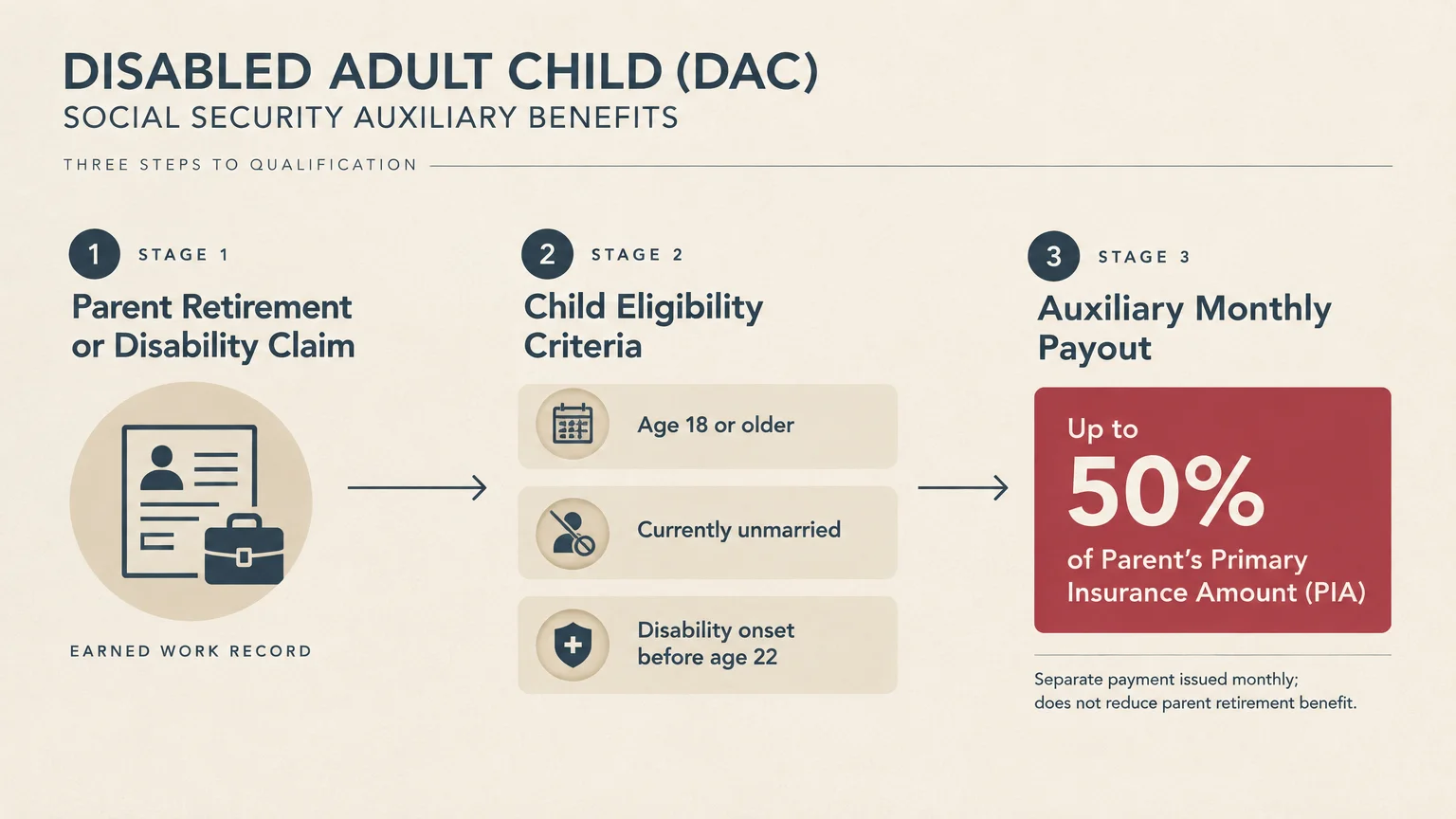
Tip #1: Unlock Disabled Adult Child Benefits on Your Work Record
You can unlock substantial financial relief through disabled adult child benefits once you claim your own retirement or disability payments. This special provision transforms your personal work record into a protective safety net for your child.
To qualify, your son or daughter must be at least 18 years old and currently unmarried. Crucially, their documented medical condition must have started before they reached age 22.
The Social Security Administration evaluates your adult child under strict adult disability criteria. Your child does not need any personal earnings history to access this reliable monthly financial support.
When you begin drawing benefits, your eligible offspring can receive up to 50 percent of your primary insurance amount. This auxiliary payment arrives as a separate check each month without reducing your baseline retirement benefit.
Applying for social security child benefits early ensures a seamless transition. This dependable cash flow helps cover specialized therapies, day programs, and vital household expenses throughout your golden years.
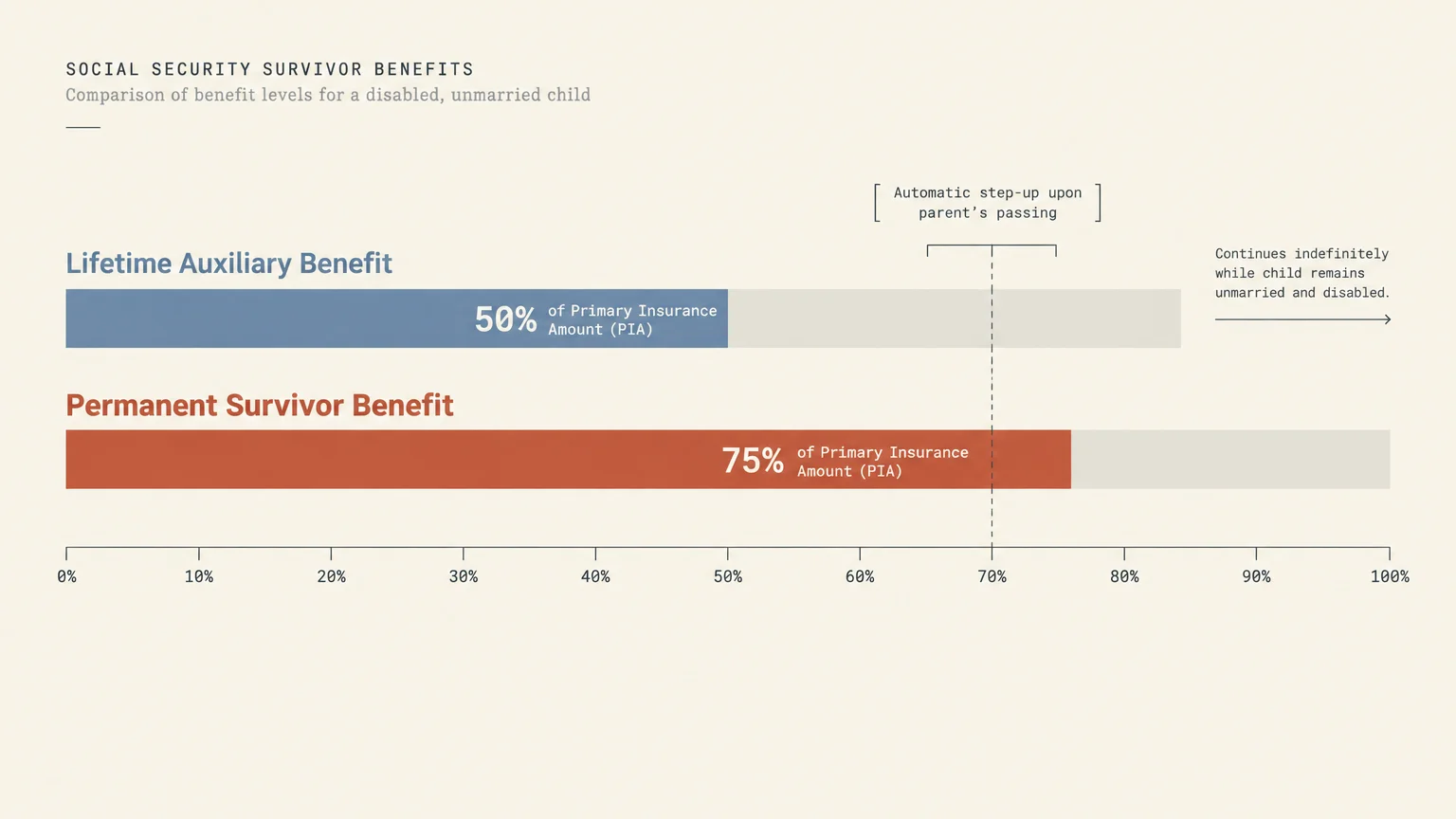
Tip #2: Secure Lifelong Survivor Support at 75 Percent
Planning for the distant future often brings emotional stress, but Social Security provides unmatched reassurance for parents. Your child’s monthly support automatically increases when you eventually pass away.
A surviving disabled adult child can receive up to 75 percent of your primary insurance amount. This higher rate permanently replaces the 50 percent auxiliary benefit they collected during your lifetime.
This survivor benefit continues indefinitely as long as your child remains unmarried and meets disability standards. It establishes a perpetual financial bedrock that outlives your personal retirement years.
Disability benefits for dependents offer vital stability when your child needs it most. You can take comfort in knowing that your decades of dedicated work protect your child for life.
Coordinating this entitlement with your long-term estate planning brings profound relief. Your child will never face the world without an established financial foundation to sustain their well-being.
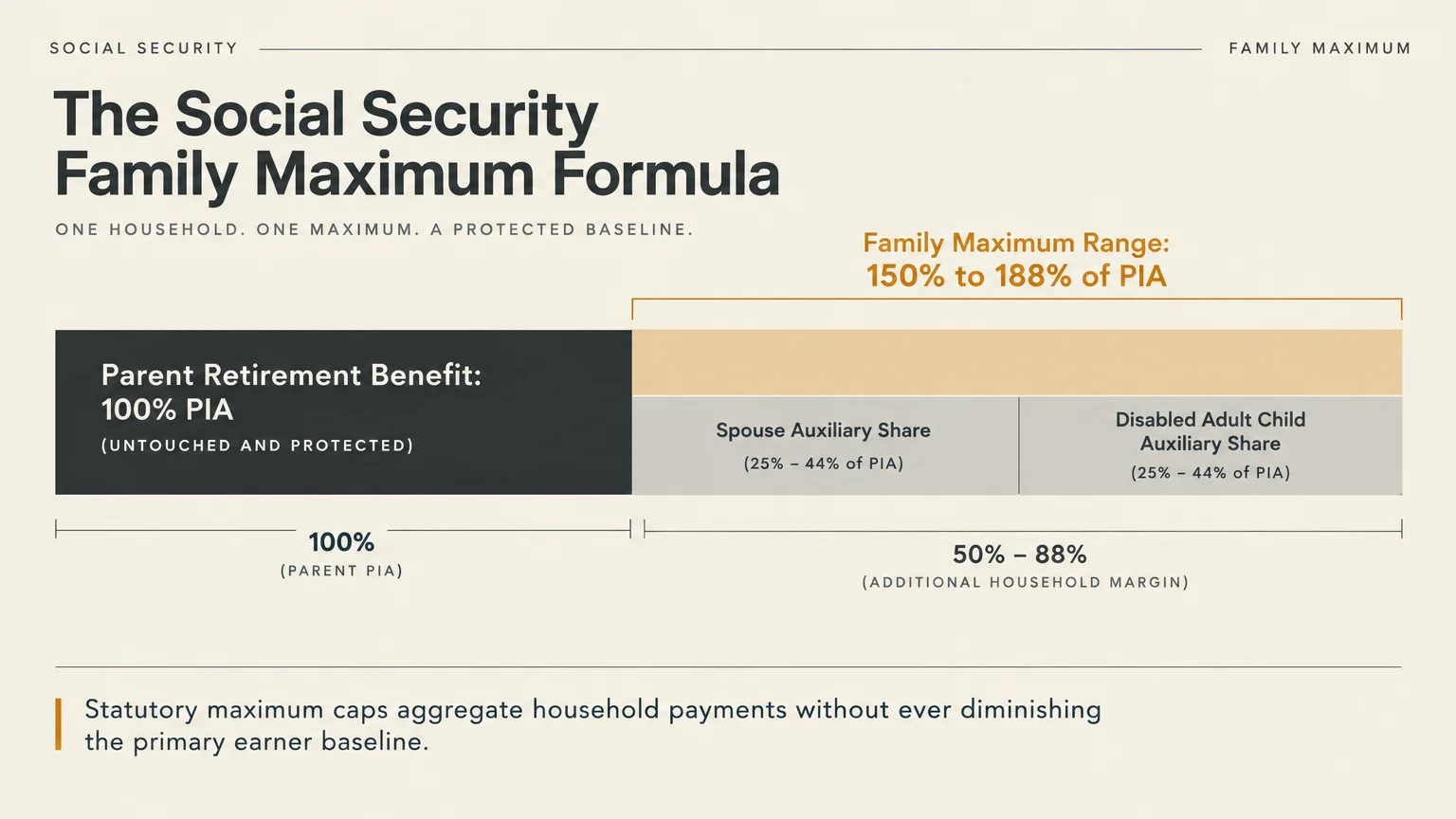
Tip #3: Navigate the Social Security Family Maximum
When multiple family members draw checks from your record, the Social Security family maximum rules take effect. Understanding this calculation helps you budget your total household income with complete precision.
The government caps total household payouts between 150 percent and 188 percent of your primary insurance amount. Your personal retirement benefit remains completely untouched by this statutory ceiling.
The agency divides any remaining allowable funds equally among your eligible dependents. If a spouse and a disabled child both claim auxiliary benefits, their payments adjust proportionally.
Knowing how this formula works allows you to project your combined monthly revenue accurately; surprises disappear when you map out the figures ahead of time.
Consult your local Social Security representative to run exact household benefit illustrations. Clear numbers will help you craft an enjoyable and stress-free retirement spending strategy.

Tip #4: Access Medicare Early Without Waiting Until Age 65
Healthcare costs often represent one of the heaviest financial burdens for families supporting a child with special needs. Fortunately, qualifying for disabled adult child benefits provides an extraordinary medical advantage.
Your child does not have to wait until age 65 to receive comprehensive Medicare coverage. They become entitled to Medicare Parts A and B after a 24-month waiting period from their benefit effective date.
Part A covers essential inpatient hospital care, skilled nursing, and hospice support. Part B delivers robust coverage for doctor visits, durable medical equipment, therapies, and regular outpatient services.
Enrolling in Medicare dramatically slashes out-of-pocket medical bills for your household. You can allocate those significant savings toward enriching activities, family travel, and fulfilling retirement hobbies.
This guaranteed federal healthcare protection remains active as long as your child maintains their disability entitlement. It lifts an enormous emotional and financial weight from your shoulders as you age.

Tip #5: Protect Medicaid Through Section 1634(c) Protections
Many parents fear that receiving a higher monthly cash benefit will strip their child of vital state Medicaid coverage. This concern is understandable because Medicaid funds critical day habilitation, personal care aides, and therapies.
Fortunately, federal law includes a powerful safeguard under Section 1634(c) of the Social Security Act. This provision protects Medicaid eligibility for individuals who transition from Supplemental Security Income to adult child benefits.
If your child loses SSI solely due to receiving or increasing DAC payments, states must deem them an SSI recipient for Medicaid purposes. Their specialized medical waivers and community supports stay intact.
You must advocate proactively by informing your local Medicaid caseworker about this protected status. Keeping proper documentation ensures continuous coverage without administrative interruptions.
Preserving Medicaid while receiving higher monthly checks creates the best possible outcome for your budget. Your child gains increased cash flow alongside comprehensive healthcare services.

Tip #6: Drop Parental Income Deeming at Age 18 Under SSI
During your child’s childhood, your household wages and assets directly affected their eligibility for Supplemental Security Income. The Social Security Administration calls this process parental income deeming.
Everything changes dramatically the moment your son or daughter turns 18 years old. Deeming stops completely, and the government evaluates only your child’s personal financial situation.
Even if you enjoy substantial retirement savings, your child can now qualify for SSI for disabled children transitioning into adulthood. The strict individual asset limit remains set at $2,000.
In 2025, the maximum federal SSI payment reached $967 monthly for an individual; it increases to $994 monthly in 2026. Eligible couples receive up to $1,450 in 2025 and $1,491 in 2026.
Applying at age 18 establishes an independent financial safety net for your child. It cushions your household budget and preserves your personal retirement wealth for future leisure.

Tip #7: Provide Food and Shelter Freely Under Updated ISM Rules
For decades, strict in-kind support and maintenance rules penalized families who provided free meals or housing to an adult disabled child. The government routinely reduced monthly SSI checks by one-third.
Groundbreaking regulatory reforms took effect on September 30, 2024, changing this dynamic forever. The Social Security Administration officially eliminated food from all ISM penalty calculations.
You can now buy groceries, prepare family dinners, and treat your child to restaurant meals without risking their benefits. This commonsense update eliminates stressful, intrusive household reporting requirements.
The agency also expanded its nationwide rental subsidy policy on that exact same date. Charging your adult child discounted rent is much less likely to trigger benefit reductions under current guidelines.
These welcome changes make supporting your loved one far easier and more affordable. You can share your home and table freely while nurturing a joyful domestic life.

Tip #8: Build Wealth Safely Using Expanded ABLE Accounts
The strict $2,000 asset cap for public benefits used to discourage families from saving money for a child with special needs. Achieving financial security felt nearly impossible without jeopardizing essential aid.
Achieving a Better Life Experience accounts provide an ingenious solution by allowing tax-advantaged savings. Funds deposited into these accounts grow tax-free and pay for qualified disability expenses.
The law shields up to $100,000 in an ABLE account from the SSI resource test. Your child can accumulate meaningful savings without forfeiting a single dollar of government support.
Annual contribution limits tied to the federal gift-tax exclusion rose to $19,000 in 2025 and reached $20,000 in 2026. Friends and relatives can contribute directly to bolster your child’s financial future.
Effective January 1, 2026, the ABLE Age Adjustment Act expands eligibility to individuals whose disability began before age 46. This historic expansion opens doors for millions of additional families nationwide.
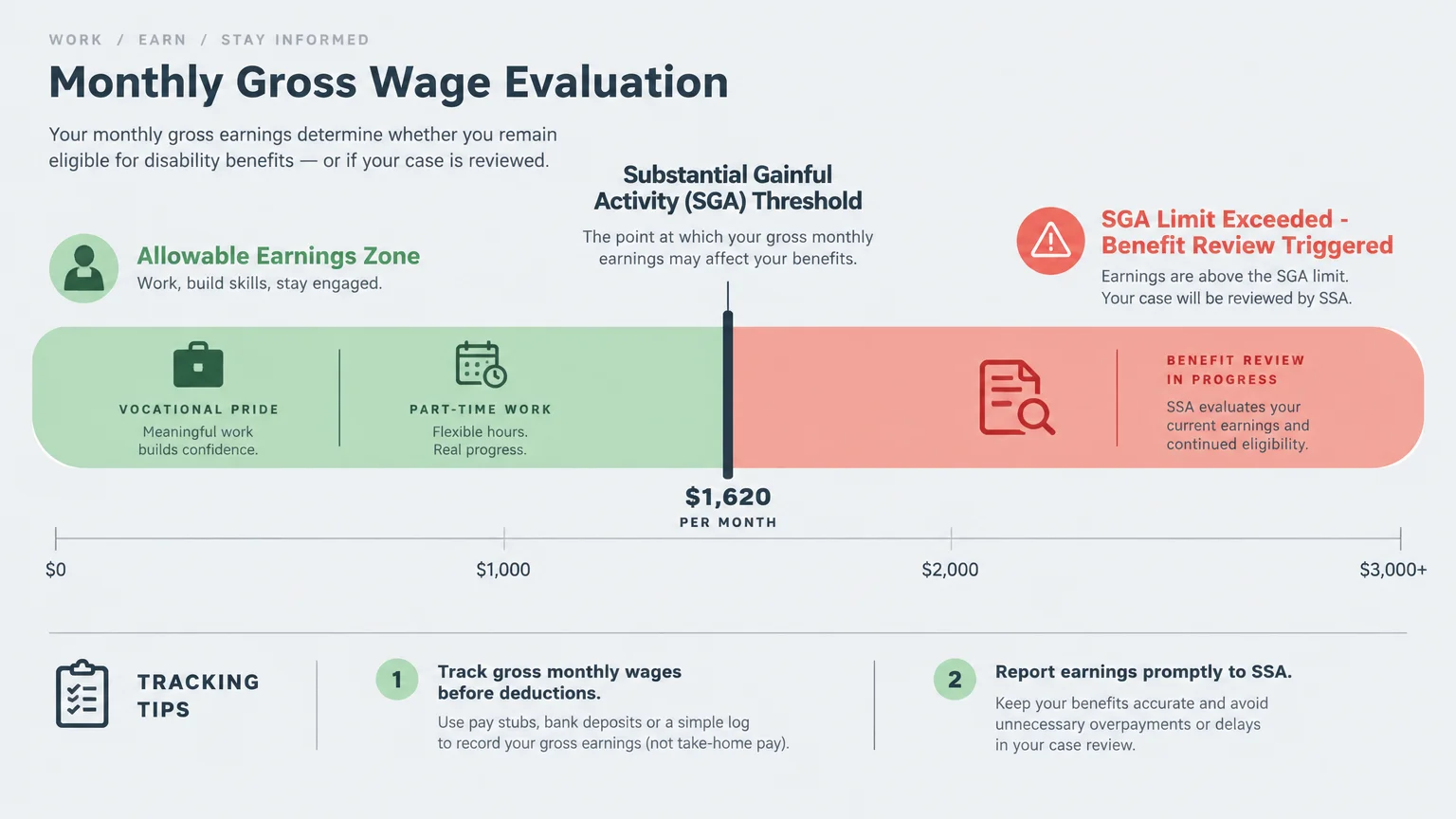
Tip #9: Monitor Monthly Earnings Against SGA Thresholds
Meaningful work offers purpose, social connection, and personal fulfillment for young adults with disabilities. However, you must carefully monitor their monthly gross wages to protect their benefit eligibility.
The Social Security Administration uses the Substantial Gainful Activity threshold to determine program qualification. Earning above this limit can terminate your child’s monthly cash payments.
In 2025, the monthly non-blind SGA limit stands at $1,620, while the statutorily blind limit is $2,700. In 2026, these thresholds climb to $1,690 for non-blind individuals and $2,830 for blind individuals.
Deducting impairment-related work expenses can help your child remain safely beneath these statutory limits. Specialized transportation costs, adaptive equipment, and job coaching fees qualify for deductions.
Understanding these wage boundaries empowers your child to explore part-time employment confidently. They can experience the dignity of work while keeping their essential benefits secure.

Tip #10: Understand the Critical Marriage Disqualification Rules
Love and companionship enrich every stage of life, but marriage requires careful navigation when disabled adult child benefits are involved. A wedding can inadvertently eliminate crucial monthly income.
If your adult child marries someone who does not receive Title II Social Security benefits, their DAC entitlement terminates permanently. They cannot reclaim those benefits under your work history later.
Losing this auxiliary benefit forces the child back onto means-tested SSI, which carries strict income and asset caps. It can disrupt years of careful retirement financial planning.
An exception exists when two disabled adult children marry each other; their respective auxiliary benefits continue without penalty. Marriage to someone receiving Social Security retirement or disability is also protected.
Many modern couples choose symbolic ceremonies and commitment celebrations instead of legal marriage to protect their support. Open communication helps your family protect both love and financial security.

The Takeaway: Living a More Blissful Retirement
Planning for a child with a disability requires diligence, but it also reveals incredible opportunities for lasting security. The Social Security system provides substantial resources to protect your family’s standard of living.
By taking advantage of adult child benefits, healthcare protections, and modern ABLE savings accounts, you build an unshakeable foundation. Your child enjoys dignity and independence, while your retirement savings remain safe.
Emphasize proactive planning today so you can relax tomorrow; knowledge transforms uncertainty into genuine confidence. You have dedicated your life to your family, and you deserve a peaceful, joyful retirement.
Celebrate the milestones ahead with enthusiasm and gratitude. With the right structures in place, your golden years can truly be the most fulfilling chapter of your life.
Frequently Asked Questions
Can a disabled adult child work while collecting Social Security benefits?
Yes, your child can work while receiving benefits, provided their gross earnings stay below the Substantial Gainful Activity cap. In 2025, that limit is $1,620 monthly, rising to $1,690 in 2026 for non-blind beneficiaries.
Beneficiaries can also utilize work incentive programs and deduct impairment-related expenses to maintain their support. These rules encourage community participation without penalizing initiative.
What happens to Medicaid if my child’s DAC benefit exceeds the SSI limit?
Your child retains their Medicaid coverage under Section 1634(c) of the Social Security Act. This federal law protects individuals who lose SSI solely because of receiving or increasing DAC benefits.
You must notify your state Medicaid agency about this protected status to prevent any lapse in essential medical services. Keeping clear records ensures smooth continuity of care.
Do I have to retire for my child to receive disabled adult child benefits?
Yes, you must actively receive Social Security retirement or disability insurance benefits before your child can draw auxiliary support. Once your claim begins, your eligible child can receive up to 50 percent of your primary insurance amount.
If you pass away, the auxiliary entitlement automatically increases to 75 percent as a survivor benefit. Filing your retirement claim unlocks this vital family support.
Can adopted children or stepchildren qualify for disabled adult child benefits?
Yes, legally adopted children and stepchildren can qualify for social security for disabled child programs under specific dependency criteria. The disability must have begun before age 22, and the child must be unmarried.
For stepchildren, the marriage between the parent and stepparent must meet statutory duration rules, and dependency requirements must be proven. Contact the Social Security Administration to verify documentation.
For a wide range of resources for older adults, visit AARP and the National Council on Aging (NCOA). Health information is available from the National Institute on Aging.
Disclaimer: This article is for informational and inspirational purposes only. It is not a substitute for professional medical, financial, or psychological advice. Please consult with a qualified expert for guidance tailored to your individual needs.