

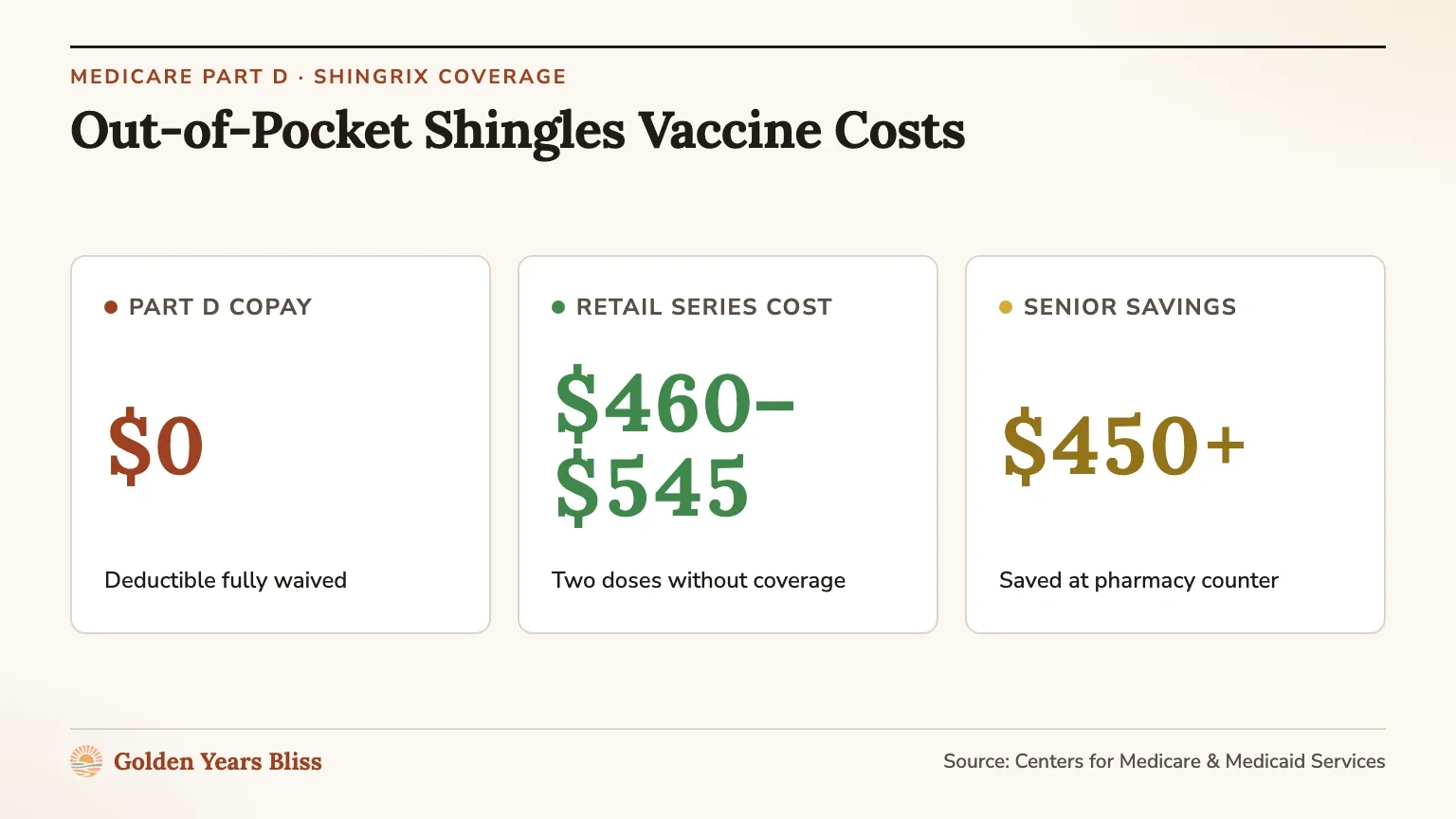
You can now protect yourself against shingles without paying a single dime out of pocket. Thanks to federal rules, Medicare prescription drug plans cover the two-dose shingles vaccine at a $0 copay.
This vital senior healthcare benefit waives your deductible entirely, saving you over $450 at the pharmacy counter. Staying healthy in retirement has never been more affordable or straightforward.
Before you schedule your appointment, you should understand how to secure your free shots without unexpected bills. Here are six essential facts every senior needs to know today.
Tip #1: The Shingles Vaccine Costs Nothing Under Part D
Under the Inflation Reduction Act, all Medicare Part D plans must provide recommended adult vaccines at no cost. You will pay no coinsurance and no copay for your shingles immunization.
You do not have to meet your annual prescription drug deductible before this benefit applies. Even if your plan has an annual deductible, your out-of-pocket cost remains zero.
This federal policy delivers tremendous financial relief for older adults on fixed incomes. Without coverage, the two-dose Shingrix series routinely costs between $460 and $545 at retail pharmacies.
Tip #2: You Must Have Medicare Prescription Drug Coverage
Original Medicare Part B covers certain shots like the annual flu and COVID-19 immunizations. However, Part B does not cover the Medicare shingles vaccine.
To receive your free vaccine, you must be enrolled in a Medicare prescription drug plan. You can use either a standalone Part D plan or a Medicare Advantage plan that includes drug coverage.
If you only carry Original Medicare Parts A and B without drug benefits, you will face the full retail cost. Always confirm your drug plan is active before booking your shot.

Tip #3: You Need Two Doses for Maximum Defense
The CDC recommends two doses of Shingrix for all immunocompetent adults aged 50 and older. You should receive your second shot between two and six months after your first.
Both shots are covered at a Part D zero copay. Completing the full series is crucial because a single dose does not provide lasting defense.
In clinical trials, two doses proved over 97% effective at preventing shingles in adults aged 50 and older. The series also cut the risk of postherpetic neuralgia by over 91%.
Tip #4: Get Your Shot at an In-Network Pharmacy
Where you receive your vaccine determines whether you actually walk away without a bill. Always visit an in-network retail pharmacy rather than your primary care physician’s office.
Pharmacies bill your Part D plan electronically in real time, guaranteeing you pay nothing at the counter. In contrast, most doctors’ offices cannot bill Part D directly.
If your doctor administers the shot, they may charge you the full cash price upfront. You would then have to submit complicated paper reimbursement forms to recover your money.

Tip #5: You Qualify Even If You Had Shingles or Zostavax
Over 99% of Americans born before 1980 carry the dormant chickenpox virus. About one in three adults will develop shingles during their lifetime as immunity naturally declines with age.
You should still get vaccinated even if you suffered through a shingles outbreak in the past. Shingrix helps prevent painful repeat occurrences and strengthens your long-term immune response.
You also need Shingrix if you previously received Zostavax, an older vaccine discontinued in 2020. The newer Shingrix formula offers significantly stronger, longer-lasting protection against nerve pain and rash complications.
Tip #6: Other Key Adult Vaccines Are Also Free
The shingles shot is not the only free vaccine available to help protect your golden years. Federal regulations ensure several other essential adult immunizations carry zero cost-sharing under Medicare.
Your Part D plan covers other recommended vaccines at no cost, including the RSV vaccine and the Tdap booster for tetanus, diphtheria, and whooping cough.
Taking advantage of these free vaccines Medicare mandates keeps your preventive health routine robust and your retirement budget secure. You can easily schedule multiple preventive shots during a single pharmacy visit.
The Takeaway: Living a More Blissful Retirement
Protecting your physical health is essential to enjoying an active, joyful retirement. Shingles can cause debilitating nerve pain, but you hold the power to safeguard your wellness effortlessly.
Thanks to Medicare Part D zero copay protections, staying healthy will not strain your retirement savings. Take charge of your senior healthcare today by contacting your local pharmacy to schedule your first dose.
For a wide range of resources for older adults, visit AARP and the National Council on Aging (NCOA). Health information is available from the National Institute on Aging.
Disclaimer: This article is for informational and inspirational purposes only. It is not a substitute for professional medical, financial, or psychological advice. Please consult with a qualified expert for guidance tailored to your individual needs.
Frequently Asked Questions
Does Original Medicare cover the shingles vaccine for free without Part D?
No, Original Medicare Parts A and B do not cover the shingles vaccine. You must enroll in a Medicare Part D prescription drug plan or a Medicare Advantage plan with drug coverage to receive the $0 copay benefit.
What should I do if my pharmacy tries to charge me for Shingrix?
Ensure the pharmacy has your Medicare Part D card on file rather than your red, white, and blue Medicare Part B card. You should also confirm that the pharmacy is in your drug plan’s pharmacy network.
Are there common side effects from the Shingrix shot?
Most people experience mild temporary side effects, such as arm soreness, swelling, fatigue, or muscle aches. These mild reactions typically fade within two to three days and indicate your immune system is responding well.
How long does protection from the two-dose shingles series last?
Long-term studies demonstrate that Shingrix provides strong protection for at least ten years. Researchers found the vaccine remains over 80% effective throughout the entire first decade after completing both doses.