
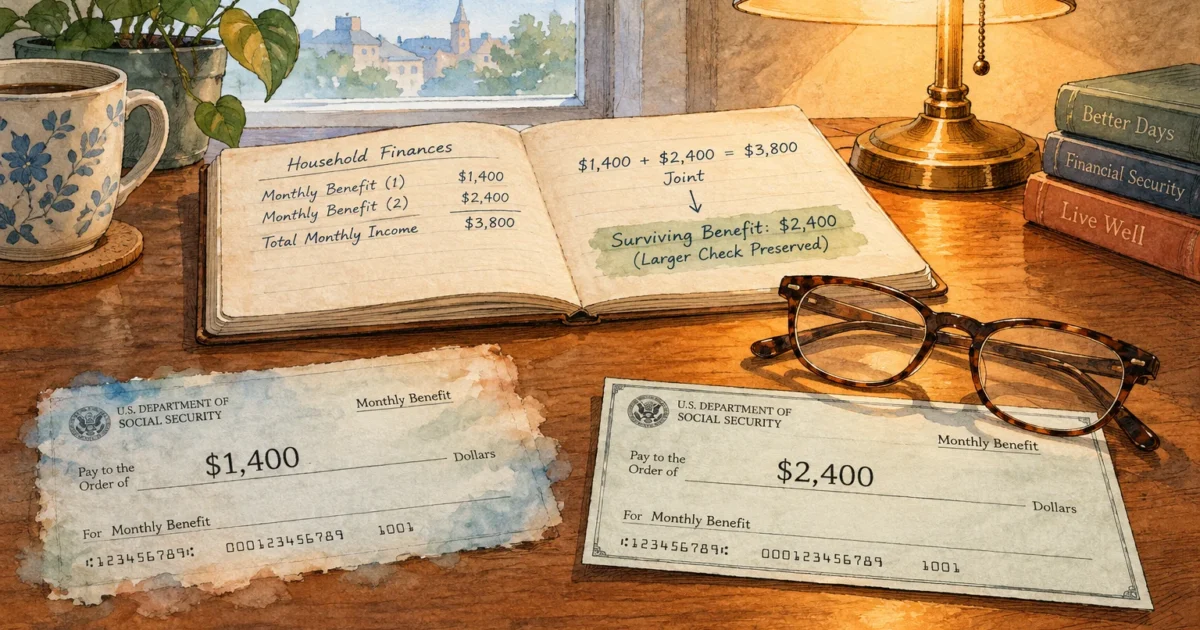
When a married couple collects Social Security, losing a partner brings an immediate financial shift alongside deep personal grief. You keep the larger of your two monthly checks, while the smaller check permanently stops.
Understanding how Social Security when spouse dies impacts your household lets you protect your standard of living. Navigating these rules early provides the clarity you need to maintain an active, fulfilling lifestyle.
Knowing your exact rights under survivor benefits Social Security transforms uncertainty into confidence. Here is precisely how married couple Social Security changes, which check stays, and how you can thrive during life transitions.
Lifestyle Idea #1: Master the Larger Check Rule to Secure Your Cash Flow
When a spouse passes away, the Social Security Administration does not permit a surviving spouse to keep both monthly benefit payments. Instead, the smaller check permanently stops, and you receive only the single larger amount between the two records.
This transition happens because survivor benefits are designed to replace a late partner’s earnings rather than provide duplicate income. You effectively receive your own retirement benefit plus an additional supplement that matches your late partner’s higher monthly check.
Consider a clear household example to see how this plays out in real life. Suppose you receive $1,400 each month based on your work record, while your spouse receives $2,400.
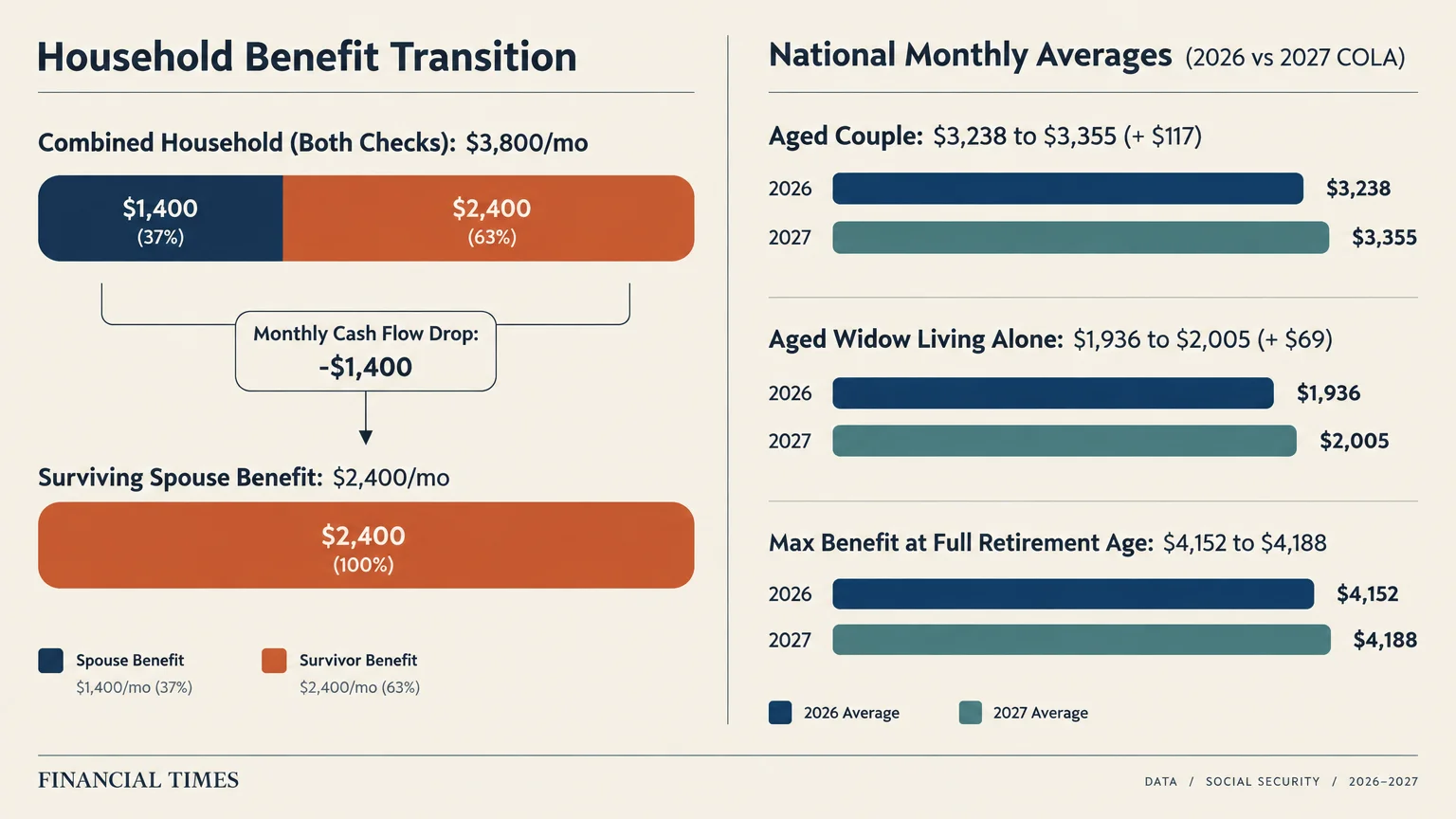
While your spouse is alive, your combined household income from Social Security totals $3,800 per month. After your spouse passes away, your monthly income drops to $2,400, meaning your $1,400 check disappears entirely.
National averages illustrate this stark financial contraction across the country. In late 2026, the average benefit for an aged couple where both receive checks stood at $3,238 per month.
Following the 3.6% COLA announced on October 14, 2026, that average couple benefit increases to $3,355 per month in January 2027. That adjustment represents a welcome joint increase of $117 each month.
However, the average aged widow living alone received $1,936 per month in late 2026, rising to $2,005 per month in January 2027. That single check represents an increase of $69, yet creates a substantial income reduction compared to a joint household.
Meanwhile, the average individual retired worker receives $2,095 per month in late 2026, increasing to $2,170 per month in January 2027. The maximum monthly benefit at full retirement age reaches $4,152 in 2026 and rises to $4,188 in 2027.
Recognizing this drop in advance empowers you to adjust your spending without sacrificing personal joy. You can renegotiate recurring subscriptions, rebalance fixed expenses, and preserve discretionary funds for dining out with friends and traveling.
A proactive budget review guarantees that your housing, healthcare, and leisure activities remain fully funded. Taking charge of your financial reality today ensures you continue living vibrantly tomorrow.
Protecting your cash flow gives you the confidence to maintain your favorite weekly routines. Staying active in your community keeps your spirits high during major life transitions.
Lifestyle Idea #2: Guard Your Accounts Against the Month-of-Death Clawback
Social Security operates on a strict payment calendar that surprises many grieving families. Benefits are paid one month in arrears, meaning a check delivered in November actually covers the month of October.
To keep a payment for any given month, the beneficiary must survive the entire calendar month. Even if a spouse passes away on the final day of the month, they are technically ineligible for that month’s benefit.
When this happens, the Social Security Administration will claw back the payment received the following month. If the agency deposits that payment directly into your joint account, they will automatically reverse the deposit.
Spending those funds before the clawback occurs can trigger painful bank overdraft fees. In addition, an unexpected negative balance adds unnecessary friction during an already stressful period.
You can prevent banking headaches by establishing a modest emergency cash reserve right away. Keep two to three months of living expenses in a separate high-yield savings account that remains untouched.
Notify your financial institution promptly when a death occurs to keep your active accounts secure. Ask the bank representative how they handle incoming Treasury deposits following a bereavement.
Most funeral directors report deaths directly to the Social Security Administration using the deceased worker’s Social Security number. However, you should confirm this notification yourself to avoid clerical delays or mistaken overpayments.
Staying ahead of administrative details protects your peace of mind and preserves your emotional energy. You can then focus your attention on personal healing, family connections, and rewarding community activities.
Clear financial boundaries keep your everyday routines running smoothly without unwelcome surprises. This stability gives you the freedom to explore local arts, gather with neighbors, and pursue creative passions.
Taking control of these practical details eliminates friction before it ever starts. You protect your emotional well-being by keeping your finances thoroughly organized.

Lifestyle Idea #3: Align Your Claim with the Survivor Full Retirement Age Schedule
Many people assume that survivor benefits follow the exact same age rules as regular retirement benefits. In reality, the Social Security Administration uses a completely separate timetable for surviving spouses.
The Survivor Full Retirement Age schedule runs two years behind the standard retirement schedule. While standard full retirement age is 67 for everyone born in 1960 or later, survivor retirement schedules phase in differently.
For survivors born in 1959, the Survivor Full Retirement Age is 66 and 6 months. For those born in 1960, it reaches 66 and 8 months, while those born in 1961 reach full eligibility at 66 and 10 months.
Survivor Full Retirement Age reaches age 67 only for survivors born in 1962 or later. Reaching this milestone entitles you to 100% of your late spouse’s basic benefit, including any delayed retirement credits they earned.
If you need cash flow sooner, you can claim a widow Social Security benefit as early as age 60. However, filing early permanently reduces your monthly payout to between 71.5% and 99% of the full amount.
Specific life circumstances offer exceptions to the standard age 60 threshold. Surviving spouses who live with a qualifying disability can begin collecting benefits at age 50 to 59 at the 71.5% rate.
Furthermore, a surviving spouse of any age who cares for the deceased spouse’s child under age 16 receives 75% of the benefit. This child-in-care provision also applies if the child developed a qualifying disability before age 22.
Evaluating your health, daily lifestyle, and financial reserves will determine whether claiming early or waiting makes the best sense. Waiting until your Survivor FRA locks in maximum long-term monthly income for life.
That guaranteed monthly floor gives you great flexibility as you age, making future travel and wellness goals easier to fund. You gain complete financial independence while maintaining your active personal schedule.
Understanding the Survivor FRA schedule helps you make empowered decisions about your retirement timing. Patience can pay off with significantly higher monthly checks for the rest of your life.
Lifestyle Idea #4: Leverage the Switch Strategy to Grow Your Personal Wealth
A powerful advantage of survivor benefits Social Security is the freedom from standard deemed filing rules. When you claim regular spousal benefits, the law forces you to apply for your own retirement benefit simultaneously.
Survivor benefits do not carry that restriction, opening the door for an exceptional income-building strategy. You can claim one benefit first while allowing the second benefit to grow untouched.
For example, you could claim a reduced survivor benefit at age 60 to cover your current living expenses. While you collect that monthly check, your own worker retirement benefit continues growing by 8% each year until age 70.
Once you reach age 70, you can switch from the survivor benefit over to your own maximized worker benefit. This switch creates a permanent step up in monthly cash flow for your later retirement years.
Alternatively, you can reverse the sequence if your deceased partner earned significantly more than you. You can claim your own worker benefit at age 62, letting the survivor benefit expand to 100% at your Survivor FRA.
Once you hit your Survivor Full Retirement Age, you switch to the full survivor benefit. This tactical flexibility allows you to customize your income stream around your unique lifestyle aspirations.
Extra retirement income opens fantastic doors for personal fulfillment and adventure. You might choose to fund extended domestic road trips, remodel your living space, or support your grandchildren’s education.
Consulting with an experienced retirement planner helps you map the exact crossover point for your earnings records. With a tailored claiming roadmap, you extract the maximum financial value from the system.
Financial confidence transforms how you view the future. When your basic income is fully optimized, you can focus on cultivating meaningful friendships, engaging hobbies, and fulfilling community service.
Smart timing transforms a complex system into an enduring advantage for your household. You gain substantial resources to fund vibrant hobbies and bucket-list travel goals.

Lifestyle Idea #5: Cultivate New Relationships Without Risking Your Benefits
Rebuilding your social life and opening your heart to romance represents an exciting part of healthy senior living. However, you must understand how marriage rules interact with survivor benefits before walking down the aisle.
The Social Security Administration enforces a critical age threshold regarding remarriage. If you remarry before reaching age 60, or age 50 if disabled, you forfeit your right to collect survivor benefits on your late spouse’s record.
As long as that new marriage remains intact, those survivor payments remain completely blocked. If that subsequent marriage later ends through divorce or death, your eligibility for the prior survivor benefit can be restored.
The rules change entirely once you blow out the candles on your 60th birthday. If you remarry at or after age 60, or age 50 if disabled, your survivor benefit remains completely unaffected.
You will continue receiving your late spouse’s full survivor check month after month. Furthermore, you gain the eventual right to claim spousal benefits on your new partner’s record if that payment proves larger.
To qualify for survivor benefits initially, the agency generally requires that you were married for at least 9 months prior to your spouse’s death. Exceptions apply if the death resulted from an accident or active military duty.
Many modern couples over 50 choose long-term cohabitation or commitment ceremonies instead of legal remarriage before age 60. This sensible approach protects vital survivor benefits while allowing romance and companionship to thrive.
Sharing your life with a caring partner enhances mental wellness, physical health, and longevity. Knowing the regulations lets you celebrate companionship while safeguarding your monthly financial foundation.
True partnership enriches your retirement experience in countless ways. Navigating the rules thoughtfully guarantees that love and financial security walk hand in hand.
Lifestyle Idea #6: Claim Divorced Spousal Benefits Without Family Friction
Many seniors are surprised to learn that divorce does not necessarily erase your right to survivor benefits. If your former spouse passes away, you could be entitled to a substantial monthly survivor benefit.
To qualify on an ex-spouse’s earnings record, your marriage must have lasted for at least 10 consecutive years. In addition, you must remain unmarried or have waited until at least age 60 to remarry.
A surviving divorced spouse receives the exact same benefit amount as a current widow or widower, up to 100% at Survivor FRA. Best of all, claiming this benefit causes zero impact on your ex-spouse’s current family.
Your survivor payments do not reduce the monthly checks received by your late ex-spouse’s current widow or surviving children. The Social Security Administration pays your benefit out of national trust funds independently.
Furthermore, you do not need to contact your ex-spouse’s surviving relatives or obtain their consent to apply. You simply contact the agency directly and provide your marriage certificate alongside the final divorce decree.
Accessing these rightful benefits can substantially boost your retirement income and broaden your lifestyle options. You can use that extra financial breathing room to enroll in university courses, join fitness clubs, or support personal hobbies.
Never leave earned benefits on the table out of embarrassment or outdated misunderstandings. You spent a decade or more building that household, and the law fully acknowledges your contribution.
Claiming what you earned reinforces your autonomy and gives you the resources to design a fulfilling daily routine. Embracing this security allows you to focus on joyful social connections and community involvement.
Honoring your past contributions provides the resources you need to build an exciting future. You can confidently invest in your personal well-being, creative pursuits, and new friendships.
Lifestyle Idea #7: Balance Active Part-Time Work with Retirement Earnings Limits
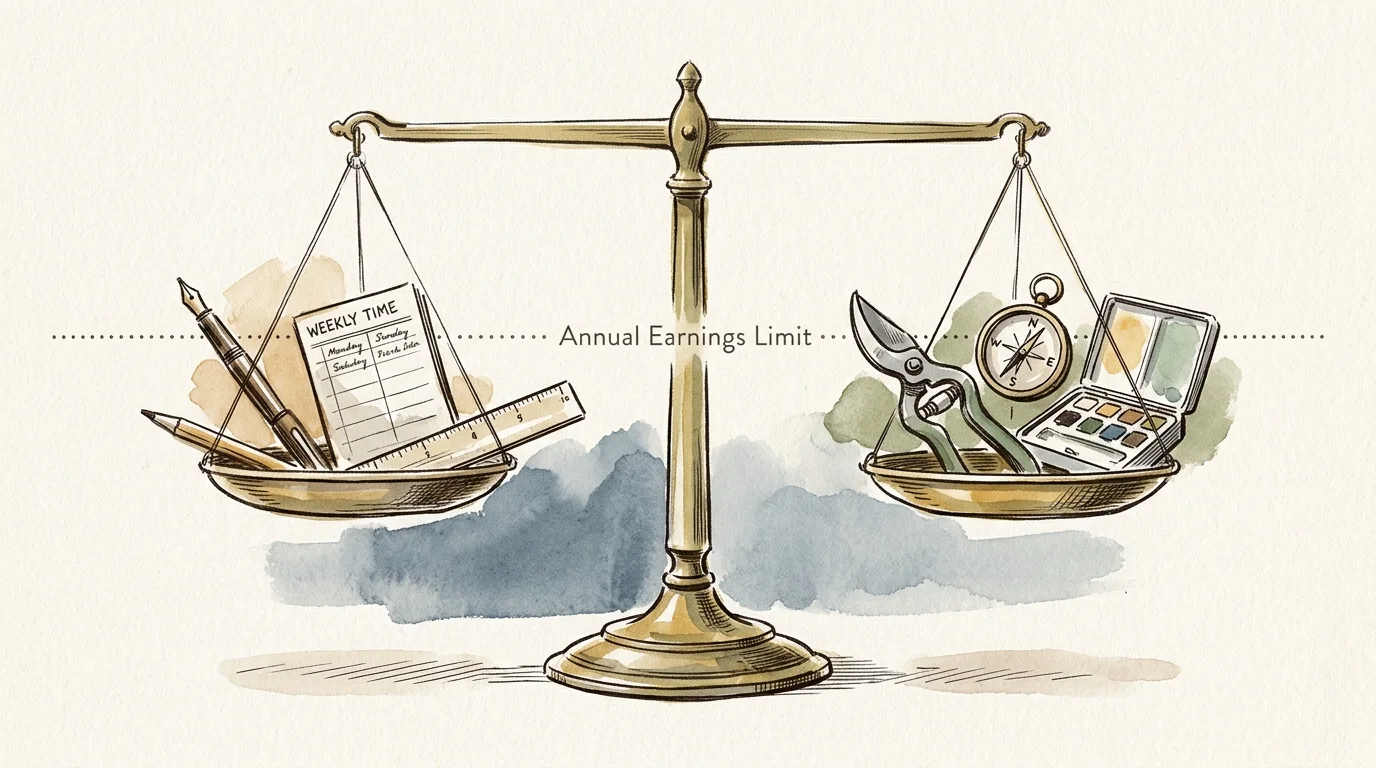
Returning to work or launching a consulting venture offers incredible mental stimulation, daily structure, and social engagement. If you claim survivor benefits before reaching full retirement age, you must monitor the Retirement Earnings Test.
Earning too much money while collecting early survivor benefits can temporarily reduce your monthly checks. For 2026, the annual earnings limit stands at $24,480 for beneficiaries who remain under full retirement age all year.
Under this rule, the agency withholds $1 of benefits for every $2 you earn above that $24,480 threshold. If you reach your Survivor Full Retirement Age during 2026, the earnings cap expands to $65,160.
In that transition year, the agency withholds $1 for every $3 earned above $65,160 until your birthday month arrives. Fortunately, these limits increase to keep pace with wage growth in 2027.
In 2027, the under-FRA limit rises to $25,560 per year, which equals $2,130 each month. For beneficiaries reaching full retirement age in 2027, the limit rises to $67,920 per year, or $5,660 per month.
Once you reach your full retirement age, the earnings cap vanishes completely. You can earn an unlimited income through consulting, speaking, or running a business without losing a single dollar of benefits.
Even if benefits are withheld early due to earnings, the money is not permanently lost. When you reach full retirement age, the agency recalculates your monthly benefit upward to credit you for the withheld amounts.
Working a targeted schedule lets you enjoy rewarding professional camaraderie while protecting your benefit payments. You keep your mind sharp, expand your network, and maintain an enviable balance between productivity and leisure.
Part-time work can fund dream vacations or local philanthropy without compromising your overall financial health. Staying socially active in the workplace reinforces a vibrant, purposeful retirement lifestyle.
Finding purpose through part-time work adds immense joy and vitality to retirement living. You maintain full control over your schedule while enjoying rewarding professional interactions.
Lifestyle Idea #8: Streamline the Application Process and Claim Every Dollar
Navigating the bureaucratic paperwork for survivor benefits Social Security requires knowing the exact procedural rules. While you can apply for your own retirement check online, you cannot apply for survivor benefits online.
To file a survivor application, you must call the Social Security Administration directly at 1-800-772-1213. Alternatively, you can schedule an in-person appointment at your local Social Security field office.
If you were already receiving spousal benefits on your partner’s record when they passed away, the transition is much easier. The agency will generally convert your monthly payments to survivor benefits automatically once the death is reported.
Be sure to claim the federal one-time lump-sum death payment of $255. This benefit is payable to a surviving spouse who was living in the same household with the deceased worker.
You must submit your application for this $255 death payment within two years of the date of death. While modest, every dollar helps offset immediate paperwork and administrative expenses.
Gather all essential paperwork into a dedicated folder before speaking with an agency representative. You will need your marriage certificate, your spouse’s death certificate, and recent W-2 forms or tax returns.
Invite a supportive adult child or trusted friend to attend your telephone or office appointment with you. Having a companion taking notes ensures you ask the right questions without feeling overwhelmed by paperwork.
Completing these administrative steps swiftly brings closure to an essential financial chapter. With your benefits securely established, you can move forward with energy, confidence, and peace of mind.
Financial organization clears mental space, allowing you to invest your time in restorative wellness and fun adventures. You are fully equipped to embrace the rich possibilities of senior living.
Reaching out to trusted professionals ensures you never face complex administrative tasks alone. A supportive network makes every transition smoother and far less stressful.

Putting It into Practice: Small Steps for Big Changes
Transitioning from a two-check household to a single check requires intentional planning, but small steps create massive relief. Start by reviewing your most recent monthly bank statements to map your household cash flow.
Identify which recurring expenses you can trim immediately without diminishing your everyday happiness. Group fitness passes, museum memberships, and community gardening clubs often cost very little while providing immense social joy.
Next, build a clear timeline of your claiming ages and calculate your Survivor Full Retirement Age. Knowing your exact numbers removes guesswork and gives you total control over your claiming strategy.
Schedule an annual checkup with a fee-only financial planner who specializes in retirement transitions. Professional guidance ensures you balance withdrawals from retirement accounts alongside your Social Security check.
Connect with local community centers, senior organizations, and volunteer groups to nurture a dependable support network. Building strong friendships provides emotional strength and keeps your social calendar delightfully full.
Plan small, invigorating outings that celebrate your personal interests, such as day trips to botanical gardens or historic landmarks. Simple adventures re-energize your spirit and remind you of the exciting possibilities ahead.
Retirement is an evolving journey marked by personal growth, resilience, and renewed purpose. Taking charge of your financial choices gives you the freedom to write an inspiring next chapter.
Celebrate each milestone you achieve as you master your budget and discover new passions. Your strength and wisdom will guide you toward a joyful, connected, and deeply rewarding lifestyle.
Embrace each new day as an opportunity to learn, explore, and connect with inspiring people. Your future remains bright and filled with rewarding adventures.
Frequently Asked Questions
Which check goes away when a spouse dies?
The smaller of the two monthly Social Security checks permanently stops. The surviving spouse receives the single larger benefit amount between their own worker check and their partner’s check.
If you earned less than your spouse, your check will effectively be stepped up to match your late partner’s payment. You will never continue receiving both checks simultaneously.
Can you work while collecting widow Social Security benefits?
Yes, you can work while collecting survivor benefits, but earnings limits apply if you have not reached full retirement age. In 2026, the limit is $24,480, rising to $25,560 in 2027.
If your earnings exceed those limits, the agency temporarily withholds $1 for every $2 earned above the threshold. Once you reach your Survivor Full Retirement Age, you can earn unlimited income without penalty.
What happens if you remarry after age 60?
Remarrying at or after age 60 has no negative effect on your eligibility for survivor benefits. You will continue collecting your late spouse’s full survivor benefit each month.
However, if you remarry before age 60, your survivor benefits are suspended for as long as your new marriage lasts. That makes timing an essential financial consideration for mature couples.
How does the 2027 COLA impact survivor benefits?
The Social Security Administration announced a 3.6% COLA for 2027, which takes effect starting with January 2027 checks. This cost-of-living adjustment applies directly to all survivor benefits.
For example, the average widow living alone will see her monthly benefit increase from $1,936 in late 2026 to $2,005 in January 2027. This boost helps offset inflation and everyday living expenses.
For resources on retirement living, travel, and finance, visit AARP. Official information on Social Security is available at SSA.gov. For travel advisories, consult the U.S. Department of State.
Disclaimer: This article provides lifestyle suggestions for informational purposes. Financial, legal, or travel decisions should be made in consultation with qualified professionals.