

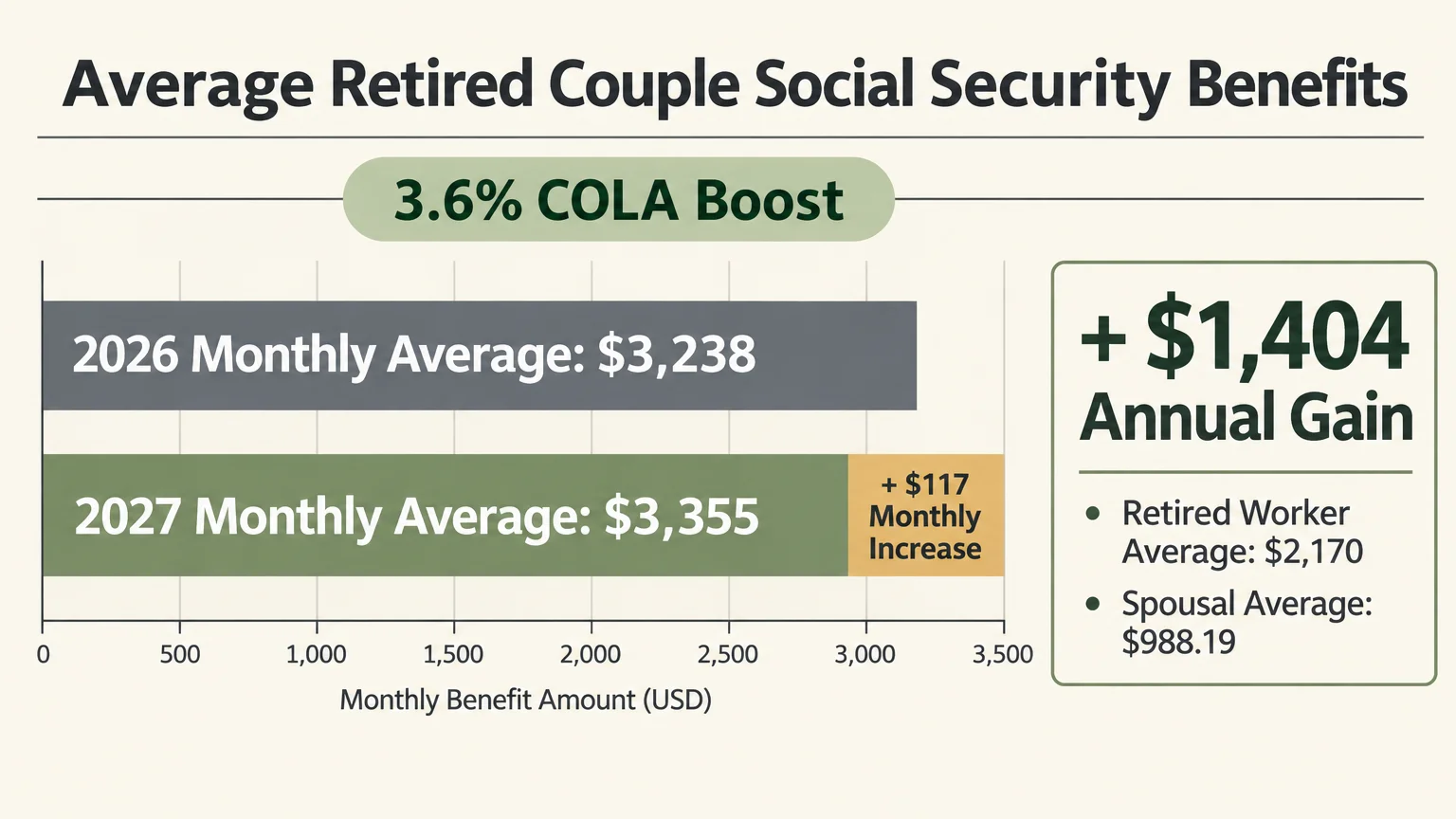
Starting in January 2027, the average retired couple receiving benefits will collect $3,355 per month—or $40,260 per year—following a 3.6% cost-of-living adjustment. That increase adds $117 every month to your shared household cash flow.
Knowing your headline check is only step one toward enjoying your retirement income. Medicare premiums, claiming ages, tax deductions, and payment dates all shape what actually lands in your bank account.
Smart planning turns your 2027 Social Security payments into travel, shared hobbies, and deeper community ties. Here is how to map out your real income and make the most of the year ahead.
Lifestyle Idea #1: Anchor Your 2027 Budget Around the Real Couple Average
Understanding what the average Social Security couple in 2027 receives gives you a clear starting point for your annual lifestyle plan. According to the Social Security Administration, the 2027 cost-of-living adjustment (COLA) is 3.6%, up from 2.8% in 2026.
This boost reflects Consumer Price Index for Urban Wage Earners and Clerical Workers data measured from the third quarter of 2025 to the third quarter of 2026. The agency announced the official adjustment on October 14, 2026.
For an average couple where both partners receive retired worker benefits, estimated monthly checks rise from $3,238 in 2026 to $3,355 in 2027. That extra $117 per month adds up to $1,404 across the full calendar year.
Individual averages give helpful context if only one partner has claimed so far. The Social Security Administration estimates the average retired worker check rises by about $75 per month, from $2,095 to $2,170—or $26,040 annually.
If your household relies on one primary earner and a spousal check, your baseline looks slightly different. According to the Social Security Administration’s October 2026 snapshot, the average pre-COLA check specifically for spouses of retired workers was $988.19 per month.
Households receiving Supplemental Security Income (SSI) also see higher federal standards in 2027. Maximum federal monthly SSI payments increase to $1,029 for an eligible individual and $1,544 for an eligible couple, while resource limits stay at $2,000 and $3,000.
Rather than letting that $117 monthly COLA bump vanish into everyday groceries, give those dollars a joyful purpose. Open a separate savings bucket dedicated to experiences you both value, such as weekend road trips, museum passes, or spoiling your grandchildren.
Couples thrive when retirement income feels purposeful instead of purely defensive. Sit down together over morning coffee, review your updated benefit notices, and pick one fun goal for that extra $1,404 this year.
Lifestyle Idea #2: Deduct Medicare Costs First to See Your True Spending Money
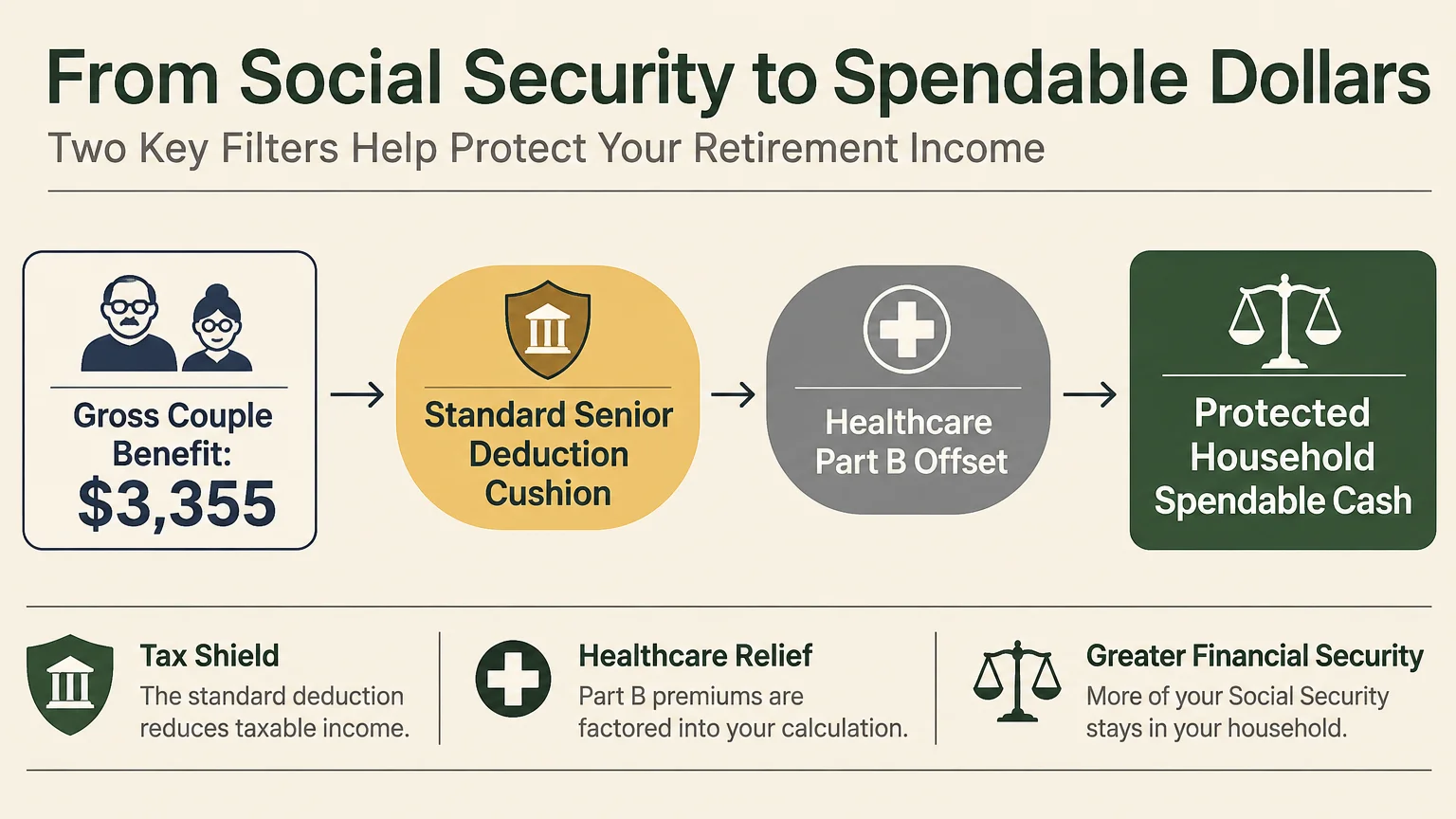
Gross retired couple benefits look impressive on paper, yet healthcare deductions change what you actually have to spend on dining out, hobbies, and travel. Checking your net deposit prevents budget surprises in January.
According to the Centers for Medicare & Medicaid Services, the standard Medicare Part B monthly premium rises to $209.40 per person starting January 1, 2027. That is a $6.50 increase—or 3.2%—from the $202.90 rate in 2026.
When both you and your spouse have standard Part B premiums deducted from your checks, your combined monthly deduction equals $418.80, or $5,025.60 per year. Subtracting that from the $3,355 couple average leaves $2,936.20 per month in net cash flow.
Out-of-pocket medical deductibles also edge higher in 2027, so build a modest health cushion into your lifestyle plan. The Centers for Medicare & Medicaid Services reports the annual Part B deductible rises from $283 to $292.
Meanwhile, Medicare Part A remains premium-free for roughly 99% of enrollees who have at least 40 quarters of Medicare-covered work. However, the Part A inpatient hospital deductible increases from $1,736 to $1,776 for 2027.
High-earning retirement income couples should also check whether Income-Related Monthly Adjustment Amounts (IRMAA) apply to their checks. These surcharges are based on your 2025 Modified Adjusted Gross Income (MAGI).
Married couples filing jointly with 2025 MAGI above $224,000—up from $218,000 in 2026—pay higher total Part B premiums ranging from $293.10 to $711.80 per month per person. Individual filers face surcharges above $112,000.
Those higher-income brackets also trigger Medicare Part D prescription surcharges ranging from $15.40 to $96.40 per month per person. Knowing your exact bracket keeps your travel and entertainment budget realistic from month one.
Once you calculate your true net deposits, automate your fixed bills and set up a guilt-free fun allowance. Taking regular walks, joining a local pickleball club, and using covered preventive screenings can also help you enjoy active days while keeping medical bills low.

Lifestyle Idea #3: Coordinate Your Claiming Ages to Maximize Lifetime Joy
If one or both of you have not yet filed, your claiming timing dramatically changes how your 2027 social security payments support your lifestyle. Couples have unique flexibility because you do not have to claim on the exact same schedule.
For workers who earned at or above the taxable maximum for at least 35 years since age 22, the Social Security Administration sets clear 2027 maximum monthly payouts. Filing at age 62 and one month yields a maximum of $3,094 per month.
Waiting until Full Retirement Age (FRA) of 67 raises that 2027 maximum to $4,188 per month, up from $4,152 in 2026. Holding out until age 70 pushes the top benefit to $5,358 per month, up from $5,181.
Your Full Retirement Age depends on your birth year under Social Security Administration rules. Anyone born in 1960 or later reaches FRA at age 67, while workers born in 1959 reach FRA at 66 and 10 months.
Claiming early locks in a permanent reduction to your own retirement check. The Social Security Administration reduces benefits by 5/9 of 1% per month for the first 36 months before FRA, and 5/12 of 1% per month beyond 36 months—up to a 30% cut at age 62.
Delaying past FRA rewards your patience with steady, guaranteed growth. For workers born in 1943 or later, delayed retirement credits add 2/3 of 1% per month—or 8% per year—yielding up to a 24% boost at age 70 for an FRA of 67.
Couples often blend these two timelines to enjoy the best of both worlds. One partner with a smaller earnings record might claim near 62 or 65 to fund active travel, hobbies, and grandparent adventures right now.
At the same time, the higher-earning partner can delay until 67 or 70 to build a much larger inflation-adjusted income floor for your seventies and eighties. That teamwork lets you savor vibrant early-retirement years without sacrificing long-term security.
Lifestyle Idea #4: Master Spousal, Divorced, and Survivor Rules Together
Navigating spousal benefits and survivor protections requires clear communication between partners, yet many couples overlook key details that protect their shared lifestyle. Understanding the rules removes financial guesswork and strengthens peace of mind.
Under Social Security Administration rules, a spouse can receive up to 50% of the higher-earning partner’s Primary Insurance Amount—the benefit calculated at FRA—by claiming at their own FRA. Note that delayed retirement credits earned by the higher earner do not increase spousal benefits.
Claiming a spousal check early shrinks that 50% maximum permanently. Benefits fall by 25/36 of 1% per month for the first 36 months and 5/12 of 1% per month beyond that—up to a 35% reduction, or as little as 32.5% of the worker’s PIA at age 62.
An exception protects parents still raising younger family members. That early reduction does not apply if you are caring for a qualifying child under age 16 or a child with a disability.
Keep the deemed filing rule in mind when mapping your dates. Anyone turning 62 on or after January 2, 2016 cannot claim a spousal benefit alone while letting their own benefit grow; filing for either automatically files for both and pays the higher amount.
Second-act relationships and blended families also benefit from knowing divorced-spouse eligibility. Unmarried ex-spouses age 62 or older can claim on a former partner’s record if the marriage lasted at least 10 years, without reducing the ex-spouse’s own payout.
If you have been divorced for at least two years, you can even apply on your ex-spouse’s record before they file for benefits themselves. That rule helps single seniors fund independent housing, hobbies, and social outings.
Survivor rules are equally vital for couples planning ahead. Widows and widowers—married at least nine months, or divorced after a 10-year marriage—can claim survivor benefits starting at age 60, or age 50 if disabled.
Depending on the claiming age, survivor checks pay 71.5% to 100% of the deceased spouse’s benefit, including any delayed retirement credits they earned. According to the Social Security Administration, the average aged widow or widower check rises by $69 to $2,005 per month in 2027.
Remarrying before age 60—or age 50 if disabled—disqualifies you from collecting survivor benefits on a prior spouse’s record, though remarrying after 60 preserves eligibility. Surviving spouses may also qualify for a one-time $255 lump-sum death payment.
Talking openly about these numbers might feel serious at first, yet it brings couples closer together. Knowing the surviving partner keeps the higher check—especially if boosted by delayed credits—frees you both to enjoy today without nagging worry.

Lifestyle Idea #5: Blend Encore Work and Social Connection Without Losing Benefits
Retirement does not mean stepping away from purpose, community, or meaningful paychecks. Many couples find that part-time consulting, tutoring, or working at a favorite local bookstore keeps their minds sharp and their social calendars full.
If you plan to work while collecting 2027 social security payments before reaching Full Retirement Age, watch the retirement earnings test limits. Going over the cap temporarily trims your monthly checks, though those withheld benefits are recalculated upward once you reach FRA.
According to the Social Security Administration’s 2027 COLA Fact Sheet, beneficiaries under FRA for all of 2027 can earn up to $25,560 per year—or $2,130 per month—up from $24,480 in 2026. Earning above that threshold withholds $1 in benefits for every $2 earned over the limit.
If you reach Full Retirement Age during 2027, the rules grow far more generous. Your annual earnings limit jumps to $67,920—or $5,660 per month—with $1 withheld for every $3 earned above the cap in months before your FRA birthday.
Starting the very month you reach FRA and continuing forever after, there is no earnings limit at all. You can earn any salary you want without losing a single cent of your monthly benefit.
Keep in mind that continuing to work also means paying payroll taxes, which can replace lower-earning years in your 35-year calculation. In 2027, the 6.2% Social Security payroll tax—12.4% if self-employed—applies up to a maximum taxable earnings cap of $192,300, up from $184,500.
The 1.45% Medicare payroll tax continues to apply to all covered wages with no earnings cap. Earning one Social Security work credit requires $1,970 in 2027, up from $1,890, and workers need 40 credits—roughly 10 years—for retirement eligibility.
Part-time work in retirement works best when it feeds your curiosity rather than draining your energy. Try seasonal roles at botanical gardens, national parks, or community arts centers where you meet friendly peers and earn extra travel money under the $25,560 cap.
Lifestyle Idea #6: Shrink Your 2027 Tax Bill Using New Senior Deductions
Taxes quietly determine how far your retirement income couples budget stretches for family visits, hobbies, and dining out. Fortunately, major 2027 tax deductions can shield a larger share of your Social Security checks and savings withdrawals.
First, understand how federal income tax thresholds apply to your benefits. For married couples filing jointly, if your combined income—adjusted gross income plus nontaxable interest plus half of your Social Security benefits—falls between $32,000 and $44,000, up to 50% of your benefits may be taxed.
Once your combined income exceeds $44,000, up to 85% of your Social Security benefits become subject to federal income tax. Those threshold amounts have not changed with inflation, so smart tax planning matters more than ever.
The good news is that your deductions are significantly higher in 2027. According to the IRS, the 2027 standard deduction increases to $33,200 for married couples filing jointly—up $1,000 from 2026—and $16,600 for single filers.
Taxpayers age 65 and older also keep the existing extra standard deduction—which was $1,650 per married spouse in 2026 and rises to $2,100 for single filers 65 and older in 2027 according to Kiplinger.
On top of those baseline amounts, seniors can claim the Enhanced Senior Deduction available from 2025 through 2028 under the One, Big, Beautiful Bill Act. According to the IRS, eligible individuals age 65 or older receive an additional $6,000 deduction.
For a married couple filing jointly where both spouses are 65 or older, that adds an extra $12,000 deduction whether you itemize or take the standard deduction. Combined with the $33,200 joint standard deduction, that shields $45,200 before even adding your regular age-65 deduction.
This enhanced deduction phases out beginning at $150,000 MAGI for joint filers—$75,000 for single filers—and disappears completely at $250,000 joint MAGI, or $175,000 single. Knowing that cutoff helps you time retirement account withdrawals or Roth conversions wisely.
If you still owe federal tax on your checks, avoid stressful April tax bills by setting up voluntary withholding. You can file IRS Form W-4V to withhold 7%, 10%, 12%, or 22% directly from your Social Security payments.
Keeping your tax bill predictable frees you up to focus on joyful living. Use the tax savings to fund a family reunion cabin, enroll in a lifelong learning seminar, or support a neighborhood charity you both care about.
Lifestyle Idea #7: Sync Your Monthly Calendar With the 2027 Payment Schedule
Smooth cash flow makes everyday life feel relaxed, especially when couples coordinate bill payments, travel deposits, and social plans. Knowing your exact 2027 deposit Wednesdays eliminates guesswork around payday.
Social Security’s 3.6% COLA begins with December 2026 benefits paid in January 2027 to nearly 72 million beneficiaries. Meanwhile, roughly 7.3 million SSI recipients receive their increased January payment early on December 31, 2026.
According to Social Security Administration Publication No. 05-10031, most retirees are paid on Wednesdays tied to their birth date. If you collect spousal or survivor benefits, your deposit date follows the primary worker’s birth date.
Beneficiaries born between the 1st and 10th of any month are paid on the second Wednesday, starting January 13, 2027. Those born from the 11th through the 20th receive deposits on the third Wednesday, starting January 20, 2027.
Anyone born from the 21st through the 31st gets paid on the fourth Wednesday, beginning January 27, 2027. Exceptions apply to people who started collecting before May 1997 or who receive both Social Security and SSI.
Those exception groups normally receive their Social Security deposit on the 3rd of each month. Because January 3, 2027 falls on a weekend following New Year’s, that payment shifts early to December 31, 2026.
If you and your partner have birthdays in different date brackets, you naturally enjoy two separate paydays every month. Many couples love this rhythm because one check covers fixed utilities while the second arrives fresh for dining, hobbies, and weekend getaways.
Pair your deposit schedule with automatic calendar reminders for recurring memberships and credit card due dates. When your bills match your Wednesday deposits, money management takes minutes instead of hours.

Putting It into Practice: Small Steps for Big Changes
Big financial shifts feel effortless when you break them into simple, couple-friendly routines. Start this week by logging into your personal online Social Security accounts together to review your official 2027 benefit statements.
Next, subtract your exact 2027 Medicare Part B premiums—$418.80 per month for two standard enrollees—plus any voluntary Form W-4V tax withholding. Write down your true monthly net income so both partners share the exact same numbers.
Schedule a relaxed 30-minute money-and-dreams coffee date once a month on your favorite Wednesday payday. Spend half the time confirming bills and half the time picking a fun local outing, class, or trip.
Finally, treat your 3.6% COLA increase as an intentional investment in happiness rather than spare change. Whether you average $3,355 together or fall above or below that mark, giving every dollar a clear job builds confidence and freedom.
Frequently Asked Questions
How can we enjoy retirement activities if our combined checks are below the $3,355 average?
Plenty of fulfilling experiences cost little or nothing when you tap into community perks. Look for free museum days, local library passes, senior center fitness classes, and volunteer roles at theaters or parks that include complimentary event tickets.
Pooling modest savings with other retired couples also stretches your dollars further. Hosting monthly potluck game nights or sharing vacation rental costs with close friends delivers rich social connection on any budget.
Will working part-time for social connection permanently reduce our 2027 Social Security payments?
No, benefits withheld under the retirement earnings test are never lost permanently. Once you reach Full Retirement Age—67 for those born in 1960 or later—the Social Security Administration recalculates your monthly check upward to credit back withheld months.
To avoid temporary withholding altogether, keep 2027 wages at or below $25,560 if you are under FRA all year. Once the month of your FRA birthday arrives, you face zero earnings limits.
What happens to our retirement income if one spouse passes away?
When one spouse passes away, the smaller Social Security check stops, and the surviving spouse keeps the higher benefit amount. This includes any delayed retirement credits the higher earner built by waiting past Full Retirement Age.
That is why coordinating your claiming ages early makes such a meaningful difference for couples. You may also qualify for the one-time $255 lump-sum death payment by contacting the Social Security Administration promptly.
How do we avoid tax-time surprises on our Social Security benefits?
Check whether your combined income exceeds the $32,000 or $44,000 married filing jointly thresholds early in the year. Factor in your 2027 joint standard deduction of $33,200 plus the $12,000 Enhanced Senior Deduction if both spouses are 65 or older.
If your retirement account withdrawals push you into taxable territory, submit IRS Form W-4V to elect 7%, 10%, 12%, or 22% withholding. Spreading taxes evenly across your monthly deposits keeps your lifestyle budget steady all year long.
For resources on retirement living, travel, and finance, visit AARP. Official information on Social Security is available at SSA.gov. For travel advisories, consult the U.S. Department of State.
Disclaimer: This article provides lifestyle suggestions for informational purposes. Financial, legal, or travel decisions should be made in consultation with qualified professionals.