

Inheriting a family home alongside your siblings can secure your financial future and preserve your family legacy. You can navigate this shared journey smoothly by understanding your property rights, tax benefits, and collective options early.
While co-owning real estate brings emotional complexity, clear communication transforms potential tension into mutual empowerment. You will find practical ways to honor your family bonds while making smart financial decisions.
By taking thoughtful steps together, you protect your relationships and unlock the full value of your inheritance. Let us explore the proven strategies that make shared property ownership clear, manageable, and rewarding.

Tip #1: Understand Your Ownership Rights and Legal Title
Inheriting a home places you in the middle of a historic generational wealth transfer. Cerulli Associates projects that $124 trillion in wealth will transfer across generations through 2048, with $105 trillion passing directly to heirs.
Residential real estate owned by Baby Boomers represents a cornerstone of this unprecedented transfer. When you inherit property alongside your brothers or sisters, the legal deed dictates your ownership framework.
Most co-inheriting siblings take title as tenants in common. This standard legal structure grants each sibling an undivided interest in the whole property.
Tenants in common do not need to hold identical ownership percentages. A will might assign forty percent to one sibling and thirty percent to two others.
As a tenant in common, you also retain the legal right to pass your ownership share to your chosen heirs. Your share does not automatically go to your siblings upon your passing.
Alternatively, your parents may have deeded the property to you as joint tenants with right of survivorship. Under joint tenancy, all siblings hold equal ownership shares simultaneously.
When a joint tenant passes away, their ownership percentage transfers immediately to the surviving siblings. The property avoids outside distribution until only one living sibling remains as the sole owner.
Reviewing the recorded deed during probate provides essential legal clarity right from the beginning. Consult an estate planning attorney or title company to verify the exact vesting language on the deed.
Tip #2: Maximize the Valuable Stepped-Up Tax Basis
Inheriting real estate offers extraordinary tax benefits that help you preserve family wealth. Learning how the stepped-up basis works allows you to make informed, highly profitable decisions.
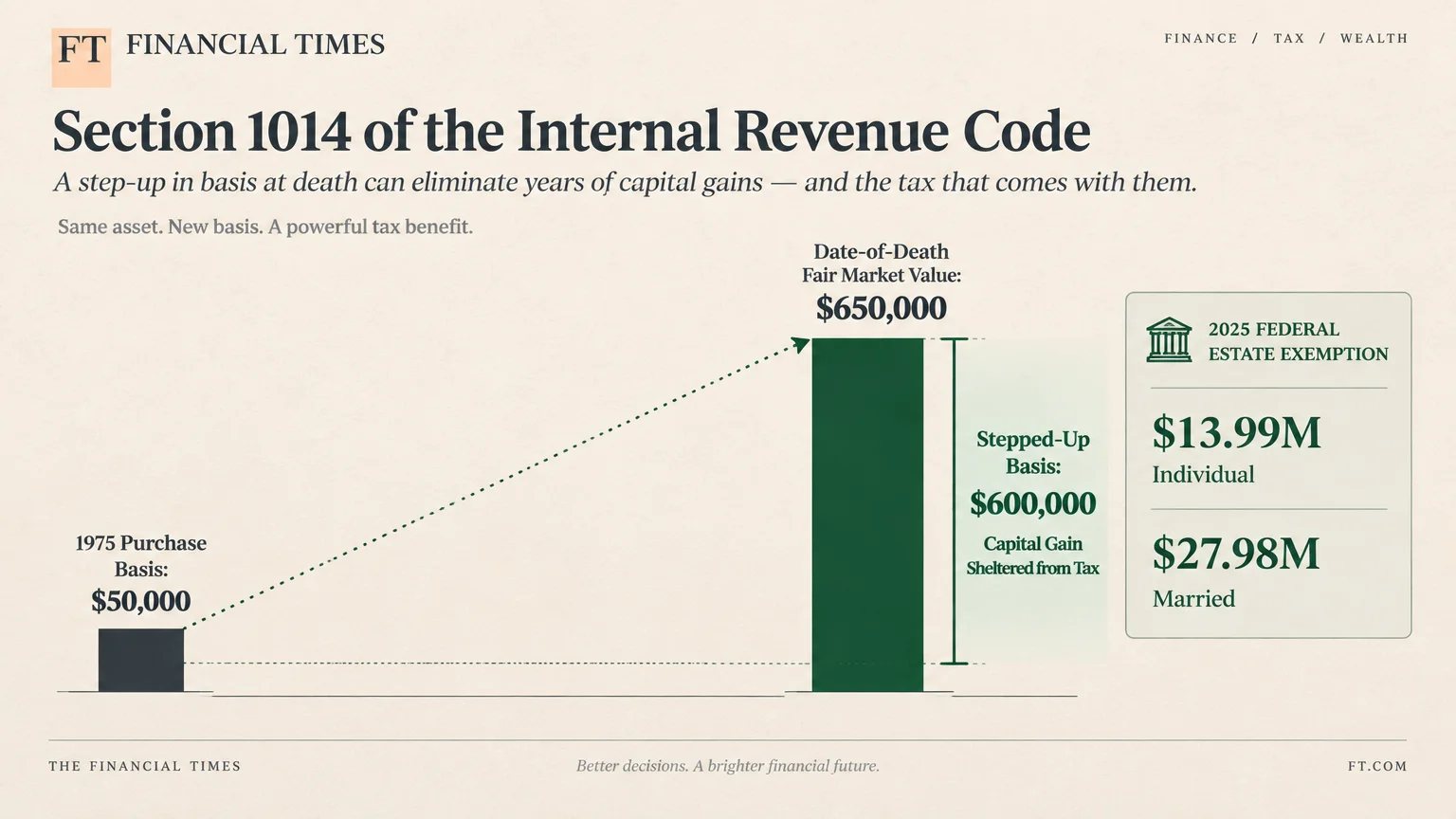
Under Internal Revenue Code Section 1014, inherited real estate receives a stepped-up tax basis to fair market value on the date of death. This provision resets the home’s baseline cost.
Suppose your parents bought their family home in 1975 for $50,000, and it appraises for $650,000 upon their passing. Your new collective tax basis instantly becomes $650,000.
That $600,000 in long-term capital appreciation completely escapes capital gains taxation. This single tax rule provides families with significant financial peace of mind.
When selling an inherited home shortly after your parents pass, you only owe capital gains tax on post-inheritance appreciation. If the sale price matches the appraisal, you owe zero capital gains tax.
Furthermore, federal estate taxes will not affect most families. The federal estate tax exemption is $13.61 million per individual for 2024 and rises to $13.99 million for 2025.
For married couples, this lifetime shield reaches $27.98 million in 2025. Consequently, the vast majority of estates pass to heirs completely free from federal estate taxation.
You should also evaluate state inheritance taxes, which individual beneficiaries must pay rather than the estate. Only five states levy an inheritance tax: Kentucky, Maryland, Nebraska, New Jersey, and Pennsylvania.
Iowa fully repealed its inheritance tax for all deaths occurring on or after January 1, 2025. Moreover, direct lineal descendants like children often receive full or generous partial exemptions under existing state laws.

Tip #3: Maintain Transparent and Proactive Family Communication
A childhood home carries deep memories, which can sometimes ignite unexpected emotional reactions. Navigating shared inheritance tips successfully requires acknowledging these feelings while treating the property as a valuable asset.
Sibling inheritance disputes rarely happen because siblings dislike each other. Rather, conflicts arise from differing financial circumstances, unresolved childhood roles, or mismatched visions for the future.
Schedule a dedicated family meeting as soon as your family feels ready. Choose a comfortable, neutral setting or host a calm video call so everyone feels heard and respected.
Build an open agenda covering property taxes, necessary repairs, homeowner insurance, and each sibling’s personal preferences. Clear topics keep discussions focused on constructive solutions rather than past grievances.
Designate one sibling to take meeting notes and email them to the entire family afterward. Documenting every discussion creates complete transparency and prevents misunderstandings later on.
Sort through personal property and cherished keepsakes before addressing the physical building. Use a rotating draft system where siblings take turns choosing items of sentimental value.
Resolving personal possessions harmoniously builds trust and goodwill among everyone. That positive momentum makes larger financial decisions about the house much easier to negotiate.
Tip #4: Evaluate the Three Paths for Splitting Inherited Property
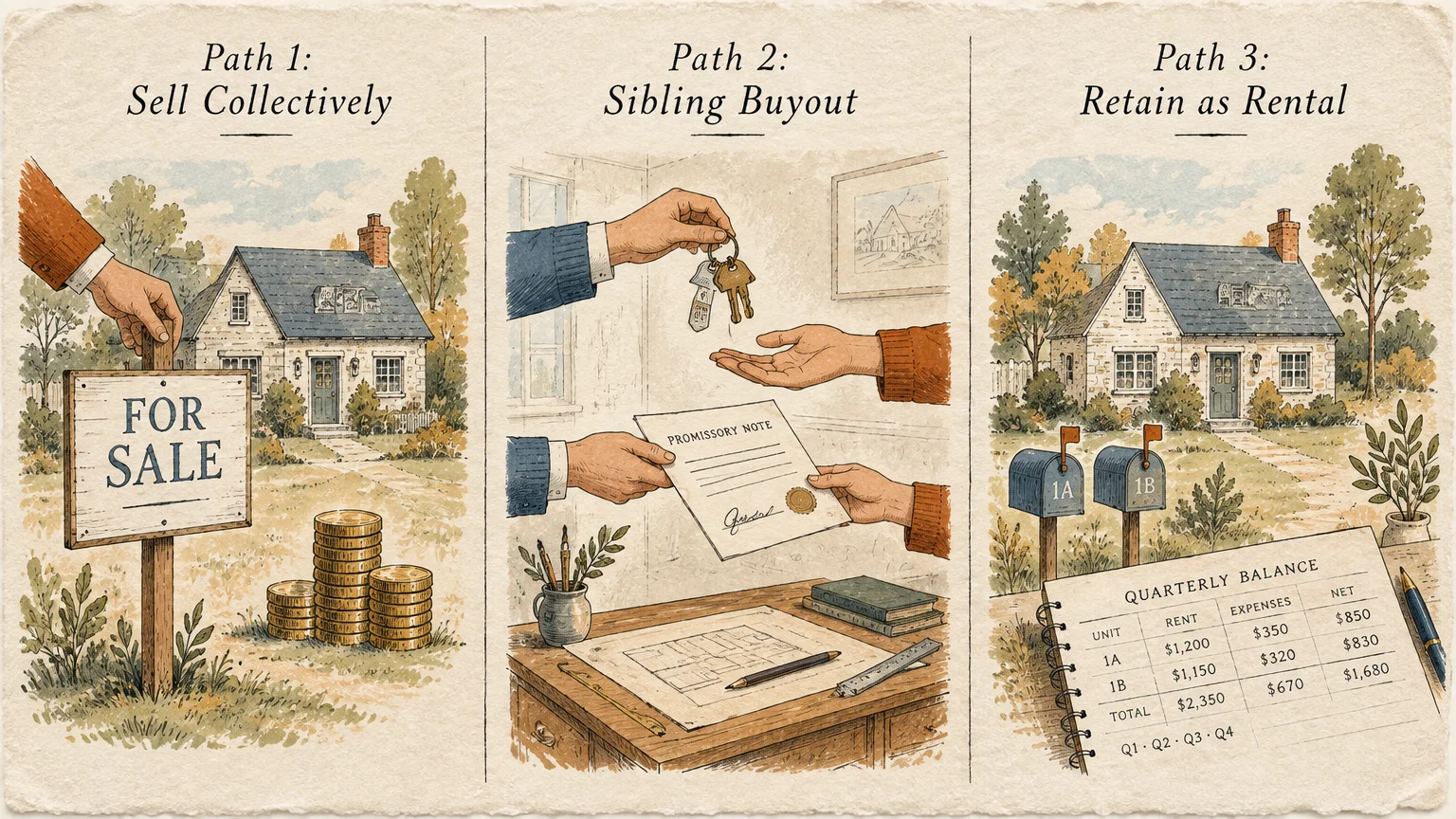
When splitting inherited property, your family must choose one of three primary avenues. Exploring each path helps you decide which arrangement best supports your retirement and financial goals.
Path 1: Selling an Inherited Home and Dividing the Proceeds
Selling an inherited home is the most common choice because it offers complete financial finality. You hire a licensed real estate agent, prepare the house for the market, and accept an offer.
After paying closing costs, the title company divides the net proceeds directly among the siblings. Each co-owner can immediately allocate their cash share toward retirement savings, travel, or paying off debts.
Path 2: One Sibling Buying Out the Others
One sibling may have a strong desire to live in the home or keep it in the family. That sibling can buy out the equity shares of their brothers and sisters.
The purchasing sibling typically takes out a new mortgage or uses personal savings to pay the others. This path preserves family heritage while providing immediate liquidity to the non-residing siblings.
Path 3: Keeping the Home as a Shared Rental
Your family might choose to retain the home as an income-producing rental property. This strategy provides recurring passive cash flow and lets the real estate appreciate over time.
However, running a rental requires ongoing cooperation, tenant management, and regular property maintenance. Siblings should form a formal limited liability company with explicit operational rules before choosing this route.
Tip #5: Manage Carrying Costs and Day-to-Day Maintenance Fairly
An inherited home comes with immediate holding expenses that someone must pay. Managing these carrying costs efficiently prevents damage to the house and keeps family relations peaceful.
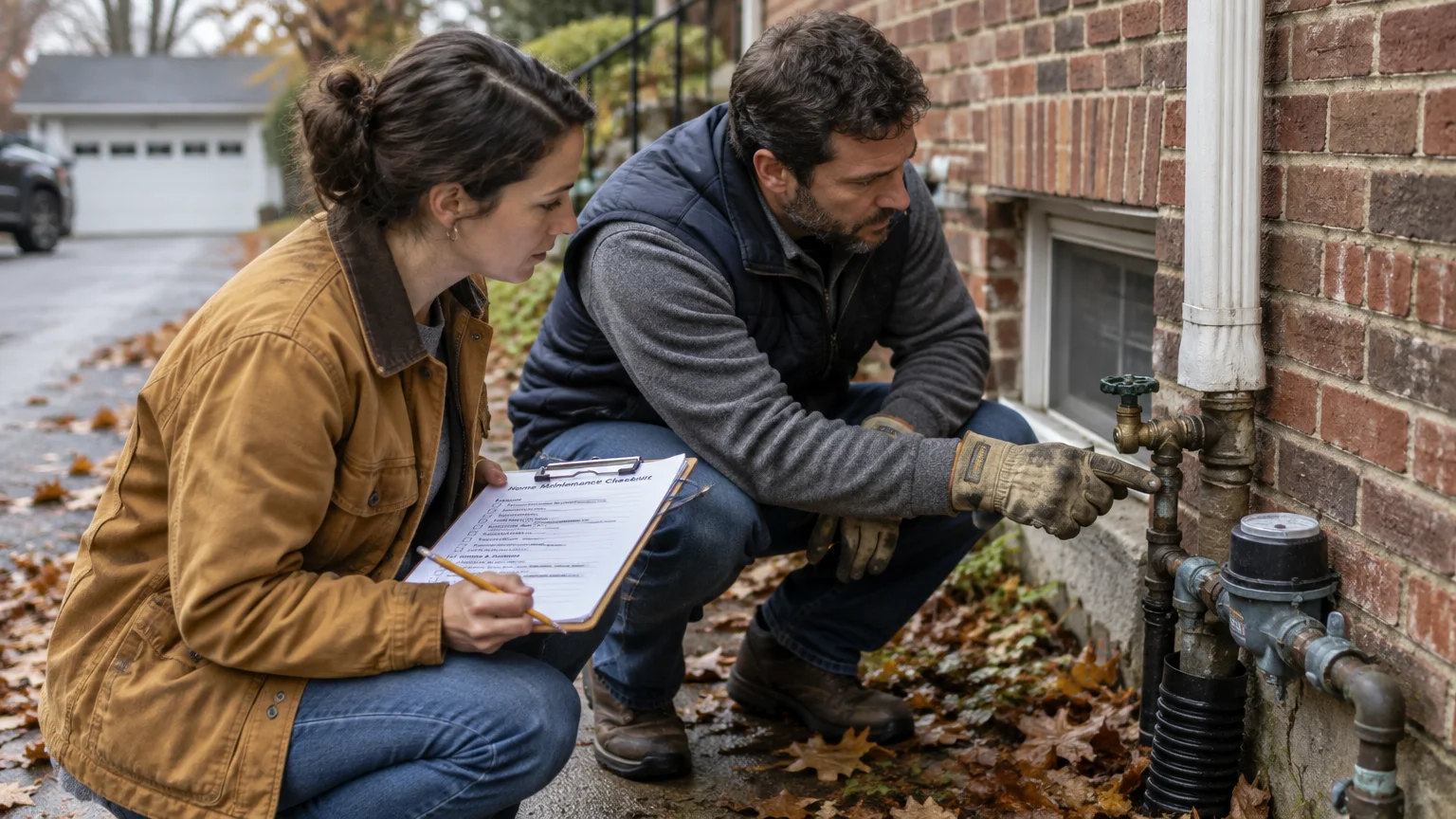
Carrying costs include property taxes, homeowner association dues, hazard insurance, lawn care, and utilities. Leaving utilities connected protects the plumbing system and prevents costly damage like mold growth.
Open a separate checking account specifically dedicated to the property’s ongoing expenses. Each sibling should deposit their proportionate share of funds into this account every month.
Contact the home insurance carrier promptly to update the policy. Most standard homeowners policies restrict coverage if a house sits unoccupied for more than thirty consecutive days.
Track every single expenditure using shared digital spreadsheets and saved receipts. Co-owners who pay for repairs out of their personal funds should receive prompt reimbursement from estate funds.
If one sibling resides in the house while preparing it for sale, establish clear written expectations. The resident sibling should pay market rent or cover the monthly utility bills in exchange for residency.

Tip #6: Structure Buyouts and Handle Gift Tax Rules Properly
Executing a fair buyout requires an accurate, objective appraisal of the property. Hire an independent, state-certified real estate appraiser to establish the home’s current fair market value.
Never rely on informal neighborhood estimates or online valuation algorithms for a buyout. An official appraisal eliminates arguments because it provides an impartial baseline that all siblings can trust.
Calculate the home’s net equity by subtracting any remaining mortgage debt from the appraised value. You can then subtract standard real estate commission savings if you negotiate that concession mutually.
The purchasing sibling then arranges financing to pay each sibling their corresponding dollar share. Lenders offer specialized probate and inheritance loans specifically designed to fund sibling buyouts smoothly.
Pay close attention to gift tax regulations if you forgive part of a sibling’s buyout cost. The annual federal gift tax exclusion is $18,000 per recipient for 2024.
This annual exclusion rises to $19,000 per recipient for 2025 and 2026, or $38,000 for married couples. Forgiving equity amounts above these annual limits requires you to file IRS Form 709.
Complete the transaction by executing a formal quitclaim or grant deed through a licensed title company. Recording the deed removes departing siblings from property liabilities and confirms sole ownership for the buyer.

Tip #7: Use Mediation and Heirs Property Protections if Disputes Arise
Disagreements can arise even when siblings approach an inheritance with the best intentions. Knowing how to resolve disputes calmly protects both your inheritance and your family connections.
Hire a certified mediator if you reach an impasse regarding whether to sell or keep the house. Mediation offers a confidential, supportive environment where a neutral third party guides productive compromise.
Mediation costs a small fraction of traditional court litigation and avoids bitter courtroom battles. Working through mediation helps you preserve lifelong sibling relationships during your golden years.
If a sibling refuses to negotiate, co-owners historically had to file a partition lawsuit. Under older common law rules, partition actions often forced a public auction on the courthouse steps.
Courthouse auctions regularly sold properties at steep discounts, destroying generational family wealth. Investors frequently exploited these distressed sales at the expense of unsuspecting heirs.
Thankfully, modern legal reforms protect your family from predatory sales. The Uniform Partition of Heirs Property Act (UPHPA) has been enacted across 24 states, the District of Columbia, and the U.S. Virgin Islands.
The UPHPA requires an independent fair-market appraisal and gives non-selling siblings a formal right of first refusal. Co-owners gain statutory time to buy out the petitioner before any sale occurs.
If the court orders a sale, the UPHPA mandates an open-market listing by a licensed real estate broker. This essential protection guarantees your family captures full market value for your inherited home.

The Takeaway: Living a More Blissful Retirement
Inheriting a house with siblings represents a meaningful transition that can enrich your retirement years. Approaching the process with patience, empathy, and professional advice turns inherited property into a lasting blessing.
Your parents built their home with love and dedication, hoping to give you a brighter tomorrow. Protecting your sibling relationships honors their memory far more than any single real estate transaction ever could.
Take time to celebrate your shared history, communicate openly with your siblings, and make confident financial choices together. A harmonious inheritance process clears the path for a joyful, stress-free retirement.
For a wide range of resources for older adults, visit AARP and the National Council on Aging (NCOA). Health information is available from the National Institute on Aging.
Disclaimer: This article is for informational and inspirational purposes only; it is not a substitute for professional medical, financial, or psychological advice. Please consult with a qualified expert for guidance tailored to your individual needs.
Frequently Asked Questions
Can one sibling force the sale of an inherited house?
Yes, any co-owner can file a partition action in court to compel the sale of shared real estate. However, modern laws provide siblings with a legal right of first refusal to buy out that share first.
Filing a partition lawsuit is expensive and stressful, so voluntary mediation or buyout negotiations remain the far superior choice for families.
What happens if one sibling lives in the home and refuses to sell?
Co-owners share equal legal possession rights, meaning other siblings cannot simply change the locks. However, the residing sibling must fulfill their share of maintenance and carrying costs.
If negotiations fail, the estate executor or non-occupying siblings can initiate formal eviction proceedings or file a court partition to compel a resolution.
Who is responsible for paying property taxes on an inherited home?
The parent’s estate typically pays property taxes and utility bills until the probate process concludes. Once title passes to the heirs, all siblings share tax responsibilities equally based on their ownership shares.
Opening a joint property checking account ensures that all siblings contribute their fair share toward property taxes on schedule.
How does the stepped-up basis affect our capital gains taxes?
The stepped-up tax basis resets the property’s valuation to fair market value on the date of your parent’s passing. You only owe capital gains tax on appreciation that occurs after that specific date.
Because siblings often sell an inherited home relatively soon after death, post-inheritance appreciation is typically small, leading to minimal or zero tax liability.