
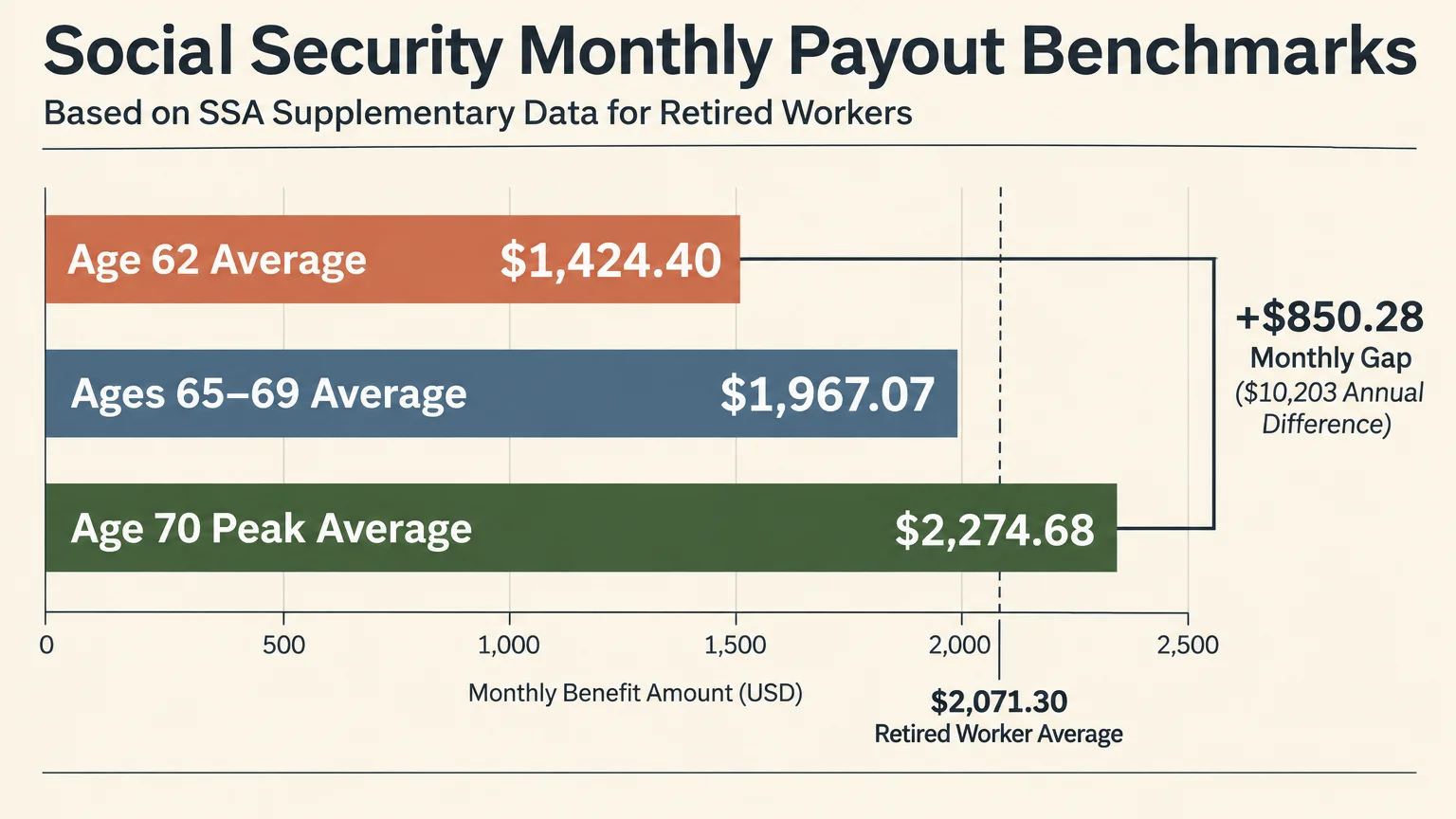
The average Social Security check jumps from $1,424.40 at age 62 to $2,274.68 at age 70—a monthly gap of $850.28. That extra $10,203 a year can transform how you travel, host family, and enjoy retirement.
Understanding the average Social Security by age lets you design your next chapter around real numbers rather than guesswork. Every claiming choice shapes your weekly budget, travel plans, and daily freedom.
Use these seven practical strategies to pair smart claiming decisions with vibrant hobbies, part-time passions, and meaningful connections throughout your 60s and 70s.
Lifestyle Idea #1: Compare the Real 60s vs. 70s Numbers Before Building Your Fun Budget
Before you book a cruise or sign up for pottery classes, ground your retirement vision in real payout figures. Across 53,624,664 retired workers in December 2025, the overall average monthly benefit stood at $2,071.30, per the Social Security Administration (SSA) Annual Statistical Supplement, 2026.
Within that overall group, men averaged $2,282.28 per month while women averaged $1,872.43 per month. Looking at the narrower age brackets reveals just how sharply Social Security in your 60s differs from Social Security in your 70s.
What Checks Look Like in Your 60s
Early retirees in the 62-to-64 bracket—about 2.61 million beneficiaries—received an average of $1,450.74 per month in December 2025. Men in this youngest group averaged $1,597.27, while women averaged $1,314.30.
Breaking that down year by year shows $1,424.40 at age 62, $1,435.81 at age 63, and $1,478.00 at age 64. Those modest checks cover basics for some households, yet they leave less room for spontaneous dining or frequent weekend getaways without outside savings.
Once you reach the 65-to-69 group—12.51 million beneficiaries—the average climbs to $1,967.07 per month ($2,179.63 for men and $1,761.81 for women). Specifically, checks averaged $1,607.27 at 65, $1,807.28 at 66, $2,016.48 at 67, $2,052.64 at 68, and $2,096.95 at 69.
What Checks Look Like in Your 70s
Stepping into your 70s brings a noticeable jump in monthly cash flow. Across 14.90 million retired workers aged 70 to 74, the December 2025 average reached $2,225.12 per month ($2,462.21 for men and $1,993.16 for women).
Age 70 leads every single year on the chart at $2,274.68 per month ($2,529.62 for men and $2,024.08 for women). Checks then sit at $2,247.76 at 71, $2,205.21 at 72, $2,207.96 at 73, and $2,178.87 at 74.
Even in the 75-to-79 bracket—covering 11.46 million beneficiaries—retired workers still averaged $2,153.59 per month ($2,369.94 for men and $1,945.68 for women). That steady foundation makes it much easier to keep funding hobbies and family visits later in life.
Turn the Numbers Into a Lifestyle Map
Take ten minutes this week to list your fixed monthly bills alongside the things that bring you joy. Knowing whether your expected check looks closer to $1,424 or $2,275 clarifies how much you need from savings or part-time income.
When you match your lifestyle wishes to realistic claiming age benefits, you stop worrying about running short at dinner with friends. Instead, you give yourself permission to spend guilt-free on the experiences you value most.
Lifestyle Idea #2: Match Your Claiming Age to Your Energy and Bucket List
Choosing when to file is as much a lifestyle decision as a math problem. Your Full Retirement Age (FRA) serves as the anchor for every claiming calculation, and SSA sets it strictly by your birth year.
People born from 1943 through 1954 have an FRA of 66. For those born between 1955 and 1959, FRA rises by two months per birth year—moving from 66 and 2 months up to 66 and 10 months.
Anyone born in 1960 or later faces an FRA of 67, meaning the youngest wave reaches full age in 2027 or afterward. Knowing your exact threshold helps you weigh early adventures against bigger future checks.
When Claiming in Your 60s Fuels Early Adventures
Claiming between 62 and your FRA permanently trims your monthly payment. SSA reduces benefits by 5/9 of 1% per month—roughly 6.67% a year—for the first 36 months early, then 5/12 of 1% per month (5% a year) beyond 36 months.
For anyone with an FRA of 67, filing right at 62 locks in a permanent 30% reduction, leaving you with 70% of your full benefit. Still, early checks can make sense if your bucket list centers on active travel while your knees feel great.
You might use early Social Security in your 60s to fund national park road trips, volunteer abroad, or follow grandkids to weekend tournaments. Pairing a modest check with low-cost housing or a paid-off mortgage lets you buy back your time sooner.
When Delaying Social Security Elevates Your 70s
If you enjoy your work or have savings to bridge the gap, delaying Social Security past FRA rewards your patience handsomely. For workers born in 1943 or later, delayed retirement credits add 2/3 of 1% per month—a full 8% every year—up to age 70.
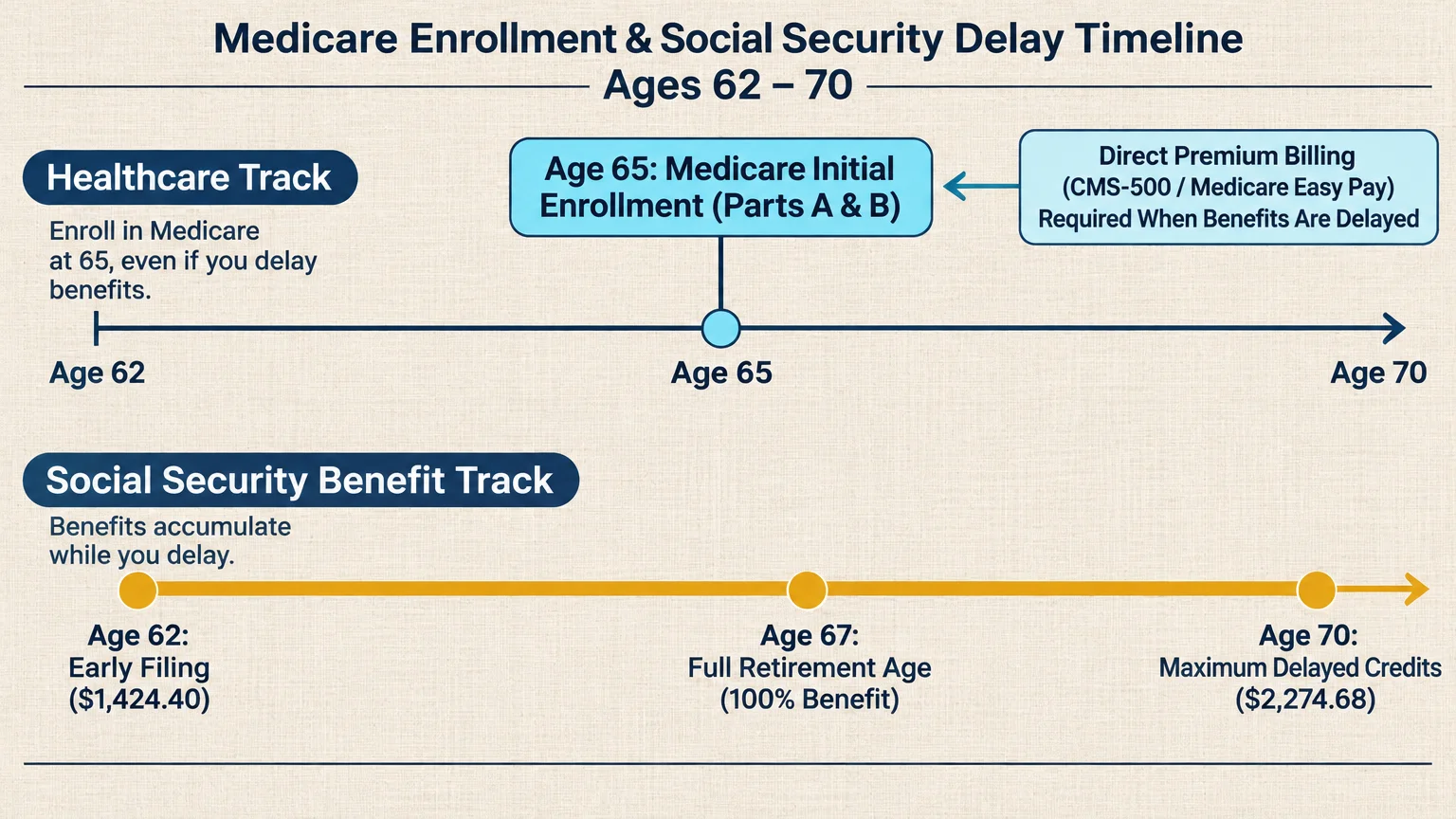
For someone with an FRA of 67, waiting until 70 creates a 24% boost, lifting your payment to 124% of your primary insurance amount. Across the full window from 62 to 70, that produces a monthly check roughly 77% higher.
Remember that delayed credits stop growing once you turn 70, so waiting past your 70th birthday brings no extra bonus. Claiming at 70 delivers maximum guaranteed income right when you may want convenient flights, comfortable hotels, or extra help around the house.

Lifestyle Idea #3: Put Annual Cost-of-Living Adjustments Straight Into Your Fun Fund
Inflation can quietly shrink a fixed budget if you do not plan for it. Fortunately, Social Security builds in annual Cost-of-Living Adjustments (COLA) that protect your purchasing power across both your 60s and your 70s.
In January 2026, a 2.8% COLA added about $56 per month on average, bringing the SSA-estimated average retired-worker check to $2,071. Then, on October 14, 2026, SSA announced a 3.6% COLA taking effect in January 2027 for nearly 72 million beneficiaries.
That 2027 raise adds roughly $75 per month to average retirement checks, lifting the overall retired-worker average from around $2,095 to $2,170 per month. Supplemental Security Income recipients see their adjustment begin on December 31, 2026.
Why a Larger Base Amplifies Every Raise
Because COLA works as a percentage, delaying Social Security multiplies every future increase in dollar terms. A 3.6% raise on a $2,275 check adds nearly $82 a month, whereas 3.6% on a $1,425 check adds just over $51.
Over a 15- or 20-year retirement, that compounding spread covers real lifestyle upgrades. It can pay for annual theater subscriptions, gym memberships, or an extra flight to see grandchildren each fall.
Create a Dedicated Experiences Account
Rather than letting each January raise vanish into everyday grocery runs, set up an automatic transfer for half of your COLA bump. Move that $35 or $40 every month into a high-yield savings bucket labeled strictly for joy.
By the end of the year, you will have $420 to $480 sitting ready for concert tickets, art supplies, or a weekend spa trip with friends. Watching that balance grow turns routine inflation adjustments into something you genuinely look forward to.
Lifestyle Idea #4: Use Encore Work to Bridge the Gap Without Penalty
Retirement no longer requires slamming a door shut at age 62 and never earning another dollar. Many vibrant seniors blend part-time passion projects with smart claiming strategies to boost both their social life and their eventual benefit.
First, understand how SSA builds your check from your highest 35 years of covered earnings, wage-indexed up to age 60. You need 40 work credits to qualify, earning up to four credits a year—with one credit requiring $1,890 in 2026 and $1,970 in 2027.
For a worker earning average wages who retires at FRA between 2025 and 2027, Social Security replaces roughly 41.9% of pre-retirement earnings. Working a few extra years in your 60s can replace lower-earning years from your 20s and nudge your lifetime average upward.
Keep Maximum Benefit Headlines in Perspective
You have likely seen headlines bragging about maximum checks over $5,000 a month. Under SSA 2026 COLA figures, a worker retiring at FRA could reach $4,152 per month, while January 2026 maximums assuming top earnings since age 22 ranged from $2,969 at 62 to $5,181 at 70.
In 2027, those top-earner maximums shift to $3,094 at 62 (62 and 1 month), $3,666 at 65, $3,883 at 66, $4,188 at 67, and $5,358 at 70. Reaching those peaks takes 35 years of earning at or above the taxable wage cap—$184,500 in 2026 and $192,300 in 2027.
Per SSA Actuarial Services, only about 6% of the 185 million covered workers in 2025 hit that wage cap. Do not feel discouraged if your estimate sits near the national averages; focus instead on how part-time work can stretch your personal budget.
Navigate the Retirement Earnings Test Smoothly
If you claim Social Security in your 60s before reaching FRA and keep working, watch the Retirement Earnings Test limits closely. In 2026, workers under FRA for the full year can earn up to $24,480 ($2,040 monthly) before SSA withholds $1 for every $2 above the cap.
That full-year exempt limit rises to $25,560 ($2,130 monthly) in 2027. During the calendar year you actually reach FRA, the limit jumps to $65,160 ($5,430 monthly) in 2026 and $67,920 ($5,660 monthly) in 2027, withholding $1 for every $3 over prior to your FRA month.
Once you hit your FRA month, the earnings limit disappears completely—you can earn any amount with zero withholding. Even better, SSA notes that withheld benefits are not lost forever; your monthly payment gets recalculated higher at FRA to credit those months back.
Pick Work That Doubles as Social Connection
Choose an encore gig that surrounds you with upbeat people rather than draining your energy. Working three mornings a week at a local nursery, golf course, library, or museum keeps your mind sharp and your calendar full.
Even modest paychecks inside the $25,560 limit can cover your utility bills and travel fund while letting you delay claiming until 67 or 70. You stay active in your community while building larger Social Security checks for your 70s.
Lifestyle Idea #5: Sync Medicare at 65 When You Delay Social Security
One of the biggest practical traps for active 60-somethings happens when health coverage and benefit timing drift out of sync. If you already collect Social Security before age 65, SSA automatically enrolls you in Medicare Parts A and B.
However, if you are delaying Social Security past 65—which millions of healthy workers now do—nobody signs you up automatically. You must enroll yourself during your 7-month Initial Enrollment Period, spanning three months before through three months after your 65th birthday month.
Missing that window without qualifying coverage triggers gaps in care and permanent Part B late-enrollment penalties that eat into your future checks. Keep in mind that the 2026 Medicare Part B base premium sits at $202.90 per month, with higher rates for upper-income filers.
Know the Current-Employment Exception
Still working at 65 with employer health insurance, or covered under a working spouse’s plan? As long as that group health plan stems from current employment, you can typically delay Part B without penalty.
When that employment or coverage ends, you qualify for an 8-month Special Enrollment Period to sign up smoothly. Be careful here: COBRA, retiree health plans, VA coverage, and Marketplace plans do not count as current-employment coverage for delaying Part B.
Also check the size of your company before skipping enrollment. If the employer has fewer than 20 employees, Medicare generally pays first at 65, meaning you usually need Parts A and B right on time.
Watch Out for the HSA Timing Trap
Many savvy savers use a Health Savings Account (HSA) in their 60s to build tax-free medical reserves for retirement travel and care. Yet enrolling in Medicare Part A after age 65 triggers up to six months of retroactive coverage.
Contributing to an HSA once Medicare coverage begins—even retroactively—can trigger annoying tax penalties, per SSA rules. Stop your HSA contributions at least six months before applying for Part A or Social Security after age 65 so your wellness budget stays penalty-free.

Lifestyle Idea #6: Build a Low-Cost Social Bridge Between Ages 62 and 70
Delaying your claim to capture those $2,200-plus checks in your 70s does not mean sitting on your sofa for eight years. Likewise, claiming earlier at 62 around the $1,424.40 average still leaves plenty of ways to enjoy a rich social life.
The secret is swapping pricey entertainment habits for community-rich experiences that cost very little. Start by auditing where your leisure dollars actually go each month and keeping only the outings that truly light you up.
Upgrade Your Social Calendar Without Overspending
Host rotating potluck dinners or board game nights with neighbors instead of defaulting to $80 restaurant tabs every Friday. Invite friends over for Saturday morning coffee walks around local lakes or botanical gardens.
Look into your local senior center, public library, and parks department for free language clubs, tai chi classes, and book groups. Many community colleges also let residents over 60 or 65 audit fascinating courses in history, photography, or creative writing for free or pennies.
Travel Smarter in Every Decade
Stretch your budget in your 60s and 70s by traveling during shoulder seasons—April, May, September, and October—when crowds thin out and lodging prices drop. House-sitting or pet-sitting for trusted networks lets you stay in exciting cities for weeks while paying zero hotel bills.
If grandparenting sits high on your priority list, turn ordinary visits into treasured rituals that cost almost nothing. Teaching a grandchild to bake bread, fish off a local pier, or plant tomatoes creates deeper memories than expensive theme parks ever could.
Lifestyle Idea #7: Coordinate Claiming Timelines With Your Partner or Travel Circle
Retirement shines brightest when you share it with people you care about. If you are married, synchronizing your claiming ages can blend the best of both worlds—early flexibility in your 60s and stronger protection in your 70s.
Remember the real-world gender gap reflected in the December 2025 SSA averages: women averaged $1,872.43 overall compared to $2,282.28 for men, and $2,024.08 at age 70 compared to $2,529.62 for men. Because one spouse often outlives the other, maximizing the higher earner’s benefit by waiting until 70 protects the household’s long-term lifestyle.
Meanwhile, the lower-earning spouse might claim earlier in their 60s to bring in steady cash for shared road trips and home projects. Sit down over coffee once a year to map out both timelines alongside your dream destinations.
Align Plans With Single Friends Too
Not coupled up? Create a retirement buddy system with two or three close friends who share your taste for adventure and realistic spending.
Splitting a vacation rental in Tuscany or a cabin in the Smokies cuts lodging costs in half while turning every meal into an instant party. Being open about your budget helps everyone pick trips that fit comfortably whether checks started at 62 or 70.

Putting It into Practice: Small Steps for Big Changes
Turning Social Security math into a joyful daily routine happens one simple step at a time. Start this week by logging into your personal online account to verify all 35 years of your earnings history.
Next, write down your estimated monthly benefit at age 62, your Full Retirement Age, and age 70 side by side. Seeing your own numbers next to the national averages—from $1,424.40 at 62 up to $2,274.68 at 70—makes the trade-off crystal clear.
If you are approaching 65 and still working or delaying your claim, circle your 7-month Medicare Initial Enrollment Period on your calendar right now. Check with your human resources office to confirm whether your workplace coverage qualifies you to wait on Part B.
Finally, pick one social or creative activity to test before the month ends—whether that means joining a hiking meetup, enrolling in a woodworking class, or planning a budget-friendly weekend with grandkids. Financial clarity gives you the confidence to say yes to life today and tomorrow.
For resources on retirement living, travel, and finance, visit AARP. Official information on Social Security is available at SSA.gov. For travel advisories, consult the U.S. Department of State.
Frequently Asked Questions
Does delaying Social Security until 70 still make sense if my estimate is below the national average?
Yes, because the 8% annual delayed retirement credit past Full Retirement Age applies as a percentage to any benefit size. Raising a $1,400 FRA check by 24% still adds $336 of guaranteed, inflation-adjusted monthly income for life.
Still, weigh that boost against your health, savings, and immediate cash needs. If waiting forces you into high-interest debt or causes daily stress, claiming earlier can be the healthier choice.
How can I afford hobbies and travel in my 60s if I wait until 70 to claim?
Bridge those years with a mix of part-time encore work, modest withdrawals from retirement savings, and smart cost-swapping. Even earning $1,500 a month at an enjoyable local job can cover groceries and weekend trips while your future Social Security check grows.
Pair that income with free community classes, shoulder-season travel deals, and potluck gatherings with friends. You keep your social life bustling without touching your long-term benefit growth.
What happens to my checks if I claim at 62 and then take a part-time job?
Before you reach Full Retirement Age, the Retirement Earnings Test lets you earn up to $24,480 in 2026 or $25,560 in 2027 without any withholding. Above that limit, SSA temporarily withholds $1 for every $2 you earn.
In the calendar year you hit FRA, the limit jumps to $65,160 in 2026 and $67,920 in 2027, withholding $1 for every $3 over. Once you reach your FRA month, there is zero limit, and SSA permanently raises your check to credit back withheld months.
How do I beat social isolation when leaving a full-time career in my 60s?
Replace workplace chatter intentionally before your final day on the job. Schedule two recurring weekly anchors—such as a Tuesday walking club and a Thursday volunteer shift—so your calendar has built-in human connection.
Saying yes to small, low-cost invitations builds momentum fast. Whether your check reflects your 60s or your 70s, strong friendships remain the richest part of retirement.
Disclaimer: This article provides lifestyle suggestions for informational purposes. Financial, legal, or travel decisions should be made in consultation with qualified professionals.