

Comparing spousal benefits vs own benefits reveals which Social Security check puts more money into your retirement budget each month. Knowing the exact rules protects your income and frees up extra cash for travel, hobbies, and family adventures.
Whether you worked for decades or paused your career to raise children, your claiming age shapes your monthly payout for life. One smart timing move can add hundreds of dollars to your household cash flow.
Walk through this simple social security checklist to compare your numbers, sidestep costly reductions, and build a stronger claiming strategy for couples.
Checklist Step #1: Verify Your 40 Work Credits and 35-Year Earnings History
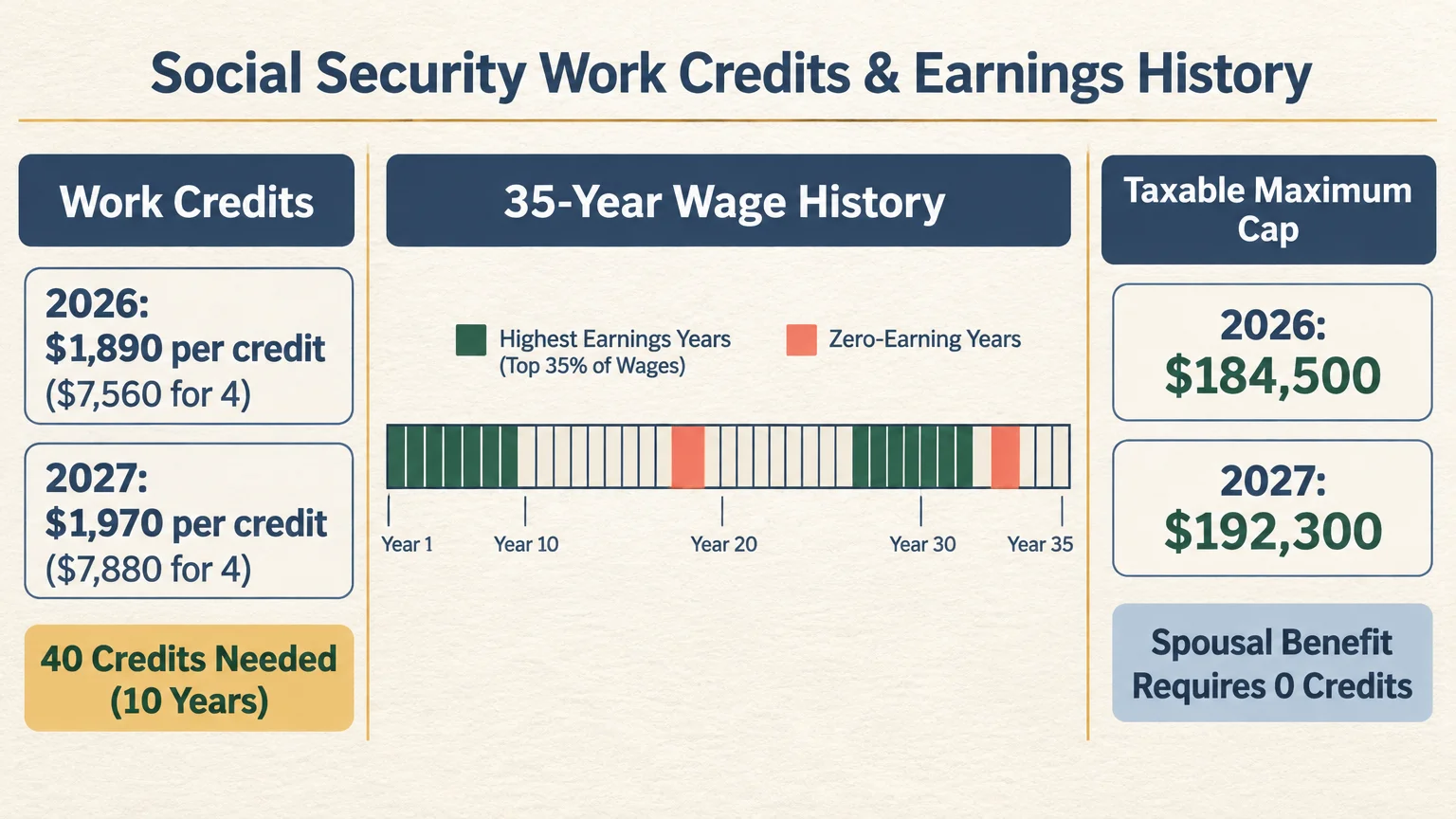
Your first move is checking whether you qualify for a retirement check on your own work record. To earn your own benefit, you need 40 work credits, which equals roughly 10 years of covered employment.
In 2026, you earn one work credit for every $1,890 in covered wages, capping at four credits for $7,560 in annual earnings. In 2027, that threshold rises to $1,970 per credit, or $7,880 for the full four credits.
By contrast, claiming a social security spousal benefit requires zero work credits of your own. Even if you stayed home to manage a household or care for aging parents, your partner’s work record can still provide monthly retirement income.
If you did work, Social Security calculates your own benefit using your highest 35 years of wage-indexed earnings. Any year without covered earnings counts as a zero in that formula, pulling your average down.
Earnings only count toward your benefit up to the annual taxable cap, which sits at $184,500 in 2026 and $192,300 in 2027. Working a few extra part-time years in your fifties or sixties can replace earlier zero-earning years and boost your personal payout.
Log into your personal account on SSA.gov this week to inspect every year on your earnings statement. Correcting a missing year of wages now prevents permanent underpayments when you finally step away from full-time work.
Checklist Step #2: Confirm Your Marriage or Divorce Eligibility Timeline
Before counting on a spousal check, verify that your marital history meets every timing requirement. Current spouses generally must be married for at least one continuous year before claiming spousal benefits.
An exception applies if you are the biological or adoptive parent of your spouse’s child. Otherwise, mark that one-year anniversary on your calendar before submitting an application.
You also must be at least age 62 to collect spousal benefits, and your spouse must already be receiving Social Security retirement or disability payments. The only age exception covers a spouse of any age caring for the worker’s child who is under 16 or disabled and entitled to benefits.
Divorced retirees have strong protections too, provided the marriage lasted at least 10 years. If you are age 62 or older and currently unmarried, you can claim on an ex-spouse’s earnings record.
Best of all, you do not have to wait for a reluctant former partner to retire. Once you have been divorced for at least two years and your ex-spouse is at least age 62, you can file on their record even if they have not claimed yet.
Many retirees hesitate to claim on a former spouse out of fear of causing conflict. Rest assured that benefits paid to a divorced spouse never reduce the ex-spouse’s check or a current spouse’s payout.
Checklist Step #3: Compare Your Full Retirement Benefit Against Half of Your Spouse’s PIA
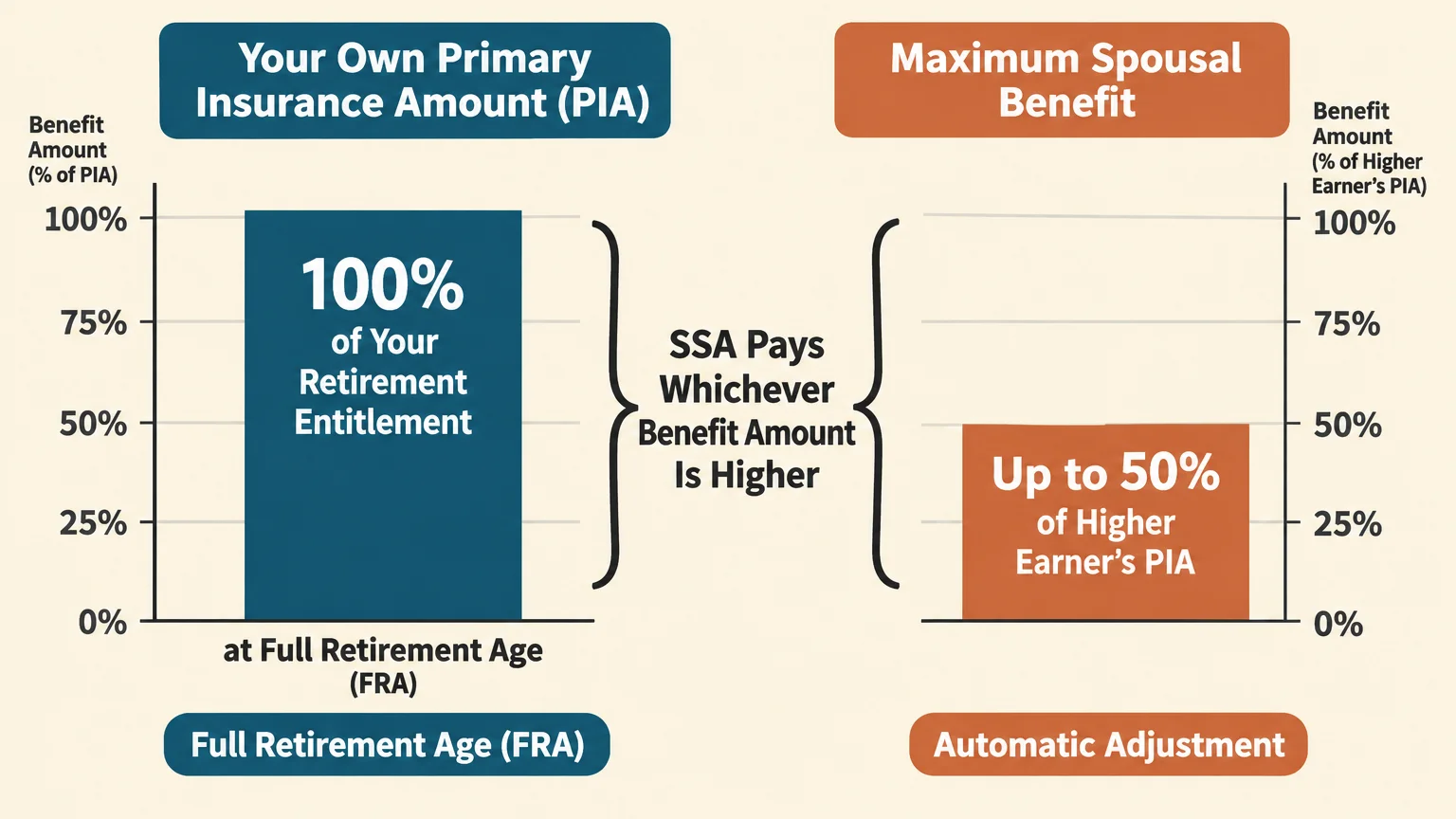
With eligibility confirmed, grab a notepad to compare the two payouts side by side. Start by looking up your Primary Insurance Amount, known as your PIA, which is the monthly check you qualify for at your Full Retirement Age.
A full social security spousal benefit equals up to 50 percent—one-half—of the higher-earning spouse’s PIA. Notice that this benchmark uses your spouse’s Full Retirement Age amount, not what they collect if they claim early or delay.
Real-world averages show why this comparison matters so much for your monthly lifestyle. As of October 2026, retired workers averaged $2,092.17 per month, while spouses of retired workers averaged $988.19.
Following the 3.6 percent Cost-of-Living Adjustment for 2027—up from 2.8 percent in 2026—average monthly checks are estimated to climb from $2,094 to $2,170 for retired workers. Average spousal checks are projected to rise from $989 to $1,024.
For career maximum earners since age 22, the Full Retirement Age check reaches $4,152 in 2026 and $4,188 in 2027. Half of that figure can easily outpace a lower-earning partner’s personal work record.
Line up your own estimated PIA next to 50 percent of your partner’s PIA right now. That single comparison instantly tells you whether your own record wins or whether a spousal supplement belongs in your plan.
Checklist Step #4: Understand How Dual Entitlement Combines Your Checks
Many couples assume a lower earner collects their entire personal benefit plus a full 50 percent spousal check stacked on top. Unfortunately, Social Security rules never pay both full amounts together.
Instead, the system uses a rule called dual entitlement, paying your own retirement benefit first. If half of your spouse’s PIA is higher than your own PIA, Social Security adds an excess spousal supplement to close the gap.
Your combined monthly payout simply equals the higher of the two numbers, not their sum. In December 2025, roughly 3.52 million dually entitled spouses received an average combined check of $1,266.83 per month—$858.55 from their own record plus $408.27 in excess spousal benefits.
Watch out for another common trap called deemed filing, created under the Bipartisan Budget Act of 2015. Anyone born on or after January 2, 1954 cannot claim a spousal benefit alone while letting their own benefit grow.
When you apply for either your own retirement benefit or a spousal or divorced-spouse benefit, you are automatically deemed to file for both at once. You receive whichever payout is higher at that moment.
Understanding dual entitlement keeps your retirement budget realistic before you book flights or downsize your home. Only survivor benefits remain exempt from deemed filing, giving widows and widowers flexible timing options later.
Checklist Step #5: Check Your Full Retirement Age and Calculate Early Claiming Cuts
Timing changes everything in the spousal benefits vs own benefits decision. Your exact Full Retirement Age depends on your birth year—66 and 10 months if you were born in 1959, and 67 for everyone born in 1960 or later.
Keep in mind a quirky calendar rule if you celebrate on New Year’s Day. Anyone born on January 1 uses the previous birth year to determine Full Retirement Age.
Claiming early shrinks your monthly check permanently, and spousal benefits suffer a noticeably steeper cut than your own record. For your own benefit, claiming early trims 5/9 of 1 percent per month for the first 36 months, then 5/12 of 1 percent for each additional month.
If your Full Retirement Age is 67 and you claim your own benefit at 62, you take a permanent 30 percent reduction. That leaves you with 70 percent of your PIA for life.
Spousal benefits get hit even harder before Full Retirement Age, unless you are caring for a qualifying child. Early spousal claims lose 25/36 of 1 percent per month for the first 36 months and 5/12 of 1 percent beyond that.
At age 62 with a Full Retirement Age of 67, that equals a 35 percent cut—shrinking the maximum 50 percent spousal share down to just 32.5 percent of your partner’s PIA. Also remember you must be 62 for the entire month to start, and payments arrive the following month.
Checklist Step #6: Factor In Delayed Retirement Credits—and Know Which Benefit Grows
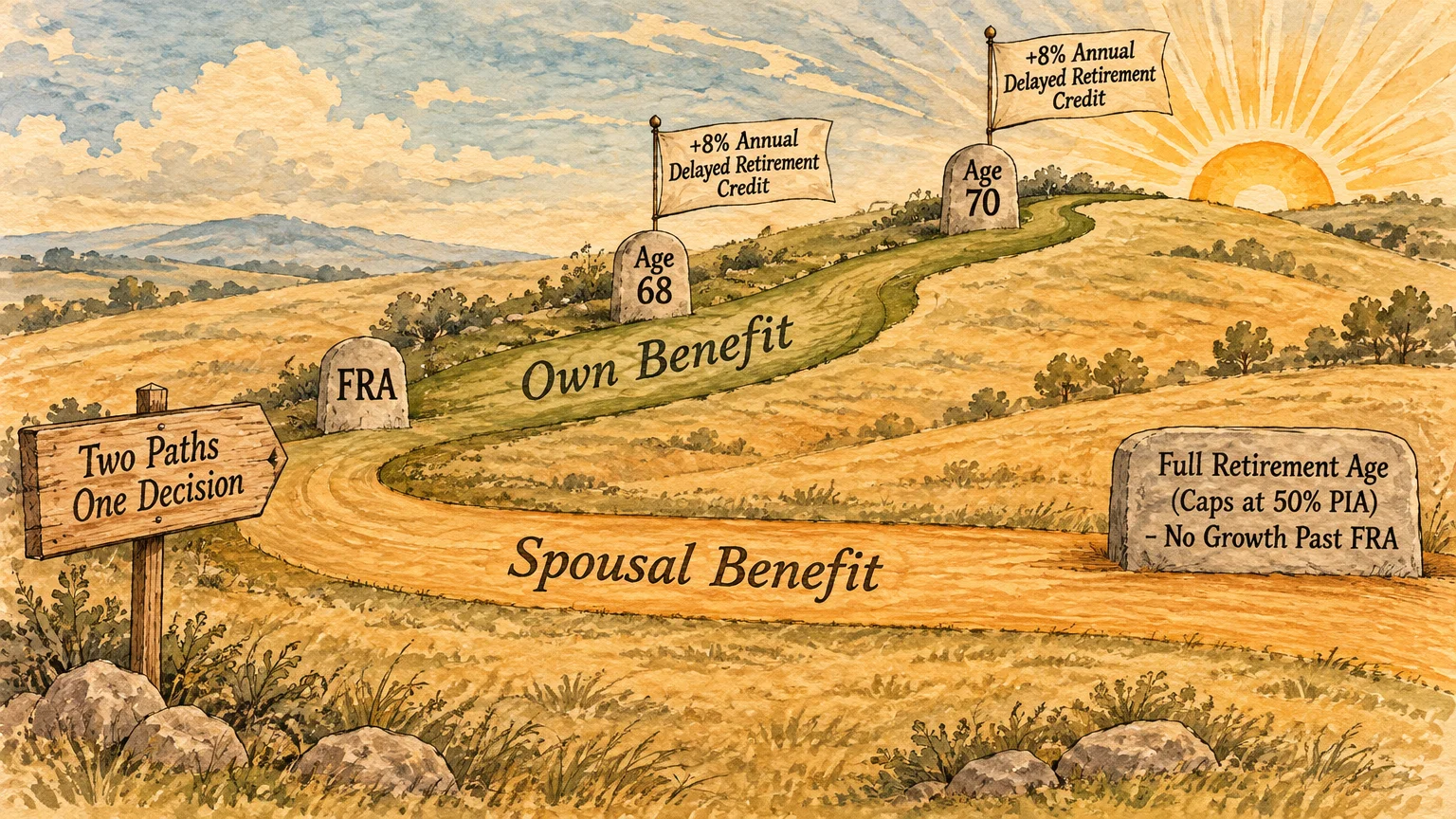
Waiting past Full Retirement Age rewards patience, but only on one side of the equation. For anyone born in 1943 or later, delaying your own retirement benefit past Full Retirement Age earns Delayed Retirement Credits.
Your own check grows by 8 percent per year—or 2/3 of 1 percent per month—all the way up to age 70. For someone with a Full Retirement Age of 67, waiting until 70 lifts your payout to 124 percent of your PIA.
Look at how dramatic that gap becomes for career maximum earners in 2026 and 2027. In 2026, the top payout jumps from $2,969 at age 62 to $5,181 at age 70; in 2027, it climbs from $3,094 at age 62 and one month to $5,358 at age 70.
Here is the catch every couple must double-check before waiting: spousal benefits never earn Delayed Retirement Credits past Full Retirement Age. Your spousal payout hits its ceiling at your own Full Retirement Age and stops growing.
Even more surprising, your spousal check is still calculated from your partner’s Full Retirement Age PIA—not their larger age-70 check. If your spouse waits until 70 to file, your spousal supplement does not expand beyond half of their Full Retirement Age amount.
That makes waiting past Full Retirement Age pointless if you plan to rely solely on a spousal benefit. Instead, check whether your partner’s delay serves a much bigger goal: protecting the surviving spouse.
Checklist Step #7: Protect the Surviving Spouse With Survivor Benefit Rules
A smart claiming strategy for couples looks beyond this year’s vacation budget to protect whichever partner lives longer. Unlike spousal benefits, survivor benefits actually capture the deceased worker’s Delayed Retirement Credits.
When one spouse passes away, the surviving partner steps up to as much as 100 percent of what the deceased spouse was receiving—or entitled to receive—at death, provided the survivor waits until their own Full Retirement Age to claim. Meanwhile, the smaller check drops off.
That rule transforms how many couples maximize social security together. When the higher earner delays until age 70, they lock in a 124 percent lifetime income floor for whichever spouse survives into their eighties or nineties.
Meanwhile, the lower-earning spouse does not have to wait until 70 to enjoy retirement today. Once the higher earner claims—or even earlier on the lower earner’s own record—that smaller check can fund road trips, golf leagues, or grandkid visits right away.
Surviving spouses can claim survivor benefits as early as age 60, or age 50 if disabled, though early claims reduce the payout down to as little as 71.5 percent—up to a 28.5 percent cut.
Better yet, deemed filing does not apply to survivor benefits. A widow or widower can claim a reduced survivor check first and switch to their own larger delayed benefit at 70—or claim their own reduced check at 62 and switch to an unreduced survivor check at Full Retirement Age.

Checklist Step #8: Account for Part-Time Work and the Earnings Test
Retirement today rarely means sitting on the porch doing nothing. Plenty of people in their sixties launch consulting gigs, teach part-time, or work seasonal jobs for social connection and extra spending money.
If you claim your own benefit or a spousal benefit before Full Retirement Age while still earning wages, watch the Retirement Earnings Test. Exceeding annual wage limits triggers temporary benefit withholding.
In 2026, if you stay under Full Retirement Age for the entire year, Social Security withholds $1 in benefits for every $2 you earn above $24,480—or $2,040 per month. In 2027, that annual limit rises to $25,560, or $2,130 per month.
During the calendar year you actually reach Full Retirement Age, the threshold gets much more generous for the months before your birthday milestone. Social Security withholds $1 for every $3 earned above $65,160 ($5,430 per month) in 2026, rising to $67,920 ($5,660 per month) in 2027.
Once you reach the month of your Full Retirement Age, the earnings test disappears completely. You can earn any salary you want without losing a penny of your monthly check.
Best of all, benefits withheld earlier are never gone forever. Starting at Full Retirement Age, Social Security permanently recalculates and increases your monthly payment to credit you for those withheld months.
Checklist Step #9: Revisit Public Pensions After the GPO and WEP Repeal—and Don’t Miss Medicare at 65
If you or your spouse worked as a public school teacher, firefighter, police officer, or government employee, throw out your old assumptions today. For decades, two harsh rules—the Windfall Elimination Provision and the Government Pension Offset—slashed benefits for public-sector retirees.
Under the old Government Pension Offset, spousal and survivor checks were reduced by two-thirds of a non-covered government pension, often wiping out a social security spousal benefit entirely. That changed dramatically with the Social Security Fairness Act, signed into law on January 5, 2025.
This landmark law repealed both the Government Pension Offset and the Windfall Elimination Provision for benefits payable for January 2024 and later. By July 2025, over 3.1 million back-payment and adjusted benefit actions totaling $17 billion had already gone out to affected retirees.
If you skipped applying for spousal benefits years ago because of a public pension, run your numbers again immediately. You may now qualify for full spousal or survivor payouts that dramatically upgrade your retirement lifestyle.
Finally, mark one critical healthcare deadline on your calendar regardless of when you claim Social Security. Even if you delay your retirement check until 67 or 70 to maximize social security, still enroll in Medicare at age 65.
Waiting past 65 without qualifying employer coverage can trigger coverage gaps and permanent late-enrollment penalties. Separating your Medicare sign-up from your Social Security claiming date keeps both your health coverage and your monthly income working smoothly.

Putting It into Practice: Small Steps for Big Changes
Numbers on a screen only matter when they support the life you want to live. Turn this checklist into a relaxed weekend money date with your partner over coffee.
Step one is logging into both of your online Social Security accounts and printing your latest earnings statements. Compare your 35-year records, verify your 40 work credits, and spot any missing wage years right away.
Step two is writing down three numbers on one sheet of paper: your own PIA at Full Retirement Age, 50 percent of your partner’s PIA, and the higher earner’s age-70 check. Seeing those figures side by side removes the guesswork from spousal benefits vs own benefits.
Step three is matching those payouts to your real-life calendar—upcoming weddings, bucket-list trips, part-time work plans, and your age-65 Medicare window. A few calm hours of planning today can add thousands of stress-free dollars across your retirement decades.
For resources on retirement living, travel, and finance, visit AARP. Official information on Social Security is available at SSA.gov.
For travel advisories before planning any retirement trips abroad, consult the U.S. Department of State.
Frequently Asked Questions
Can I claim spousal benefits at 62 and switch to my own higher benefit at 70?
No, unless you were born before January 2, 1954. Under the deemed filing rule, anyone born on or after that date who files for either their own retirement check or a spousal check is automatically deemed to apply for both at once.
Social Security pays your own benefit first and adds a spousal supplement only if half of your partner’s Full Retirement Age PIA is higher. Survivor benefits are the major exception, allowing widows and widowers to claim one benefit first and switch later.
What if my spouse has not retired yet—can I still claim a Social Security spousal benefit?
If you are currently married, your spouse generally must already be receiving Social Security retirement or disability benefits before you can collect a spousal check. You cannot file on their record while they continue delaying.
Divorced spouses follow a different rule that protects their independence. If you were married at least 10 years, have been divorced at least two years, are currently unmarried, and both of you are at least 62, you can claim even if your ex has not filed.
Does working part-time in retirement ruin our claiming strategy for couples?
Part-time work only triggers temporary withholding if you claim before Full Retirement Age and earn above the annual limit—$24,480 in 2026 or $25,560 in 2027. Higher limits of $65,160 in 2026 and $67,920 in 2027 apply during the year you reach Full Retirement Age.
Even if benefits are withheld, that money is not lost permanently. At Full Retirement Age, Social Security permanently boosts your monthly check to credit those withheld months, and no earnings cap applies from that month forward.
How do recent COLA increases and the GPO/WEP repeal change our retirement budget?
Annual inflation adjustments help your Social Security checks keep pace with rising travel, grocery, and healthcare costs—including the 2.8 percent COLA in 2026 and 3.6 percent COLA in 2027. Delaying the higher earner’s benefit makes those percentage increases apply to a larger base amount.
Meanwhile, the 2025 repeal of the Government Pension Offset and Windfall Elimination Provision restored full Social Security eligibility for millions of public-sector retirees. If a non-covered pension previously blocked your spousal check, checking your updated benefit could immediately expand your monthly cash flow.
Disclaimer: This article provides lifestyle suggestions for informational purposes. Financial, legal, or travel decisions should be made in consultation with qualified professionals.