
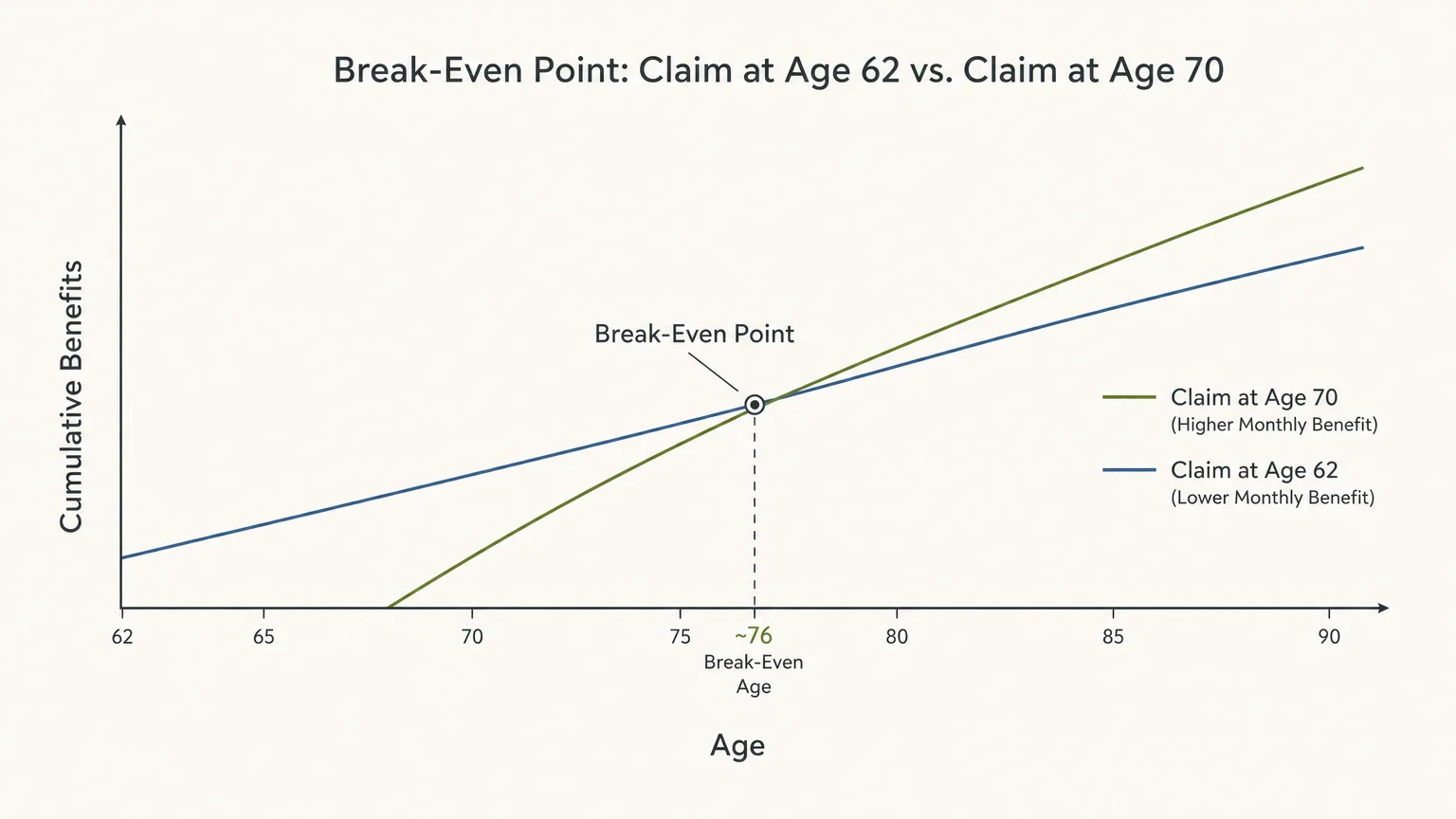
Tip #4: Factor in Your Break-Even Point
Comparing early and delayed claims requires you to deeply examine the mathematical concept of the break-even point. The break-even point highlights the exact age when the total accumulated dollars from a delayed, higher payout finally surpass the total accumulated dollars from an early, lower payout. Knowing this crossover age allows you to frame your final decision around realistic life expectancy rather than just monthly amounts.
When you claim at 62, you receive eight full years of monthly checks before the 70-year-old claimant receives a single dime. Those eight years of early income create a massive, undeniable financial head start. If you receive fourteen hundred dollars a month starting at 62, you collect over one hundred and thirty-four thousand dollars by the time you reach your seventieth birthday.
The person who bravely waited until 70 must live long enough for their larger monthly checks to make up for that lost time and missed income. In most standard scenarios, the break-even age falls somewhere between 78 and 82. If you expect to live vibrantly well into your late eighties or nineties, delaying to 70 provides far more total wealth over your lifetime.
Conversely, if chronic health issues suggest a significantly shorter life expectancy, claiming early ensures you actually get to enjoy the money you paid into the system over your working career. Understanding the break-even math prevents you from making a purely emotional choice, anchoring your strategy in practical, long-term realities.






As a CPA for over 30 years, I have had numerous clients where we had to make this decision. The ONLY situations where the client was better off delaying taking the payment was where they were continuing working.
You read that correctly.
Because of the government’s policy of reducing the Social Security benefit, Under no other scenario did it turn out better to delay taking their Social Security benefits.
Why?
Tax rates rarely went down. Between investments, part time work, and other factors (like inflation and state rate hikes), taxes actually increased during the retirement.
As the article itself says, the breakeven point after investing the excess funds (a total of $84,000+) is between 78-82. The combined number for men and women just hit 79. If all of the benefits begin at the same time as the average person dies, it makes no sense to delay taking your Social Security. You should note that the Chart showing the breakeven point does not accurately reflect those facts.
Do I take social security next year in June when I turn 67. I am retired and not working?
I retired at 64 to take care of my wife that had just had neck fusions front and back. I knew I would make less than at full retirement age, but weighed the difference and decided that 64 was right for me. I was already a retired Marine and had just retired as a County Deputy. I’ve been retired 9 years now and am extremely happy I retired early. What I would have lost by not retiring until 70, would have taken decades to get back, IF I would have lived long enough.
ABSOLUTELY!@@
Good information
My husband retired at 65 due to being ill should we had signed up for ssi disability?
I do turn 67 in June. Thankfully my health has been improving due to some good and forced choices. The plan is to start receiving my money back from social security on my birthday and pay off all my high interest loans through a debt avalanche. That will take a year. Then pay down our house another 4 years plus invest so we have approximately 100,000 in the bank with all debt paid.
I got very sick and was forced to retire at 63 and it was a God sent. With the Military Retiement, the company retirement I was working at the time and the SS and the part my wife received we have managed to keep up fairly well and been able to stay in our home. That Military service the rewards made all possible.
Keep the Faith Brother!!!!!!!!!!
should I retire at 63 or wait until full retirement age, I have money in FRS through my job will it benefit me or not, I am still confused?
I get widows benefits and am about to turn 64 in a few months. Will I continue to get my widow benefits at full retirement age or be forced to take retirement? Which would be best?
As already mentioned, delaying until 70 is advantageous if a person continues to work and/or has a much younger spouse who is in good health. Otherwise, you only know post factum if the decision to postpone was the right one.
I draw the widows pension ss now and work part time I’m 66 I’m waiting till 70 to draw mine which is larger than his is this bad?
I am 70 years old and by December 31st will be 71 years old,its the right time to retired