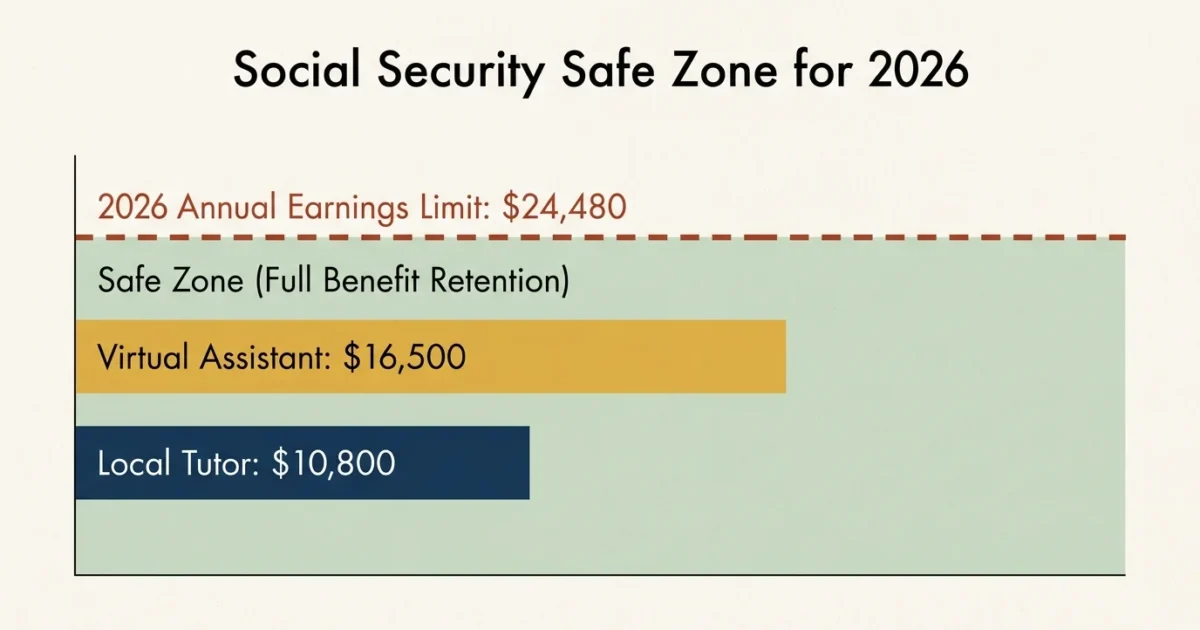
You can easily boost your retirement income and stay active without sacrificing your hard-earned benefits. By strategically selecting part-time work social security rules permit, you maintain full control over your lifestyle while adding predictable cash flow to your monthly budget. For beneficiaries under full retirement age in 2026, the Social Security Administration allows you to earn up to $24,480 annually ($2,040 monthly) before any withholding kicks in. Once you reach full retirement age, you can earn unlimited income without any benefit reductions whatsoever. Exploring rewarding flexible roles empowers you to build financial confidence, enjoy meaningful social connections, and protect your lifetime benefits seamlessly.

Tip #1: Virtual Assistant and Remote Administrative Support
Working as a virtual assistant offers tremendous flexibility while keeping your earnings manageable and predictable. Businesses across the country regularly hire experienced professionals to organize email inboxes, schedule client appointments, update online calendars, and perform light data entry. Because you set your own schedule, you can precisely control your working hours each month. If you are focused on working without losing social security benefits, remote administrative support provides an ideal environment where you dictate your availability from the comfort of your home office.
Consider the math for a typical virtual assistant position. If you charge $22 per hour and work 15 hours per week, your weekly gross earnings total $330. Over a 50-week work year, your annual gross income reaches $16,500. This places you a full $7,980 below the 2026 earnings limit of $24,480 for individuals under full retirement age. You enjoy steady supplemental cash flow without ever triggering a benefit reduction or payroll inquiry from the Social Security Administration.
Why Virtual Assisting Fits a Retirement Schedule
Virtual administrative roles eliminate commuting expenses, daily dress codes, and rigid corporate hours. You can coordinate your assignments around morning walks, grandkid visits, or afternoon hobbies. Clients care most about accuracy and clear communication, making your decades of professional communication experience a tremendous asset.
Calculating Your Safe Working Hours
To ensure you stay safely beneath the annual threshold, establish a monthly income cap with your clients. If your hourly rate increases to $25 per hour, cap your working hours at 18 hours per week. That limits your gross income to $1,800 per month ($21,600 per year), keeping you comfortably within the safe earnings zone while earning an extra $21,600 annually.

Tip #2: Local Tutoring and Educational Mentoring
Sharing your expertise with younger generations offers profound personal fulfillment while providing exceptional pay rates. Local families, learning centers, and online educational platforms actively seek tutors for reading, elementary math, high school history, or specialized skills like piano and second languages. Because educational tutoring commands strong hourly rates, you earn substantial secondary income while working relatively few hours every month.
When searching for jobs that don’t affect social security payouts, high-hourly roles like tutoring give you maximum control over your schedule. For example, if you tutor students for 10 hours per week at $30 per hour during the standard 36-week academic school year, your total annual gross income amounts to $10,800. This leaves a generous margin of $13,680 under the 2026 annual limit of $24,480. You gain meaningful social interaction and mental stimulation while keeping your monthly Social Security check untouched.
Maximizing Hourly Pay to Work Fewer Hours
By specializing in subject areas where you already possess strong knowledge—such as high school essay writing, algebra, or conversational Spanish—you can command $35 to $50 per hour. Earning a higher hourly wage allows you to restrict your workweek to just 6 to 8 hours. Working fewer hours preserves your free time while keeping your aggregate annual compensation well within federal limits.
Choosing Between Independent Tutoring and Agency Work
You can work as an independent tutor or join an established local tutoring service. Agency employment offers regular W-2 wages with automatic tax withholding, simplifying your paperwork. Independent tutoring offers higher hourly gross pay, but requires basic tracking of your business expenses to determine your net self-employment earnings.
Tip #3: Seasonal Tax Preparation and Bookkeeping
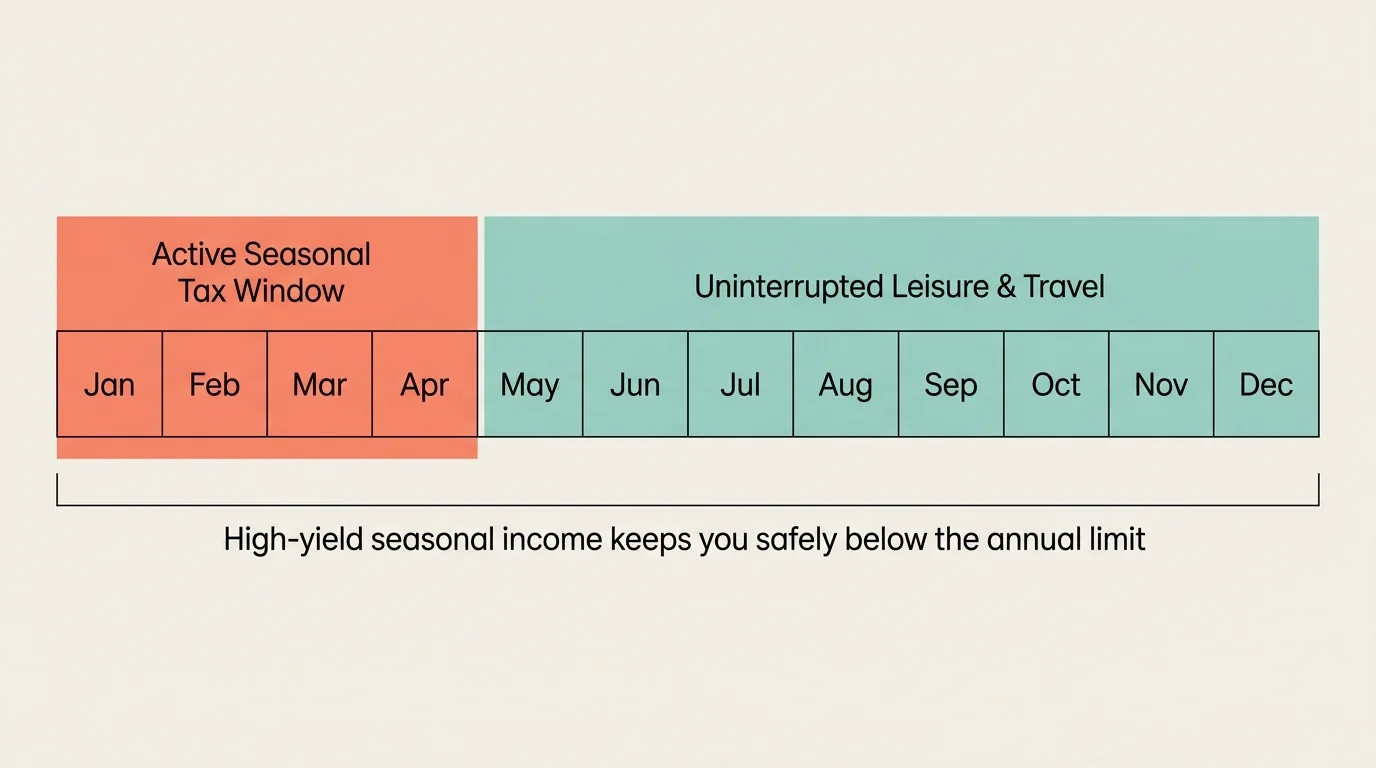
Seasonal tax preparation represents one of the most effective social security earnings limit jobs available to detail-oriented retirees. Accounting firms, national tax franchises, and small local businesses experience intense demand between January and mid-April each year. They actively hire retirees for temporary full-time or part-time roles to prepare basic tax returns or handle financial intake processing.
The Social Security Administration evaluates your earnings on a total calendar-year basis once you enter your second calendar year of benefits. If you work intensively during the four months of tax season and earn $18,000, and then choose not to work for the remaining eight months of the year, your total calendar-year earnings remain $18,000. Because $18,000 is far below the $24,480 benchmark for 2026, your benefits remain completely intact for all twelve months of the year.
Understanding How the SSA Measures Seasonal Income
The earnings test compares your total annual earned income against the annual exempt amount. Whether you earn your income over four months or spread across twelve months, only the total calendar-year dollar amount matters to the Social Security Administration. This annual accounting framework makes seasonal work exceptionally attractive for retirees who prefer long blocks of complete leisure.
Keeping Your Financial Records Organised
Maintain accurate copies of your seasonal pay stubs and final Form W-2. Tracking your cumulative year-to-date earnings ensures you know your exact financial position before accepting optional overtime shifts during peak tax deadlines in early April.

Tip #4: Professional Pet Sitting, Dog Walking, and House Sitting
If you love animals and outdoor movement, starting a pet sitting or house sitting service provides exercise, joy, and flexible earnings. Many neighborhood homeowners prefer hiring mature, dependable adults to care for their pets and oversee their property while traveling. You can accept local assignments that fit your lifestyle, whether that means walking two dogs a day or spending a week house sitting for a traveling neighbor.
For retirees operating as independent contractors (receiving Form 1099-NEC), the Social Security Administration applies a crucial and favorable standard: they evaluate your net earnings from self-employment rather than your total gross revenue. Net earnings equal your gross receipts minus allowable business expenses, such as vehicle mileage, advertising, platform fees, and pet care supplies.
Self-Employment Net Income Rules Explained
Suppose you generate $22,000 in gross client fees during 2026 providing pet sitting services. After deducting $4,200 in legitimate, documented business expenses—such as driving expenses calculated at standard IRS mileage rates—your net self-employment earnings total $17,800. The Social Security Administration evaluates only that $17,800 figure against the $24,480 threshold, leaving you comfortably clear of benefit withholding.
Creating a Flexible Local Client Base
Building a client list in your immediate neighborhood minimizes driving expenses and unpaid transit time. Word-of-mouth recommendations in local community groups allow you to select clients whose schedules align perfectly with your retirement routine.

Tip #5: Museum Docent and Community Tour Guide
Retirement provides the perfect opportunity to share your passion for local history, art, architecture, or nature. Museums, historical landmarks, botanical gardens, and local tourism boards frequently hire part-time tour guides and docents. These positions offer structured schedules, intellectual engagement, and constant opportunities to connect with visitors from around the world.
Engaging in part-time work social security guidelines permit keeps your days vibrant while preserving your monthly benefit check. Most museum and tour guide positions pay between $17 and $22 per hour. Working 12 to 16 hours per week at $19 per hour generates approximately $228 to $304 per week, or about $11,856 to $15,808 annually. Compare this figure to historical earnings limits—such as the $23,400 limit in 2025 or the $24,480 threshold in 2026—and you see how easily these positions fit into a secure financial plan.
Combining Passion with Predictable Hours
Tour guiding allows you to stay physically active by walking through galleries or historic downtown districts. Positions are often concentrated around weekend shifts or morning hours, leaving your afternoons free for personal relaxation or family time.
Keeping Track of Monthly Earnings Thresholds
Although the SSA evaluates annual earnings overall, monitoring your monthly income ensures you maintain a smooth budget throughout the year. Averaging under $2,040 per month guarantees you will stay comfortably under the $24,480 annual threshold for 2026.

Tip #6: Freelance Writing, Proofreading, and Content Editing
If you possess strong grammar skills and enjoy writing, freelancing as a proofreader, copywriter, or content editor offers incredible autonomy. Businesses, digital marketing agencies, and self-published authors consistently hire freelance editors to review reports, articles, and marketing copy. You set your own project fees and select assignments that match your interests.
Freelancers can adjust their workload dynamically throughout the year. If you notice your cumulative yearly income approaching your targeted budget, you can pause taking on new clients until the new tax year begins. Freelance writing also allows you to prepare effectively for future regulatory changes, such as anticipating the social security income limit 2027 figures that federal authorities will announce in October 2026 alongside annual Cost-of-Living Adjustments (COLA).
Setting Client Caps to Protect Your Benefits
When working on a per-project basis, establish an annual earnings cap for your freelancing activities. Capping your freelance income at $1,500 per month ($18,000 per year) leaves an extra $6,480 buffer below the 2026 limit. This protection allows you to take on surprise, high-paying quick projects without stressing over benefit calculations.
Planning Ahead for Future Earnings Limit Adjustments
The Social Security earnings limits increase over time to account for national wage growth. The under-FRA threshold expanded from $23,400 in 2025 to $24,480 in 2026. As federal regulators establish higher thresholds for 2027 and beyond, you can expand your freelance project acceptance rate while keeping your benefits fully protected.

Tip #7: Community Library Assistant and Park Concierge
Municipal libraries, local parks departments, and community recreation centers provide exceptionally reliable part-time employment options. Positions such as front-desk concierge, library assistant, or park ranger host offer calm, welcoming work environments focused on public service. These positions typically feature transparent hourly wages and fixed scheduling.
Working 14 hours per week at a local library for $18 per hour provides $252 in gross weekly earnings. Over 52 weeks, your gross income equals $13,104. This stable W-2 income provides financial consistency without any risk of exceeding federal thresholds.
W-2 Payroll Simplicity for Seniors
Working a standard W-2 position eliminates guesswork. Your employer automatically withhold standard taxes, and your Box 1 gross wages on Form W-2 show your exact earnings for the year. This clean documentation makes annual reporting to the Social Security Administration simple and straightforward.
Understanding the Benefit Recoupment Feature
It is reassuring to understand what actually happens if you accidentally cross the earnings threshold. For workers under full retirement age, the Social Security Administration withholds $1 in benefits for every $2 earned above the $24,480 limit in 2026. If you reach your full retirement age in 2026, the limit increases significantly to $65,160 ($5,430 per month), with the SSA withholding $1 for every $3 earned above the limit prior to the month you reach full retirement age.
Crucially, money withheld under the earnings test is not permanently lost. When you reach your Full Retirement Age (age 67 for individuals born in 1960 or later), the Social Security Administration automatically recalculates your monthly benefit upward. They credit back the withheld amounts over your remaining retirement years, permanently increasing your monthly check amount.

The Takeaway: Living a More Blissful Retirement
Working during retirement is about far more than additional income; it is about staying engaged, sharing your lifelong talents, and building a routine filled with purpose. By selecting part-time positions that naturally align with federal earnings guidelines, you enjoy the best of both worlds. You expand your monthly cash flow, make meaningful contributions to your community, and keep your foundational Social Security benefits completely secure.
Take time to assess your skills, set your preferred schedule, and select a job that brings genuine joy to your life. With clear planning and knowledge of the earnings limits, you can step confidently into a active, fulfilling, and financially worry-free retirement.
For a wide range of resources for older adults, visit AARP and the National Council on Aging (NCOA). Health information is available from the National Institute on Aging.
Frequently Asked Questions
What types of income count toward the Social Security earnings limit?
The earnings test counts only gross wages from W-2 employment and net earnings from self-employment (Schedule C income). The Social Security Administration does not count investment returns, stock dividends, interest, capital gains, private pensions, 401(k) or IRA distributions, annuities, or passive rental income toward the earnings limit.
What happens to the earnings limit during the year I reach Full Retirement Age?
In the calendar year you reach Full Retirement Age (FRA), a much higher limit applies. For 2026, you can earn up to $65,160 ($5,430 per month) during the months prior to reaching FRA without losing benefits. For earnings above $65,160, the SSA withholds $1 for every $3 earned. Starting the exact month you reach your Full Retirement Age, all earnings limits vanish completely, allowing you to earn unlimited income without any benefit withholding.
Do I permanently lose Social Security money if I earn over the annual limit?
No, you do not lose that money permanently. Benefits withheld because of the earnings test are credited back to you once you reach your Full Retirement Age. At that point, the Social Security Administration recalculates your monthly benefit upward to account for the months benefits were withheld, resulting in a higher monthly benefit check for the rest of your life.
How does the Social Security Administration monitor my part-time earnings?
The Social Security Administration tracks earned income primarily through annual W-2 statements and tax returns submitted to the Internal Revenue Service (IRS). If you anticipate earning over the annual limit, you can contact the SSA directly to report your estimated income. This voluntary reporting prevents unexpected overpayments and ensures your monthly checks remain accurate.
Disclaimer: This article is for informational and inspirational purposes only. It is not a substitute for professional medical, financial, or psychological advice. Please consult with a qualified expert for guidance tailored to your individual needs.