

Protecting your hard-earned retirement savings starts with mastering the subtle rules of healthcare costs. Avoiding unexpected healthcare expenses keeps your golden years financially secure and stress-free.
Many retirees are surprised to learn that their income can dramatically raise their monthly healthcare rates. Fortunately, you can easily prevent these extra costs with a little proactive planning.
Learning the common medicare surcharge triggers empowers you to keep more money in your pocket every month. Let us explore the smartest ways to safeguard your retirement budget.

Tip #1: Overlooking the Two-Year Lookback and Income Cliffs
Medicare premiums are not one-size-fits-all for every American retiree. If your income exceeds specific limits, the government adds extra fees to your monthly coverage.
These extra charges are known as the Income-Related Monthly Adjustment Amount, or IRMAA. Understanding how income related medicare premiums work is the first step toward protecting your wealth.
Many seniors do not realize that the Social Security Administration uses a two-year lookback period. Your 2025 premiums depend directly on the tax return you filed for 2023.
Similarly, your 2026 healthcare expenses will reflect your modified adjusted gross income from 2024. This time delay catches many retirees completely off guard when bills arrive.
Your Modified Adjusted Gross Income, or MAGI, determines your tier. The formula adds your standard adjusted gross income together with any tax-exempt municipal interest from Line 2a.
Understanding the 2025 and 2026 Surcharge Thresholds
In 2025, surcharges begin if your MAGI exceeds $106,000 as an individual tax filer. For married couples filing jointly, the starting income threshold is $212,000.
In 2026, those starting limits rise to $109,000 for singles and $218,000 for married couples. Roughly 8% of all Medicare beneficiaries cross these lines and pay higher rates.
Unlike progressive federal income tax brackets, IRMAA functions as a strict financial cliff. Exceeding a threshold by just one single dollar triggers the entire surcharge for the full year.
The Financial Impact on Your Monthly Budget
The standard Medicare Part B monthly premium is $185.00 in 2025. When IRMAA applies, your Part B monthly payment can jump to anywhere between $259.00 and $628.90 per person.
In addition, Medicare Part D prescription drug plans carry their own extra monthly surcharges. These Part D fees range from an extra $13.70 up to $85.80 every month.
When both spouses are enrolled, these surcharges apply individually to each person. A single extra dollar of earnings can suddenly cost a married couple thousands in extra premiums.
You can avoid this trap by reviewing your MAGI projections before the end of every tax year. Keeping your taxable income just under the threshold protects your monthly cash flow.
Tip #2: Executing Massive Lump-Sum Roth Conversions
Converting a traditional individual retirement account into a Roth IRA is a popular wealth-building strategy. Roth accounts provide tax-free growth and tax-free withdrawals for your future retirement needs.
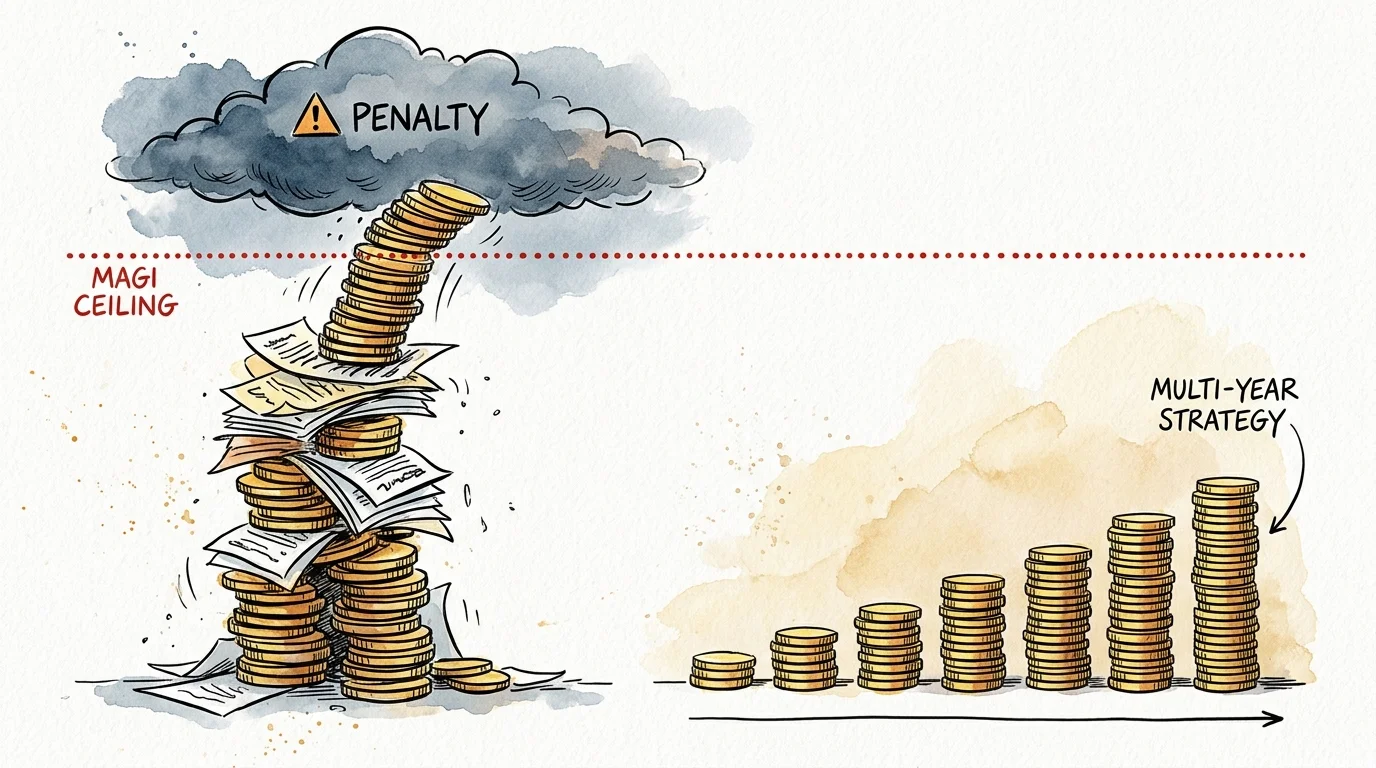
However, moving large sums of money in a single calendar year can create serious financial pitfalls. Large conversions represent one of the most frequent IRMAA mistakes made by new retirees.
Every dollar you convert from a traditional account counts as ordinary taxable income during that tax year. A sizable conversion can push your annual earnings directly into a higher surcharge bracket.
The Delayed Shock of Conversion Taxes
Because of the two-year lookback system, the conversion you execute today impacts your premiums two years later. You might celebrate your smart tax move today, only to face higher healthcare bills later.
For example, a large conversion at age 63 will increase your medicare Part B surcharge at age 65. Both you and your spouse could face elevated monthly rates across all twelve months.
Fortunately, you do not have to abandon Roth conversions altogether to keep your healthcare affordable. The secret lies in pacing your transactions carefully over several consecutive years.
Smart Strategies for Multi-Year Conversions
Consider implementing a multi-year bracket-bumping strategy to manage your taxable income effectively. Calculate the exact dollar gap between your current earnings and the next IRMAA threshold.
Convert only enough funds each year to fill that gap without crossing over into the next tier. This disciplined approach systematically builds tax-free wealth while keeping your Medicare rates low.
Another excellent window for conversions occurs between your retirement date and age 63. Conversions completed before age 63 will not trigger surcharges when you first enroll at age 65.
Always consult your tax advisor before finalizing any major retirement account transfers. Proper modeling ensures your long-term savings strategy stays completely aligned with your healthcare budget.

Tip #3: Failing to Appeal Surcharges After Life-Changing Events
Many seniors retire at age 65 after enjoying several peak earning years in their careers. When they sign up for Medicare, they are shocked by an unexpectedly high premium notification.
This happens because the government uses your high earnings from age 63 to determine your initial costs. Many retirees assume these inflated bills are mandatory and simply pay them without questioning.
Accepting this automatic assessment without checking your options is an expensive mistake. You have the legal right to request a formal recalculation based on your current financial situation.
How Form SSA-44 Protects Your Wallet
You can easily appeal your surcharge by submitting Form SSA-44 to the Social Security Administration. This document is officially called the Medicare Income-Related Monthly Adjustment Amount Life-Changing Event form.
Filing this form allows the government to evaluate your current income rather than your outdated tax return. If approved, your monthly premiums drop immediately to match your true retirement earnings.
Recognized Life-Changing Events
The Social Security Administration recognizes eight specific life events that qualify you for an immediate reassessment. The most common qualifying event is a complete work stoppage due to retirement.
Other approved categories include a significant reduction in work hours, marriage, divorce, or the death of a spouse. You can also qualify if you lose income-producing property due to a natural disaster.
The loss of an employer pension or the receipt of a corporate reorganization settlement also qualifies. Providing documentation of these life changes ensures your appeal receives prompt approval.
Attach proof of your life change, such as a retirement letter or tax estimate, with your submission. Taking an hour to complete this paperwork can put thousands of dollars back in your pocket.

Tip #4: Mismanaging Asset Sales and Required Minimum Distributions
Selling valuable assets during retirement is an exciting milestone that can unlock substantial financial freedom. However, capital gains from these transactions can serve as unexpected medicare surcharge triggers.
When you sell a secondary residence, a family cabin, or appreciated stock, profits count toward capital gains. These gains flow straight into your MAGI calculation and can easily elevate your surcharge bracket.
Another major factor that increases taxable income is the Required Minimum Distribution, known as an RMD. The government requires you to withdraw funds from pre-tax retirement accounts once you reach a certain age.
Navigating SECURE 2.0 and Distribution Rules
Under the SECURE 2.0 Act, Required Minimum Distributions currently begin when you turn age 73. That starting age is scheduled to increase to age 75 beginning in the year 2033.
Forced RMDs combine with pensions and Social Security, easily pushing your MAGI past IRMAA limits. Fortunately, proactive retirees have powerful legal tools to neutralize this unwanted taxable income.
Harnessing Qualified Charitable Distributions
If you are age 70½ or older, you can utilize Qualified Charitable Distributions, or QCDs. This strategy allows you to send money directly from your traditional IRA to a qualified charity.
In 2025, you can donate up to $108,000 directly to eligible charities through a QCD. The donated amount counts toward satisfying your mandatory RMD for the calendar year.
Best of all, funds sent through a QCD are completely excluded from your adjusted gross income. This keeps your MAGI below surcharge thresholds while supporting the causes you care about most.
If you plan to sell real estate, consider spreading the sale across multiple years using installment contracts. Structuring your gains over several tax cycles keeps your income predictable and avoids sharp surcharge spikes.
Tip #5: Missing Enrollment Windows Without Creditable Coverage
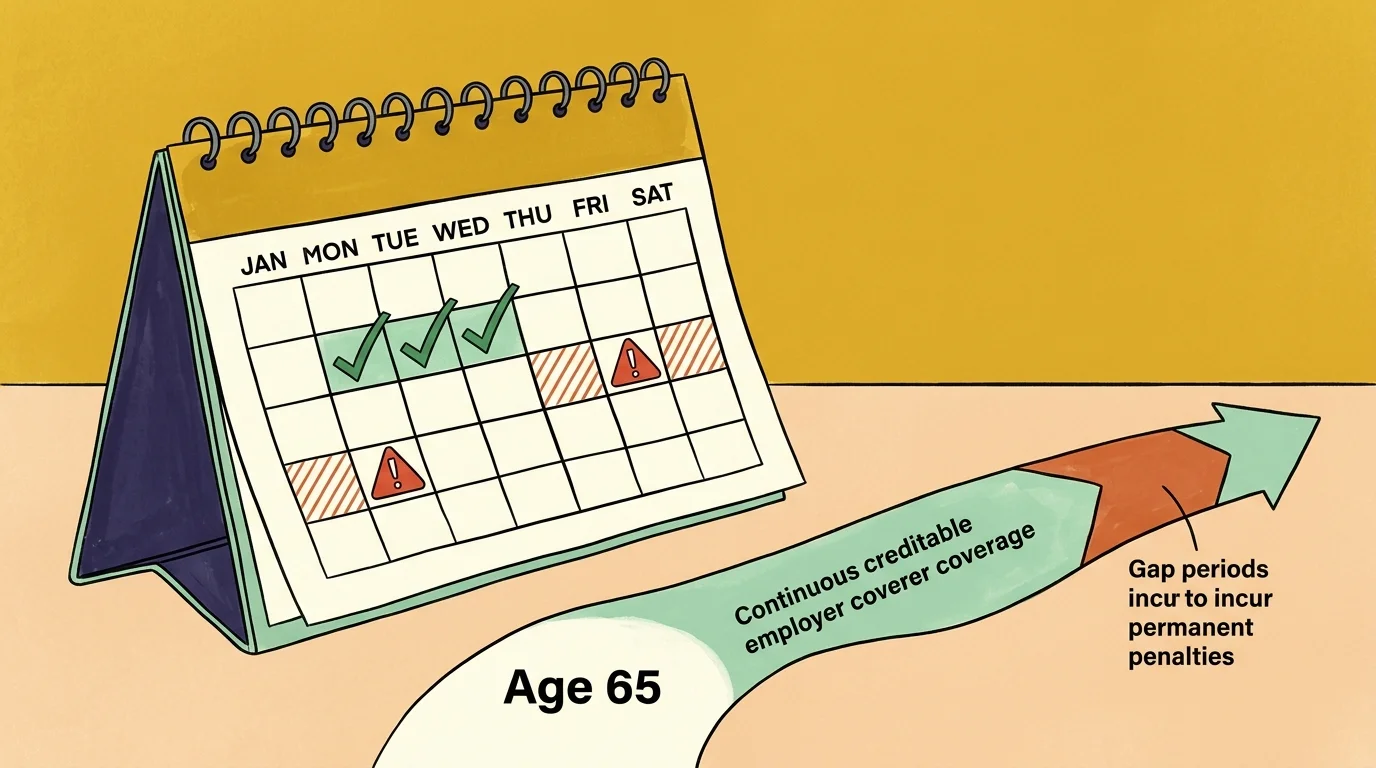
Distinguishing between annual income surcharges and permanent late penalties is essential for every retiree. While IRMAA surcharges adjust every year, late enrollment penalties remain on your record for life.
If you delay signing up for Medicare Part B without having qualifying coverage, penalties accrue rapidly. Avoiding medicare penalties requires careful attention to your initial enrollment periods and active insurance status.
The Lifelong Cost of Part B Penalties
The Part B late enrollment penalty adds an extra 10% surcharge to your base premium. You pay this 10% penalty for every full 12-month period you were eligible but lacked creditable coverage.
Because the penalty is calculated on current base rates, your extra fee increases whenever standard premiums rise. This permanent penalty can quietly cost you thousands of dollars over the course of retirement.
Understanding Part D Prescription Drug Penalties
Medicare Part D carries its own permanent late penalty for missing prescription drug coverage windows. The penalty equals 1% of the national base beneficiary premium for every uncovered month.
This monthly penalty is added permanently to your Part D premium, regardless of which private plan you choose. Even a short lapse in coverage can follow you for decades.
Avoiding the Common COBRA Trap
Many older adults assume that COBRA or retiree health insurance counts as creditable active employer coverage. However, Medicare regulations strictly state that COBRA and retiree plans do not qualify as active coverage.
Relying on COBRA beyond your eight-month Special Enrollment Period triggers permanent lifetime penalties. Always confirm that your coverage is based on current, active employment at a company with 20 or more workers.
Mark your initial seven-month enrollment window on your calendar as you approach your 65th birthday. Enrolling on time guarantees smooth healthcare access and protects your retirement budget from lifelong penalties.

The Takeaway: Living a More Blissful Retirement
Your golden years should be a rewarding chapter filled with relaxation, adventure, and cherished family moments. Mastering the rules surrounding healthcare surcharges empowers you to protect the retirement wealth you worked hard to build.
By staying aware of the two-year lookback period, you can make informed decisions about your taxable income. Structuring asset sales and Roth conversions thoughtfully keeps your premiums low and your budget predictable.
Remember that life changes give you the right to appeal unexpected rate hikes using official forms. You never have to settle for unfair healthcare costs when your financial circumstances change.
Taking these proactive steps delivers immediate financial clarity and long-lasting peace of mind. With smart planning on your side, you can embrace your retirement with complete financial confidence.
Frequently Asked Questions
How long do Medicare IRMAA surcharges last once they are applied?
IRMAA surcharges last for exactly one calendar year at a time. The Social Security Administration recalculates your status every autumn using your latest available tax return.
If your income drops in a subsequent tax year, your monthly premiums will automatically adjust downward. You are never permanently locked into an elevated surcharge tier.
Does tax-exempt municipal bond interest count toward Medicare surcharges?
Yes, tax-exempt municipal interest is included when calculating your Modified Adjusted Gross Income. The government adds line 2a from your IRS Form 1040 to your adjusted gross income.
Even though municipal bonds avoid federal income taxes, they still count toward your Medicare surcharge thresholds. Be sure to factor this interest into your annual retirement income projections.
Can married couples avoid surcharges by filing their taxes separately?
Filing separately rarely helps married couples avoid income-related healthcare surcharges. The IRS imposes significantly lower threshold limits on married individuals who file separately and live together.
In most cases, filing separately causes couples to hit the highest surcharge tiers much faster. Consult a tax professional before altering your tax filing status.
How quickly does Social Security process Form SSA-44 appeals?
The Social Security Administration typically processes Form SSA-44 appeals within four to eight weeks. Processing times can vary depending on the workload of your local office.
Once your appeal is approved, Medicare adjusts your premium rates retroactively. Any excess premiums you paid during the review period will be refunded directly to you.
For a wide range of resources for older adults, visit AARP and the National Council on Aging (NCOA). Health information is available from the National Institute on Aging.
Disclaimer: This article is for informational and inspirational purposes only. It is not a substitute for professional medical, financial, or psychological advice. Please consult with a qualified expert for guidance tailored to your individual needs.