
Turning 65 unlocks exciting opportunities to travel, explore new hobbies, and deepen ties with family. It also grants access to lucrative tax breaks for retirees that keep your hard-earned money where it belongs.
Recent legislative updates provide powerful tax deductions over 65 that substantially decrease your annual tax bill. You can redirect those savings into memorable cross-country adventures, creative classes, or community projects.
Claiming these overlooked tax deductions ensures your retirement remains financially secure and deeply rewarding. Here are eight essential strategies to optimize your returns and elevate your lifestyle this season.
Lifestyle Idea #1: The Brand-New $6,000 Senior Bonus Deduction
A major legislative update offers older adults a substantial financial lift. The landmark One Big Beautiful Bill Act introduced an enhanced senior tax deduction 6000 directly targeting adults aged 65 and older.
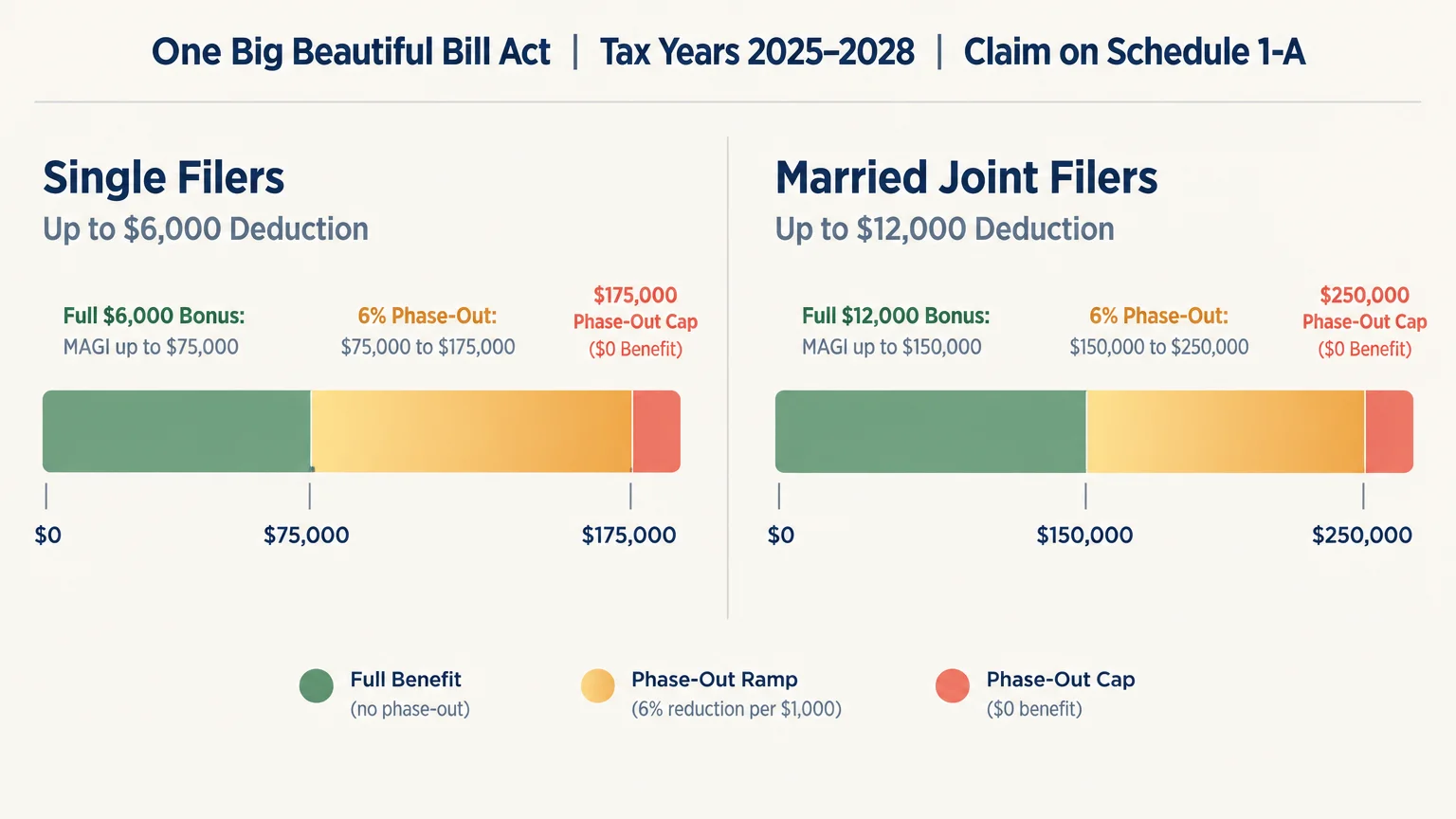
This provision provides a temporary deduction of up to $6,000 per eligible individual. Married couples filing jointly can claim up to $12,000 if both partners have reached age 65.
You can claim this deduction for tax years 2025 through 2028 using Schedule 1-A. The relief applies whether you itemize your deductions or take the standard deduction.
Because this deduction stacks on top of existing allowances, it generates immense savings. You can easily direct this financial surplus toward your personal retirement dreams.
Understanding Income Phase-Out Limits
The full benefit applies to single filers with a modified adjusted gross income up to $75,000. For married couples filing jointly, the full threshold extends to $150,000.
The deduction phases out gradually at a rate of 6% above those income thresholds. It completely phases out at $175,000 for single taxpayers and $250,000 for married couples.
Keep in mind that married taxpayers filing separately cannot claim this deduction. Coordinate your filing status carefully with your spouse to capture the maximum allowable benefit.
Timing your retirement withdrawals strategically protects your eligibility for this write-off. Consider drawing from cash savings or Roth accounts to keep your income below phase-out limits.
Funding Your Retirement Adventures
Saving thousands of dollars on your annual tax return frees up substantial disposable income. You might invest those recovered funds into private pottery lessons, foreign language courses, or weekend cabin getaways.
Extra liquidity also lets you spoil your grandchildren without dipping into core investments. Treat them to zoo visits, theater outings, or summer camp adventures with your tax savings.
You can also use these extra funds to purchase high-quality gardening supplies or join a local golf league. Thoughtful financial planning converts tax code advantages into joyful everyday experiences.
Review your annual income early in the year to ensure you land safely within the qualifying range. Staying proactive helps you keep more money in your pocket.
Lifestyle Idea #2: The Enhanced Age-65 Standard Deduction Boost
Reaching your 65th birthday brings an automatic bump to your standard deduction. The IRS grants this additional allowance to help older taxpayers preserve their retirement assets.
For the 2026 tax year, the base standard deduction is $16,100 for single filers and $32,200 for married couples. Seniors receive an extra bonus on top of that base.
Single and head-of-household filers aged 65 or older receive an additional $2,050. Married filers receive an extra $1,650 per qualifying spouse.
Looking ahead to the 2027 tax year, the base standard deduction rises to $16,600 for singles and $33,200 for joint filers. The senior addition increases to $2,100 and $1,700 respectively.
Streamlining Your Lifestyle and Paperwork
Taking advantage of the standard deduction eliminates the hassle of tracking every minor receipt. You bypass hours of tedious accounting and reduce your filing stress significantly.
Fewer hours spent sorting paper invoices means more time for gardening, walking club meetups, or pickleball games. Simplicity is a true luxury in modern retirement living.
The higher deduction shields a larger slice of your pension and Social Security benefits from taxation. This creates a predictable financial cushion for your monthly household budget.
Stacking Deductions for Greater Value
This standard deduction enhancement stacks cleanly with the new $6,000 senior deduction. A single filer over 65 can shield $24,150 from federal taxation in 2026 without itemizing.
A married couple over 65 can protect $47,500 of joint income completely tax-free. That massive threshold leaves more funds available for domestic travel, culinary excursions, and wellness memberships.
Check the appropriate age box on Form 1040 to claim your extra allowance effortlessly. Never miss this simple box, as it immediately enhances your bottom line.
Lifestyle Idea #3: Qualified Charitable Distributions from Your IRA
Philanthropy enriches retirement by connecting you to causes you cherish. Qualified Charitable Distributions, or QCDs, allow you to give back while generating remarkable tax advantages.
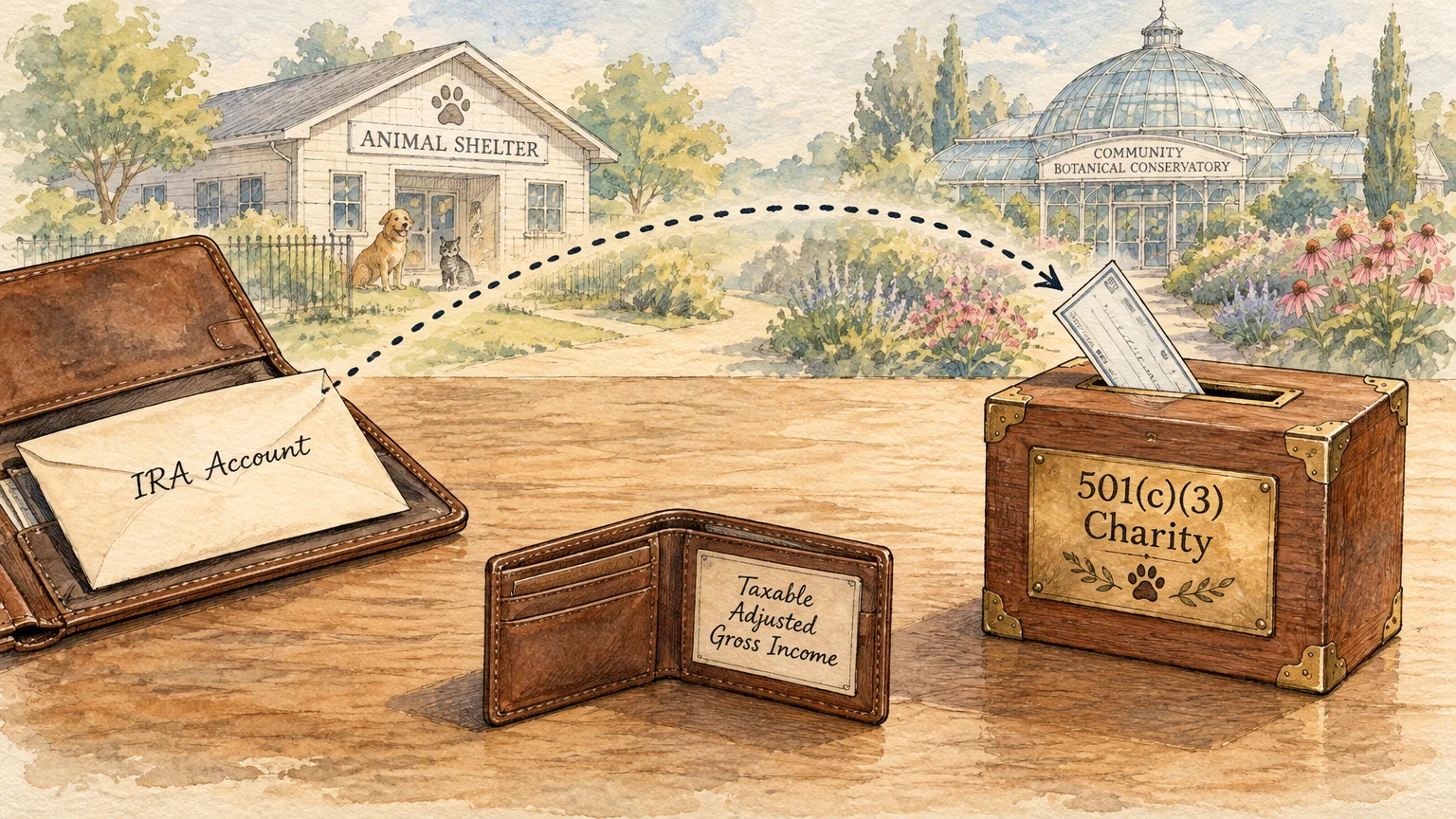
If you are age 70½ or older, you can transfer money directly from a traditional IRA to a qualified charity. In 2026, the annual limit rises to $111,000 per individual.
The IRS excludes this transferred money entirely from your taxable income. Because the distribution avoids your tax return, your adjusted gross income stays pleasantly low.
Satisfying Required Minimum Distributions
QCDs count directly toward your Required Minimum Distributions once you reach mandatory withdrawal age. You satisfy IRS mandates without artificially inflating your reported earnings.
Preventing an income spike protects you from higher Medicare Part B and Part D premiums. It also keeps more of your Social Security benefits exempt from taxation.
Make sure the IRA custodian sends funds directly to the non-profit organization. Withdrawing the money to your personal checking account first invalidates the tax exemption entirely.
Deepening Community Connections
Use QCD gifts to foster vibrant social connections in your home community. Support local theater troupes, neighborhood youth centers, or animal rescue organizations.
Many seniors volunteer alongside organizations that receive their charitable gifts. This hands-on involvement builds meaningful friendships and gives your retirement days purposeful rhythm.
Talk to your favorite non-profit leaders about their current funding goals. Directing your gifts toward specific educational projects creates a tangible legacy right before your eyes.
Giving generously stimulates personal happiness and creates lasting memories. Aligning your charitable intentions with tax efficiency maximizes your community impact.
Lifestyle Idea #4: Above-the-Line Deductions for Everyday Giving
Generosity should always be simple and accessible. Starting in the 2026 tax year, non-itemizers gain an exciting above-the-line deduction for everyday charitable gifts.
Taxpayers who take the standard deduction can deduct up to $1,000 for single returns or $2,000 for joint returns. You claim this benefit directly without needing Schedule A.
Only direct cash, check, or credit card donations to qualified public charities count toward this allowance. Contributions to donor-advised funds do not qualify for this specific tax break.
Understanding the New Itemized Floor
Charitable giving rules also shift for seniors who itemize their deductions in 2026. The tax code introduces a new floor equal to 0.5% of your adjusted gross income.
You can only deduct charitable gifts that exceed that half-percent threshold on Schedule A. For an income of $80,000, your first $400 in donations will not generate a deduction.
This structural change makes the above-the-line deduction far more attractive for standard deduction filers. You get rewarded for generosity without clearing complicated mathematical hurdles.
Sharing Goodness with Loved Ones
Involve your grandchildren in your charitable decisions to impart valuable financial lessons. Let them research local animal shelters or libraries that could benefit from a $500 gift.
Delivering a donation check together teaches younger generations about empathy and community stewardship. It turns a routine tax deduction into an unforgettable family bonding moment.
You can also partner with civic clubs to sponsor park benches or community garden plots. Small acts of civic generosity enrich your neighborhood and expand your circle of friends.
Retain bank statements and written acknowledgments from the charities for your records. Good recordkeeping guarantees a smooth and effortless filing process come springtime.
Lifestyle Idea #5: Unreimbursed Medical Expenses and Medicare Premiums
Maintaining robust health is essential for an active and adventurous retirement. Fortunately, the IRS permits substantial deductions for unreimbursed healthcare costs on Schedule A.
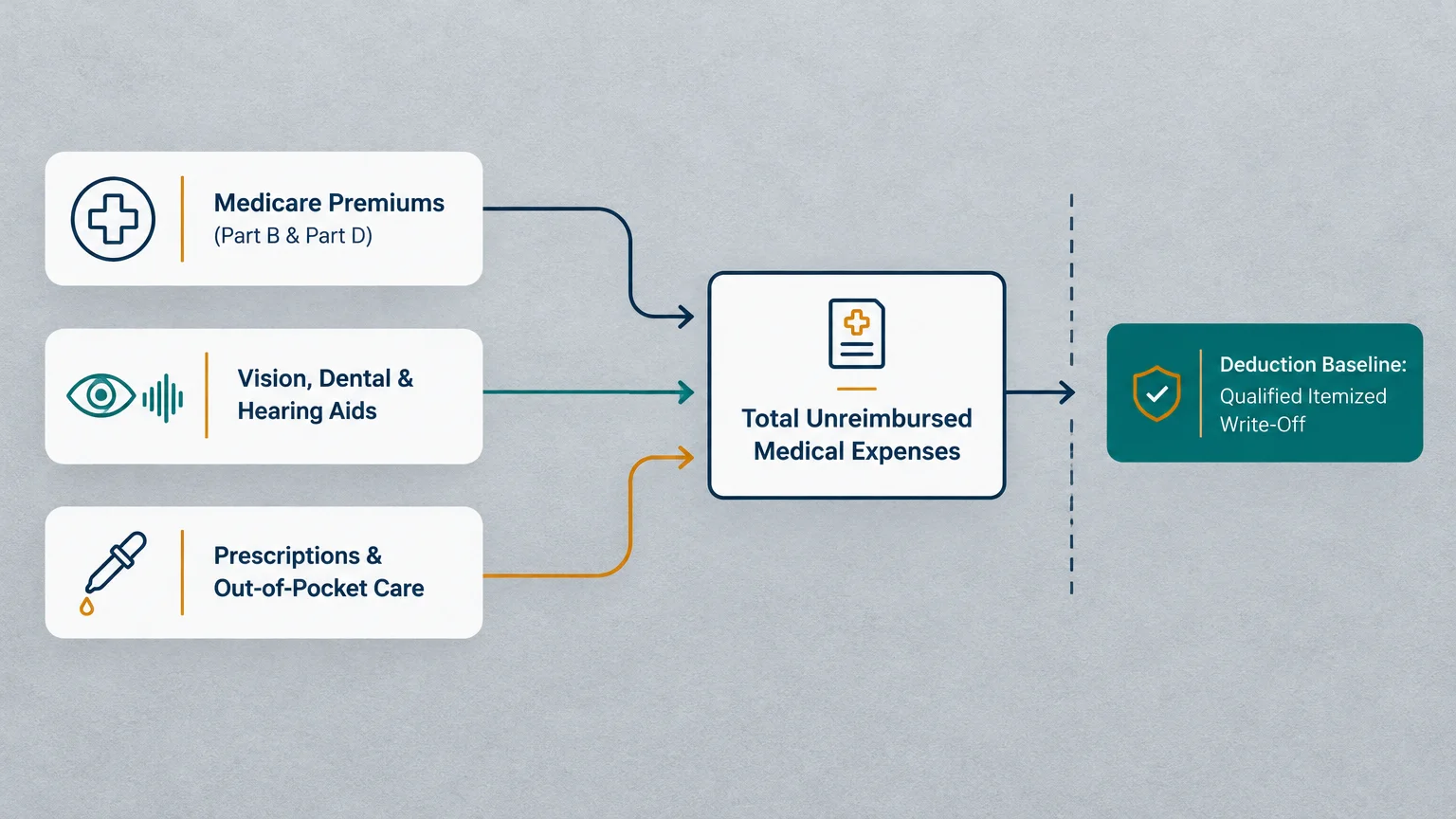
You can deduct qualifying out-of-pocket medical and dental expenses that exceed 7.5% of your adjusted gross income. This relief offsets substantial costs from unexpected medical care.
Many retirees overlook the fact that healthcare premiums count toward this 7.5% threshold. Your monthly Medicare Part B and Part D premiums qualify for inclusion.
Supplemental Medigap policies and Medicare Advantage plan premiums are also deductible. Combining these recurring premium costs helps you cross the required percentage floor quickly.
Everyday Health Upgrades That Qualify
Eligible expenses extend far beyond doctor visits and hospital stays. Routine out-of-pocket costs for prescription eyeglasses, hearing aids, and dental bridges qualify under the rule.
If you install home modifications for safety—such as walk-in tubs or wheelchair ramps—those costs count too. Improving your home’s accessibility protects your mobility and lowers your tax bill.
Even mileage driven for medical appointments and specialist care counts toward your total. Track your medical miles throughout the year to capture every allowable dollar.
Prioritizing Vitality and Movement
Investing in your physical well-being keeps you energized for hiking trails and playing with grandkids. Do not postpone essential dental or optical work when deductions offset the expense.
Schedule major procedures in a single calendar year if possible. Bunching expenses helps you surpass the 7.5% threshold and maximize your itemized medical savings.
Consult your healthcare provider about necessary wellness equipment that might qualify. Maintaining vibrant health provides the ultimate return on your retirement investments.
Lifestyle Idea #6: Deductible Long-Term Care Insurance Premiums
Protecting your future independence brings deep mental comfort during retirement. Long-term care insurance provides that safety net while delivering valuable age-based tax write-offs.
The IRS treats qualified long-term care insurance premiums as deductible medical expenses. These premiums fall under the standard 7.5% adjusted gross income medical deduction floor.
Self-employed seniors gain an even greater advantage with these policies. If you consult or run a small business, you can deduct 100% of eligible premiums above the line.
Age-Based Deduction Limits for 2026
Deduction limits increase substantially as you celebrate milestones in your golden years. For the 2026 tax year, individuals aged 51 to 60 can deduct up to $1,800.
Taxpayers aged 61 to 70 can deduct up to $4,810 per person. Adults aged 71 and older can deduct an impressive $6,200 per policyholder.
A married couple in their seventies could deduct up to $12,400 in combined annual premiums. That substantial deduction creates major tax relief while shielding retirement assets.
Preserving Independence and Family Harmony
Securing a comprehensive long-term care policy protects your family from unexpected caregiving burdens. It ensures your adult children focus on companionship rather than coordinating intensive medical care.
Knowing you have dedicated care resources frees you to embrace life with greater enthusiasm. You can book overseas vacations and explore national parks with total confidence.
Review your policy annually with your insurance representative to verify tax-qualified status. Keeping policies up to date protects your coverage and your annual tax benefits.
Peace of mind allows you to focus on joyful social activities and lifelong friendships. Protecting your estate preserves your legacy for generations to come.

Lifestyle Idea #7: Catch-Up and Super Catch-Up Retirement Contributions
Many modern seniors maintain vibrant encore careers, consulting gigs, or creative ventures. Staying professionally active not only sharpens your mind; it unlocks extraordinary retirement contribution deductions.
For 2026, the base contribution limit for 401(k), 403(b), and 457 plans is $24,500. Workers aged 50 and older can contribute an additional $8,000 standard catch-up.
Under SECURE 2.0 rules, workers aged 60 to 63 gain a “super catch-up” allowance. In 2026, you can contribute an extra $11,250 instead of the standard catch-up.
For 2027, the base limit climbs to $25,500, the catch-up reaches $8,500, and the super catch-up hits $11,750. These generous thresholds let working seniors supercharge their savings.
The New Mandatory Roth Catch-Up Rule
High-earning seniors must prepare for an important procedural change effective January 1, 2026. If your prior-year FICA wages exceeded $150,000, your catch-up contributions must be Roth.
Roth contributions do not provide an immediate upfront deduction on your current tax return. However, your money grows completely tax-free and permits tax-free withdrawals throughout retirement.
If your earnings stay below that $150,000 threshold, you can continue traditional pre-tax contributions. That direct deduction lowers your current taxable income significantly.
Traditional IRA Catch-Up Opportunities
Do not forget traditional IRAs if you lack access to an employer plan. For 2026, the base IRA limit is $7,500 plus an inflation-indexed $1,100 catch-up for age 50+.
That total of $8,600 provides another straightforward write-off against your active consulting or freelance income. You reduce your tax burden while securing your future financial freedom.
Balancing meaningful part-time work with flexible leisure time gives retirement an invigorating rhythm. Channeling that income into catch-up accounts accelerates your overall financial peace.
Lifestyle Idea #8: Pre-Medicare Health Savings Account Contributions
Working past age 65 has become a popular and fulfilling choice for many active adults. If you delay Medicare while covered by a qualifying high-deductible health plan, HSAs offer unrivaled benefits.
Health Savings Accounts provide a triple tax advantage unmatched by any other savings vehicle. Contributions are 100% tax-deductible, balances grow tax-deferred, and qualified medical withdrawals are tax-free.
For the 2026 tax year, the contribution limit is $4,400 for self-only coverage and $8,750 for families. Adults aged 55 and older can contribute an additional $1,000 catch-up.
Avoiding the Medicare Enrollment Trap
You must heed a crucial legal rule regarding Medicare and HSA eligibility. Enrolling in any part of Medicare—including premium-free Part A—immediately ends your HSA contribution rights.
If you delay Medicare past 65, Part A coverage retroactively applies up to six months when you eventually apply. You must stop HSA contributions six months prior to avoid stiff tax penalties.
Consult your human resources coordinator before making mid-year benefit choices. Proper timing ensures you capture deductions without facing excess contribution surcharges.
Funding Restorative Wellness and Self-Care
HSA balances roll over indefinitely from year to year without any “use-it-or-lose-it” penalties. You can build a substantial healthcare fund dedicated entirely to retirement wellness.
Use these accumulated funds later in life for therapeutic massages, dental restoration, or specialized fitness equipment. An HSA turns tax savings into a personal wellness fund for your best years.
Having dedicated medical savings gives you the freedom to travel abroad without anxiety. You can explore new destinations knowing your healthcare needs are fully funded.

Putting It into Practice: Small Steps for Big Changes
Transforming complex tax strategies into real-world lifestyle enhancements requires only a few deliberate steps. Start by gathering your financial records and reviewing your filing goals this weekend.
Check whether your projected income qualifies for the $6,000 bonus deduction on Schedule 1-A. Keep modified adjusted gross income targets in mind as you draw down retirement assets.
Take advantage of free community assistance programs designed specifically for older taxpayers. The IRS Tax Counseling for the Elderly program serves filers aged 60 and older across the country.
Similarly, the AARP Foundation Tax-Aide program provides exceptional free tax assistance at local community centers. Their trained volunteers specialize in senior tax deductions and retirement income questions.
Automate your charitable giving and organize out-of-pocket medical receipts into physical or digital folders. Staying organized throughout the year eliminates last-minute tax season anxiety.
Set aside the money you save through these deductions for intentional lifestyle upgrades. Whether funding an overseas cruise or taking art lessons, your tax savings should enhance your life.
Share these boomer tax tips with friends during your next coffee date or book club meeting. Discussing healthy finances openly helps your entire social circle thrive together.
Frequently Asked Questions
Can I claim both the extra standard deduction and the senior tax deduction 6000?
Yes, you can claim both deductions simultaneously on your tax return. The $6,000 senior bonus deduction stacks on top of the standard deduction using Schedule 1-A.
This combination allows a single senior to shield over $24,000 in income from federal taxes in 2026. Married couples over 65 can shield more than $47,000 together.
How can I manage tax planning if I feel anxious about complicated IRS paperwork?
You do not have to navigate the tax filing process alone. Programs like AARP Foundation Tax-Aide and Tax Counseling for the Elderly provide complimentary, compassionate assistance.
You can also work with an accredited Certified Public Accountant who understands senior finances. Professional guidance gives you total confidence while ensuring you capture every legitimate write-off.
What should I do if unexpected retirement withdrawals push me past deduction limits?
Strategic timing of distributions can prevent you from crossing critical income phase-out thresholds. Consider pulling extra cash from a Roth IRA or taxable savings account instead of traditional accounts.
Roth distributions do not count toward your modified adjusted gross income. This smart maneuvering keeps you eligible for phase-out-sensitive tax deductions over 65.
Can volunteer work and community service generate tax breaks for retirees?
While you cannot deduct the monetary value of your volunteer time, associated out-of-pocket expenses are deductible. You can deduct unreimbursed supply costs and standard mileage driven for charitable service.
Keep a detailed mileage log and save your purchase receipts when volunteering for registered charities. These small deductions add up quickly while you make a positive difference in your town.
For resources on retirement living, travel, and finance, visit AARP. Official information on Social Security is available at SSA.gov. For travel advisories, consult the U.S. Department of State.
Disclaimer: This article provides lifestyle suggestions for informational purposes. Financial, legal, or travel decisions should be made in consultation with qualified professionals.