

Packing up for a warmer climate or a home near your grandchildren brings exciting possibilities. When you are moving states, Social Security retirement and disability checks stay intact, so your core monthly income travels right alongside you.
Still, relocating across state lines can reshape your tax bill, Supplemental Security Income supplements, and healthcare coverage. Knowing what shifts and what stays steady lets you step into your next chapter with total confidence.
Lifestyle Idea #1: Count on Your Core Federal Benefit Traveling With You
Your Social Security retirement, survivors, and Social Security Disability Insurance benefits come from a federal program based on your lifetime earnings record. Crossing a state border does not reduce your monthly payment, trigger a new review, or force you to reapply.
According to AARP and the Social Security Administration, your federal check follows you smoothly from coast to coast. That stability gives you the freedom to choose a hometown based on sunshine, walkability, or family ties rather than fear of losing your baseline income.
How Cost-of-Living Adjustments Follow You Everywhere
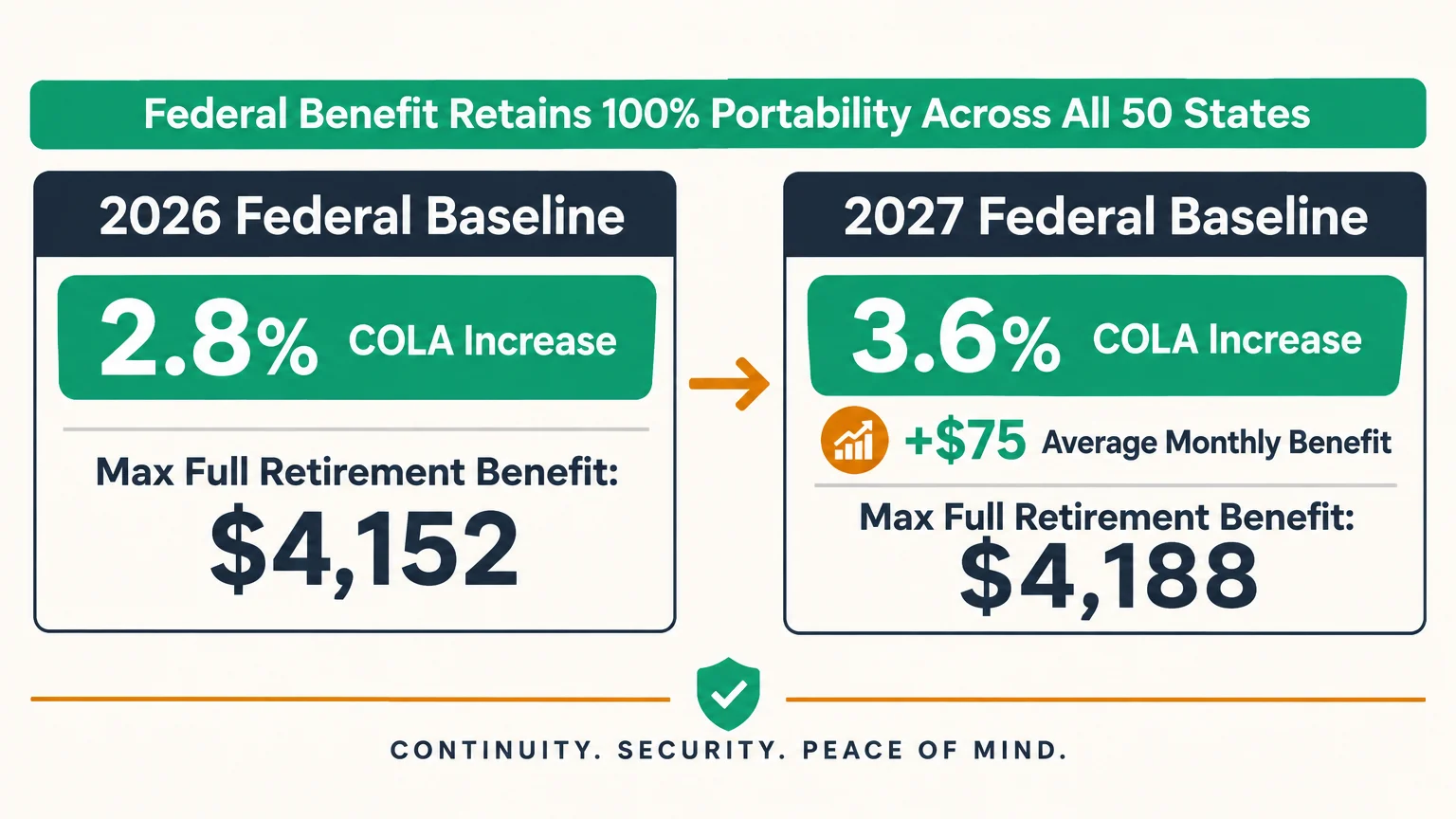
Annual inflation boosts apply equally no matter which zip code you call home. Social Security and Supplemental Security Income recipients received a 2.8% cost-of-living adjustment in 2026 to help keep pace with everyday expenses.
On October 14, 2026, the Social Security Administration announced a 3.6% adjustment for 2027, starting with January 2027 Social Security payments. That increase adds about $75 per month to the average retirement benefit across every state.
If you earned top wages over your career, your federal cap also remains untouched when you relocate. The maximum monthly benefit for a worker retiring at full retirement age is $4,152 in 2026 and rises to $4,188 in 2027.
Turning Predictable Income Into New Adventures
Knowing your primary deposit will arrive like clockwork makes budgeting for a fresh lifestyle much easier. You can redirect your energy toward scouting local pickleball courts, volunteering at museums, or hosting weekend dinners with family.
Before signing a lease or making an offer on a home, compare your steady federal check against local housing, utility, and insurance costs. Even when your deposit stays identical, lower everyday expenses in a new region can stretch your fun fund much further.
Lifestyle Idea #2: Map Out State Taxes on Social Security Before You Pack
While your gross deposit stays the same, your take-home spending power can change once state tax rules enter the picture. Examining state taxes on social security early helps you avoid an unpleasant April surprise after you settle in.
Forty-two states and Washington, D.C. do not tax Social Security benefits at all in 2026. Nine of those states collect no broad-based individual income tax, while the remaining states in that group specifically exempt retirement and disability benefits.
West Virginia recently joined the tax-free list after completing a multi-year phase-out. Following a 35% exemption in 2024 and a 65% exemption in 2025, West Virginia fully exempts 100% of Social Security benefits starting with the 2026 tax year.
The Eight States That Still Tax Some Benefits
Only eight states tax Social Security benefits in some form for tax year 2026, according to the Connecticut Office of Legislative Research and state revenue rules. Even within those eight states, generous income thresholds shield many lower- and middle-income retirees from owing anything.
Colorado: Taxpayers age 65 and older enjoy a full exemption on their benefits. Residents ages 55 through 64 also get a full exemption if their adjusted gross income is $75,000 or less for single filers or $95,000 or less for joint filers.
If you are 55 to 64 in Colorado and earn above those limits, the state caps your subtraction at $20,000. That rule rewards retirees who wait until 65 or manage withdrawals carefully before relocating to the Rockies.
Connecticut: Benefits stay completely exempt if your federal adjusted gross income falls below $75,000 as a single or married-filing-separately taxpayer, or below $100,000 for joint or head-of-household filers. Above those thresholds, Connecticut taxes no more than 25% of your benefits.
Minnesota: For 2026, a simplified subtraction fully exempts benefits up to adjusted gross incomes of $86,410 for single or head-of-household filers, $110,780 for joint filers, and $55,390 for married couples filing separately. Beyond those limits, the exemption phases out by 10% for each $4,000 over, or $2,000 for separate filers.
Montana: Montana taxes the federally taxable share of your benefits without an income-based exemption. However, taxpayers age 65 and older receive a $5,500 subtraction from federal taxable income, as noted in state guidance and Kiplinger tax summaries.
New Mexico: Retirees pay zero state tax on benefits when adjusted gross income stays at or below $100,000 for single filers, $150,000 for joint or head-of-household filers, or $75,000 for married couples filing separately. High-desert living remains completely tax-free on benefits for most households.
Rhode Island: Your benefits are exempt only after you reach full retirement age and keep adjusted gross income below $107,000 for single, head-of-household, or separate filers. Joint filers qualify below $133,500 to $133,750 under the latest indexed state thresholds.
Utah: Utah taxes benefits at its flat income tax rate, yet offers a nonrefundable credit to offset the bill. That credit phases out by 2.5 cents per dollar once income exceeds $54,000 for single filers, $90,000 for joint or head-of-household filers, or $45,000 for separate filers.
Vermont: Benefits are fully exempt at adjusted gross incomes of $55,000 or less for single, head-of-household, or separate filers, and $70,000 or less for joint filers. The exemption tapers down completely once income reaches $65,000 for individuals or $80,000 for couples.
Disability Rules, Federal Taxes, and Estimated Payments
If you receive Social Security Disability Insurance, your new state applies the exact same tax rules used for retirement checks. Pay close attention to age-gated exceptions, because younger disability recipients in states like Colorado or Rhode Island may not qualify for senior exemptions.
Supplemental Security Income works differently because neither the federal government nor any state ever taxes those needs-based payments. Even so, remember that the Social Security Administration does not withhold state income taxes from retirement or disability checks.
If you move to one of the eight taxing states and exceed its exemption limit, set aside cash for quarterly state estimated payments. You also still owe federal income taxes regardless of where you live if your combined income crosses longstanding federal thresholds.
Federal rules tax up to 50% of benefits when combined income exceeds $25,000 for single filers or $32,000 for couples, and up to 85% above $34,000 or $44,000. For tax years 2025 through 2028, a temporary senior deduction adds up to $6,000 per person age 65 or older.
Qualifying couples can claim up to $12,000 under that temporary provision, which reduces taxable income after adjusted gross income is figured. It phases out at 6% of modified adjusted gross income above $75,000 for single filers or $150,000 for joint filers.
Lifestyle Idea #3: Check SSI State Supplements and Living-Arrangement Rules
While retirement and disability checks stay steady across state lines, Supplemental Security Income plays by a very different rulebook. An ssi state supplement can grow, shrink, or disappear overnight when you cross into a new state.
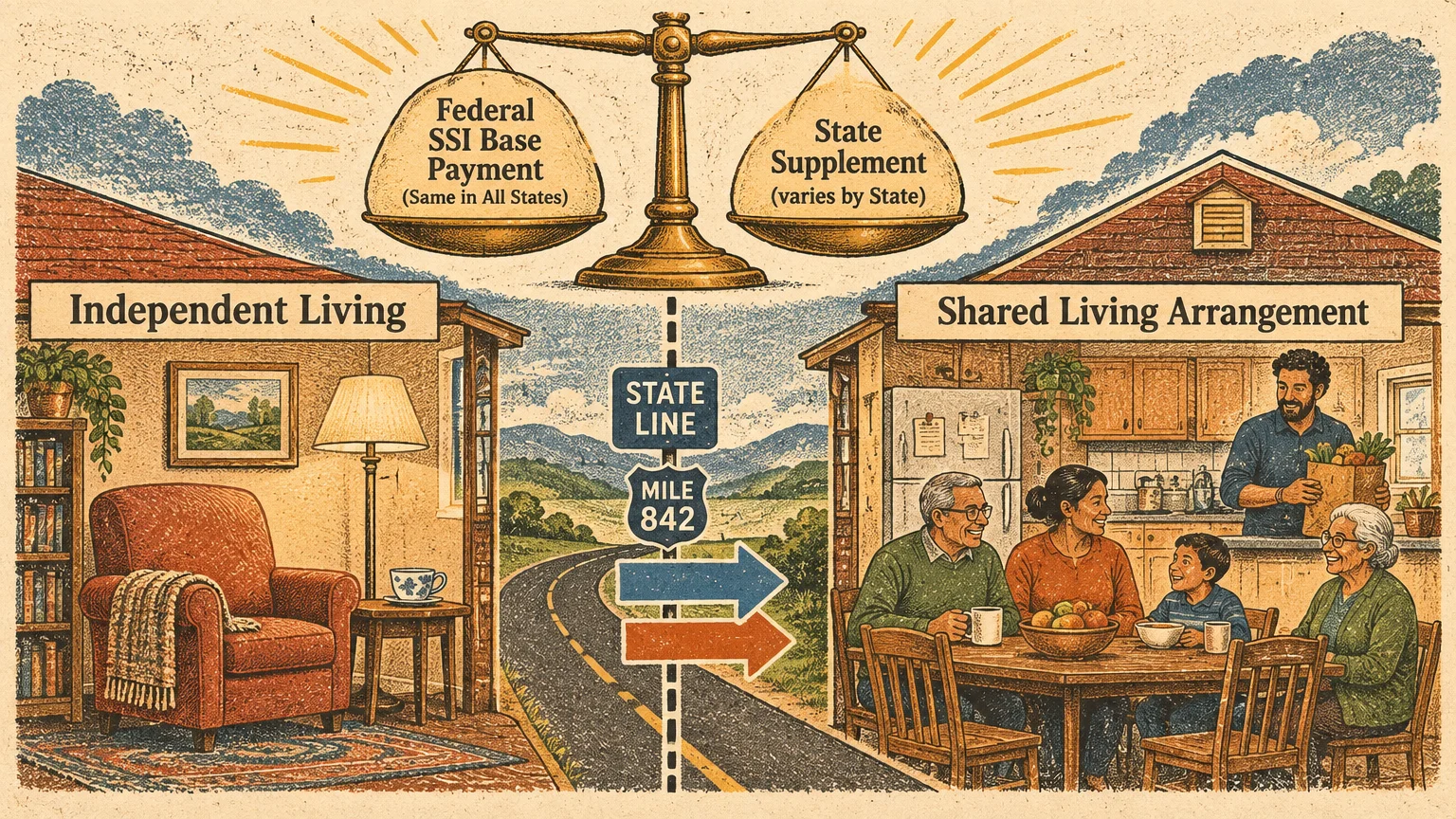
The federal base rate remains identical nationwide for eligible individuals and couples who meet strict income and asset limits. In 2026, the maximum federal payment is $994 per month for an eligible individual and $1,491 per month for an eligible couple.
Countable resource limits stay capped at $2,000 for individuals and $3,000 for couples. Starting December 31, 2026 for January 2027 benefits, the federal base rate rises to $1,029 for individuals and $1,544 for couples, while resource caps remain unchanged.
How State Supplements Shift Your Total Monthly Check
Forty-four states and Washington, D.C. add an optional state-funded payment on top of the federal base rate for qualifying residents. Six states offer no supplement at all: Arizona, Arkansas, Mississippi, North Dakota, Tennessee, and West Virginia.
Even among states that pay an extra amount, rules vary dramatically depending on how you live. Roughly 20 states restrict their supplements primarily to residents living in assisted living centers, nursing homes, or licensed care facilities rather than independent apartments.
Thirty-three states administer their own supplemental payments separately from Washington. According to the Social Security Administration, federal approval does not always start the state check automatically, so you must contact your new state agency directly after moving.
Watch Out for Shared Housing and Territory Rules
Retiring to another state to live with an adult child or share a home with friends feels wonderfully supportive. Yet if someone pays part of your rent or shelter costs, the agency can reduce your payment under in-kind support and maintenance rules.
Before changing your living setup, review how paying your fair share of household expenses protects your full Supplemental Security Income amount. Clear written agreements about rent and utilities help prevent unexpected payment cuts during an already busy transition.
Be especially cautious if you dream of retiring to a tropical island territory. Supplemental Security Income is payable only in the 50 states, Washington, D.C., and the Northern Mariana Islands, which pays no state supplement.
Moving to Puerto Rico, Guam, the U.S. Virgin Islands, or American Samoa for a full calendar month or 30 or more consecutive days ends your eligibility completely. The U.S. Supreme Court upheld that geographic restriction in its 2022 Vaello Madero decision.
Lifestyle Idea #4: Complete Your Social Security Address Change Without Missing a Beat
Filing a mail-forwarding request with the U.S. Postal Service does not update your records with the federal government. Completing an official social security address change ensures your annual tax forms, adjustment notices, and benefit letters reach your new mailbox.
Skipping this step can leave you scrambling at tax time or missing time-sensitive eligibility requests, even when your money arrives by direct deposit. Fortunately, updating your details takes only minutes once you know which channel fits your benefit type.
Updating Online vs. Calling a Representative
If you receive Social Security retirement, survivors, or disability benefits, or carry Medicare coverage, you can update your U.S. mailing address online. Sign in to your personal account through Login.gov or ID.me and open the My Profile section.
Online users can also update direct deposit details and schedule a future move date up to 60 days ahead of packing day. Handling that task early crosses one major errand off your list before movers even arrive.
Supplemental Security Income recipients face stricter rules and cannot change an address online. That restriction also applies if you receive both Supplemental Security Income and disability benefits together, use a representative payee, or lack a U.S. mailing address.
To update those records, call the national toll-free number at 1-800-772-1213, or TTY 1-800-325-0778, Monday through Friday from 8 a.m. to 7 p.m. local time. You can also stop by a local office in person with your new lease or deed.
If you hold a Social Security card without receiving retirement, disability, Supplemental Security Income, or Medicare benefits, you do not need to report your move. The agency only tracks addresses for active beneficiaries and enrollees.
Respect Strict Deadlines and Banking Transitions
Supplemental Security Income recipients must report a move and any living-arrangement changes no later than 10 days after the end of the month in which the move occurred. For example, a move in May must be reported by June 10.
Missing that deadline can trigger a penalty reduction of $25 to $100 per occurrence, plus repayment of any resulting overpayments. Mark that date in bright ink on your calendar so your transition stays stress-free.
If you switch to a hometown credit union or regional bank after settling in, avoid closing your old checking account too soon. Keep your prior account open for at least two payment cycles, roughly 60 days, while Treasury routing updates process smoothly.
Lifestyle Idea #5: Align Your Medicare, Medigap, Medicaid, and SNAP Coverage
Healthcare and nutrition support sit right alongside monthly income when planning a joyful retirement move. While your core federal deposit stays steady, companion programs operate under local networks and state-run budgets that require careful handoffs.
How Medicare Parts A, B, C, and D Respond to a Move
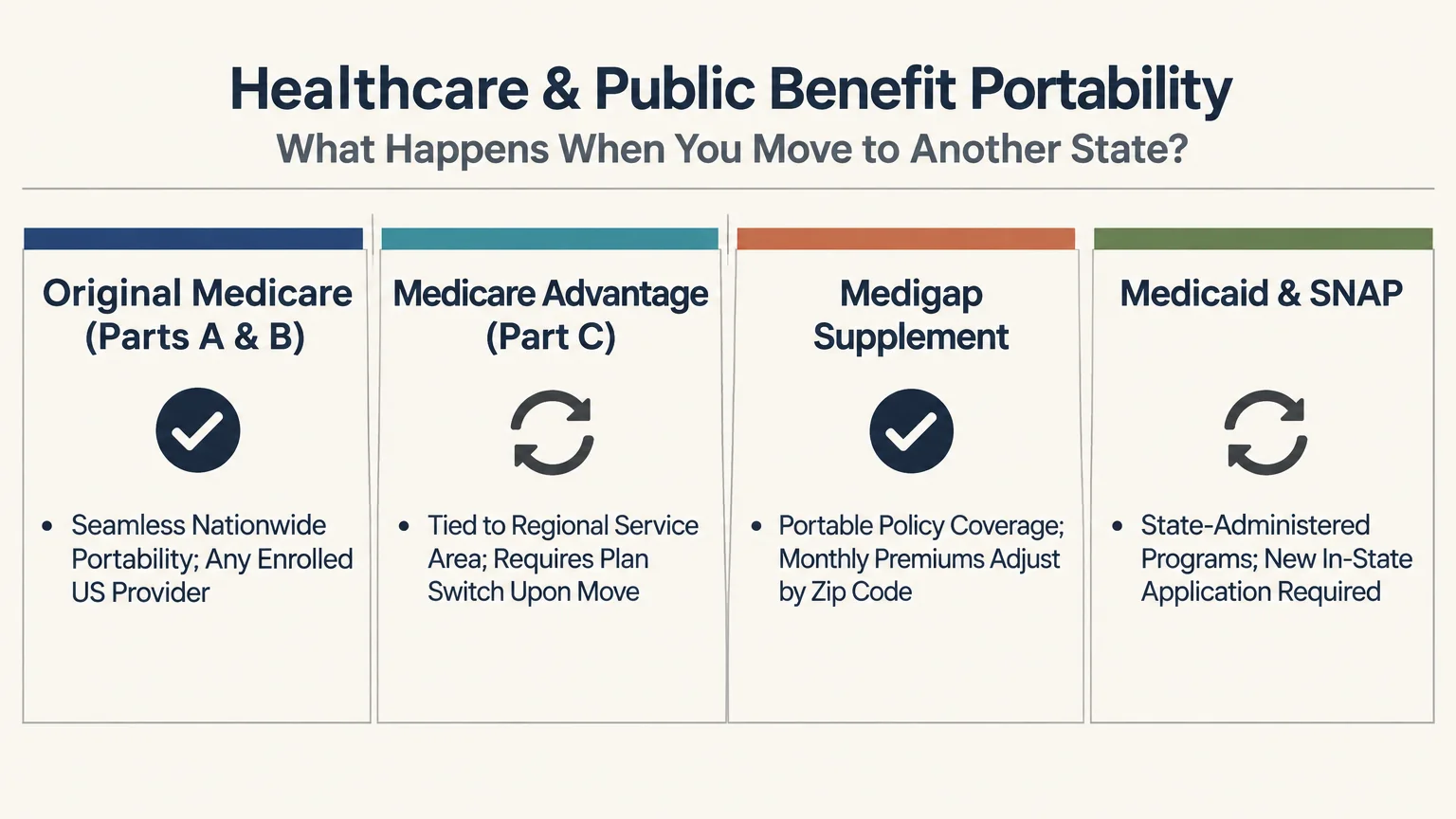
Original Medicare Parts A and B follow you across all 50 states with zero loss of coverage. When you update your address with the Social Security Administration, your Part A and Part B records update automatically in tandem.
Medicare Advantage Part C plans and standalone Part D prescription drug plans work differently because private insurers run them within specific counties or regions. Moving outside your current plan service area triggers a Special Enrollment Period so you can switch coverage.
According to Medicare.gov, if you notify your plan before moving, your enrollment window starts the month before your move and lasts two full months afterward. If you notify the insurer after moving, your window begins the move month and continues for two full calendar months.
Do not ignore those dates if you carry a Medicare Advantage plan. If you fail to pick a new plan after leaving your old service area, your insurer will drop your coverage and return you to Original Medicare.
Medigap Policies, Medicaid, and Nutrition Benefits
Standardized Medigap supplemental policies remain valid everywhere in the country, which gives frequent travelers wonderful flexibility. However, monthly premiums vary widely by state and zip code, so call your insurer to ask how your rate will adjust.
Moving alone does not grant a federal guaranteed-issue right to switch Medigap insurers without medical underwriting. Exceptions apply mainly if you leave a Medicare SELECT network area or qualify under specific state consumer rules.
Medicaid and Supplemental Nutrition Assistance Program benefits never transfer directly across state borders. You must close your active case in your former state and submit a brand-new application after establishing residency in your new home.
Keep in mind that 34 states plus Washington, D.C., known as 1634 states, grant automatic Medicaid eligibility once Supplemental Security Income is approved. Other states require a separate application, and home- and community-based waiver waitlists do not transfer between states.

Lifestyle Idea #6: Test-Drive Your New Community Before Committing Full-Time
Financial spreadsheets only tell half the story when retiring to another state. Before selling a longtime family home or signing a multi-year lease, spend time living like a local in your top candidate town.
Book a short-term rental during the least comfortable weather season rather than the prettiest week of spring. Experiencing summer humidity or winter ice firsthand shows whether daily errands, dog walks, and morning drives still feel effortless.
Visit neighborhood grocery stores, check driving times to major clinics, and chat with residents at coffee shops or farmers markets. Ask locals about property taxes, homeowners insurance, and utility spikes so your real budget matches your projections.
Testing a town first also protects your peace of mind around family connections. Practice the drive or flight to see grandchildren and longtime friends so you know how often those cherished reunions will realistically happen.
Lifestyle Idea #7: Build a Welcoming Social Circle in Your New Hometown
Relocating in your 50s, 60s, or 70s offers a rare chance to reinvent your daily social calendar. Leaving behind familiar neighbors feels bittersweet, yet fresh surroundings make it surprisingly easy to meet people who share your current interests.
Start with low-pressure community hubs within your first few weeks. Public libraries, botanical gardens, community colleges, and local senior centers host book clubs, hobby workshops, and walking groups filled with newcomers looking for friendly faces.
Volunteering a few hours a week at an animal shelter, food pantry, or historic site turns shared purpose into fast friendships. Saying yes to neighborhood potlucks or hobby nights quickly transforms an unfamiliar street into a true community.
For resources on retirement living, travel, and finance, visit AARP. Official information on Social Security is available at SSA.gov. For travel advisories, consult the U.S. Department of State.
Putting It into Practice: Small Steps for Big Changes
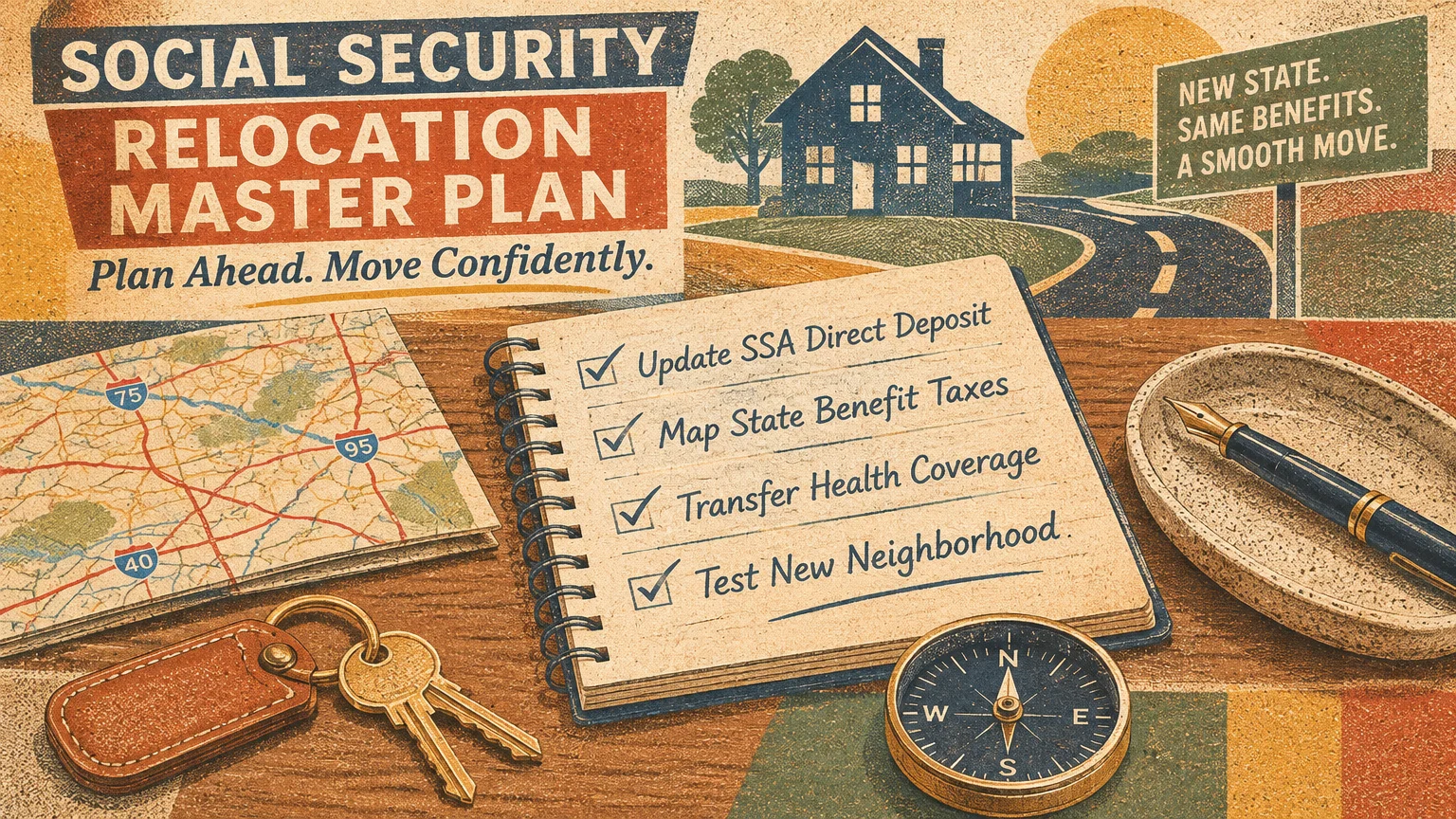
Breaking your move into a simple timeline keeps paperwork manageable and leaves more room for excitement. Start 60 days before moving day by checking state tax exemptions, comparing local Medicare Advantage or Part D plans, and scheduling your online address change.
During your moving month, contact your Advantage or drug plan to activate your Special Enrollment Period and close out any state-level nutrition or Medicaid cases. Keep your previous bank account open for two full payment cycles while new direct deposit routing clears.
If you receive Supplemental Security Income, call 1-800-772-1213 no later than 10 days after the end of your moving month to report your new address and living setup. Contact your new state agency right away if your destination offers a state-run supplement.
Once the boxes are unpacked, celebrate by signing up for one local class, club, or volunteer shift within your first month. Pairing rock-solid benefit planning with active social roots turns your relocation into one of life’s finest chapters.
Frequently Asked Questions
Does retiring to another state mean I have to reapply for Social Security?
No, moving between U.S. states never requires you to reapply for retirement, survivors, or disability benefits. You simply update your mailing address and direct deposit online or by phone so your payments and notices arrive without interruption.
How do I pay state taxes if I move to one of the eight states that tax benefits?
Because the Social Security Administration does not withhold state income taxes from benefit checks, you may need to make quarterly estimated tax payments directly to your new state revenue department. Check whether your age and income already qualify you for a full exemption first.
What if I feel anxious about affording social activities or making friends after moving?
Look for free or low-cost community options such as library lectures, walking clubs, park district fitness classes, and volunteer shifts. Showing up regularly to one or two weekly gatherings builds genuine friendships without straining your retirement budget.
Can I move to Puerto Rico or the U.S. Virgin Islands and keep all my benefits?
Retirement and disability benefits generally continue if you move to U.S. territories, though local healthcare networks still shift. However, Supplemental Security Income eligibility ends if you move to Puerto Rico, Guam, the U.S. Virgin Islands, or American Samoa for a full month or 30 consecutive days.
Disclaimer: This article provides lifestyle suggestions for informational purposes. Financial, legal, or travel decisions should be made in consultation with qualified professionals.