Tip #1: California — Complete Exemption for Social Security vs. Full Tax on Pensions
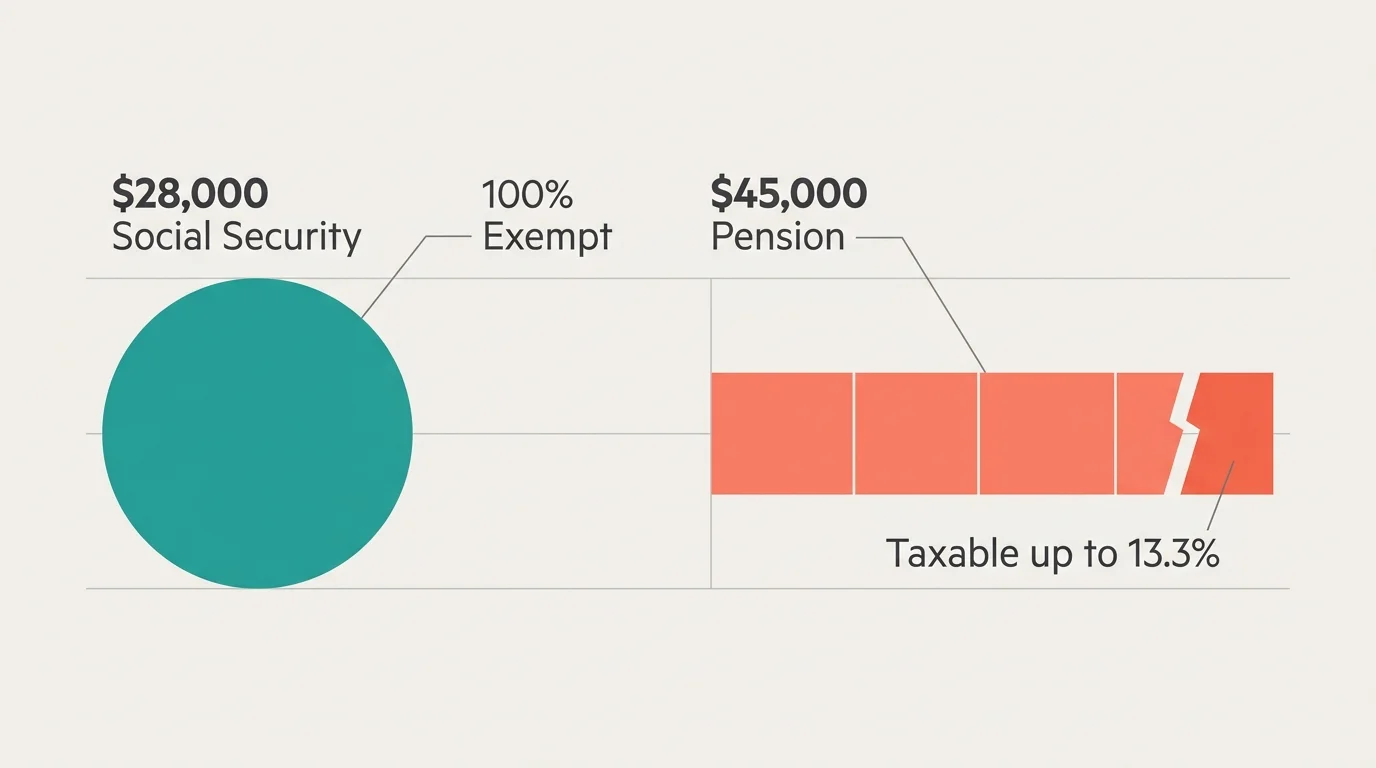
In California, your retirement income experiences two vastly different tax treatments depending on the source of your funds. The Golden State grants a full 100% exemption to Social Security retirement benefits, ensuring that your monthly federal checks arrive without any state income tax deductions. However, California treats private corporate pensions, out-of-state pensions, and state government pensions as standard taxable income; this means your pension distributions face progressive state income tax rates that top out at 13.3%.
Understanding California’s Progressive Tax Structure
Because California applies its standard tax brackets to pension distributions, high-earning retirees who receive substantial pension payments can quickly move into higher tax brackets. For instance, if you receive $45,000 annually from a private corporate pension along with $28,000 in Social Security benefits, your Social Security remains entirely untouched by the California Franchise Tax Board. Conversely, the full $45,000 pension amount combines with your other taxable income, subjecting those dollars to state personal income tax rates.
Actionable Financial Planning Strategy for California Residents
If you choose to enjoy your golden years in California, proactive financial planning helps protect your monthly budget. You can balance taxable pension withdrawals by taking tax-free Roth IRA distributions or leveraging tax-efficient investment strategies to keep your income in lower tax brackets. Comparing pension and Social Security state taxes reveals that managing your withdrawal sequence prevents unexpected spikes in your annual tax obligation.