

Your dedicated military service earned you valuable retirement benefits, and you deserve to keep as much of your hard-earned money as possible. Relocating to a military-friendly state can immediately stretch your pension and lower your annual tax bill.
While many seniors gravitate toward states with zero income tax, several surprising destinations offer exceptional exemptions specifically designed for veterans. These policies help protect your nest egg so you can focus on building a joyful lifestyle.
Explore these ten states with surprising tax breaks to see how much money you can save in your golden years.
Tip #1: California Shields Up to $20,000 for Qualifying Retirees
California long carried a reputation among veterans as one of the few states that fully taxed military retirement pay. That dynamic changed dramatically with landmark legislation that offers significant relief for armed forces retirees.
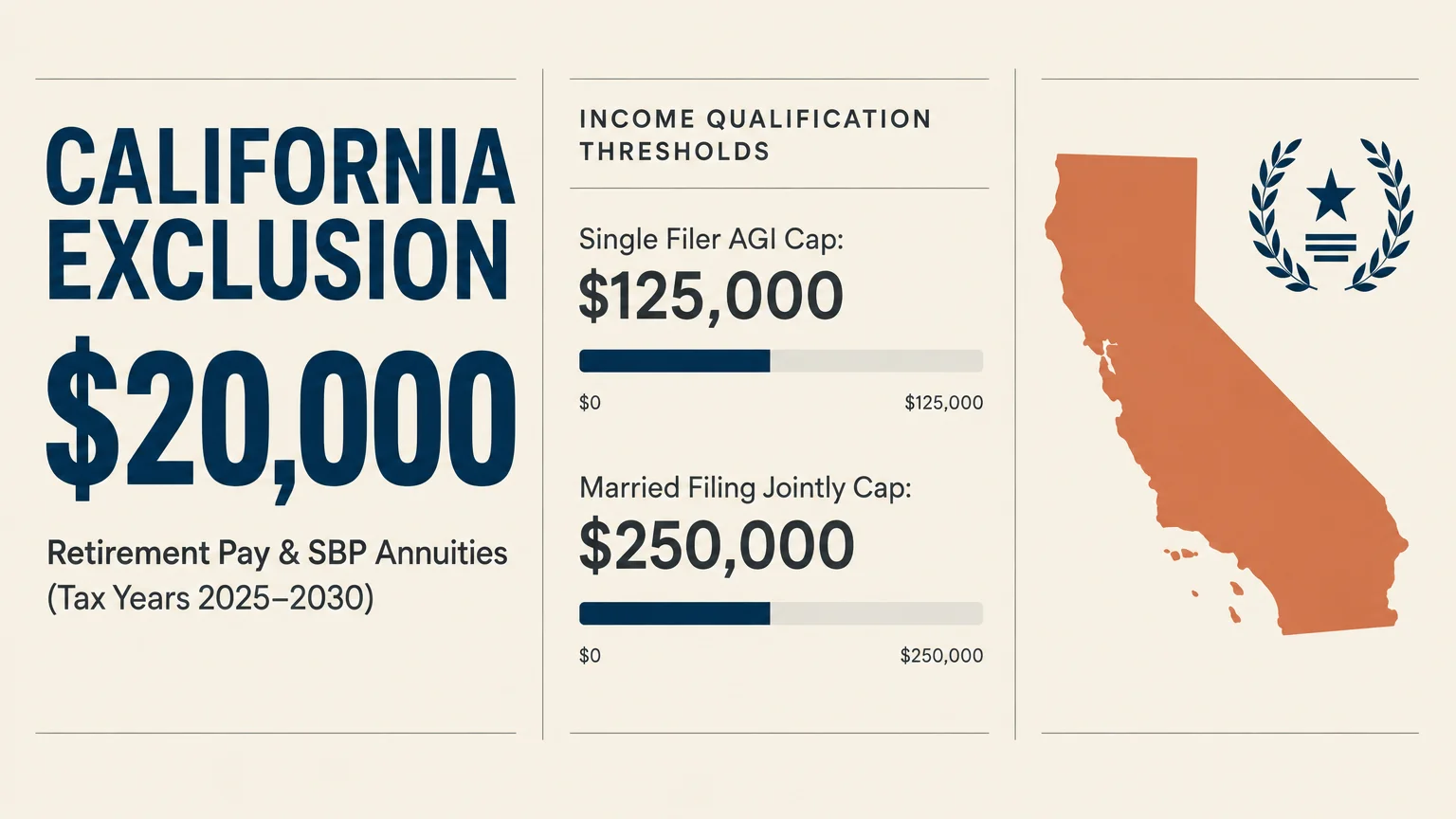
Starting with the 2025 tax year, California allows qualifying military retirees to exclude up to $20,000 of retirement pay or Survivor Benefit Plan (SBP) annuities. This provision provides meaningful annual savings through the 2030 tax year.
To qualify for this tax relief, your federal adjusted gross income must stay under $125,000 as a single filer. Married couples filing jointly can earn up to $250,000 while claiming the full benefit.
If you love the Pacific coast or want to live near major military communities in San Diego, this policy makes the Golden State far more accessible. You can enjoy world-class amenities while shielding a generous portion of your pension.
Veterans can also tap into comprehensive state services and dedicated community clinics across the region. Combining these state exemptions with federal tax shelters allows you to optimize your overall retirement budget.

Tip #2: New York Offers a Full 100% Military Pension Exemption
New York is widely recognized for having some of the highest state and local tax rates in the nation. However, its treatment of military pensions provides a wonderful and welcoming surprise for veteran retirees.
The Empire State provides a complete 100% income tax exemption on all military retirement pay and federal pension distributions. You do not have to pay a single penny of state personal income tax on those earnings.
Unlike many other states, New York does not impose any income thresholds or age restrictions on this benefit. Whether you retired at age forty or sixty-five, your military pension remains completely exempt.
This full exemption applies equally to your Survivor Benefit Plan payments, providing financial security for your spouse. As a result, you can keep your baseline retirement income safe from state tax collectors.
From peaceful upstate communities in the Adirondacks to bustling suburbs, New York delivers exceptional cultural resources for retirees. Your military pension tax-free status helps balance out other living costs across the state.

Tip #3: New Jersey Completely Exempts Armed Forces Retirement Pay
New Jersey frequently appears on lists of high-tax states due to its elevated property and income tax rates. Yet under Public Law 2021, c.185, the Garden State treats military retirees with exceptional financial care.
New Jersey completely exempts military retirement pay and military SBP annuities from state gross income tax. You can receive your full military pension without surrendering any portion to state authorities.
This total exemption applies regardless of your age or your total annual household income. It stands out as one of the most generous veteran tax benefits by state in the Mid-Atlantic region.
Retiring in New Jersey places you close to top-tier healthcare systems, world-class transit networks, and vibrant coastal towns. You can settle down near family while preserving your pension income.
By pairing this military pension tax-free advantage with local senior property tax relief programs, you can build an affordable, fulfilling retirement. The state proves that high-tax reputations do not always tell the whole story.

Tip #4: Illinois Protects All Qualified Pension and Retirement Income
Illinois is well known for higher property and sales taxes, which leads many retirees to overlook the Prairie State. However, Illinois is remarkably generous when evaluating your military retirement pay tax exemption.
The state offers a full 100% exemption on military retirement pay alongside most other federally qualified retirement benefits. Your military pension distributions bypass state income tax completely.
This protective tax umbrella also covers traditional IRA withdrawals, 401(k) distributions, and qualified public pensions. This broad shield makes Illinois one of the best states for military retirees managing diverse income streams.
You will not encounter any income caps, complex phase-out calculations, or age minimums to claim this exemption. That consistency allows you to structure your post-military financial plan with clarity and peace of mind.
With premier medical centers in Chicago and quiet, scenic towns along the Mississippi River, Illinois offers diverse lifestyles. You can pursue active hobbies and cultural outings without paying state income tax on your pension.

Tip #5: Connecticut Expands Full Exemptions to Uniformed Services
Connecticut has long carried a reputation as an expensive New England enclave with rigorous tax policies. Despite this reputation, the Constitution State offers a full personal income tax exemption on armed forces retirement pay.
You pay zero state income tax on your military retirement earnings, no matter your total household income or age. This policy ensures your service-earned compensation stays directly in your household budget.
Connecticut expanded this relief even further under Senate Bill 1 in May 2026. This legislation extended the full tax exemption to retired officers of the U.S. Public Health Service Commissioned Corps.
That expansion highlights Connecticut’s ongoing commitment to honoring all branches of uniformed public service. You can take advantage of these progressive changes to protect your family’s financial wellness.
The state offers rich maritime heritage, picturesque towns, and rapid access to major East Coast metropolitan hubs. Living here allows you to enjoy classic New England charm without sacrificing your pension to state taxes.
Tip #6: Virginia Expands Subtractions for Mature Service Members
Virginia is home to one of the largest populations of active-duty troops and veterans in the entire country. To support this community, lawmakers enacted a phased-in tax subtraction under Code of Virginia § 58.1-322.02.
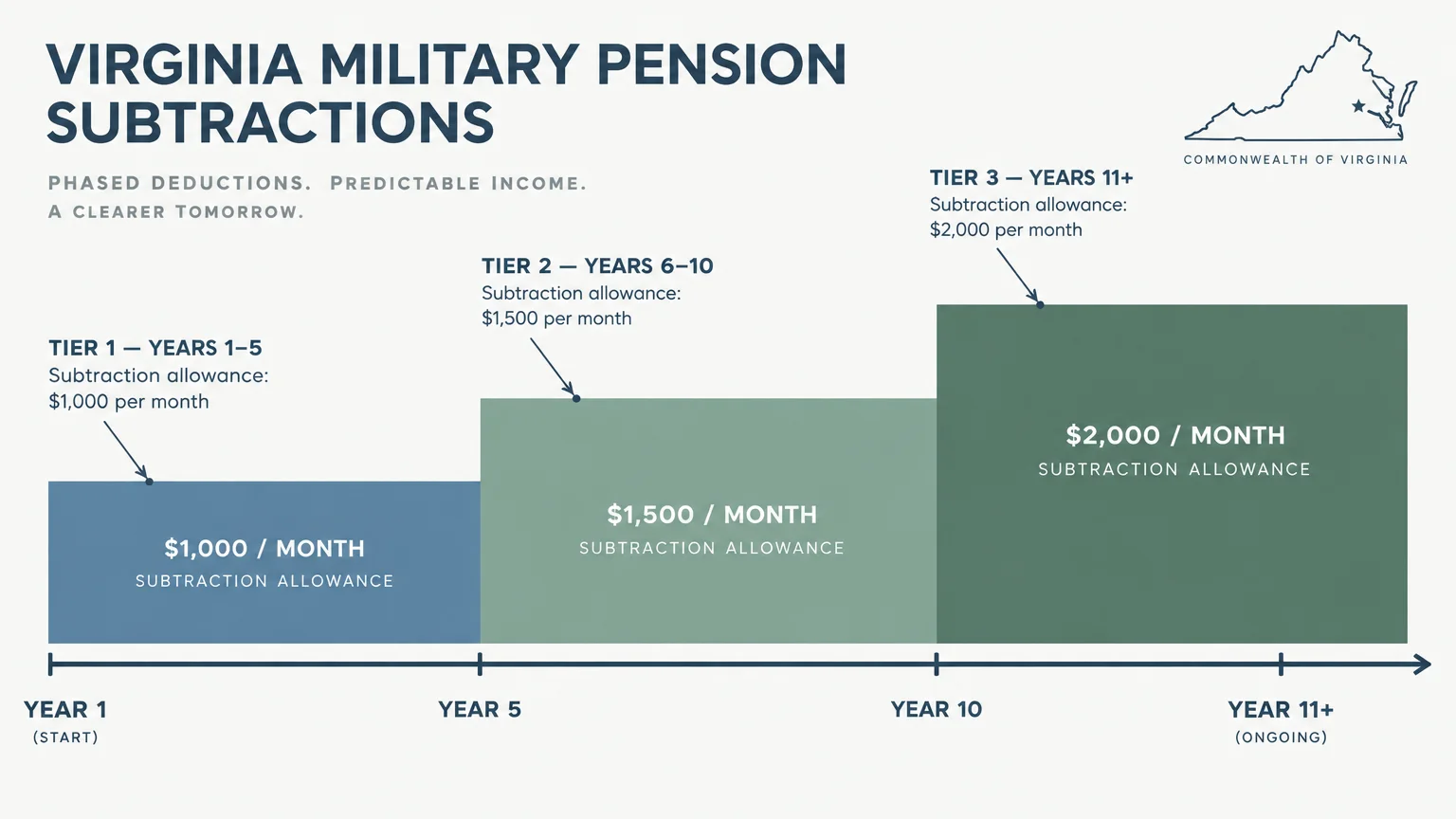
This subtraction has expanded each year to provide greater financial breathing room for retired service members. Starting in tax year 2025 and continuing beyond, veterans aged 55 and older can deduct up to $40,000 of military retirement pay.
While not an outright 100% exemption, this substantial deduction shields the vast majority of most military pensions from state taxation. It provides an immediate boost to your net monthly income.
Virginia also exempts all Veterans Affairs (VA) disability compensation, creating a powerful layered tax shelter for medically retired veterans. You can keep your core income streams working for your personal goals.
From the military hubs in Hampton Roads to the scenic beauty of the Shenandoah Valley, Virginia offers vibrant living options. The growing tax subtraction makes staying in the Old Dominion increasingly attractive.

Tip #7: Rhode Island Permanently Phases Out Military Pension Taxes
Rhode Island was once viewed cautiously by veterans because the state routinely taxed military retirement earnings. That policy changed when state leaders recognized the vital contributions military retirees bring to local communities.
Rhode Island permanently phased out its state income tax on military pensions beginning in tax year 2023. Military retirement pay is now 100% exempt from Rhode Island personal income tax.
This exemption applies directly to your retired pay and requires no complicated income caps or sliding phase-out scales. You can enjoy your coastal retirement without worrying about surprise tax obligations.
Rhode Island’s compact size allows you to live near stunning shorelines, historic harbors, and cultural attractions in Providence. You also gain quick access to specialized veteran healthcare facilities across New England.
The Ocean State gives you seaside living alongside genuine financial protection for your armed forces pension. It represents a refreshing, modern choice among states with tax breaks for military retirees.

Tip #8: North Carolina Exempts Pensions for Long-Serving Personnel
North Carolina has long been celebrated for its proud military history, housing major installations like Fort Liberty and Camp Lejeune. Through House Bill 334, the state enacted major tax relief beginning with the 2021 tax year.
The legislation grants a 100% state income tax exemption on military retirement pay for career service members. You qualify if you completed at least twenty years of creditable military service.
Veterans who were medically retired under 10 U.S.C. Chapter 61 also receive this complete state tax exemption, regardless of total years served. This protection ensures injured personnel receive the financial security they deserve.
Surviving spouses receiving payments from the military Survivor Benefit Plan are equally exempt from state income tax under this law. This safeguard provides lasting peace of mind for your loved ones.
With mild winters, beautiful beaches, and majestic mountain towns, North Carolina offers an enviable retirement lifestyle. Eliminating income taxes on your pension makes living in the Tar Heel State even more enticing.

Tip #9: Nebraska Delivers Full Tax Relief Across the Great Plains
Nebraska offers a peaceful lifestyle, friendly communities, and an exceptionally low cost of daily living. With the passage of Legislative Bill 387, the state became far more appealing to transitioning veterans.
Starting on January 1, 2022, Nebraska enacted a complete 100% exemption on military retirement pay from state personal income tax. You no longer need to pay state tax on your hard-earned armed forces pension.
The exemption applies to all military retirees living in the state, regardless of your rank, age, or overall income bracket. This policy keeps thousands of dollars in your pocket every single year.
Nebraska also provides strong support networks for veterans through Offutt Air Force Base and statewide community organizations. You can easily find camaraderie and meaningful volunteer opportunities in every county.
If you appreciate open spaces, minimal traffic, and welcoming neighborhoods, Nebraska delivers an extraordinary quality of life. The full pension tax exemption lets you maximize your savings while thriving in the Heartland.

Tip #10: Vermont Introduces Progressive Pension Subtractions
Vermont is known for picturesque villages, scenic mountain views, and traditionally high state tax brackets. However, the Green Mountain State recently introduced progressive reforms to support veteran retirees.
Effective retroactively to January 1, 2025, Vermont provides a 100% income tax exemption on military retired pay for qualifying households. This tax break offers welcome financial relief to retirees and surviving spouses.
To receive the full exemption, your federal adjusted gross income must remain under $125,000. If your income falls between $125,000 and $175,000, you can take advantage of a proportional phase-out deduction.
This sliding scale ensures middle-income military retirees retain more of their pension to cover seasonal heating and general living expenses. It makes northern New England living far more viable on a fixed income.
Vermont offers an active, nature-focused lifestyle filled with hiking, skiing, and close-knit small-town charm. With this updated tax benefit, you can savor peaceful mountain living while keeping more of your pension.

The Takeaway: Living a More Blissful Retirement
Choosing where to settle during retirement involves balancing your personal passions with smart financial management. You do not have to limit your search strictly to states without income taxes.
Many states with general income taxes offer generous exemptions that make them wonderful contenders for your golden years. These policies reward your military service by keeping your pension earnings intact.
When evaluating potential destinations, examine the entire financial picture, including local sales taxes, healthcare quality, and community amenities. A state with modest property taxes and full pension relief may offer superior overall value.
Your military career required dedication, courage, and sacrifice; your retirement should be characterized by freedom and peace of mind. Take time to explore your options, consult a tax advisor, and design a life that brings you joy.
For a wide range of resources for older adults, visit AARP and the National Council on Aging (NCOA). Health information is available from the National Institute on Aging.
Disclaimer: This article is for informational and inspirational purposes only. It is not a substitute for professional medical, financial, or psychological advice. Please consult with a qualified expert for guidance tailored to your individual needs.
Frequently Asked Questions
Is VA disability compensation taxable at the state level?
No, VA disability compensation is completely exempt from federal and state income taxes in all fifty states. You do not need to report this compensation as taxable income anywhere in the country.
This universal tax exemption also applies to Dependency and Indemnity Compensation (DIC) payments for surviving family members. These funds remain 100% tax-free regardless of where you decide to live.
Do military pension tax exemptions also apply to Survivor Benefit Plan payments?
In most states that exempt military retirement pay, Survivor Benefit Plan (SBP) annuities receive identical tax-free treatment. States like New York, New Jersey, and North Carolina specifically protect these survivor payments.
However, state tax codes can vary in their exact definitions and eligibility criteria. You should always verify local state statutes to ensure your surviving spouse receives the full intended tax shelter.
How do states verify your eligibility for military retirement tax exemptions?
You typically claim your military tax exemption when filing your annual state personal income tax return. Most states require you to attach your Form 1099-R showing your military retired pay distributions.
Some states with service-duration requirements, such as North Carolina, may also ask for a copy of your DD Form 214. Keeping your military service records organized makes claiming these deductions seamless.
Can I claim a military retirement tax break if I work a second civilian career?
Yes, you can generally claim military retirement tax exemptions while earning income from a second civilian job. States with 100% exemptions like Illinois and New Jersey exempt your military pension regardless of outside earnings.
In states with income caps like California or Vermont, your civilian wages will count toward your total adjusted gross income. Make sure your combined income stays within the required thresholds to claim the maximum exemption.