

Selecting the right Medicare Part D plan can save you thousands of dollars while protecting your health and retirement budget. Because every insurer prices medications differently, your ideal plan depends entirely on the specific prescriptions you take and the pharmacy you prefer.
Major updates for the 2026 and 2027 coverage years—including hard out-of-pocket spending caps and newly negotiated drug prices—make a fresh Part D comparison essential. Even if you love your current coverage, shifting premiums and shrinking plan options can quietly raise your costs.
Follow these practical tips to evaluate your prescription drug coverage Medicare options with total confidence and peace of mind.
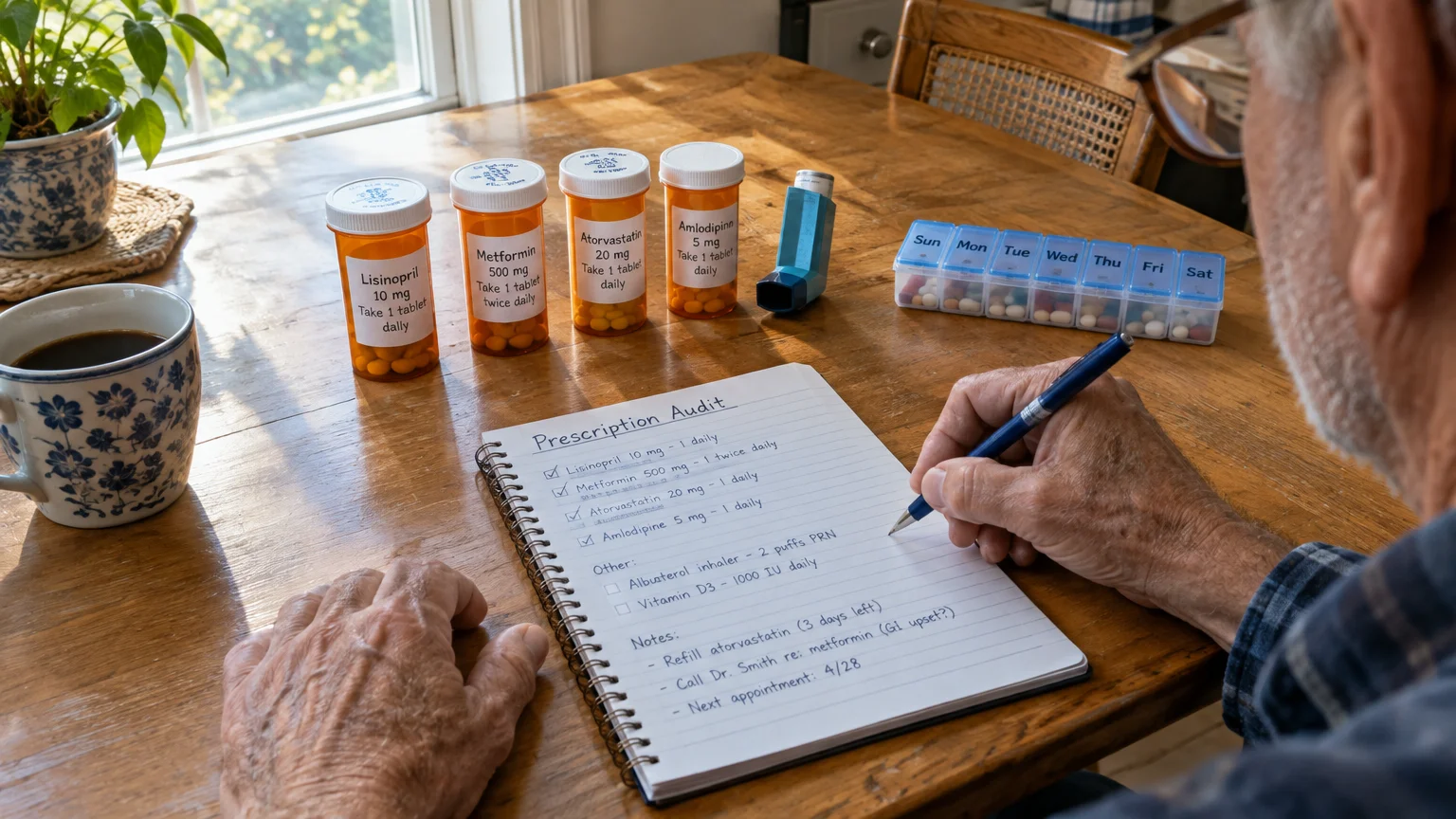
Tip #1: Audit Your Exact Medication List and Dosages First
You cannot choose the right insurance policy by looking at company brand names or advertised monthly rates alone. Your personal medication cabinet is the only compass that matters when choosing a Part D plan.
Before you look at a single insurance brochure, gather every prescription bottle you take regularly or seasonally. Write down the exact drug name, the strength, and the number of doses you take each month.
Why Formulation Details Matter
Pay close attention to whether your prescription is an extended-release tablet, an immediate-release capsule, a topical cream, or an ointment. Insurance plans frequently cover a standard tablet for a low copay while placing the capsule version of that exact same medication on a high-cost tier.
Even a small difference in dosage strength can change how an insurer categorizes your medicine. Entering the exact formulation into your comparison worksheet prevents costly surprises at the pharmacy counter in January.
If you take brand-name medications, schedule a quick medication review with your primary care physician or pharmacist before you shop for coverage. Ask whether an equally effective generic version is available that could lower your copays across multiple plans.
Understanding Plan Formularies and Drug Tiers
Every Medicare Part D plan publishes an official list of covered medications called a formulary. If a drug you take does not appear on a plan’s formulary, you will usually have to pay full retail price unless your doctor wins a formal exception.
Plans organize their formularies into distinct pricing levels known as tiers. Preferred generic drugs sit on the lowest tier with the smallest copays, while non-preferred generics and preferred brand-name drugs carry moderate costs.
Non-preferred brands and complex specialty medications sit on the highest tiers, where you typically pay a percentage of the drug’s price rather than a flat fee. A smart Part D comparison checks which tier each of your daily medications occupies on every plan you consider.
Never assume two plans from the same insurance company share the same formulary or tier placements. Insurers design basic and enhanced plans to serve vastly different health profiles, so verify every single medication line by line.
Tip #2: Decide Between a Standalone Plan and Medicare Advantage
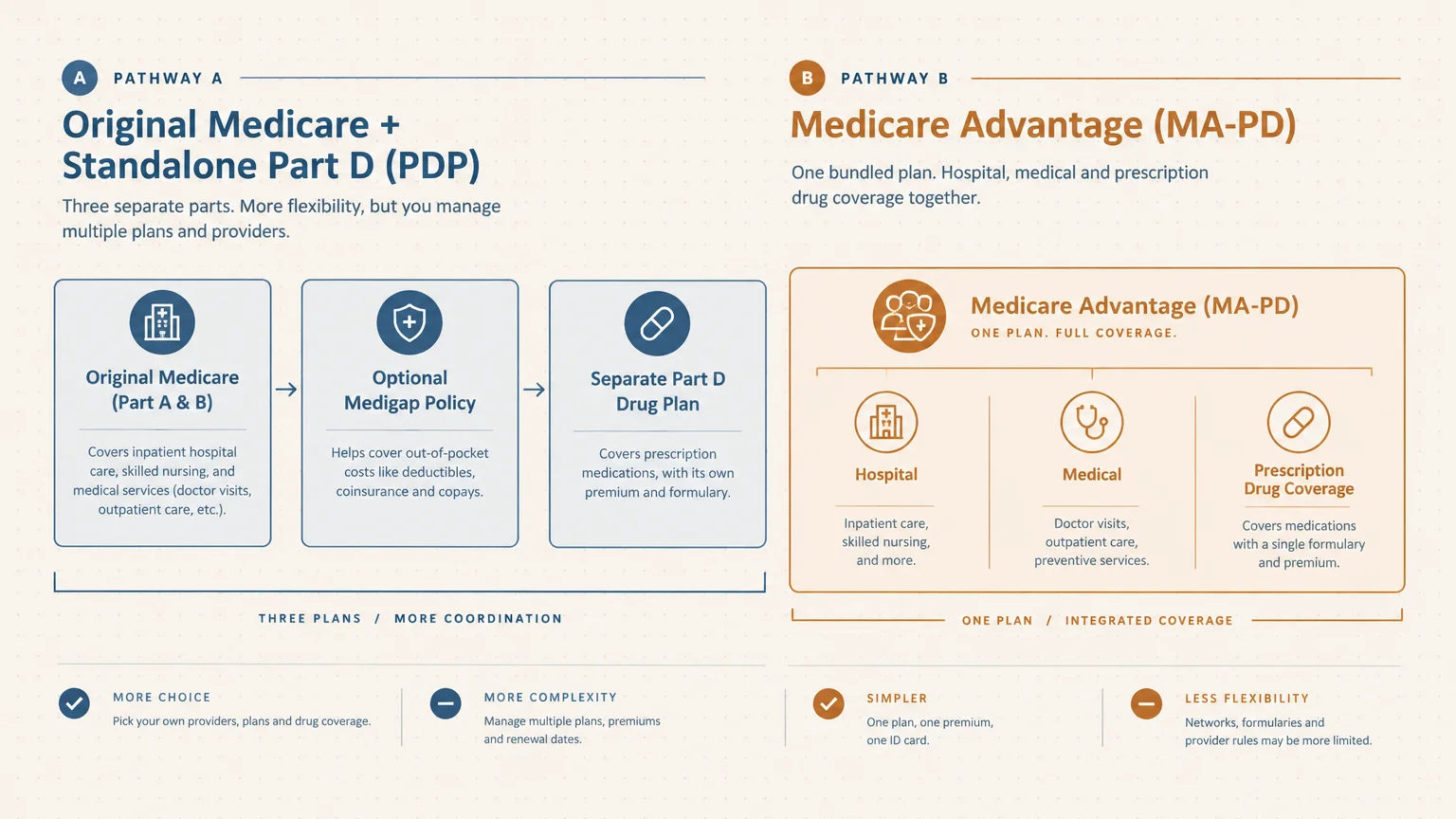
Medicare gives you two distinct pathways for getting your prescription drug benefits. You can pair Original Medicare with a standalone Part D plan, or you can enroll in a Medicare Advantage plan that bundles medical and prescription coverage together.
Your choice between these two pathways shapes both your monthly budget and your freedom to choose doctors and hospitals. Understanding how the market is shifting for 2026 and 2027 will help you pick the structure that fits your lifestyle.
Weighing Standalone Plans Against Bundled Coverage
If you have Original Medicare—especially if you also carry a Medigap supplemental policy—you will shop for a standalone Prescription Drug Plan. The Centers for Medicare & Medicaid Services projects the enrollment-weighted average monthly premium for standalone Part D plans will rise by less than $1, moving from $35.09 in 2026 to $36.00 in 2027.
However, averages never tell the whole story for individual shoppers. A temporary federal subsidy program initiated in 2025 to hold down standalone Part D plan premiums officially ends after 2026.
Because that federal stabilization program is ending, individual standalone plans may see significant price adjustments, and the total number of available standalone Part D plans is shrinking by roughly 13% in 2027. If your current standalone plan is terminating or raising its monthly rate sharply, shopping the market is your best defense.
Exploring the Medicare Advantage Prescription Option
If you prefer an all-in-one health and drug plan with built-in extras, a Medicare Advantage plan with prescription drug coverage offers remarkable premium value. For Medicare Advantage plans that include prescription drug coverage, the average monthly Part D premium portion is projected to drop 38%, falling from $11.32 in 2026 to $7.00 in 2027.
Looking at the broader picture, overall weighted average Medicare Advantage premiums are projected to drop from $14.37 in 2026 to $12.00 in 2027. Many retirees find Medicare Advantage plans in their local zip code that charge no additional monthly premium beyond the standard Part B premium.
Before you switch from Original Medicare to a Medicare Advantage plan solely for lower drug premiums, evaluate the medical network rules carefully. Medicare Advantage plans require you to use in-network doctors and hospitals, whereas Original Medicare paired with a standalone Part D plan lets you visit almost any provider nationwide who accepts Medicare.
Tip #3: Calculate Your Total Annual Costs Beyond the Monthly Premium
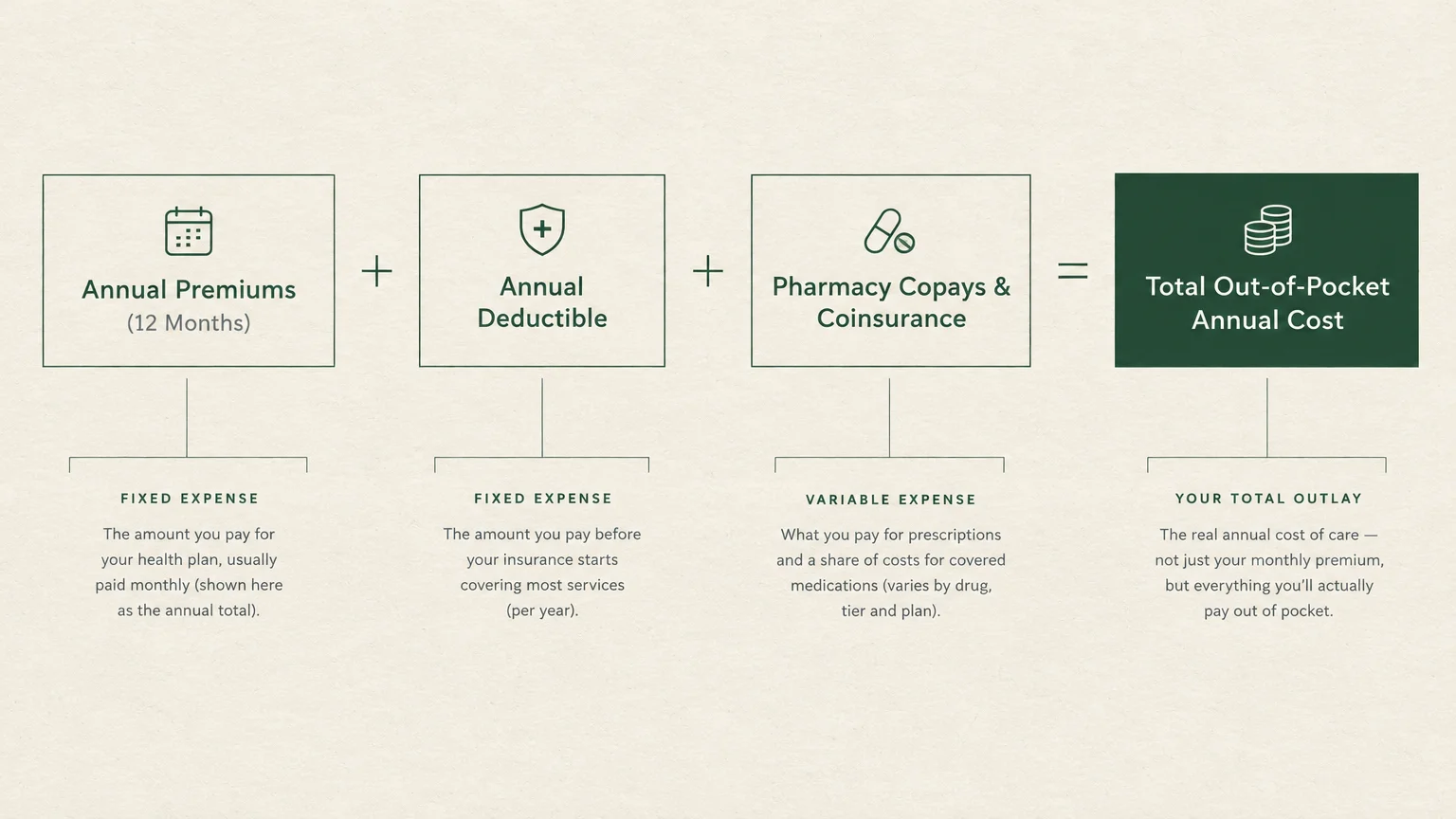
One of the biggest mistakes retirees make when choosing a Part D plan is picking the policy with the lowest monthly premium. A plan with a rock-bottom monthly fee can easily cost you far more over the year if it charges high deductibles and steep coinsurance for your medications.
To find the true winner for your wallet, add up your twelve monthly premiums plus what you will pay out of pocket for refills throughout the calendar year. Understanding the three simplified coverage stages makes this math clear and predictable.
Stage One and Stage Two: Deductibles and Initial Coverage
First comes the deductible stage, where you pay the negotiated retail cost of your prescriptions until you meet your plan’s annual deductible. The federally mandated maximum standard Part D deductible is $615 in 2026, increasing to $700 in 2027.
Keep in mind that individual plans may charge less than the federal maximum or offer a $0 deductible across all tiers. Furthermore, many plans waive the deductible entirely for lower-tier generic medications so your coverage kicks in on day one.
Once you satisfy any applicable deductible, you enter the initial coverage stage. During this phase, you pay your plan’s copays or coinsurance—built around a standard 25% coinsurance structure—until your total out-of-pocket spending reaches the annual federal cap.
Stage Three: The Hard Cap and Catastrophic Coverage
You no longer have to worry about the confusing Part D coverage gap, commonly known as the “donut hole,” because it remains permanently eliminated. Instead of falling into a sudden coverage gap mid-year, you move smoothly from initial coverage straight into catastrophic protection.
The hard cap on out-of-pocket spending for covered Part D prescription drugs is $2,100 in 2026 and rises to $2,400 in 2027. Every dollar you spend on covered deductibles, copays, and coinsurance counts toward reaching this threshold.
Once you hit that $2,100 limit in 2026—or $2,400 in 2027—you enter catastrophic coverage and pay $0 for covered Part D medications for the rest of the calendar year. This hard ceiling provides tremendous peace of mind if you manage chronic conditions or require high-cost cancer or autoimmune therapies.
Remember that the hard cap only applies to medications covered on your plan’s formulary. Picking a plan that covers all of your high-cost drugs ensures your spending stops at the federal limit.
Tip #4: Check If Your Prescriptions Have Newly Negotiated Medicare Prices
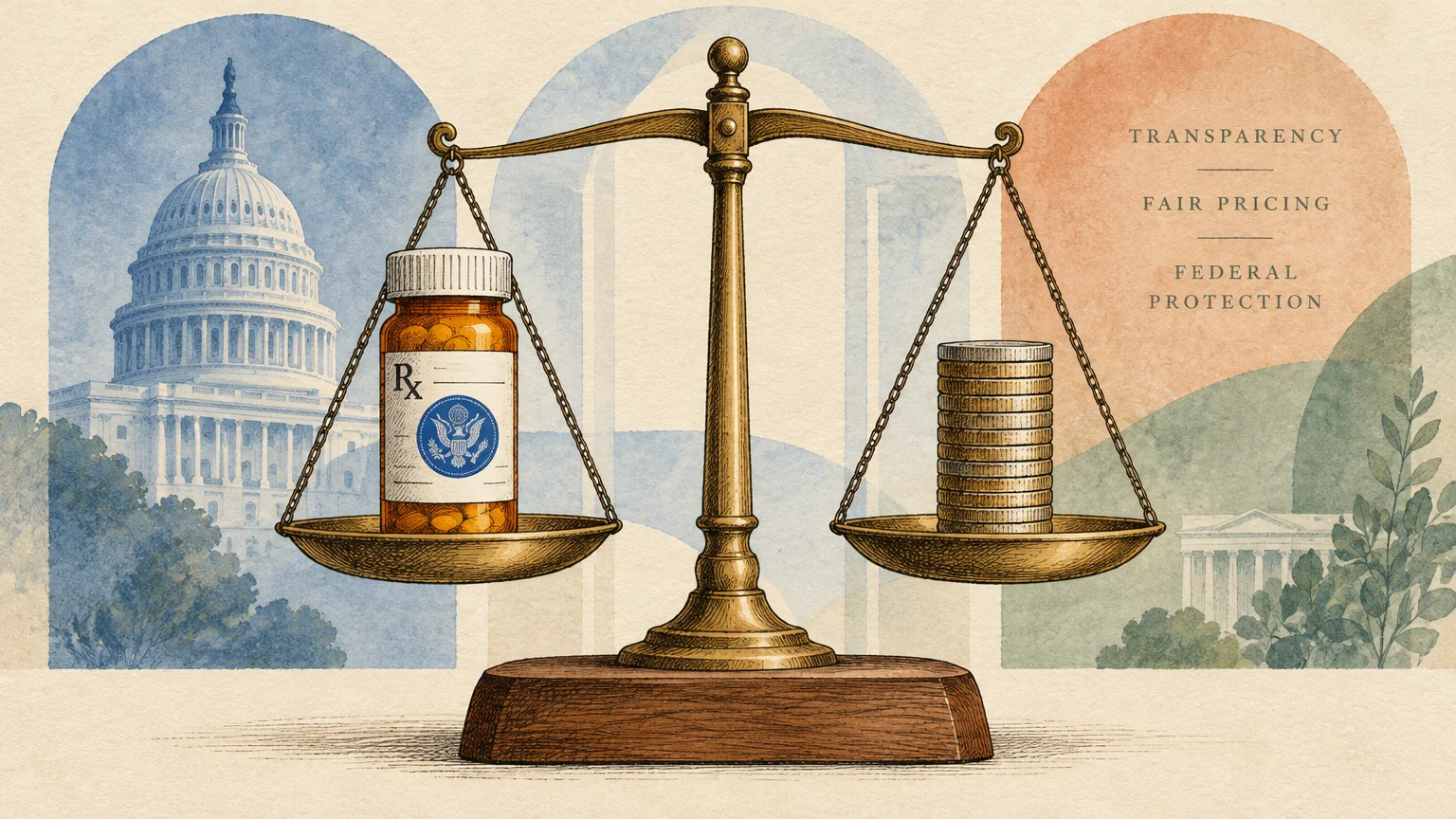
For decades, Medicare was prohibited from negotiating drug prices directly with pharmaceutical manufacturers. Today, the Medicare Drug Price Negotiation Program is actively lowering the baseline prices of some of the nation’s costliest and most widely used medications.
If you take any of these selected brand-name medications, your out-of-pocket expenses during the deductible and initial coverage stages can drop noticeably. Knowing which drugs are included helps you evaluate how different plans structure your copays.
Which Medications Are Included for 2026 and 2027
Following the first 10 negotiated drug prices that took effect in 2026, lower Medicare-negotiated prices for 15 additional Part D drugs take effect on January 1, 2027. This expansion brings relief to millions of older adults managing diabetes, respiratory illnesses, heart conditions, cancer, and gastrointestinal disorders.
The medications gaining newly negotiated prices for 2027 include popular treatments such as Ozempic, Rybelsus, Wegovy, Trelegy Ellipta, Breo Ellipta, Janumet, and Tradjenta. The list also covers specialized therapies including Xtandi, Ibrance, Pomalyst, Calquence, Austedo, Vraylar, Otezla, Ofev, Linzess, and Xifaxan.
Every Medicare Part D plan is required to include drugs with negotiated maximum fair prices on its formulary. That rule guarantees you will have access to these essential treatments regardless of which insurer you select.
Why You Still Need to Compare Plans for Negotiated Drugs
Even though Medicare negotiates the underlying maximum fair price for these medications, individual insurance plans still decide how to structure your cost sharing. One plan might charge you a flat copay for Trelegy Ellipta or Ozempic, while another plan might charge you a percentage coinsurance based on the negotiated price.
Additionally, plans can apply different clinical review rules to negotiated medications unless restricted by federal guidelines. Always check your Part D comparison results to see your exact monthly out-of-pocket cost for these drugs under each competing policy.
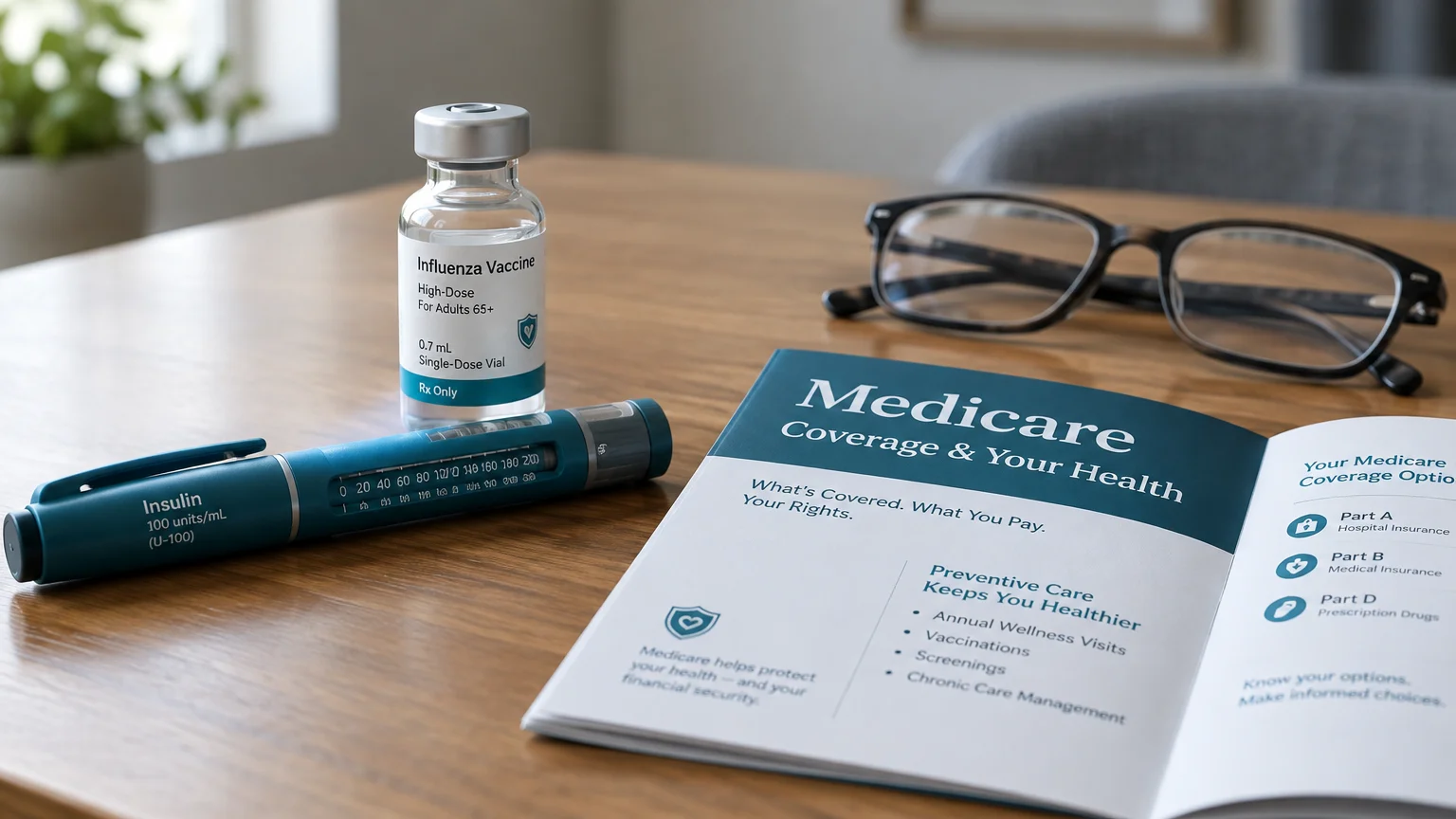
Tip #5: Maximize Built-In Protections for Insulin and Adult Vaccines
Federal rules give Medicare beneficiaries strong financial protections for insulin and preventive adult vaccines. Understanding how these rules work ensures you never overpay for diabetes supplies or routine immunizations.
While the spending limits are standardized by law, how you use your plan still determines whether your pharmacy trip goes smoothly. A few quick checks during enrollment will lock in these valuable benefits without a hitch.
Locking In the $35 Monthly Insulin Cap
Under the Inflation Reduction Act, beneficiaries pay no more than $35 per month for each covered insulin product, and no deductible applies. If you obtain a three-month supply through a retail or mail-order pharmacy, your copay is capped at $35 per month’s supply.
Notice the most important word in that rule: covered. A Medicare Part D plan only caps your insulin at $35 if your specific insulin brand and delivery format—such as a prefilled pen versus a vial—appear on that plan’s formulary.
Insurer formularies do not cover every single insulin brand on the market. When choosing a Part D plan, verify that your exact insulin product is listed on the plan’s formulary, or ask your doctor if you can easily transition to the plan’s covered insulin brand.
Claiming $0 Adult Vaccines
Preventive care is one of the cornerstones of a vibrant, active retirement. Under current Medicare Part D rules, you pay $0 out-of-pocket for all adult vaccines recommended by the Advisory Committee on Immunization Practices (ACIP).
This zero-dollar benefit covers expensive, crucial immunizations such as the shingles vaccine, the RSV vaccine, and the tetanus-diphtheria-whooping cough booster. You do not have to meet your annual deductible before receiving these recommended shots for free.
To avoid upfront billing headaches, always get your Part D vaccines at an in-network pharmacy. If you receive a Part D vaccine at your doctor’s office and the office does not bill your drug plan directly, you might have to pay upfront and submit paperwork for reimbursement.
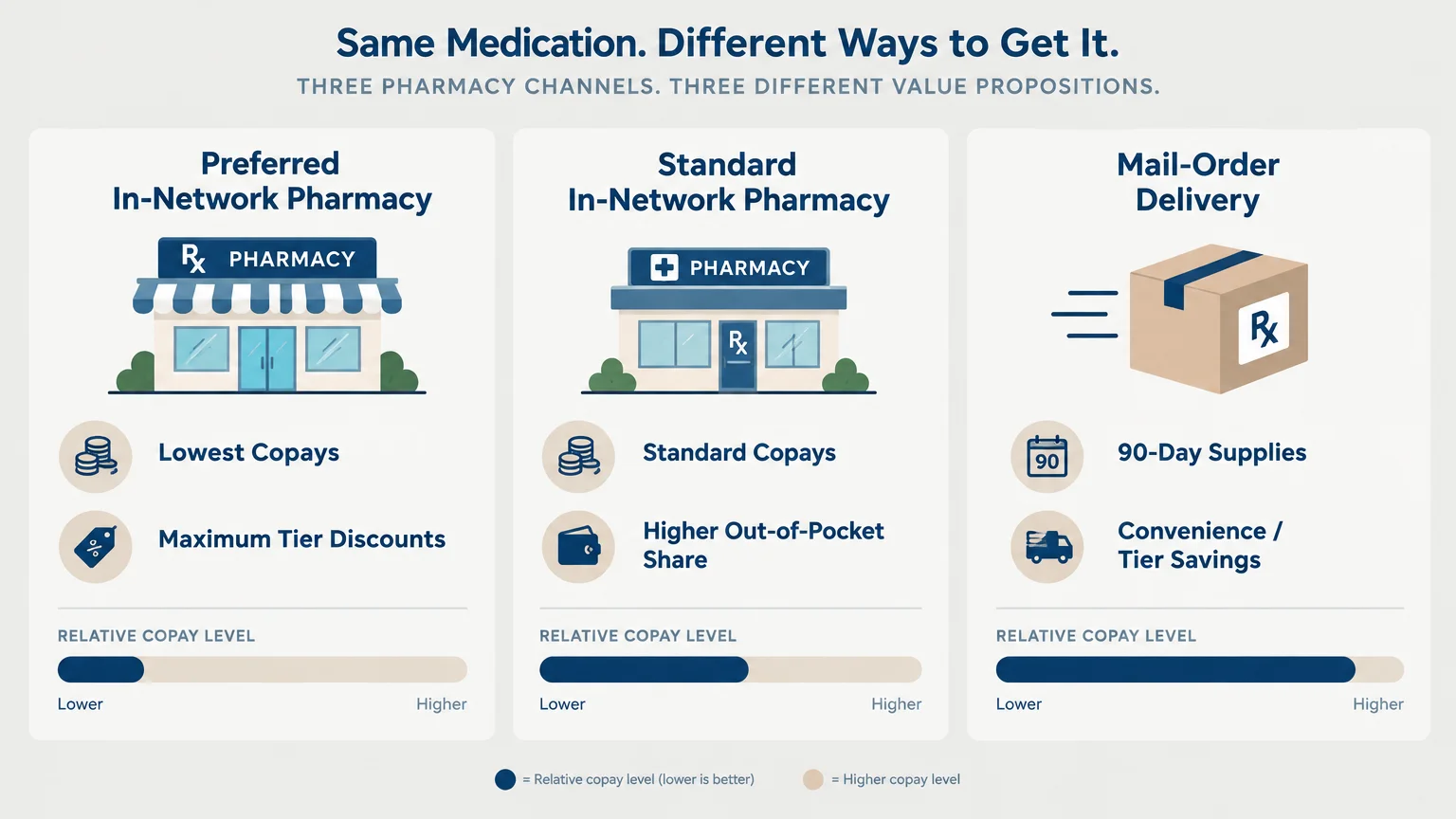
Tip #6: Verify Preferred vs. Standard Pharmacies and Mail-Order Options
Where you pick up your prescriptions matters almost as much as which insurance card sits in your wallet. Nearly every Medicare Part D plan uses a tiered pharmacy network to steer members toward specific drugstores that have agreed to deeper price discounts.
Overlooking pharmacy status during your Part D comparison can easily double or triple what you pay for common generic and brand-name medications. Taking five minutes to check your local drugstore’s status protects both your convenience and your budget.
How Preferred Networks Lower Your Copays
Insurers divide their in-network drugstores into two categories: preferred in-network pharmacies and standard in-network pharmacies. At a preferred pharmacy, you might pay $0 to $2 for a thirty-day supply of a tier-one generic medication.
At a standard in-network pharmacy right across the street, that exact same prescription could cost you $10 to $15 every single month. Multiply that difference across four or five daily prescriptions, and a preferred pharmacy can save you hundreds of dollars a year.
Be careful never to use an out-of-network pharmacy for routine refills. Unless you face a genuine medical emergency while traveling, Part D plans generally pay nothing at out-of-network pharmacies, and what you spend there will not count toward your $2,100 (2026) or $2,400 (2027) annual cap.
Smart Strategies for Independent Pharmacies and Snowbirds
If you love the personal touch of a local, family-owned independent pharmacy, call the pharmacist before you enroll in a new plan. Ask which Part D plans place their store in the preferred network for the upcoming calendar year.
If you spend winters in a warmer state or travel frequently to visit grandchildren, prioritize a plan whose preferred network includes a major national pharmacy chain. That way, you can transfer and refill prescriptions seamlessly from coast to coast without paying out-of-network penalties.
Finally, compare each plan’s mail-order pharmacy pricing for ninety-day maintenance refills. Many plans offer three months of preferred generic medications through mail order for $0, saving you both money and trips to the drive-thru window.
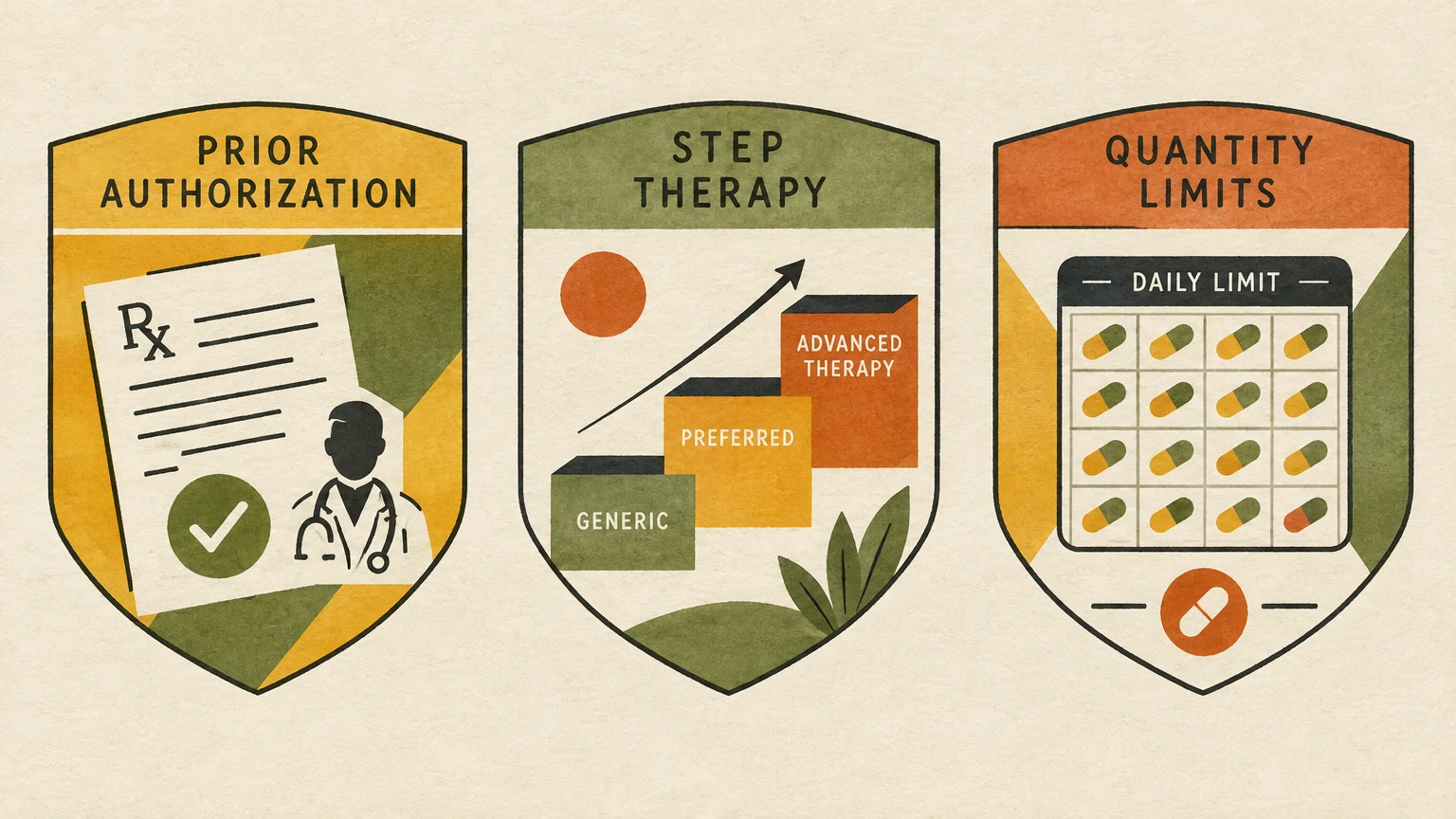
Tip #7: Watch Out for Utilization Management Rules and Restrictions
Seeing your medication listed on a plan’s formulary is a great start, but it does not always guarantee an automatic refill at the pharmacy counter. Insurance companies frequently attach safety and cost-control conditions known as utilization management restrictions.
Discovering these hurdles on January 2 when your bottle is nearly empty can cause unnecessary stress. Spotting them while choosing a Part D plan lets you either pick a less restrictive policy or prepare your doctor well in advance.
Decoding Prior Authorization, Step Therapy, and Quantity Limits
The most common restriction is prior authorization, which requires your prescribing doctor to submit clinical paperwork proving why you need that specific drug before the insurer will pay. Even if your old plan approved the medication, a new insurer will usually require a brand-new prior authorization in January.
Step therapy is a “try and fail” rule where the plan requires you to try a lower-cost generic or alternative medication first. Only after your doctor documents that the cheaper drug did not work for you—or caused side effects—will the plan cover the costlier prescription.
Quantity limits restrict the exact number of pills, patches, or inhalers you can receive within a thirty-day or ninety-day window. If your doctor prescribes two tablets a day for symptom control when the insurer’s standard limit is one tablet a day, your refill will hit a roadblock without an approved exception.
How to Handle Restrictions Smoothly
When you view plan details online, look closely at the notes column next to each of your prescriptions for flags marking prior authorization, step therapy, or quantity limits. If two plans have similar total annual costs, choose the plan with fewer administrative hoops on your daily medications.
If every affordable plan in your area places a restriction on your prescription, take advantage of Medicare’s transition refill rules. New enrollees generally have the right to a temporary transition supply during their first ninety days in a plan, giving your doctor plenty of time to file the necessary clinical exception forms.
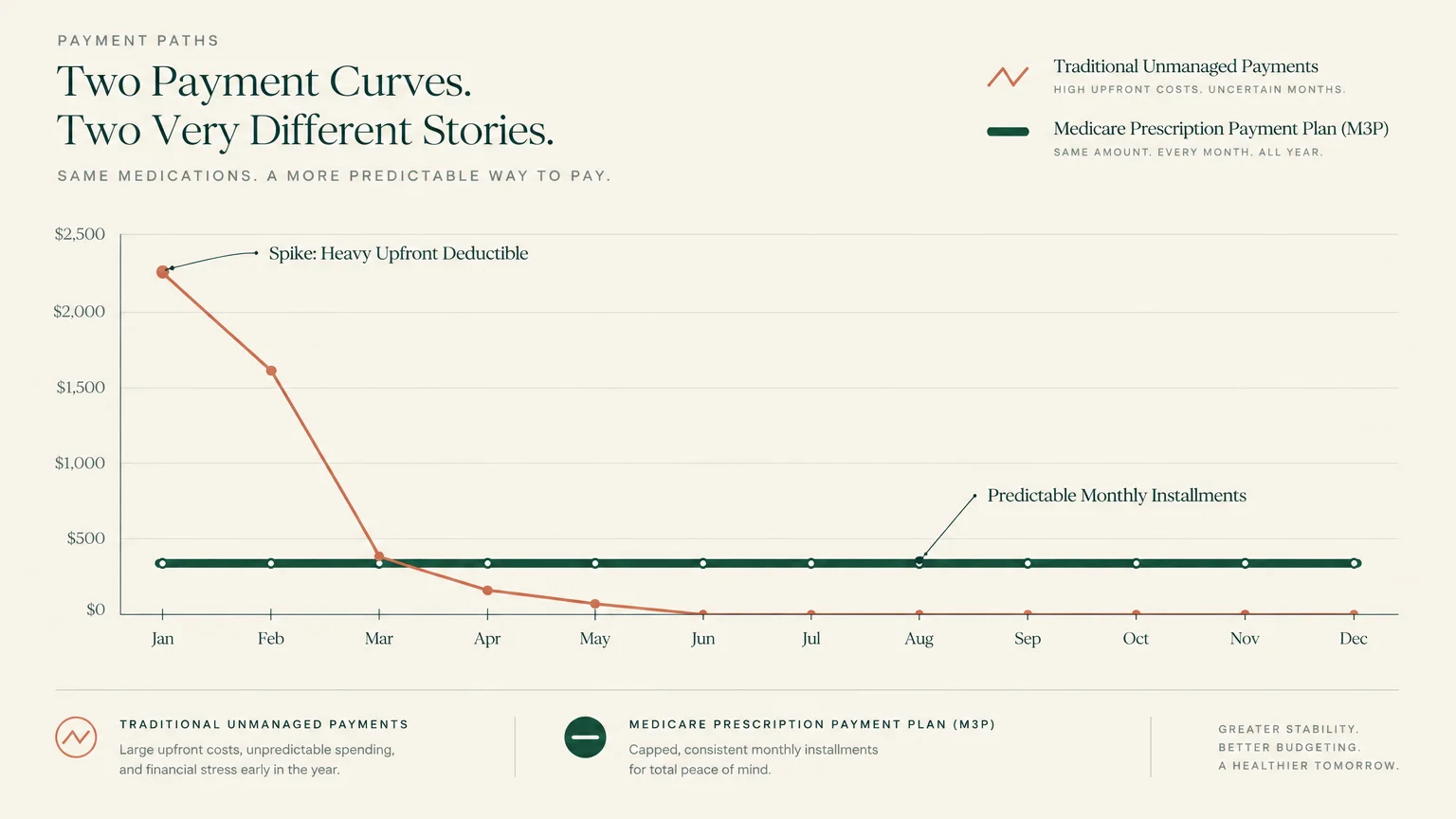
Tip #8: Smooth Out Your Budget With the Medicare Prescription Payment Plan
Even with an annual out-of-pocket cap of $2,100 in 2026 and $2,400 in 2027, paying a large sum at the pharmacy counter in January can strain a fixed retirement budget. If you take expensive brand-name or specialty medications, you might hit your deductible and a hefty coinsurance bill on your very first refill of the year.
Thankfully, you do not have to pay that entire amount all at once at the register. Every Part D plan offers a practical budgeting tool called the Medicare Prescription Payment Plan.
How Monthly Cost Smoothing Works
You can opt into the Medicare Prescription Payment Plan through your Part D provider to spread high out-of-pocket prescription costs into manageable, interest-free monthly payments across the calendar year. Instead of paying the pharmacist when you pick up your medication, you pay $0 at the pharmacy counter.
Your Part D insurance company pays the pharmacy directly and then sends you a monthly bill for your share of the medication costs, separate from your regular monthly plan premium. Because the program charges zero interest and zero fees, you never pay a penny more than you would at the counter.
Notice that this program does not reduce your total drug costs or lower the $2,100 (2026) or $2,400 (2027) cap. Rather, it breaks a painful winter pharmacy bill into predictable monthly installments through December.
Deciding If You Should Opt In
The Medicare Prescription Payment Plan works best if you have high out-of-pocket drug expenses early in the calendar year. Enrolling before January—or right after you pick your plan during open enrollment—gives you a full twelve months to spread out your early-year deductible and coinsurance bills.
If your drug costs are already low and steady every month, or if you receive Extra Help from Medicare, you probably do not need to opt in. Contact your chosen Part D insurer by phone or online right after enrollment if you want to activate this monthly payment option before your first January refill.
Tip #9: Protect Yourself From the Lifelong Late Enrollment Penalty
If you enjoy vibrant health and take zero prescription medications right now, you might feel tempted to skip Medicare Part D altogether. Why pay a monthly premium for prescription drug coverage Medicare offers when your medicine cabinet only holds multivitamins?
Skipping Part D when you first become eligible can trigger a permanent financial surcharge unless you have other qualifying drug coverage. Understanding how Medicare calculates this penalty will help you make a smart, protective decision.
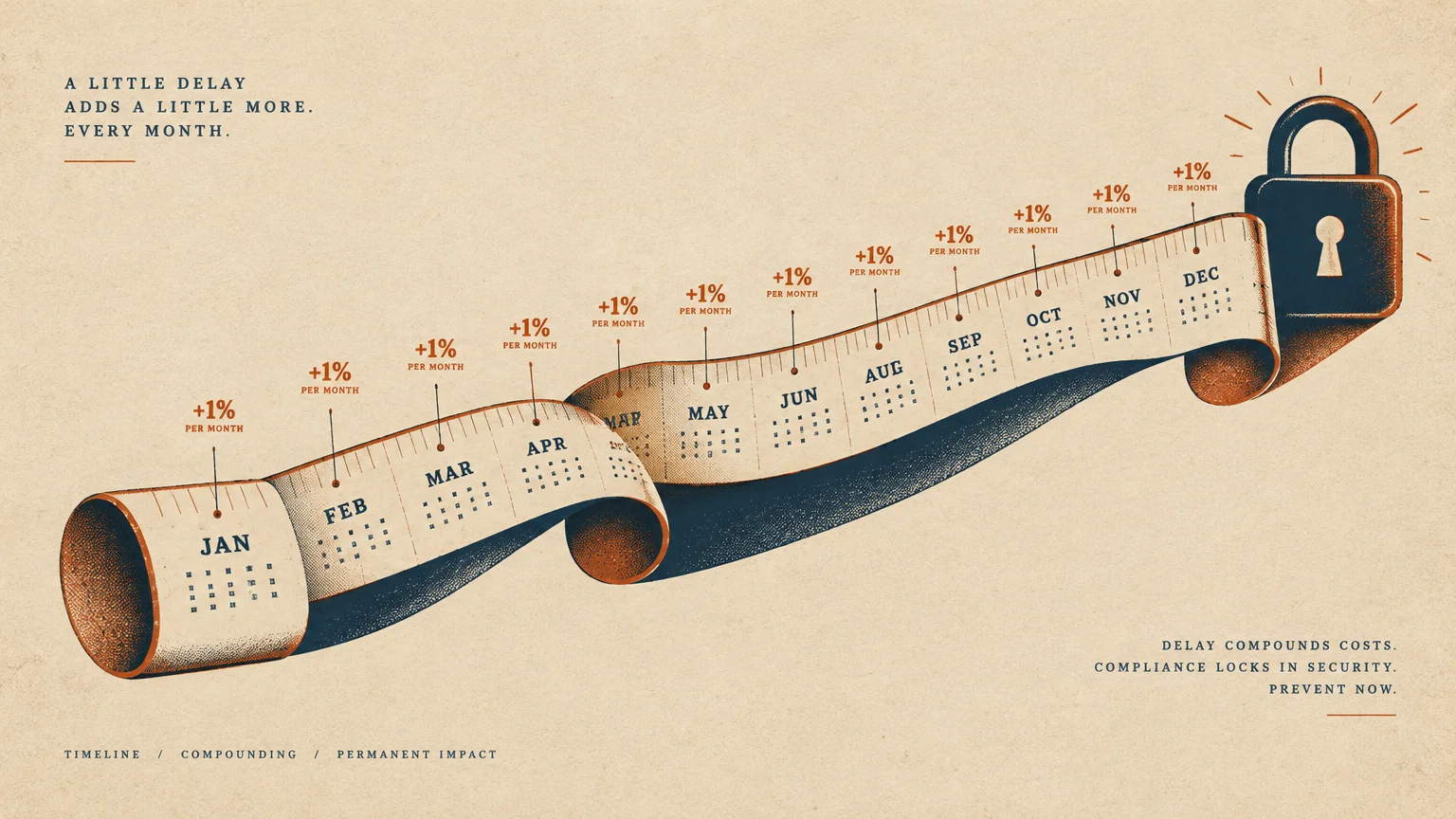
How the 1% Monthly Penalty Adds Up
Medicare assesses a late enrollment penalty if you go 63 or more consecutive days without a Part D plan or other creditable prescription drug coverage after your Initial Enrollment Period ends. Creditable coverage includes health plans from a current employer, a spouse’s employer, a union, TRICARE, or the Department of Veterans Affairs that pay at least as much as standard Part D.
The late enrollment penalty continues to be calculated at an extra 1% of the national base beneficiary premium for each full month you were eligible for Part D, didn’t join, and lacked creditable coverage. The statutory base beneficiary premium is $41.33 for 2027, adhering to the Inflation Reduction Act’s 6% annual growth cap.
If you waited thirty months without creditable coverage before finally joining a Part D plan, you would face a 30% penalty calculated against that $41.33 base figure every single month in 2027. Worse yet, that penalty stays attached to your monthly bill permanently for as long as you have Medicare drug coverage, and it adjusts upward whenever the base beneficiary premium rises.
The Smart Strategy for Healthy Retirees
If you take no medications and lack creditable coverage from an employer or the VA, treat Part D like homeowner’s insurance. Shop for the lowest-premium standalone Part D plan available in your zip code—or consider a $0-premium Medicare Advantage plan that includes drug coverage.
Many regions offer standalone plans with ultra-low monthly premiums designed specifically for healthy retirees. Enrolling in a low-cost plan today keeps your penalty clock at zero and protects you if a doctor prescribes an expensive new medication mid-year, when you normally cannot join a plan until autumn.

Tip #10: Run a Fresh Comparison Every Autumn During Open Enrollment
Choosing a Part D plan is never a “set it and forget it” decision. Insurance companies renegotiate contracts with drug manufacturers and pharmacy chains every single year, which means your current plan can look completely different twelve months from now.
Making an annual habit of reviewing your prescription drug coverage Medicare options takes less than an hour and consistently protects your retirement savings. Put the official enrollment window on your calendar so you never miss your chance to upgrade.
Mark Your Calendar for October 15 Through December 7
The Medicare Open Enrollment Period runs from October 15 through December 7, 2026. Any new Part D plan elections or changes you make during this window take effect on January 1, 2027.
Every September, your current insurance carrier will mail you an important document called the Annual Notice of Change. Open that envelope immediately and check four key details for the coming year: your new monthly premium, your deductible, whether your drugs changed tiers, and whether your pharmacy remains in the preferred network.
With the end of the temporary federal premium stabilization subsidy after 2026 and standalone plan options shrinking by roughly 13% in 2027, reviewing your Annual Notice of Change this autumn is more urgent than ever. If your insurer is discontinuing your plan or raising your monthly rate, you have from October 15 through December 7 to move smoothly into a better policy.
How to Use Free, Objective Comparison Tools
You do not need to rely on television commercials or cold calls from sales agents to run an accurate Part D comparison. Visit the official federal Plan Finder tool at Medicare.gov, where you can log into your secure account, confirm your saved medication list, and sort every available plan in your zip code by lowest total annual cost.
Look closely at the “Total Drug + Premium Cost” column, which automatically factors in your specific deductible, your monthly copays at your chosen pharmacies, and the $2,100 (2026) or $2,400 (2027) out-of-pocket cap. Also check each plan’s Medicare Star Rating—ranging from one to five stars—which measures customer service, pricing accuracy, and member satisfaction.
If you prefer personal guidance from someone who does not earn an insurance commission, reach out to your local State Health Insurance Assistance Program (SHIP). Trained SHIP counselors offer free, confidential, one-on-one help to walk you through your Part D comparison and enroll you before the December 7 deadline.
For a wide range of resources for older adults, visit AARP and the National Council on Aging (NCOA). Health information is available from the National Institute on Aging.

The Takeaway: Living a More Blissful Retirement
Your golden years should be spent enjoying your passions, traveling, and making memories with loved ones—not stressing over surprise bills at the pharmacy counter. By focusing on your total annual out-of-pocket costs rather than just the monthly premium, you put yourself firmly in control of your healthcare budget.
Take full advantage of today’s improved Medicare protections, including the permanent elimination of the coverage gap, the $35 monthly insulin cap, $0 recommended adult vaccines, and newly negotiated prices on 15 additional medications for 2027. Combine those benefits with a preferred pharmacy and the interest-free Medicare Prescription Payment Plan if you want predictable monthly cash flow.
Gather your pill bottles this autumn between October 15 and December 7, 2026, and compare your options with fresh eyes. A thoughtful thirty-minute review today sets you up for a healthier, wealthier, and more blissful year ahead starting January 1, 2027.
Frequently Asked Questions
Should I enroll in a Medicare Part D plan if I don’t take any prescription drugs?
Yes, unless you already have creditable prescription drug coverage through an employer, union, TRICARE, or the VA. Skipping coverage leaves you exposed to a permanent late enrollment penalty of an extra 1% of the national base beneficiary premium ($41.33 in 2027) for every full month you go without coverage.
By picking the lowest-premium standalone plan in your area—or a $0-premium Medicare Advantage plan with drug coverage—you avoid lifelong penalties. You also gain immediate protection if you develop a health condition mid-year that requires costly medication.
What happens when I reach the annual out-of-pocket spending cap on my medications?
Once your out-of-pocket spending on covered Part D prescriptions—including your deductible, copays, and coinsurance—reaches $2,100 in 2026 or $2,400 in 2027, you automatically enter the catastrophic coverage stage. For the remainder of that calendar year, you pay $0 at the pharmacy counter for all covered Part D medications.
Keep in mind that monthly plan premiums and money spent on drugs not covered by your plan’s formulary do not count toward this cap. That is why verifying that all of your expensive medications sit on your plan’s formulary is the single most important step when choosing a Part D plan.
Can my spouse and I just enroll in the exact same Medicare Part D plan?
Medicare Part D plans are strictly individual policies; there are no family or couples plans under Medicare. Even if you and your spouse live in the same household and visit the same pharmacy, you will likely take very different daily prescriptions.
Because each insurer’s formulary favors different medications, the plan that saves your spouse the most money could be an expensive mismatch for your prescriptions. Always run a separate Part D comparison for each spouse and feel completely comfortable enrolling in two different plans.
Why is my standalone Part D plan changing its premium so much for 2027?
While the enrollment-weighted average monthly premium for standalone Part D plans is projected to move only slightly from $35.09 in 2026 to $36.00 in 2027, individual plans can shift dramatically. A temporary federal Premium Stabilization Demonstration initiated in 2025 to hold down standalone Part D premiums officially ends after 2026.
With that federal subsidy ending and the total number of standalone plans shrinking by roughly 13% in 2027, some insurers are adjusting their rates and consolidating plans. Reviewing your options between October 15 and December 7, 2026 lets you switch smoothly to a more competitive policy for January 1, 2027.
Disclaimer: This article is for informational and inspirational purposes only. It is not a substitute for professional medical, financial, or psychological advice. Please consult with a qualified expert for guidance tailored to your individual needs.