

Your sixty-third year unlocks exceptional opportunities to optimize your retirement savings and secure lifetime financial peace. Making thoughtful 401(k) decisions right now shields your nest egg from unexpected financial shocks.
A single uncoordinated withdrawal at age 63 can trigger steep healthcare surcharges and reduce your future income. Fortunately, proactive pre-retirement planning gives you complete control over your wealth.
By coordinating your account distributions with federal tax rules today, you protect your hard-earned assets for decades ahead. Let us explore the critical moves that keep your golden years bright and prosperous.
Tip #1: Coordinate Age 63 Withdrawals to Sidestep the Costly Medicare IRMAA Surcharge Trap
The single most dangerous 401(k) choice you can make at age 63 involves withdrawing substantial taxable sums without examining federal healthcare brackets. Many retirees assume their current taxes remain isolated within the present calendar year.
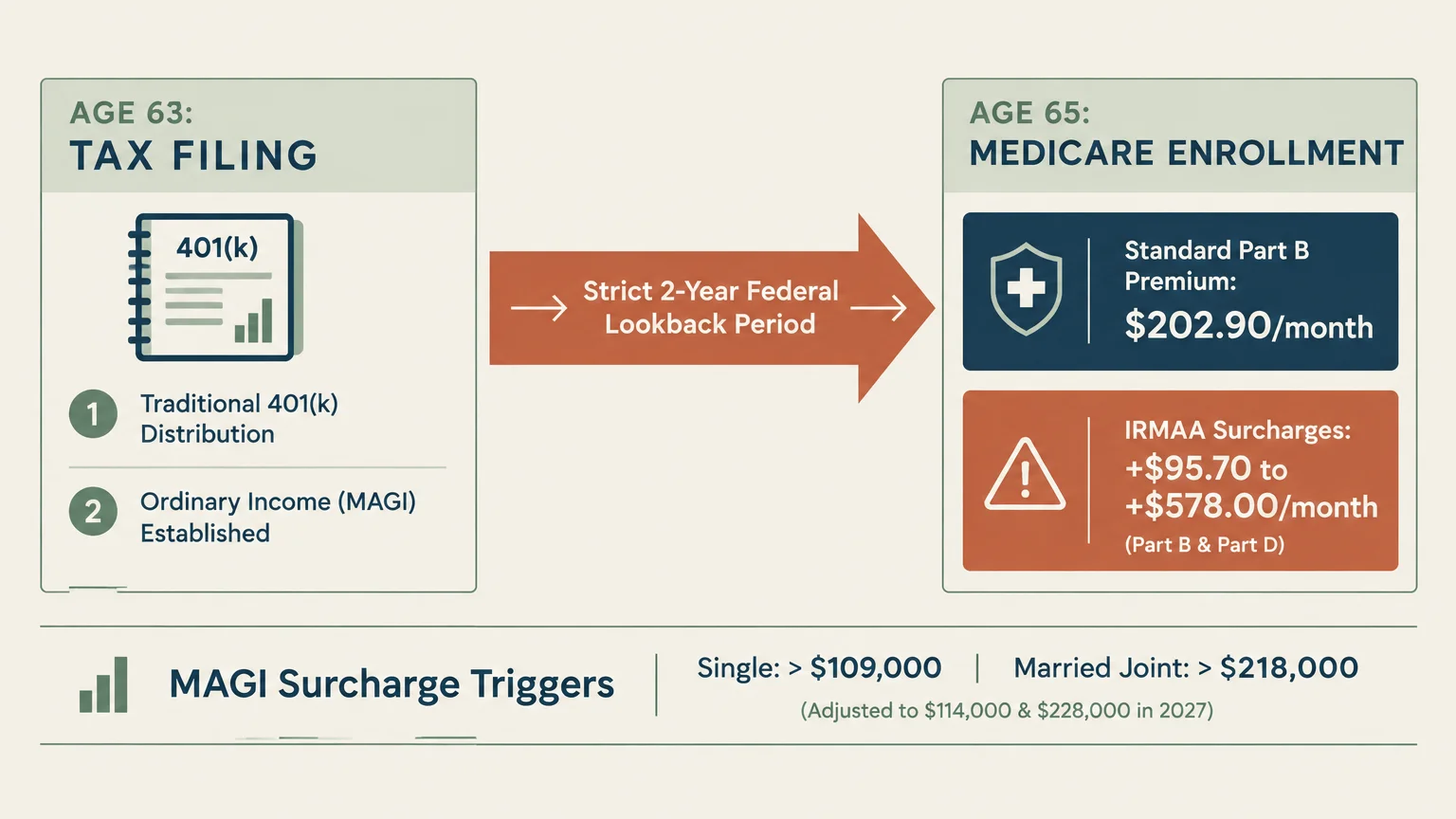
In reality, your age 63 tax return directly controls the healthcare premiums you will pay when enrolling in Medicare at age 65. Withdrawing too much from a traditional 401(k) today creates an expensive ripple effect tomorrow.
Because you reached age 59½ years ago, you can access your retirement savings penalty-free. However, freedom from early withdrawal penalties does not shield you from aggressive ordinary income tax brackets.
Taking large distributions to remodel a home, fund travel, or pay off debt can suddenly inflate your taxable income. That choice echoes directly into your Medicare years with surprising financial consequences.
The Hidden Danger of the Age 63 Medicare Two-Year Lookback
Medicare coverage officially begins at age 65 for most Americans, but the federal government plans your costs far in advance. The Social Security Administration evaluates your income using a strict two-year lookback period.
This means your tax return filed for age 63 establishes your monthly Medicare premiums at age 65. Any spike in traditional 401(k) withdrawals at 63 flows directly onto that pivotal tax return.
The government measures your Modified Adjusted Gross Income, commonly known as MAGI. Traditional 401(k) withdrawals count dollar-for-dollar as ordinary income, driving your MAGI higher with every distribution.
If your MAGI crosses specific statutory thresholds, Medicare imposes the Income-Related Monthly Adjustment Amount, or IRMAA. Suddenly, the money you withdrew at 63 inflates your monthly healthcare bills two years later.
You cannot undo an uncoordinated distribution once the calendar year closes. Careful tax forecasting at age 63 ensures you avoid this silent, costly retirement trap.
How the Income-Related Monthly Adjustment Amount Multiplies Costs
Standard Medicare Part B premiums equal $202.90 per month for standard income levels. When your age 63 MAGI exceeds federal thresholds, that monthly rate increases substantially.
IRMAA surcharges begin when MAGI exceeds $109,000 for single filers or $218,000 for married couples filing jointly. Exceeding those thresholds by even $1 triggers automatic monthly penalties.
These surcharges apply to both Medicare Part B and Medicare Part D prescription drug coverage. Combined surcharges add between $95.70 and $578.00 per month for each individual.
For married couples, both spouses pay the surcharge separately based on that joint tax return. That single dollar over the threshold can cost a couple thousands of dollars across a single year.
For future planning, the married threshold rises to $228,000 and the single threshold rises to $114,000 in 2027. Tracking these precise figures keeps your hard-earned wealth firmly in your hands.
Real-World Scenarios: How a Modest Withdrawal Triggers Big Surcharges
Consider a married couple where one spouse withdraws $30,000 from a traditional 401(k) at age 63. If their combined baseline income already equals $200,000, that withdrawal pushes their total MAGI to $230,000.
Because $230,000 exceeds the $218,000 married threshold, both spouses trigger the IRMAA surcharge tier at age 65. Even a modest withdrawal over the line forces both partners to pay increased Medicare premiums.
Over twelve months, those surcharges add substantial mandatory expenses to their retirement budget. Keeping that distribution just $12,001 lower would have preserved their standard baseline rates.
Single filers face an identical dynamic when income crosses the $109,000 limit. Checking your cumulative annual earnings before taking an autumn distribution protects your monthly cash flow.
The SECURE 2.0 Super Catch-Up: Your Final Window at Age 63
While managing 401(k) withdrawals matters immensely, age 63 also represents an incredible, time-sensitive savings opportunity. Under the SECURE 2.0 Act, workers turning 60, 61, 62, or 63 enjoy enhanced contribution limits.
The standard employee base 401(k) deferral limit sits at $24,500, with projections rising to $25,500. Standard catch-up contributions for workers aged 50 to 59 and 64 and older provide an additional $8,000.
However, workers aged 60 through 63 qualify for a special super catch-up contribution limit of $11,250. This special provision allows you to defer an impressive total of $35,750 into your employer plan.
Age 63 is your absolute final year to capture this higher $11,250 super catch-up amount. In the calendar year you turn 64, your catch-up allowance drops back down to $8,000.
Failing to utilize this final window leaves valuable tax-advantaged savings space permanently on the table. You should note that employers can choose whether to offer this optional super catch-up feature.
Consult your human resources department immediately to confirm your plan provides this enhanced savings benefit. Maximizing your balance today fuels greater peace of mind tomorrow.
If both you and your spouse are age 63 and working, you can each utilize the super catch-up. Together, a couple can defer an extraordinary sum into retirement savings in a single year.
Even if you plan to retire midway through the year, you can accelerate your contributions. Front-loading your deferrals into early paychecks allows you to capture the full $11,250 limit before retiring.
Navigating Mandatory Roth Catch-Up Rules for High Earners
If you enjoy a thriving career earning peak wages at 63, federal rules require extra attention. Section 603 of SECURE 2.0 alters how higher earners make their catch-up contributions.
Workers whose prior-year FICA wages from their sponsoring employer exceeded $150,000 face new mandatory rules. For those individuals, all catch-up contributions must go into a designated Roth account.
This threshold is projected to rise to $155,000, but the core principle remains consistent. High earners can no longer use the $11,250 super catch-up to reduce their current taxable income.
Instead, you must contribute those catch-up dollars using after-tax funds. While this prevents an immediate tax deduction, it builds powerful tax-free wealth for your golden years.
Roth dollars grow tax-free and provide completely tax-free distributions when you need income down the road. Understanding this rule prevents unexpected payroll tax adjustments during your peak earning years.
Remember that the $150,000 threshold looks exclusively at prior-year wages from your current sponsoring employer. If you changed employers recently, your wage history at the prior firm does not count toward this rule.
Take time to review Box 3 of your prior year W-2 form with your payroll team. Understanding your classification ensures your payroll deferrals flow into the correct account without processing delays.
Coordinating 401(k) Distributions with Social Security Claiming
Many individuals at age 63 consider stepping away from work and claiming early Social Security benefits. Anyone reaching age 63 today was born in 1963, establishing a Full Retirement Age of 67.
Claiming Social Security at age 63 permanently slashes your monthly benefit by roughly twenty-five percent. Relying on early 401(k) withdrawals instead to bridge the gap requires meticulous balance.
Draining too much traditional 401(k) capital early risks depleting your market-invested growth assets prematurely. Conversely, claiming Social Security early permanently locks in lower monthly payments for life.
Balancing modest, calculated retirement savings distributions with delayed Social Security benefits creates a stronger financial foundation. Every year you delay claiming Social Security past 63 increases your lifetime guaranteed income.
Evaluating this choice holistically prevents both account exhaustion and unnecessary healthcare premium hikes. Thoughtful coordination protects both your liquid assets and your monthly guaranteed checks.
Avoiding the Social Security Earnings Test Trap
If you decide to semi-retire at 63 while collecting early Social Security, federal earnings limits apply. The Social Security retirement earnings test limit is $24,480, rising to $25,560 in 2027.
If your earned wages exceed this threshold, the Social Security Administration withholds $1 in benefits for every $2 earned above the cap. This withholding surprises many enthusiastic semi-retirees.
Interestingly, 401(k) withdrawals do not count as earned wages toward this federal earnings limit. That rule often tempts individuals at 63 to substitute taxable retirement distributions for active wages.
However, replacing earned income with large traditional 401(k) distributions creates the dangerous IRMAA surcharge lookback problem. You might avoid the earnings penalty only to trigger massive Medicare surcharges at 65.
Navigating this balance requires looking at both earned wages and account distributions together. Harmonizing both income streams preserves your cash flow without inviting administrative penalties.
Strategic Pre-Retirement Planning Before the Age 75 RMD Horizon
Knowing your future distribution deadlines provides clarity when structuring 401(k) withdrawals at age 63. Under SECURE 2.0, individuals born after January 1, 1960 do not face Required Minimum Distributions until age 75.
This gives you an expansive twelve-year planning window between age 63 and age 75. You have ample time to manage your balances without mandatory government withdrawal pressures.
Additionally, SECURE 2.0 completely exempts designated Roth 401(k) accounts from lifetime Required Minimum Distributions. Your Roth savings can continue growing compounded and tax-free for your entire lifetime.
With RMDs deferred until age 75, you do not need to rush large taxable distributions at 63. You can spread withdrawals smoothly across low-income years to stay comfortably below IRMAA thresholds.
Because you do not face mandatory withdrawals until 75, your investments benefit from uninterrupted compounding. Compounding over another decade can double the value of conservative, well-allocated retirement assets.
Design a long-term plan that draws from taxable, tax-deferred, and Roth accounts in balanced proportions. Multi-asset distribution planning smooths your tax exposure across every phase of retirement.
Evaluating Roth Conversions at 63 Without Spiking Your Tax Bracket
Many savers explore converting traditional 401(k) funds into Roth accounts to secure tax-free income. While Roth conversions represent a brilliant wealth-building tool, timing is everything at age 63.
Every dollar converted from a traditional retirement account into a Roth counts as taxable income in the year executed. A massive conversion at 63 can catapult your MAGI above the $109,000 or $218,000 IRMAA limits.
Crossing that line triggers the two-year lookback penalty, increasing your Medicare premiums at 65. The extra healthcare surcharges effectively erode the tax benefits you sought through the conversion.
Instead of executing one massive conversion, consider executing smaller, multi-year partial conversions. Calculate your exact headroom under the IRMAA limits before moving a single dollar.
Targeted partial conversions allow you to grow your tax-free bucket safely. You enjoy the protective benefits of Roth ownership while keeping your Medicare premiums at the base rate.
Coordinating Health Savings Accounts and Healthcare Reserves at 63
If you maintain an active Health Savings Account, age 63 is the ideal time to review your contributions. HSA funds offer triple tax advantages that traditional 401(k) accounts cannot match.
Qualified distributions from an HSA remain completely tax-free and never count toward your Modified Adjusted Gross Income. Using HSA dollars for medical expenses at 63 helps keep your MAGI beneath the IRMAA limits.
However, remember that enrolling in Medicare Part A requires stopping HSA contributions six months prior. Because Medicare backdates coverage up to six months, planning your final contribution window prevents tax penalties.
Utilizing dedicated health reserves shields your traditional retirement savings from premature depletion. You maintain financial flexibility while protecting your future healthcare budgets.
Precision Tax-Bracket Filling: Maximizing Low-Rate Windows
Retirement savers often benefit from taking controlled distributions that fill the lowest federal tax brackets. At age 63, you can withdraw just enough to utilize your standard deduction and lower brackets.
The goal is to avoid crossing the line where IRMAA penalties or higher federal brackets activate. Precise financial modeling reveals exactly how many dollars you can withdraw at optimal rates.
If you leave your current job at 63, your earned income may decline significantly mid-year. That sudden income drop creates a brief, advantageous window to execute targeted withdrawals or small conversions.
Always coordinate these distribution decisions with a certified public accountant or financial planner. Professional tax modeling ensures you capture every available deduction without stepping over dangerous income thresholds.
Addressing Outstanding 401(k) Loans and Employer Matching
Leaving employment at age 63 with an outstanding 401(k) loan presents another potential distribution trap. If you fail to repay the loan balance, your plan administrator treats the unpaid amount as a distribution.
That deemed distribution counts immediately as ordinary taxable income on your annual tax return. An unexpected loan offset can accidentally launch your MAGI past the single $109,000 or married $218,000 threshold.
Review your loan balances carefully before deciding to separate from service or retire. Repaying the balance or rolling it over into an IRA avoids an accidental tax spike.
Simultaneously, verify that you continue capturing every dollar of employer matching contributions while working at 63. Employer matching funds represent guaranteed return on your investment that boosts your nest egg.
Step-by-Step Distribution Tactics for Financial Peace
Creating an intentional withdrawal hierarchy at age 63 ensures your financial independence remains vibrant. Begin by assessing your non-retirement cash reserves and taxable brokerage accounts for immediate spending needs.
Drawing from non-retirement savings allows you to cover lifestyle expenses without artificially inflating your MAGI. This keeps your tax return clean and preserves your eligibility for standard Medicare pricing.
Next, calculate your taxable income baseline, including pensions, part-time wages, and interest. Determine exactly how much room remains before you reach the single $109,000 or married $218,000 threshold.
If you must withdraw from your traditional 401(k), cap your annual distributions beneath that ceiling. Modest, disciplined withdrawals satisfy your cash needs while dodging unexpected federal penalties.
Establish automated monthly transfers from your cash reserves to your checking account to simulate a regular paycheck. Creating this steady income rhythm provides emotional comfort and simplifies household budgeting.
Replenish that cash reserve strategically once each year using carefully timed, tax-efficient distributions. This disciplined cadence prevents reactive withdrawals during sudden stock market swings.
Review your financial plan each autumn alongside a trusted tax professional or financial advisor. Annual checkups ensure your distribution strategy adapts smoothly to updated cost-of-living thresholds and evolving goals.
Protecting Your Mental Well-Being Through Financial Clarity
Retirement planning is not merely an exercise in mathematics; it deeply influences your daily peace of mind. Knowing your healthcare and living expenses remain fully protected brings genuine comfort.
Unexpected tax surprises create unnecessary anxiety during what should be your most joyful season. Taking proactive steps at age 63 replaces uncertainty with unwavering confidence and clarity.
Celebrate the decades of dedicated labor that built your substantial retirement savings. You possess the wisdom and resources necessary to navigate these administrative rules successfully.
Approach your finances with enthusiasm and purposeful intent. A well-crafted distribution strategy frees your energy to focus on family, travel, hobbies, and personal fulfillment.
Common 401(k) Misconceptions to Discard at Age 63
Many savers mistakenly believe that reaching age 59½ means all distribution rules disappear. While the early withdrawal penalty ceases, tax bracket management becomes far more critical than ever before.
Another widespread misconception suggests that you must stop contributing to your 401(k) once you reach your sixties. In truth, staying employed allows you to leverage the powerful $11,250 super catch-up limit.
Some individuals also assume that Medicare premiums remain flat for all enrollees regardless of prior earnings. Recognizing the reality of IRMAA protects your household from unwelcome financial surprises at age 65.
Finally, remember that Required Minimum Distributions will not force your hand until you reach age 75. You hold the steering wheel, allowing you to dictate the pace of your retirement withdrawals.
The Compounding Advantage of Patient Distribution Strategies
Leaving your remaining traditional 401(k) balance invested during your mid-sixties produces incredible compound growth. Money allowed to compound undisturbed can significantly bolster your late-retirement security.
Even moderate investment returns over a ten-year span can expand your portfolio substantially. Protecting your capital from unnecessary early withdrawals ensures your wealth works tirelessly on your behalf.
Coordinate your asset allocation to balance stability with steady, inflation-beating expansion. A well-diversified mix of conservative bonds and high-quality equities provides dependable income throughout retirement.
Pairing disciplined withdrawals with prudent asset management guarantees lasting resilience. Your future self will celebrate the patient choices you implement during your sixty-third year.
Designing a Holistic Bridge to Age 65 and Beyond
Building a successful bridge to age 65 requires integrating healthcare, taxes, and lifestyle expenses into one cohesive plan. Every financial decision you make at 63 directly shapes your upcoming retirement milestones.
Maintain an emergency reserve equal to several months of expenses in a high-yield cash account. Liquid reserves prevent you from raiding your 401(k) during sudden home repairs or medical emergencies.
Examine your private health insurance or COBRA options if you plan to retire before Medicare begins at 65. Securing dependable bridge coverage prevents gap periods and unexpected medical out-of-pocket bills.
Coordinate with your spouse to align retirement dates and tax bracket projections. Shared planning ensures you both maximize available deductions and keep joint income beneath the $218,000 threshold.
Your golden years represent an incredible horizon filled with purpose, freedom, and joy. Guiding your 401(k) choices with knowledge ensures that freedom remains securely funded for life.

The Takeaway: Living a More Blissful Retirement
Your sixty-third year represents an empowering threshold where mindful planning yields extraordinary peace of mind. By mastering the rules surrounding 401(k) withdrawals, you safeguard your future against costly surprises.
Remember that the choices you make today directly influence your Medicare Part B and Part D premiums at age 65. Staying mindful of the $109,000 and $218,000 thresholds protects your hard-earned wealth.
Take full advantage of your final year for the $11,250 SECURE 2.0 super catch-up contribution if you remain employed. Every additional dollar saved now builds greater security for your vibrant golden years.
Equipping yourself with accurate knowledge transforms financial management from a source of stress into an empowering journey. You hold every tool necessary to protect your wealth and thrive.
Celebrate your golden years with enthusiasm, surrounded by the people and passions you cherish most. Your proactive decisions today build a foundation of enduring joy and independence.
Give yourself permission to celebrate your accomplishments and look toward the future with genuine excitement. With thoughtful coordination, a resilient distribution strategy, and clear goals, your retirement will truly be blissful.
Frequently Asked Questions
Can I withdraw from my 401(k) at age 63 without paying a penalty?
Yes, you can access your 401(k) penalty-free because you have surpassed age 59½. However, traditional 401(k) withdrawals remain fully subject to ordinary income tax rates.
These distributions also increase your Modified Adjusted Gross Income, which can trigger Medicare IRMAA surcharges two years later. Always calculate the tax and healthcare consequences before finalizing a withdrawal.
What happens if I turn 64 next year regarding catch-up contributions?
When you enter the calendar year you turn 64, you age out of the enhanced super catch-up limit. Your maximum allowable catch-up contribution decreases from $11,250 to the standard $8,000 allowance.
Age 63 represents your final opportunity to maximize that higher contribution amount under current SECURE 2.0 regulations. Make sure to review your plan options with your employer before year-end.
Do 401(k) distributions count toward the Social Security earnings test?
No, distributions from a traditional or Roth 401(k) do not count as earned wages toward the earnings test. Only wages from active employment or net self-employment earnings count against the $24,480 cap.
However, traditional distributions still increase your overall taxable income and MAGI. That income growth can impact both the taxation of your Social Security benefits and your future Medicare costs.
When must I begin taking Required Minimum Distributions from my 401(k)?
Under SECURE 2.0, anyone born in 1960 or later does not have to take Required Minimum Distributions until age 75. This gives individuals who are 63 today a long, flexible planning runway.
Furthermore, designated Roth 401(k) accounts are completely exempt from lifetime RMDs, matching the rules of Roth IRAs. You can leave your Roth balance untouched to grow tax-free indefinitely.
How do I appeal an IRMAA surcharge if my income drops after retiring?
If your income drops significantly due to retirement, you can file Form SSA-44 with Social Security. Work reduction or work stoppage qualifies as an official life-changing event under federal guidelines.
Filing this form allows the Social Security Administration to use your current lower income instead of the two-year lookback tax return. Successful appeals eliminate unfair surcharges and restore standard Medicare rates.
For a wide range of resources for older adults, visit AARP and the National Council on Aging (NCOA). Health information is available from the National Institute on Aging.
Disclaimer: This article is for informational and inspirational purposes only. It is not a substitute for professional medical, financial, or psychological advice. Please consult with a qualified expert for guidance tailored to your individual needs.