

Securing a bigger Social Security check each month directly enhances your retirement quality and provides real peace of mind. While the annual cost-of-living adjustment (COLA) applies automatically across the board, you do not have to settle for the standard base payout. By taking proactive financial steps today, you can strategically expand your monthly benefit foundation so every future percentage increase yields far more dollar power. For instance, the 2.8% boost for 2026 raised the average monthly retirement check to $2,071, but seniors who optimize their benefits collect significantly more. Discover six actionable, expert-approved strategies to maximize your monthly income, protect your gains from taxes, and elevate your financial freedom throughout retirement.
Tip #1: Delay Your Claiming Age to Compound Your COLA Base
The simplest way to magnify every future COLA bump starts with understanding a fundamental mathematical rule: a percentage increase on a larger base number always delivers a bigger dollar boost. Social Security cost-of-living adjustments calculate as a percentage of your primary insurance amount; therefore, increasing your baseline check directly magnifies the real cash value of every future inflation adjustment.
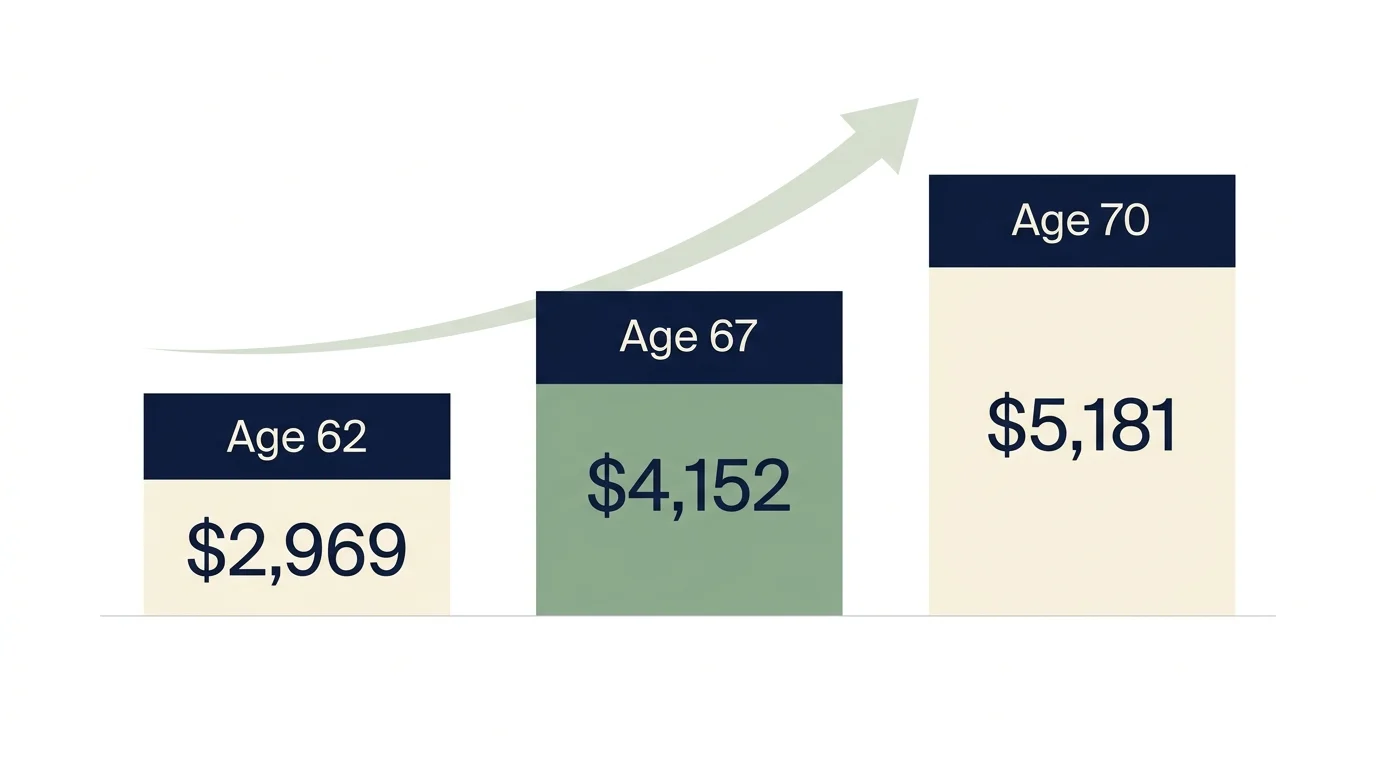
If you choose to claim benefits as early as age 62, your lifetime baseline suffers a permanent reduction of up to 30%. For retirees claiming in 2026, the maximum possible monthly benefit at age 62 stands at $2,969. If you wait until reaching your Full Retirement Age (FRA)—which is officially age 67 for anyone born in 1960 or later—that maximum payout climbs to $4,152 per month.
However, the strategy becomes even more lucrative if you delay past your FRA. The Social Security Administration rewards patience by adding delayed retirement credits to your record. You earn an additional 8% simple interest per year—which breaks down to 2/3 of 1% per month—for every year you wait between age 67 and age 70. By holding out until age 70, the maximum monthly payout skyrockets to $5,181 in 2026.
Consider how this impacts your annual COLA increase. Suppose the government announces a 2.8% cost-of-living adjustment. On a modest $2,000 baseline monthly check, that 2.8% increase adds $56 per month, yielding $672 in extra cash each year. But on a maximized $4,000 monthly check, that exact same 2.8% adjustment delivers $112 per month, placing $1,344 of extra income in your pocket annually. Delaying your claim builds a massive baseline that compounds with every single COLA announcement for the rest of your life.
Tip #2: Optimize Your Earnings Test Limits if You Work in Retirement
If you enjoy staying active in the workforce after starting your Social Security benefits, you can turn your job into a tool for future benefit growth. Many seniors worry that working while receiving benefits permanently penalizes their income, but understanding the official Retirement Earnings Test rules allows you to leverage ongoing work to your advantage.
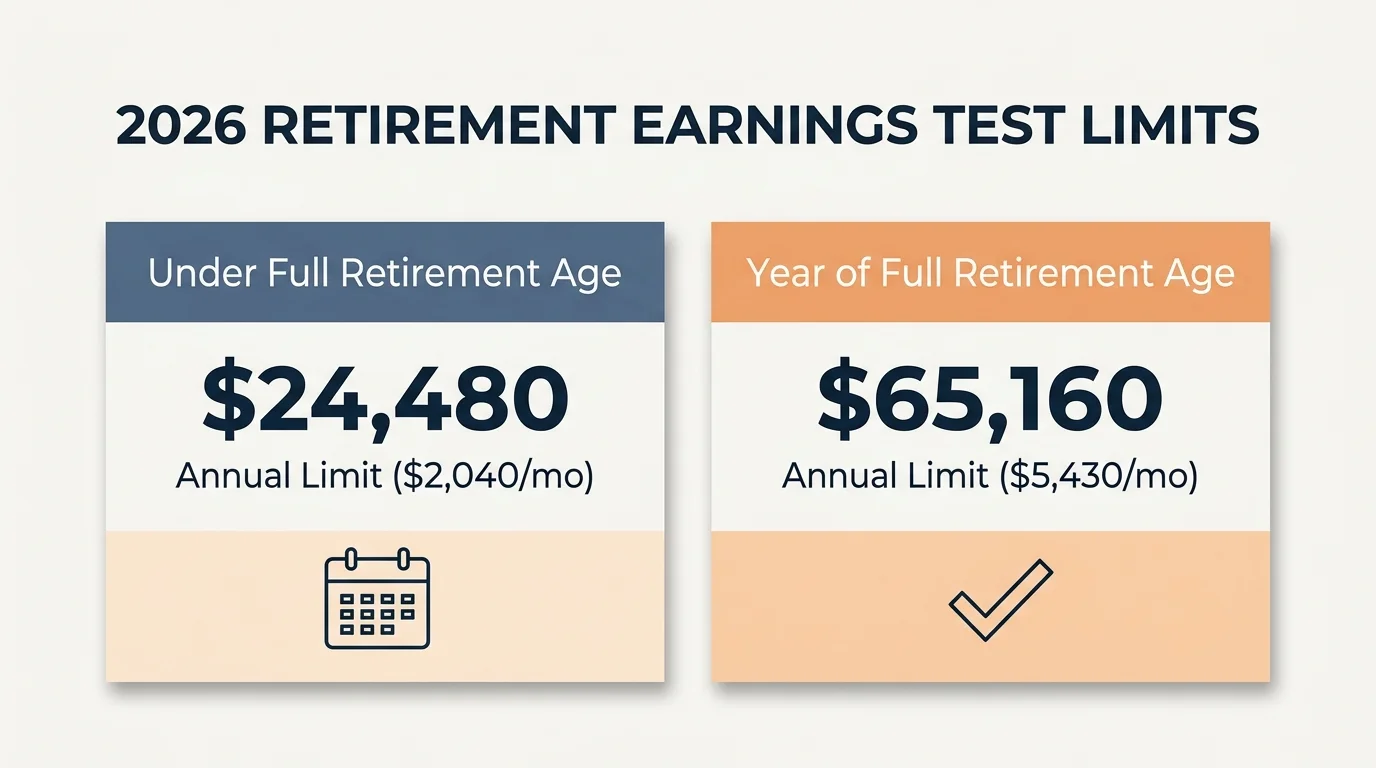
When you work while collecting Social Security prior to reaching your Full Retirement Age, the government applies specific income caps. For 2026, the exempt earnings limit for individuals under FRA all year is $24,480 annually ($2,040 per month). If your job pays you more than this threshold, Social Security temporarily withholds $1 of benefits for every $2 you earn above $24,480.
In the specific calendar year you reach your Full Retirement Age, the threshold expands dramatically to $65,160 annually ($5,430 per month). During that final stretch, Social Security only withholds $1 for every $3 earned over the limit up until the exact month you reach age 67. Once you reach your FRA, the earnings test disappears entirely; you can earn an unlimited income without losing a single cent from your monthly check.
Here is where the major benefit hidden in the fine print comes alive: withheld benefits are never truly lost. Once you cross your Full Retirement Age threshold, Social Security automatically recalculates your benefit amount to credit back all the payments withheld during your working years. This adjustment permanently increases your baseline check. Because your baseline jumps, every subsequent annual COLA percentage applies to this newly elevated figure, giving you a bigger payout every single January.

Tip #3: Replace Low-Earning Years in Your 35-Year Calculation Base
The Social Security Administration calculates your core benefit baseline using your Average Indexed Monthly Earnings (AIME) across your highest 35 earning years. If you logged fewer than 35 years of taxed work over your lifetime, Social Security fills in those empty slots with zeros. Even a single zero in your calculation record drops your baseline average significantly, suppressing your payout and weakening every future COLA.
You can eliminate these baseline drags by continuing to earn income today. Every year you work in your 50s, 60s, or beyond can displace an earlier year from your record. Because wages late in your career are often significantly higher than wages earned early in your working life, replacing low or zero-earning years with modern earnings pushes your overall average upward.
For 2026, the maximum amount of income subject to Social Security payroll tax is $184,500—up from $176,100 in 2025. High-earning seniors who work even a year or two longer near this wage cap effectively erase early career years, such as part-time summer jobs from college, from their calculation history.
To put this tip into practice, create or log into your personal account on the official Social Security Administration website. Carefully review your earnings statement for accuracy and identify any years with low or zero recorded income. Taking on consulting projects, freelancing, or working part-time for a couple of extra years replaces those bottom figures, permanently lifting your baseline check and maximizing your annual COLA returns.

Tip #4: Prevent Medicare Part B Premiums from Eroding Your Gains
Receiving a generous COLA announcement feels wonderful, but many retirees experience disappointment when they look at their actual bank statements in January. Why does this happen? Because Medicare Part B premiums automatically deduct from most Social Security checks before the net funds reach your bank. If rising Part B costs swallow up your raise, your real purchasing power stays flat.
To protect your net COLA boost, you must manage your taxable income to avoid triggering Medicare’s Income-Related Monthly Adjustment Amount (IRMAA). IRMAA acts as a surcharge added to your standard Part B and Part D premiums if your Modified Adjusted Gross Income (MAGI) from two years prior exceeds specific government tiers. Crossing an IRMAA threshold by even a single dollar forces you to pay significantly higher Medicare premiums, effectively swallowing your entire annual COLA raise.
You can prevent IRMAA surcharges by implementing smart, tax-efficient withdrawal strategies in retirement. Instead of pulling large cash sums from traditional tax-deferred IRAs or 401(k)s—which count directly toward your MAGI—pull excess retirement funds from Roth accounts, which offer completely tax-free distributions that do not trigger IRMAA surcharges.
Additionally, if you are age 70½ or older, consider utilizing Qualified Charitable Distributions (QCDs). A QCD allows you to transfer funds directly from a traditional IRA to an eligible charity without counting that money as taxable income. By keeping your taxable income below IRMAA thresholds, you preserve every single dollar of your cost-of-living adjustment.

Tip #5: Coordinate Spousal and Survivor Benefits for Maximum Growth
Social Security optimization is rarely a solo venture for married couples. By coordinating your claiming timeline with your spouse, you can strategically maximize your joint household baseline, ensuring that future COLA increases multiply a much larger combined benefit pool.
Spousal benefits allow a husband or wife to receive up to 50% of their partner’s Full Retirement Age benefit amount if that payout exceeds their own individual record. However, the most critical coordination strategy involves survivor benefits. When one spouse passes away, the surviving partner retains the larger of the two monthly Social Security checks while the smaller check stops.
Because of this rule, it is usually wise for the higher-earning spouse to delay claiming until age 70. Delaying accumulates an 8% annual growth rate through delayed retirement credits, elevating the primary check to its absolute maximum limit—such as the $5,181 maximum cap in 2026. Every annual COLA then compounds on top of this maximized primary check.
When the higher-earning spouse eventually passes away, the surviving spouse steps into that elevated payment amount, inheriting the maximized benefit baseline along with all the compounded COLA gains accrued over the years. If you are divorced after at least 10 years of marriage, remember that you may also claim spousal or survivor benefits based on your ex-spouse’s earnings record, offering another avenue to boost your household baseline without impacting their personal payout.
Tip #6: Reduce Taxes on Your Benefits to Keep More of Your COLA Boost
A higher gross COLA check increases your top-line income, but federal income taxes can quietly strip away those financial gains if you aren’t careful. Depending on your combined income level, up to 85% of your Social Security benefits can become subject to federal income tax.
The Internal Revenue Service calculates taxability on Social Security using a formula known as provisional income. Your provisional income equals your Adjusted Gross Income (AGI), plus any non-taxable interest income, plus 50% of your total Social Security benefits.
If you file taxes as an individual and your provisional income falls between $25,000 and $34,000, up to 50% of your benefits are taxable. If your provisional income exceeds $34,000, up to 85% of your Social Security check becomes taxable. For married couples filing jointly, up to 50% of benefits are taxable if provisional income sits between $32,000 and $44,000; exceeding $44,000 subjects up to 85% of your benefits to federal income tax.
To shield your annual COLA increase from tax erosion, manage your income streams deliberately. Prioritize distributions from non-taxable accounts like Roth IRAs, structure taxable brokerage capital gains carefully across low-income years, and avoid unnecessary withdrawals that push you into higher provisional income brackets. Keeping your provisional income below these key benchmarks ensures that your annual COLA raise stays in your wallet rather than going to the tax collector.

The Takeaway: Living a More Blissful Retirement
Your golden years offer a wonderful opportunity to focus on personal happiness, health, family, and adventure. By actively applying these six smart strategies, you take complete ownership of your financial baseline—ensuring that every annual Social Security cost-of-living adjustment delivers meaningful, lasting financial growth to your household.
Whether you choose to delay your initial claim to age 70, replace low-earning years, manage your income to avoid Medicare IRMAA surcharges, or coordinate spousal strategies, every positive decision expands your monthly cash flow. Embrace these practical steps, consult with a trusted financial planner to tailor them to your personal scenario, and step confidently into a bright, blissful, and financially secure retirement!
For a wide range of resources for older adults, visit AARP and the National Council on Aging (NCOA). Health information is available from the National Institute on Aging.
Disclaimer: This article is for informational and inspirational purposes only. It is not a substitute for professional medical, financial, or psychological advice. Please consult with a qualified expert for guidance tailored to your individual needs.
Frequently Asked Questions
How is the official Social Security COLA calculated each year?
The Social Security Administration determines the annual COLA by evaluating inflation trends through the Consumer Price Index for Urban Wage Earners and Clerical Workers (CPI-W). Official calculations compare the average CPI-W figures during the third quarter (July, August, and September) of the current year against the third quarter average of the previous year. If there is a percentage increase, benefits rise by that exact percentage starting with payouts the following January.
What was the COLA percentage for 2026 and how did it affect checks?
The COLA increase for 2026 was set at 2.8%, which was officially announced in October 2025 and took effect with benefits paid in January 2026. This adjustment boosted the estimated average monthly retirement check across the nation from $2,015 in 2025 up to $2,071 in 2026, providing seniors with an average monthly gain of $56 to help offset inflationary living expenses.
Does working while receiving Social Security permanently lower my COLA boost?
No, working does not permanently lower your COLA or your benefit payout. Although earning over the Retirement Earnings Test exempt limits ($24,480 in 2026 for those under Full Retirement Age) results in temporary benefit withholdings, Social Security recalculates your baseline check once you reach your Full Retirement Age (age 67 for those born in 1960 or later). This recalculation restores those withheld funds into your permanent baseline payout, which subsequently increases the dollar value of every future COLA raise.
How much does delaying Social Security past Full Retirement Age increase my benefit check?
Delaying your Social Security claim past your Full Retirement Age earns you delayed retirement credits at a rate of 8% simple interest per year (or 2/3 of 1% per month). You can accrue these credits until you reach age 70. In 2026, while the maximum benefit at Full Retirement Age is $4,152 per month, delaying until age 70 increases the maximum potential monthly payout to $5,181.