

Zero-dollar monthly premiums look irresistible when you are budgeting for travel, hobbies, and family visits in retirement. Yet those glossy brochures rarely show the surprise medical bills that can sideline your plans.
Understanding Medicare Advantage hidden costs helps you protect your savings before a health scare hits. A smart Medicare plan comparison keeps your retirement cash flowing toward the experiences you actually enjoy.
Today, 55% of eligible Medicare beneficiaries—35.2 million of 64.2 million people—choose private Advantage plans, according to KFF. Knowing what those contracts omit puts you firmly in charge of your golden years.
Hidden Cost #1: The Zero-Dollar Premium Illusion and Income Surcharges
Many retirees see zero-dollar plan ads and assume their monthly healthcare bill vanishes. In reality, you still pay the standard Medicare Part B premium every single month unless a plan rebate specifically covers part of it.
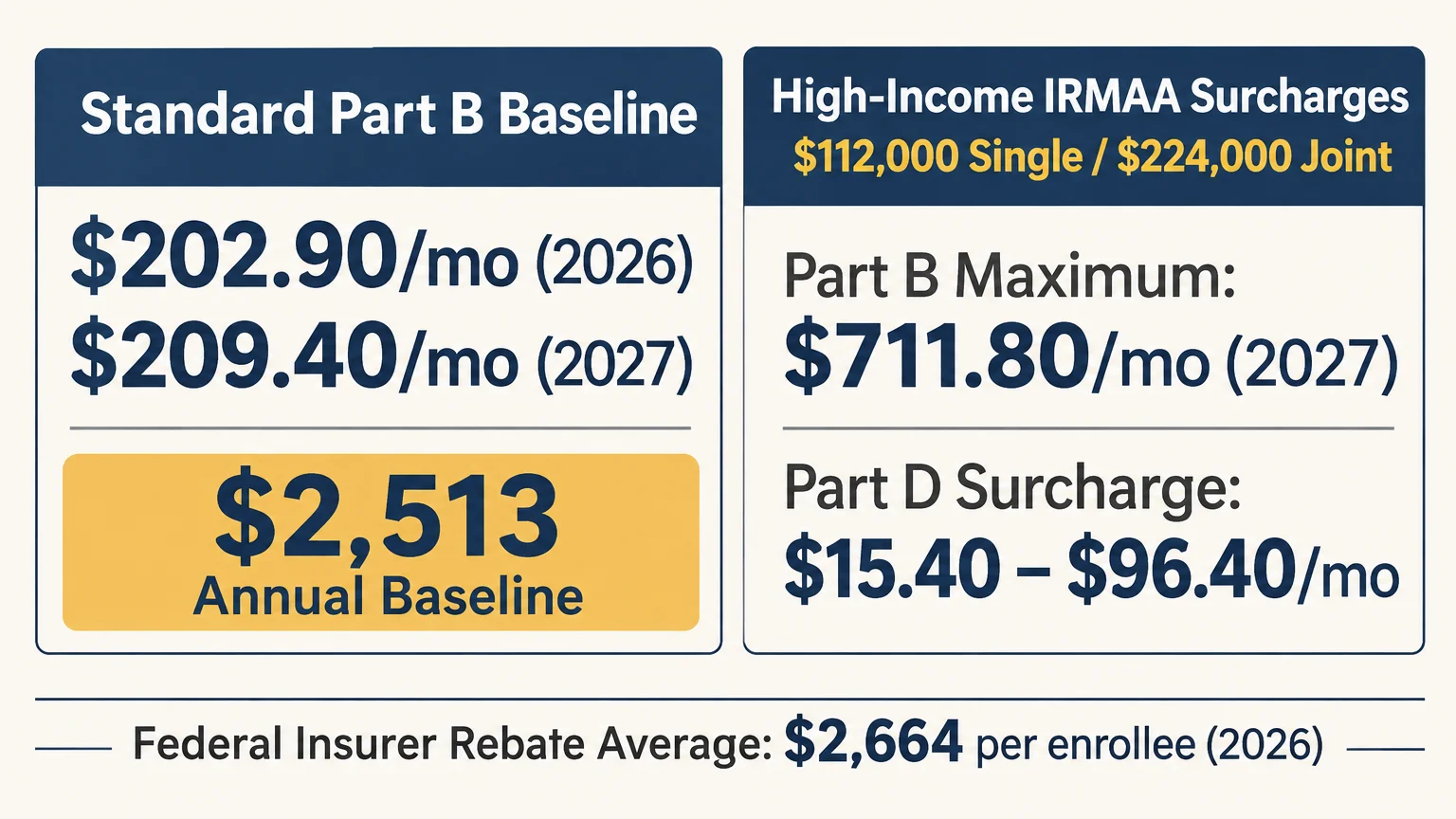
CMS reports that the standard Part B premium sits at $202.90 per month in 2026 and climbs to $209.40 per month in 2027. That single line item trims nearly $2,513 from your annual budget before you visit a doctor.
Higher earners face an even steeper surprise through the Income-Related Monthly Adjustment Amount, known as IRMAA. If your 2025 modified adjusted gross income tops $112,000 as a single filer or $224,000 jointly, surcharges kick in automatically.
CMS figures show high-income retirees pay up to $711.80 monthly for Part B in 2027, plus an extra $15.40 to $96.40 per month for Part D drug coverage. Selling a home or taking large retirement withdrawals can trigger those higher tiers.
Private insurers market low premiums because the federal government subsidizes them heavily. MedPAC notes that Washington pays Advantage insurers roughly 14% more per enrollee than traditional Medicare, totaling about $76 billion in extra annual federal spending.
KFF data shows those insurers receive an average federal rebate of $2,664 per enrollee in 2026 to fund perks and trim upfront premiums. You still shoulder the copays whenever you actually use medical care.
Check your tax strategy with a financial advisor before Roth conversions or property sales push your income past IRMAA thresholds. Planning withdrawals early preserves more of your monthly Social Security check for weekend getaways and grandkid outings.
Hidden Cost #2: Sky-High Out-of-Pocket Maximums During Serious Illness
Healthy years on a private plan feel effortless because routine checkups cost almost nothing. Everything changes when a major diagnosis turns small copays into a steady drain on your checking account.
CMS sets federal ceilings on Medicare Advantage out of pocket medical spending each year. For covered Part A and Part B services, the federal cap sits at $9,250 in-network and $13,900 combined for PPOs in 2026.
Those federal limits jump roughly 6.5% for the 2027 plan year, reaching $9,850 in-network and $14,800 combined. A single rough year of cancer treatment or orthopedic surgery can push your household bills right toward that ceiling.
Actual plan averages still pack a punch for fixed-income budgets. KFF reports that the 2026 enrollment-weighted average cap reaches $5,421 in-network—$4,636 for HMOs versus $6,592 for PPOs—and $9,825 combined for PPO plans.
Location shapes your financial exposure, too, especially if you love quiet country living. KFF data reveals that rural Advantage enrollees face higher average in-network caps than urban neighbors, at $6,078 compared with $5,291.
Worst of all, that medical spending ceiling leaves major bills completely untouched. Both KFF and NCOA emphasize that your monthly Part B, plan, and Part D premiums do not count toward your out-of-pocket limit.
Prescription drug expenses sit outside that medical cap as well. A retiree battling a chronic condition can hit the full medical cap and still pay thousands more at the pharmacy counter.
Build a dedicated healthcare emergency fund equal to your plan’s maximum out-of-pocket limit before booking nonrefundable cruises or tours. Knowing that cash sits safely in reserve lets you enjoy every trip without financial anxiety.

Hidden Cost #3: Separate Prescription Caps and Jumping Drug Deductibles
Pharmacy bills catch many seniors off guard because medical and drug budgets run on entirely separate tracks. Even after you hit your plan’s medical limit, your prescription copays keep ticking until they hit a second annual ceiling.
Under the Inflation Reduction Act, CMS and Medicare.gov confirm that the Part D annual cap rises from $2,100 in 2026 to $2,400 in 2027. That cap launched at $2,000 in 2025, so upper limits are already creeping upward.
Upfront pharmacy deductibles are climbing alongside that cap. Federal rules raise the maximum allowed Part D deductible from $615 in 2026 to $700 in 2027, creating a heavier January hit for retirees on brand-name medications.
Don’t let lower headline drug premiums fool you during fall shopping season. While CMS projects average drug premiums inside Advantage plans will dip from $11.32 in 2026 to $7.00 in 2027, Avalere Health warns that prescription deductibles inside those plans jump 30% on average.
There is good news worth factoring into your math, though. Covered insulin stays capped at $35 per month, and recommended adult vaccines remain $0 under current Part D protections.
Meanwhile, comparing Medicare Advantage vs Original Medicare on prescriptions requires looking closely at standalone Part D rates. KFF notes that seniors keeping Original Medicare and staying in the same standalone drug plan face an average 50% premium hike from $34 to $51 monthly in 2027.
KFF also points out that non-low-income-subsidy enrollees on Original Medicare will find zero $0-premium standalone drug options in 2027. Shopping your exact medication list each autumn saves hundreds of dollars regardless of which path you pick.
Run every current prescription through the official plan finder tool every October, paying close attention to tier placement and deductible rules. Ask your doctor whether safe generic alternatives or 90-day mail-order refills lower your annual pharmacy tab.
Hidden Cost #4: Prior Authorization Roadblocks and Post-Acute Care Denials
Time and independence matter just as much as cash when you are eager to get back on the golf course or dance floor. Insurer gatekeeping often stalls critical care right when your body needs swift recovery.
KFF reports that 99% of Advantage enrollees need prior authorization for certain medical services like inpatient hospital stays and chemotherapy. Furthermore, 95% of enrollees in 2026 face prior authorization hurdles for skilled nursing facility stays.
Original Medicare works very differently, requiring prior authorization only for a tiny list of specific items and outpatient procedures. Private plans instead review treatments upfront and frequently say no.
Federal transparency figures reveal just how often insurers block care. In CMS’s first mandatory payer-reported data for 2025 analyzed by KFF, Advantage insurers denied 12% of standard requests—ranging from 5% at Elevance to 17% at UnitedHealth Group—and 10% of expedited requests.
Earlier 2024 CMS data tracked by KFF showed insurers fully or partially denied 4.1 million requests, or 7.7% of all requests. Yet enrollees appealed only 11.5% of those denials.
When patients do push back, they win most of the time. KFF found that appeals overturned 67% of appealed Advantage denials in the 2025 dataset, proving how many initial rejections fail to hold up under scrutiny.
Recovery after a fall or stroke carries the steepest denial risk. HHS Office of Inspector General reports analyzed by KFF show plans initially denied 65% of long-term care hospital requests, 54% of inpatient rehab requests, and 12% of skilled nursing requests.
Even approved rehab stays can end abruptly before you regain full strength. A 2025 nursing home survey from AHCA and Plante Moran found that 67% of skilled nursing providers saw Advantage plans cut off coverage early against medical advice.
Those sudden cutoffs force families to choose between discharging an unready loved one or paying out of pocket. New CMS rule CMS-0057-F requires 72-hour expedited and 7-day standard medical decisions starting in 2026, plus electronic authorization systems in 2027.
Keep copies of every doctor note and never accept an initial denial or early rehab discharge notice at face value. File an expedited appeal immediately with your physician’s backing so your recovery stays on track.

Hidden Cost #5: Narrow Doctor Networks and Unexpected Hospital Walkouts
Part of the joy of retirement is splitting time between seasons, visiting out-of-state grandkids, or seeing top specialists when an ache flares up. Restrictive provider networks quietly shrink those freedoms.
A KFF report cited by the American Hospital Association shows Advantage enrollees can see an average of only 48% of the doctors available to Original Medicare beneficiaries locally. Worse yet, high government Star Ratings do not guarantee a broad physician network.
More than half of Advantage enrollees hold HMO plans, according to KFF. Outside true emergencies, HMO contracts typically pay zero toward out-of-network visits, leaving you holding 100% of the bill.
Even snowbirds and frequent travelers with PPO plans face steeper out-of-network copays and higher combined spending caps. Seeing an out-of-network specialist while visiting family across the country can quickly wreck your vacation budget.
Worse still, major medical centers are actively walking away from private Advantage contracts mid-relationship. Becker’s Hospital Review tracked 41 health systems dropping or announcing contract breaks with Advantage insurers during 2026.
That list includes trusted regional giants like Vanderbilt Health, BJC HealthCare, Fairview Health Services, NewYork-Presbyterian, and Ohio State Wexner. Hospitals cite frequent prior authorization denials and slow or inadequate insurer payments as their main reasons for leaving.
When your longtime hospital leaves your plan’s network, you face an agonizing choice. You either switch doctors during ongoing care or pay massive out-of-network charges to stay with the team you trust.
Call your primary physician, specialist offices, and preferred local hospital billing desk directly every fall to confirm next year’s contracts. Online insurer directories often lag behind real-world breakups, so direct phone confirmation protects your care.

Hidden Cost #6: Shrinking Perks and Sudden Plan Exits
Free gym memberships, dental credits, grocery cards, and ride vouchers draw millions of retirees into private plans. Behind the scenes, insurers are quietly trimming those extras and even shutting down entire plans.
Market power sits heavily with just two companies. KFF reports that UnitedHealthcare and Humana control 46% of all Medicare Advantage enrollment in 2026, meaning corporate profit shifts ripple across millions of households at once.
An Avalere Health analysis of 2027 CMS data shows noticeable cuts across popular extras. While dental remains on 96% of plans, vision on 98%, and hearing on 95%, other everyday benefits are disappearing fast.
Avalere Health, Better Medicare Alliance, and Leerink Partners data reveal 21% fewer plans offering meals—dropping from 61% to 49%—alongside 15% fewer plans offering medical rides, falling from 38% to 33%. Over-the-counter allowances drop 6% from 66% to 58% of general plans, fitness perks dip 5%, and dental caps and Part B givebacks shrink too.
Many retirees never tap those advertised perks anyway. The Commonwealth Fund 2024 Value of Medicare Survey found that 3 in 10 Advantage enrollees used zero supplemental benefits in the prior year, while only 42% used dental and 41% used vision.
Adding insult to injury, CMS rescinded the rule requiring plans to send mid-year reminders about unused perks for 2027. Without reminders, free dental cleanings and OTC dollars expire unused every December.
Entire plans are vanishing in some neighborhoods, too. KFF reports that about 3.1 million Advantage prescription drug enrollees—2.8 million in general plans and 300,000 in Special Needs Plans—will lose their current plan at the end of 2026.
Across 193 counties housing 638,000 beneficiaries, zero general-enrollment Advantage drug plans will operate in 2027, up from 123 counties in 2026. If your plan folds, you must scramble during fall enrollment to replace coverage before January 1.
Calculate the real dollar value of perks you actually used over the past twelve months before picking a plan for its bonus gifts. Put calendar alerts on your phone every quarter so dental cleanings and allowance credits never go to waste.
Hidden Cost #7: The Medigap Underwriting Trap When You Try to Switch
Many seniors sign up for an Advantage plan at 65 thinking they can easily switch to Original Medicare with a Medigap supplement later if health declines. That single assumption creates one of the costliest Medicare costs retirees face.
Original Medicare has no annual out-of-pocket cap and charges 20% Part B coinsurance after an annual deductible of $283 in 2026 or $292 in 2027. CMS also sets the 2027 Part A hospital deductible at $1,776 per benefit period—up from $1,736 in 2026—plus $444 daily for hospital days 61 through 90 and $222 daily for skilled nursing days 21 through 100.
To cover those open-ended gaps, 46% of Original Medicare beneficiaries purchase a private Medigap policy, according to KFF. Medigap pays most or all of that 20% coinsurance and lets you visit virtually any Medicare-accepting doctor nationwide without prior authorization.
Here is the catch that blindsides retirees years later. CMS Publication 02110 and KFF explain that federal law grants just one guaranteed 6-month Medigap Open Enrollment Period starting the month you are 65 or older and enrolled in Part B.
Outside that starter window, federal law gives you only narrow escapes, such as two 12-month Advantage trial rights or guaranteed-issue protection if your plan leaves your area—provided you apply 60 days before to 63 days after coverage ends. After those windows close, most states let Medigap insurers use medical underwriting.
Under medical underwriting, insurers review your health history and can charge dramatically higher monthly rates or reject your application outright for heart disease, diabetes, cancer, or arthritis. Only Connecticut, Massachusetts, Maine, and New York require continuous or annual guaranteed issue for ages 65 and older, alongside narrower protections in states like Minnesota, Rhode Island, and Delaware.
If you live in any other state and develop a chronic illness while on Advantage, you can find yourself locked out of affordable Medigap policies for life. Switching back to Original Medicare without Medigap leaves you exposed to uncapped 20% hospital and doctor bills.
Weigh that long-term Medigap protection carefully when you turn 65 or during your first 12-month Advantage trial window. Paying a predictable Medigap premium early can safeguard your freedom to choose any top specialist nationwide at age 75 or 80.
Putting It into Practice: Small Steps for Big Changes
Sorting through healthcare paperwork rarely sounds fun, yet taking one calm afternoon to audit your plan frees your mind for the adventures ahead. Treat your annual checkup like tuning up your car before a cross-country road trip.
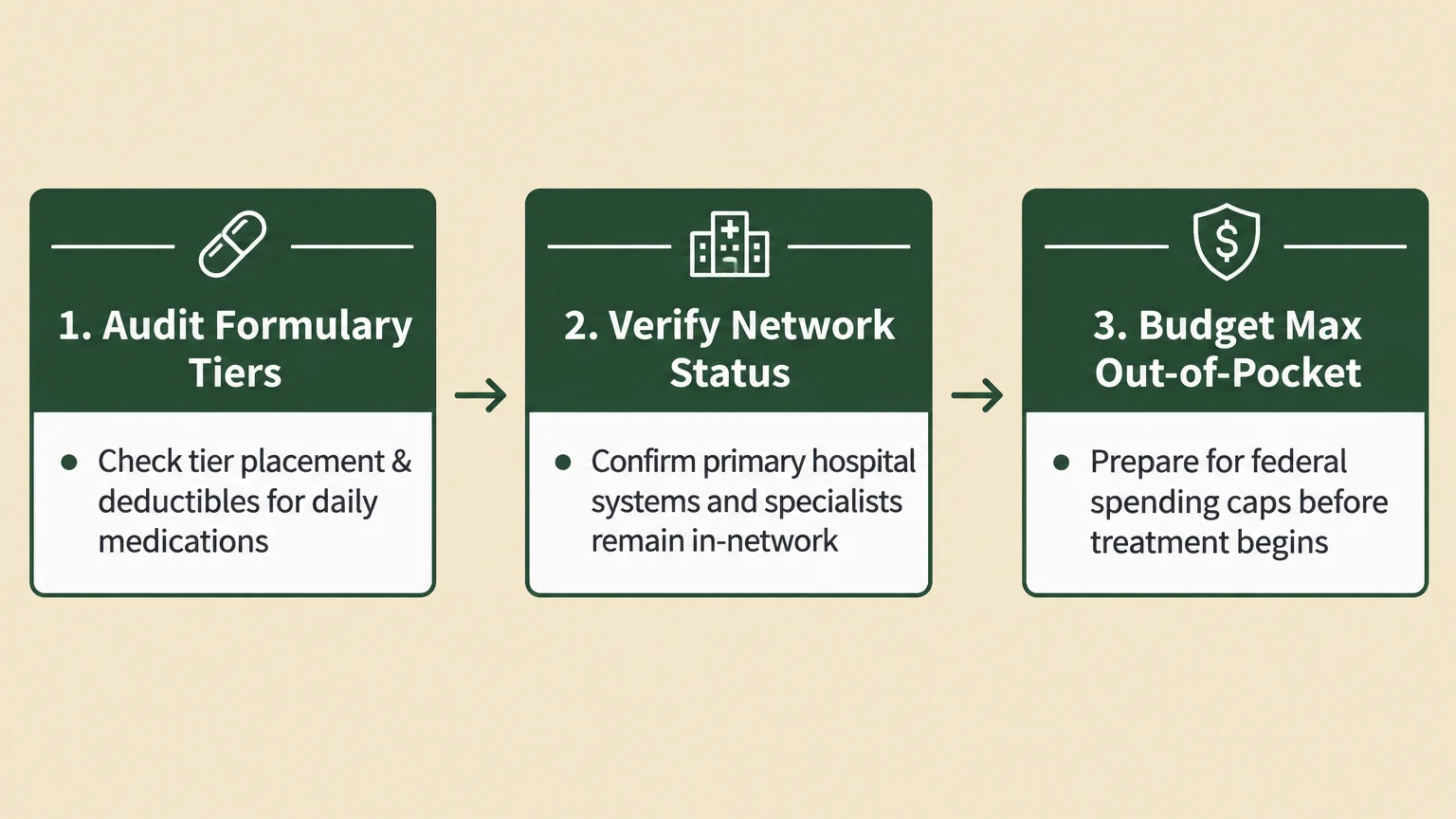
Grab last year’s medical receipts and tally every copay, drug bill, and denied claim you faced. Seeing your actual annual spending on one sheet of paper makes Medicare plan comparison crystal clear.
Mark Medicare’s two big calendar windows right on your kitchen wall. Medicare.gov confirms you can switch plans during Fall Open Enrollment from October 15 through December 7 for January 1 coverage, or use the Medicare Advantage Open Enrollment Period from January 1 through March 31 for one single switch.
Next, pick up the phone and verify your doctors, hospital system, and medications against your Annual Notice of Change letter arriving each September. Confirming those three essentials protects you from surprise spring bills.
If you feel overwhelmed by rules in your state, reach out to your local State Health Insurance Assistance Program for free, unbiased guidance. Trained counselors help you compare local networks and Medigap protections without pushing a sales commission.
Finally, connect with friends in your community center or walking club to swap honest local feedback about which hospital networks run smoothly. Sharing practical tips keeps everyone’s retirement savings focused on travel, hobbies, and lifelong friendships.
Frequently Asked Questions
Can I switch from Medicare Advantage back to Original Medicare whenever I want?
No, you must wait for an official enrollment window unless you qualify for a Special Enrollment Period such as moving or losing your plan. Medicare.gov allows switches during Fall Open Enrollment from October 15 to December 7, or one switch during the January 1 to March 31 Medicare Advantage Open Enrollment Period.
Remember that leaving Advantage does not automatically guarantee you a Medigap policy to cover Original Medicare’s 20% coinsurance. Check your state’s medical underwriting laws before dropping an existing Advantage contract.
What should I do if my Medicare Advantage plan terminates at the end of 2026?
If your plan exits your county, federal rules grant you valuable guaranteed-issue rights to buy a Medigap policy without health questions. CMS guidelines state you must apply between 60 days before and 63 days after your current coverage ends to lock in that protection.
You can also pick another Advantage plan in your area if options remain available during Fall Open Enrollment. Keep your official termination notice in a safe folder because Medigap insurers require proof of that exit.
How can I fight a prior authorization denial without losing my mind?
Ask your doctor’s office to submit an expedited appeal immediately along with detailed clinical notes explaining why the care is medically necessary. KFF data shows that appeals overturned 67% of appealed Advantage denials in 2025, so persistence strongly favors patients.
Under 2026 CMS rules, plans must issue expedited decisions within 72 hours and standard decisions within 7 calendar days while giving a specific denial reason. Knowing those strict clocks helps you hold insurers accountable.
Are Medicare Advantage plans still worth considering on a tight retirement budget?
Yes, Advantage plans can work well if you stay healthy, live near a broad in-network hospital system, and keep savings ready for potential copays. You gain predictable zero- or low-premium monthly costs alongside built-in drug coverage and extra dental or vision allowances.
Still, compare that upfront savings against your worst-case annual spending limit and travel goals. A plan that fits your active lifestyle today should also protect your peace of mind tomorrow.
For resources on retirement living, travel, and finance, visit AARP. Official information on Social Security is available at SSA.gov. For travel advisories, consult the U.S. Department of State.
Disclaimer: This article provides lifestyle suggestions for informational purposes. Financial, legal, or travel decisions should be made in consultation with qualified professionals.