
Worrying headlines about Social Security benefit cuts might tempt you to file for retirement checks early. Rushing to claim benefits before full retirement age can permanently slash your lifetime income.
Claiming at age 62 locks in a permanent thirty percent reduction in your monthly income. That self-imposed penalty hurts far more than the potential cuts you fear.
You have the power to protect your financial freedom by mastering your claiming decision today. Understanding the math will give you lasting confidence and peace of mind.
Tip #1: Compare the Real Math Before Acting on Fear
When fear drives financial choices, expensive mistakes often follow. Many pre-retirees rush into claiming Social Security early at age 62 because they worry the program will run out of money.
This emotional reaction creates the exact outcome you want to avoid. Filing early inflicts a guaranteed, permanent financial penalty on your monthly income.
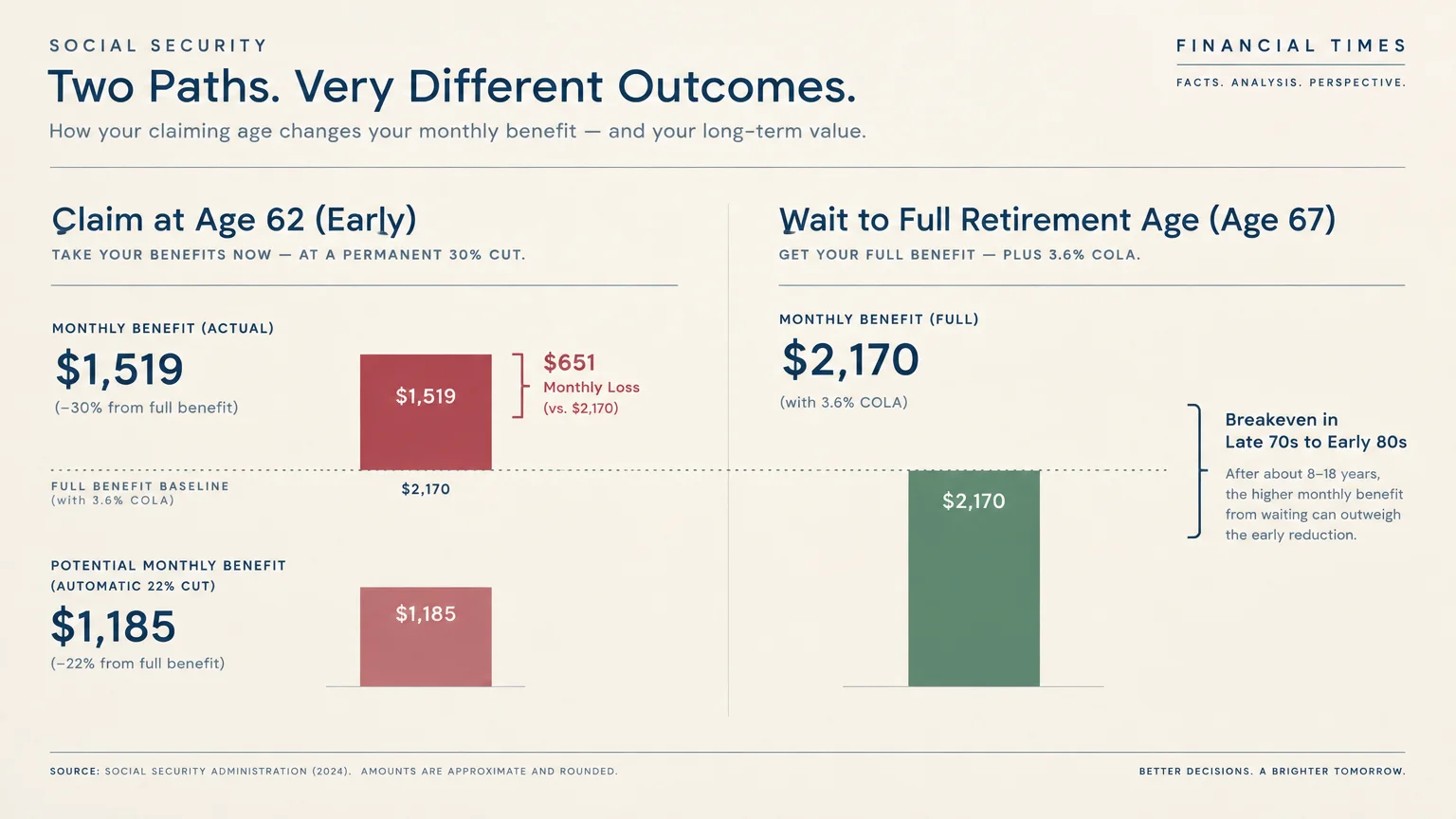
For anyone born in 1960 or later, your Full Retirement Age is 67. Claiming at age 62 slashes your baseline benefit by a staggering 30 percent for life.
Contrast that guaranteed 30 percent reduction with projected program shortfalls. The Social Security Trustees Report projects an automatic 22 percent cut in late 2032 if lawmakers never act.
Locking in an immediate 30 percent cut to escape a possible 22 percent reduction makes little mathematical sense. You surrender more money right away than the worst-case scenario would take from you later.
In late 2026, the estimated average monthly check for retired workers reaches $2,095. A 3.6 percent Cost-of-Living Adjustment raises that average check to $2,170 in January 2027.
If your earned benefit at Full Retirement Age is $2,170, claiming at age 62 drops that check to just $1,519. You lose $651 every single month for the rest of your life.
If Congress allows a 22 percent trim in 2032, your early-filing check drops even further. You would face a smaller percentage cut on top of your already deeply discounted check.
In that scenario, your $1,519 check would shrink to roughly $1,185 per month. Meanwhile, waiting for your full benefit leaves you with substantially more income under any future policy outcome.
Most retirees break even on delayed claiming around their late seventies or early eighties. Once you live past that breakeven threshold, waiting produces tens of thousands of extra dollars.
Today, a healthy 62-year-old has a high probability of living well into their eighties or nineties. Planning for a long, vibrant life requires maximizing your monthly cash flow.
Social Security is one of the only income streams you cannot outlive. Preserving its full value shields you from outlasting your personal investments.
Over a thirty-year retirement, an extra several hundred dollars each month provides extraordinary comfort. You can travel, support your family, and handle unexpected healthcare costs with ease.
Before you submit your application to the Social Security Administration, pause and evaluate your timeline. A calm perspective helps you avoid irreversible Social Security mistakes.
Tip #2: Understand How the Trust Fund Really Works
Sensational headlines often suggest that Social Security faces complete bankruptcy. In reality, the program functions on ongoing tax revenues rather than a finite pile of cash.
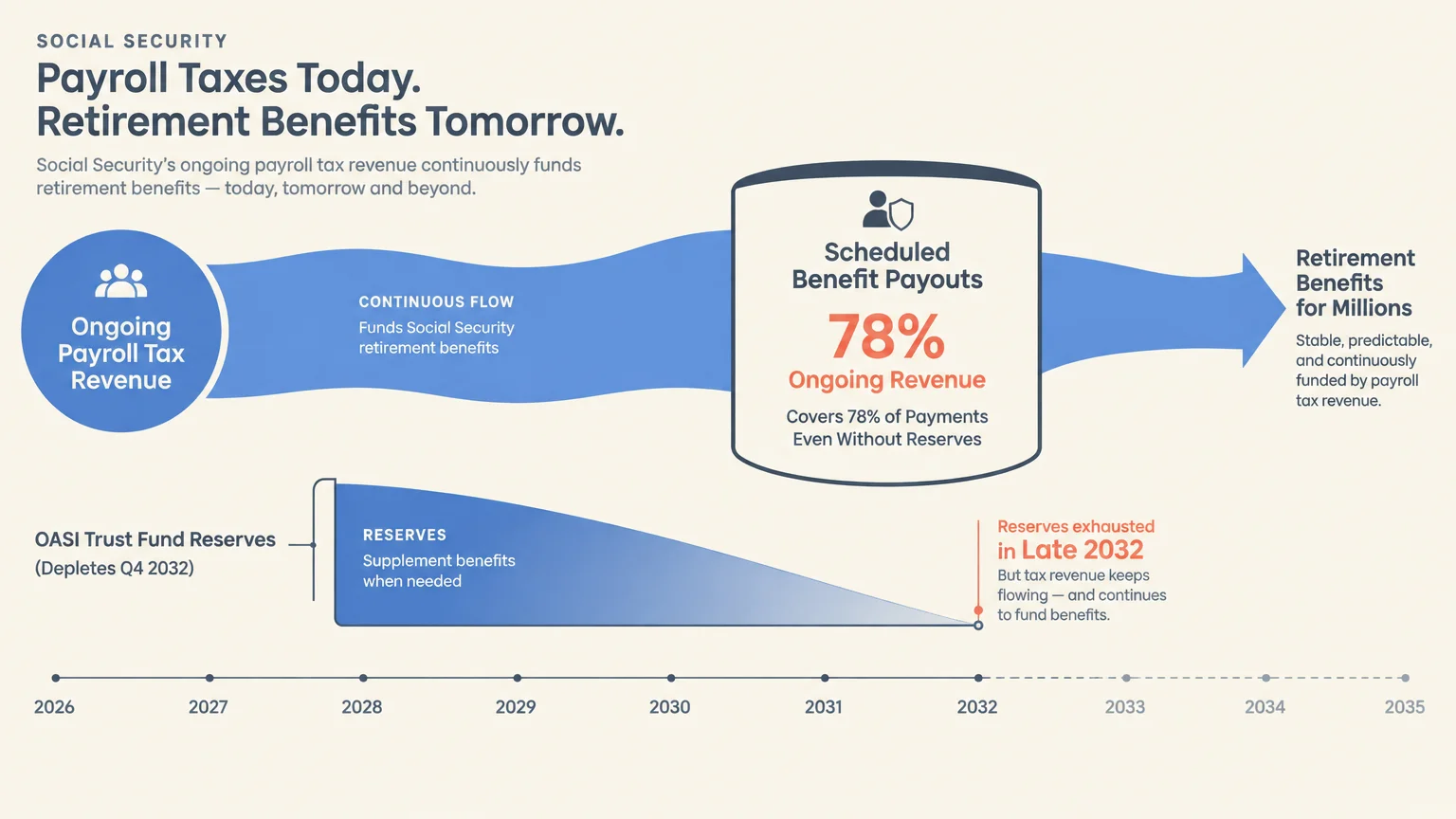
According to the June 2026 Social Security Trustees Report, the Old-Age and Survivors Insurance Trust Fund will deplete its reserves in the fourth quarter of 2032. That dedicated fund specifically pays retirement and survivor benefits.
Reserve depletion does not mean your benefits will vanish into thin air. Even if the reserves hit zero, ongoing payroll taxes will still cover 78 percent of scheduled retirement payments.
Without congressional intervention, automatic Social Security benefit cuts of 22 percent would take effect in late 2032. However, lawmakers have never allowed such an automatic reduction to occur in the program’s history.
If Congress decides to combine the retirement fund with the Disability Insurance Trust Fund, the reserve timeline extends into the third quarter of 2034. In that scenario, ongoing revenues would cover 83 percent of scheduled benefits.
Meanwhile, the Disability Insurance Trust Fund remains exceptionally strong on its own. Current projections confirm it will remain fully solvent through at least the year 2100.
Millions of working Americans pay into the system every payday through dedicated payroll taxes. These continuous contributions guarantee that substantial revenue flows into the Social Security trust fund month after month.
In 2026, workers pay Social Security taxes on wages up to $184,500. In 2027, that maximum taxable earnings threshold increases to $192,300.
Rising wage caps and growing employment continually replenish the system with fresh capital. The program remains active, solvent in part, and backed by the economic strength of the nation.
Lawmakers understand the immense political power of older voters. Letting benefits fall off a cliff would trigger unprecedented outrage across the entire country.
When the program faced a similar funding crunch in 1983, bipartisan leaders passed comprehensive reforms to secure payments. You can expect Congress to negotiate solutions well before late 2032 arrives.
Historical reforms have routinely shielded individuals who are already retired or approaching retirement age. Any future adjustments will almost certainly focus on younger workers who have decades to prepare.
Trusting the political reality frees you from making frantic financial decisions. You can focus on building a sustainable lifestyle rather than reacting to worst-case headlines.
When you look past the media hysteria, the fundamental strength of the system becomes clear. That knowledge gives you the confidence to execute a patient claiming decision.

Tip #3: Evaluate the High Cost of the Earnings Test
Many older adults decide to claim benefits early while continuing to work full-time or part-time jobs. Unfortunately, this move triggers the Retirement Earnings Test, which can temporarily strip away your monthly checks.
If you claim benefits before Full Retirement Age, strict statutory limits cap how much money you can earn from employment. Exceeding those limits forces the Social Security Administration to withhold your checks.
For 2026, the annual earnings limit sits at $24,480. In 2027, that exempt threshold climbs to $25,560 for beneficiaries who remain under Full Retirement Age all year.
For every $2 you earn above the annual limit, the government withholds $1 from your retirement benefits. Earning a modest salary can easily wipe out your entire annual Social Security income.
Imagine you earn $35,560 in 2027 while claiming benefits early. You exceed the threshold by exactly $10,000, which means the agency withholds $5,000 from your benefits.
The Social Security Administration does not withhold partial checks. They withhold entire monthly checks until they fulfill the full withholding requirement for that calendar year.
The rules become more generous during the calendar year you reach your Full Retirement Age of 67. In 2027, the earnings threshold jumps to $67,920 for the months before your birthday month.
In that transition year, the agency withholds only $1 for every $3 you earn above the higher limit. Once you reach your actual birthday month, all earnings limits vanish completely.
While withheld benefits are not lost forever, claiming early while working creates severe cash flow frustration. The agency recalculates your monthly benefit at age 67 to credit those withheld months back to you.
Even so, you have already accepted a permanent percentage reduction on your baseline benefit for life. Filing early just to see your checks withheld provides zero financial advantage.
You also pay income taxes and payroll taxes on those earnings while receiving delayed access to your benefits. This unnecessary complexity complicates your tax return and drains your energy.
If you plan to remain in the workforce, delaying your application makes immense practical sense. You avoid administrative headaches and allow your monthly benefit baseline to grow uninterrupted.
Working during your early sixties allows you to save more while avoiding unnecessary tax complications. Keeping your earned income separate from your retirement benefits simplifies your personal finances.
Step back and evaluate your employment plans before touching your Social Security. Giving your career the final chapter it deserves without triggering clawbacks protects your hard-earned dollars.

Tip #4: Protect Your Surviving Spouse from Permanent Losses
Claiming decisions rarely affect just one person. If you are married, your choice directly dictates the financial security your spouse enjoys for decades to come.
Many retirees do not realize that filing early slashes spousal benefits by up to 32.5 percent. That steep reduction permanently reduces the household income you rely on together.
At Full Retirement Age, an eligible spouse can receive up to 50 percent of the primary earner’s full benefit. Claiming at age 62 reduces that spousal payment down to just 32.5 percent.
The consequences become even more critical when you consider survivor benefits. When one spouse passes away, the smaller of the couple’s two Social Security checks disappears.
The surviving partner then steps up to receive the larger of the two monthly payments. If the higher earner claimed benefits early at 62, they permanently lock in a smaller survivor check.
Statistically, women tend to outlive men by several years and often rely heavily on survivor benefits. A reduced monthly check can severely compromise a widow’s standard of living in late life.
Locking in that 30 percent penalty can leave your surviving partner struggling with living expenses in later life. Surviving spouses often face higher healthcare costs and single-filer tax brackets.
As a single filer, your surviving spouse will pay higher tax rates on less overall income. Having a larger, unreduced Social Security payment cushions that harsh tax transition.
By waiting until Full Retirement Age or beyond, the higher earner creates a powerful financial safety net. That patient strategy guarantees the surviving spouse receives the maximum possible monthly income.
Couples should coordinate their claiming strategies to maximize their combined lifetime value. Having the higher earner delay while the lower earner files earlier can often balance cash flow and protection.
This balanced strategy brings immediate cash flow into the household while safeguarding the long-term survivor check. It delivers the best of both worlds for couples navigating retirement together.
Thoughtful retirement planning honors the commitment you made to your partner. Protecting your spouse’s future dignity and comfort is one of the greatest gifts you can provide.
Taking time to discuss these numbers together brings clarity to your long-term plan. Open conversations eliminate financial anxiety and strengthen your shared retirement vision.
When both partners understand the strategy, you move forward with shared confidence and optimism. That emotional harmony is the foundation of a truly joyful retirement.
Tip #5: Harness Delayed Retirement Credits for Maximum Growth
While claiming early imposes severe penalties, waiting past Full Retirement Age provides exceptional rewards. The Social Security system offers a guaranteed annual return that private markets rarely match.
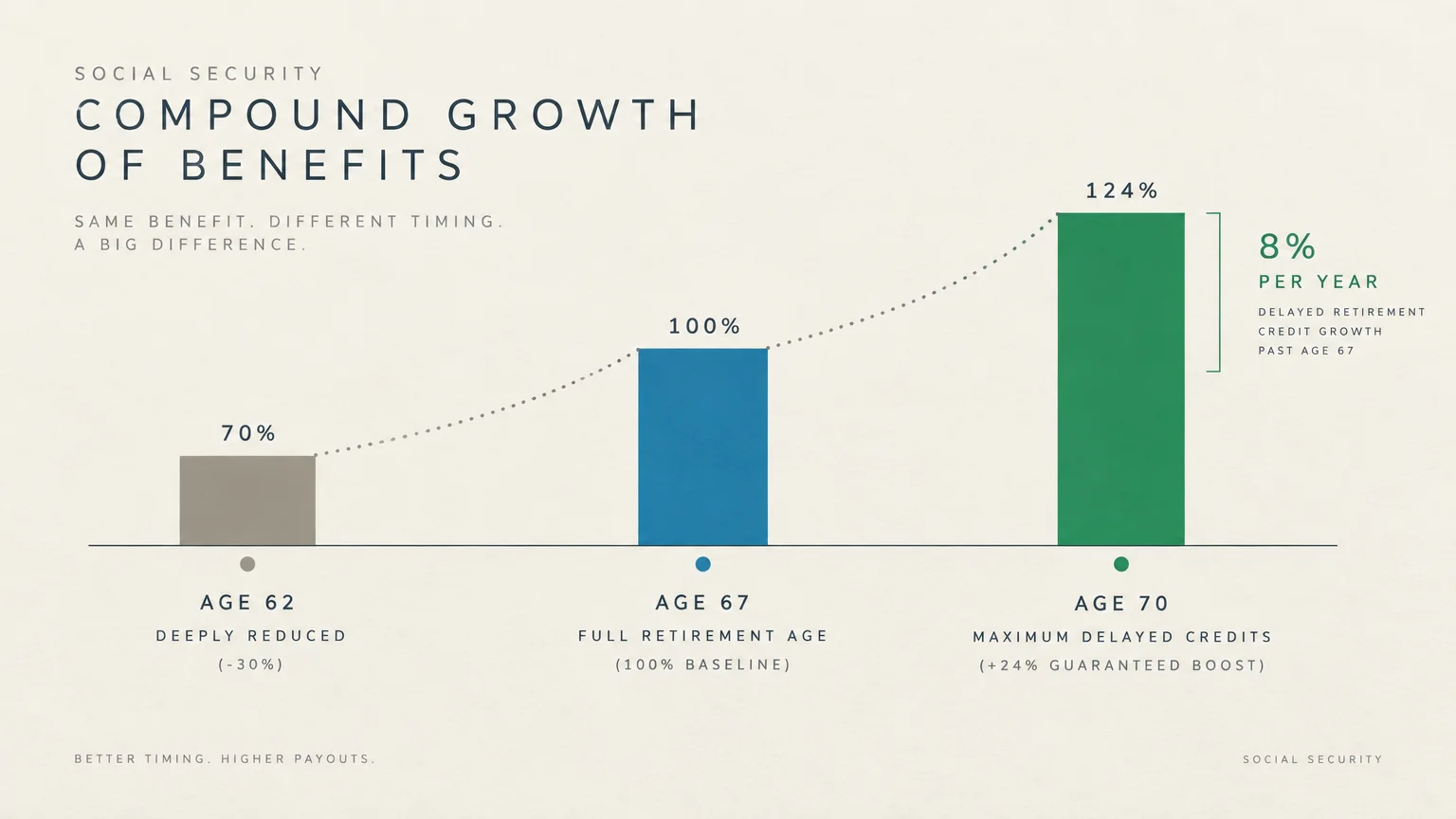
For every year you delay claiming benefits beyond your Full Retirement Age of 67, your benefit grows by 8 percent. That equals an increase of two-thirds of 1 percent for every single month you wait.
By postponing your claim until age 70, you secure a permanent 24 percent increase over your baseline amount. This guaranteed boost remains locked in for the rest of your life.
Compare the two extremes of the claiming spectrum. Filing at 62 gives you 70 percent of your baseline, while filing at 70 provides 124 percent.
That means your monthly check at age 70 will be more than 77 percent larger than your check at age 62. That massive gap can transform your entire retirement lifestyle.
No commercial annuity or high-yield bond can provide an inflation-adjusted, government-backed return of 8 percent per year. It represents one of the most lucrative financial moves available to American retirees.
Annual Cost-of-Living Adjustments amplify this advantage every single year. The Social Security Administration announced a 2.8 percent adjustment in 2026, followed by a 3.6 percent boost for 2027.
A 3.6 percent increase applied to a larger baseline check produces substantially more real dollars in your pocket. Over twenty or thirty years, these compounding increases build extraordinary purchasing power.
If market downturns strike your investment portfolio, that guaranteed check acts as an unshakeable bedrock. You can leave your depressed stock investments alone to recover while living off your robust benefit.
Delayed retirement credits also serve as the ultimate insurance policy against outliving your assets. No matter how the stock market performs, your government-backed monthly check arrives reliably on schedule.
Modern healthcare advancements mean many seniors enjoy active lives well into their eighties and nineties. Securing the highest possible monthly income ensures you maintain your independence and comfort throughout those years.
You also eliminate the stress of managing complex investments during your later retirement years. A generous, automated monthly deposit provides simplicity and freedom when you want it most.
Delaying your claim is not about guessing your life expectancy down to the exact day. It is about maximizing your financial peace of mind during your golden years.
Every extra month you can wait pays dividends for the rest of your life. That steady patience creates true financial abundance.
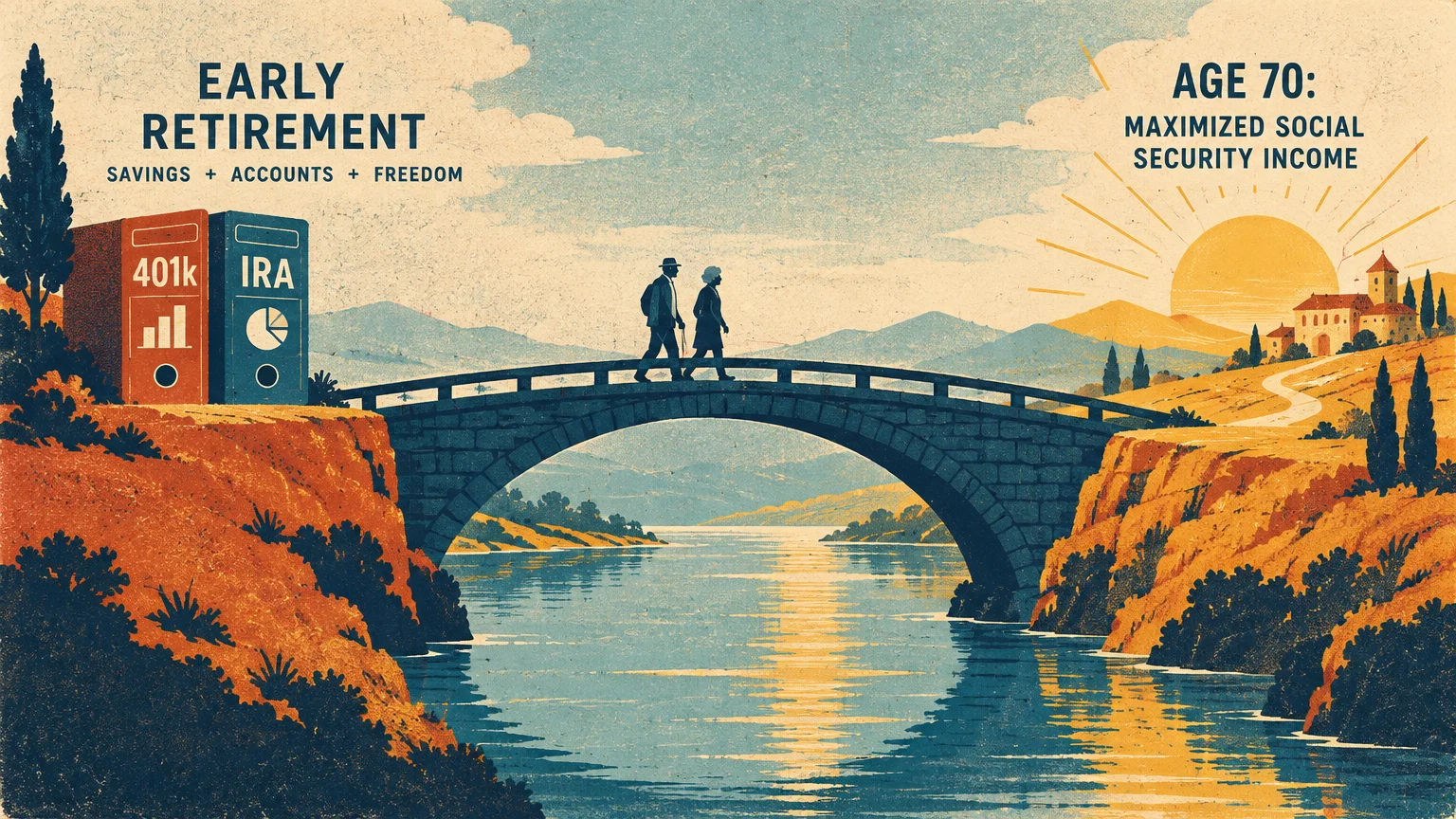
Tip #6: Build a Bridge Strategy to Delay Claiming
You might wonder how you can delay claiming if you want or need to leave your full-time career at 62. You can achieve this goal by creating a dedicated Social Security bridge.
A bridge strategy involves tapping your personal savings, 401(k), or traditional IRA to cover living expenses during your early sixties. This allows your future Social Security benefits to compound untouched.
Many financial planners recommend spending down tax-deferred retirement accounts before collecting Social Security. Drawing from these accounts early can lower your future required minimum distributions.
Lowering future required distributions also reduces your taxable income in your seventies and eighties. That smart tax move helps you keep more of your hard-earned wealth.
It also prevents large required distributions from triggering higher Medicare Part B and Part D premiums down the road. Preserving lower healthcare premiums protects your monthly cash flow in older age.
You can also bridge the gap by transitioning into enjoyable, flexible work. Taking on freelance consulting, seasonal projects, or part-time roles can cover your everyday grocery and housing bills.
Working on your own terms keeps your mind engaged and expands your social circle. Many retirees find that light part-time work brings a wonderful sense of routine and purpose.
If you have cash reserves or taxable brokerage accounts, spending those assets first can offer tax-efficient living expenses. You can realize capital gains at favorable rates while your Social Security credits grow.
Reviewing your household budget can also uncover simple ways to free up monthly cash. Trimming unnecessary recurring subscriptions or dining expenses can provide the breathing room you need to wait.
Some seniors choose to downsize their homes or relocate to areas with lower property taxes. That single move can free up substantial home equity to fund your bridge years.
View every month you delay as purchasing a higher guaranteed pension for your future self. That mindset turns retirement planning into an empowering journey of self-care.
You do not have to delay all the way to age 70 to reap meaningful rewards. Waiting even one or two years past age 62 permanently raises your income floor.
With a clear bridge strategy in place, you never have to feel trapped by financial fear. You take control of your financial destiny and protect your lifelong happiness.
Creating your bridge plan puts you firmly in the driver’s seat of your golden years. You replace uncertainty with an actionable, empowering roadmap for success.

The Takeaway: Living a More Blissful Retirement
Fear of policy changes should never dictate your retirement timeline. Headlines come and go, but the permanent claiming decisions you make will stay with you forever.
Claiming early out of panic locks in a guaranteed 30 percent penalty to escape a potential 22 percent cut. When you examine the facts, patient planning emerges as the true path to prosperity.
Your golden years should be a season of celebration, gratitude, and personal fulfillment. You worked hard for decades to build your career and earn your benefits.
By delaying your claim toward Full Retirement Age or beyond, you give yourself the gift of lasting stability. You protect your spouse, boost your monthly income, and shield your household from inflation.
You also insulate your retirement from stock market volatility and economic surprises. A larger guaranteed check provides the peace of mind you need to savor every single day.
Focus on what you can control rather than worrying about what lawmakers might do down the road. Build your bridge, communicate with your loved ones, and optimize your personal resources.
Surrounding yourself with accurate information empowers you to make wise, life-affirming choices. You have the tools, wisdom, and resilience to navigate your retirement with grace.
Take confidence in the knowledge that you hold the reins to your financial future. When you make decisions based on clear math rather than anxiety, you create genuine bliss in retirement.
Frequently Asked Questions
Will Congress really allow an automatic benefit cut in 2032?
History strongly suggests that Congress will enact legislation before reserves run out in late 2032. Lawmakers from both parties recognize that allowing an automatic 22 percent cut would be politically catastrophic.
In past decades, Congress introduced bipartisan adjustments such as payroll tax updates and gradual retirement age shifts to safeguard payments. You can expect similar negotiated solutions as the deadline approaches.
Protecting current retirees and older workers remains a top priority across the political spectrum. Lawmakers know that older Americans represent the nation’s most active and reliable voting demographic.
Can I reverse my decision if I already claimed benefits early?
If you filed within the past twelve months, the Social Security Administration allows a one-time withdrawal of your application. You must repay all benefits received to reset your claiming status.
This reset allows your benefits to continue growing as if you had never filed in the first place. It provides a valuable second chance if you regret claiming too early.
If you have already reached Full Retirement Age, you can also voluntarily suspend your benefits until age 70. Suspending your payments allows you to earn delayed retirement credits that increase your future checks.
What happens to my benefits if I work after reaching Full Retirement Age?
Once you reach your Full Retirement Age of 67, the Retirement Earnings Test disappears completely. You can earn an unlimited income from employment without losing a single dollar of your benefits.
Continuing to earn substantial income may even boost your benefit amount in future years. The agency recalculates your benefit annually to reflect your highest thirty-five years of earnings.
If your current earnings replace a lower-earning year from earlier in your career, your monthly payment will increase. Working past Full Retirement Age only helps your financial situation.
How do annual COLAs affect my benefits if I delay claiming until age 70?
You do not lose out on annual Cost-of-Living Adjustments by choosing to delay your claim. All statutory COLAs enacted after you turn age 62 automatically apply to your primary insurance amount.
When you finally claim at age 70, your benefit includes every past adjustment alongside your 24 percent delayed retirement boost. This ensures your delayed benefit keeps full pace with national inflation.
This compounding effect makes delayed claiming one of the most effective inflation hedges available. You receive both the 8 percent annual growth credits and all cumulative cost-of-living increases.
For a wide range of resources for older adults, visit AARP and the National Council on Aging (NCOA). Health information is available from the National Institute on Aging.
Disclaimer: This article is for informational and inspirational purposes only. It is not a substitute for professional medical, financial, or psychological advice. Please consult with a qualified expert for guidance tailored to your individual needs.