
You can stretch your retirement savings further while trading routine chores for sunny plazas, vibrant social clubs, and fresh adventures. Roughly 760,000 Americans already collect Social Security across more than 150 countries, totaling over $7.5 billion annually.
Choosing the right destination turns a modest monthly check into an active, connected lifestyle. Below, you will find five budget retirement destinations backed by 2026 rankings, verified visa thresholds, and practical tips for building community.
Lifestyle Idea #1: Panama — Dollarized Ease and Generous Senior Perks
Panama earned the number two spot on International Living‘s 2026 Global Retirement Index with a score of 89.3. Because the country uses the U.S. dollar, your fixed pension never loses purchasing power to sudden currency swings.
Social Life, Hobbies, and Everyday Rhythm
Whether you prefer cool mountain breezes in highland towns or coastal boardwalks near Panama City, you will find lively expat circles ready to welcome newcomers. Weekly farmers markets, hiking clubs, and volunteer animal rescues make meeting friends effortless.
Direct flights between Panama City and major U.S. hubs also keep family visits simple. You can host grandchildren during school breaks or fly home for holidays without enduring exhausting multi-day itineraries.
Visa Rules, Discounts, and Monthly Budgets
Panama’s famous Pensionado Visa has no minimum age requirement and grants indefinite permanent residency from day one. You only need to visit the country once every two years to maintain your legal status.
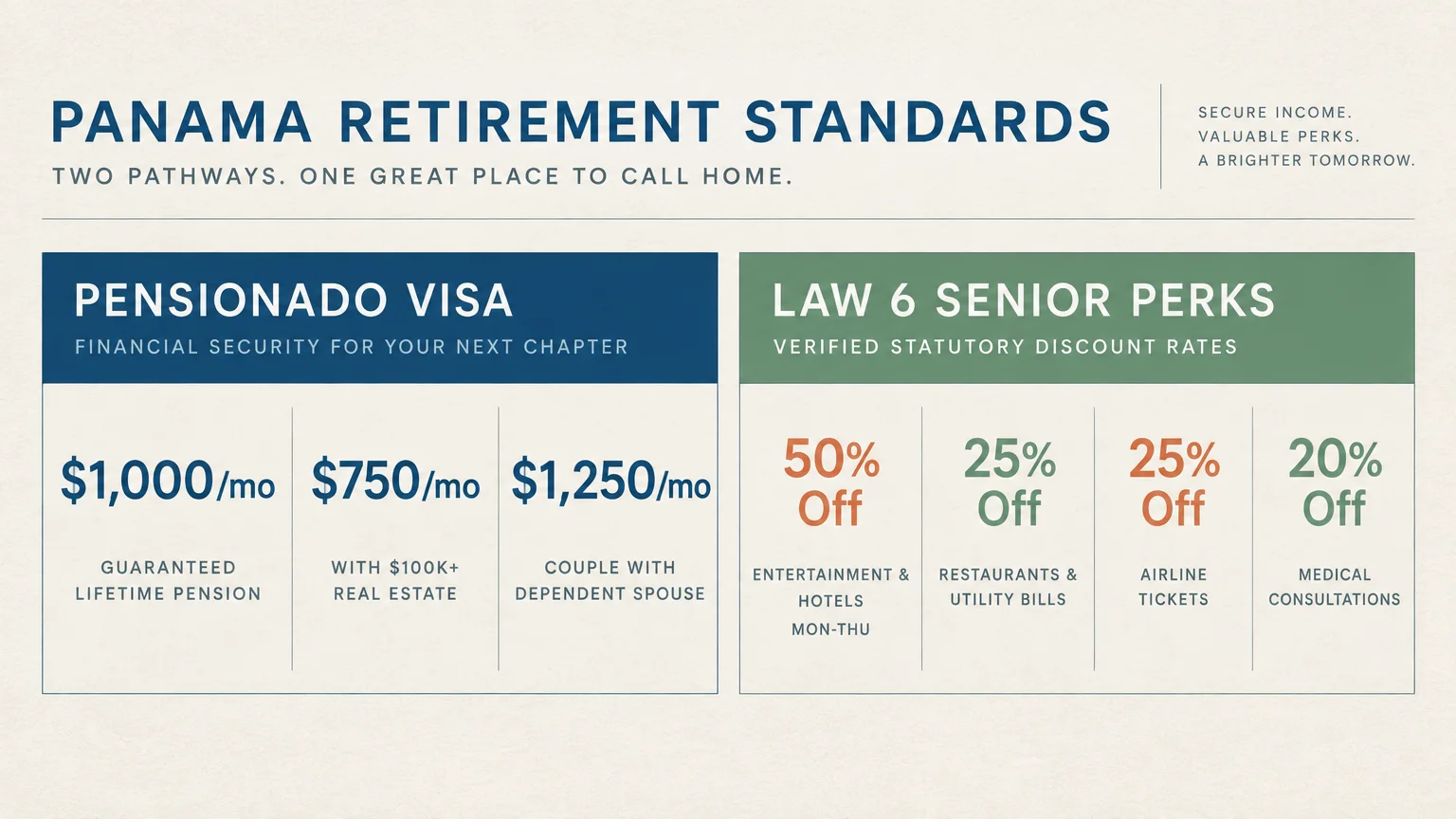
To qualify, you must prove a guaranteed lifetime pension of at least $1,000 per month, or $750 monthly if you own Panamanian real estate worth over $100,000. Couples add $250 monthly for a dependent spouse, bringing the total to $1,250.
Keep in mind that investment or 401(k) drawdowns do not satisfy the lifetime pension rule. Social Security and defined-benefit pensions qualify, and Panama taxes foreign pensions at 0% under its territorial tax system.
Once approved, Law 6 of 1987 unlocks impressive retiree discounts nationwide. Residents receive 50% off entertainment and Monday-through-Thursday hotel stays, 25% off restaurant meals, utility bills, and airline tickets, plus 20% off medical consultations.
A legislative proposal to expand those senior discounts was vetoed on September 20, 2026, so the classic Law 6 percentages remain the official standard. Most couples live comfortably in Panama on $2,000 to $3,000 per month.
How to Get Started in Panama
Book a two-week exploratory trip splitting your time between a mountain town and a beach community. Attend a local expat coffee morning, test public transit, and ask long-term residents which neighborhoods fit your daily pace.
Lifestyle Idea #2: Costa Rica — Pura Vida Community and Universal Care
Ranked third overall in International Living‘s 2026 index, Costa Rica blends lush biodiversity with an unhurried, friendly pace. Between 70,000 and 120,000 Americans already call this Central American haven home, creating built-in social networks across the country.
Active Living and Meaningful Connections
Morning beach walks, birdwatching groups, and neighborhood yoga classes shape daily life for retirees here. Local cultural centers also host Spanish conversation tables and cooking workshops where newcomers quickly connect with warm-hearted neighbors.
Instead of isolating gated routines, Costa Rican communities revolve around outdoor markets and town festivals. Embracing that slower rhythm helps you build genuine friendships while staying physically active well into your seventies and eighties.
Residency Paths, Taxes, and CAJA Healthcare
Costa Rica’s Pensionado Visa requires a guaranteed lifetime pension of at least $1,000 per month. It grants two-year renewable temporary residency, leading to permanent residency after three years and citizenship eligibility after seven years.
If your retirement income comes from investments rather than a pension, alternative paths exist. The Rentista Visa requires $2,500 in monthly passive income, while the Investor path requires a $150,000 qualifying investment.
Under Costa Rica’s territorial tax rules, foreign-sourced pensions and U.S. Social Security benefits remain tax-exempt. Only income earned locally inside Costa Rica faces progressive tax rates ranging from 0% to 25%.
Every legal resident must enroll in Costa Rica’s universal public healthcare system, known as CAJA. Monthly fees are set individually by the social security agency based on declared income, commonly falling around 9% to 11%.
How to Get Started in Costa Rica
Visit during both the sunny dry season and the lush rainy season before signing a long-term lease. Tour a local CAJA clinic, compare neighborhood grocery prices, and try commuting without a car if you prefer walkable towns.
Lifestyle Idea #3: Portugal — European Charm on a Practical Budget
Portugal took fourth place in International Living‘s 2026 index and ranked number one in SmartAsset‘s July 2026 list of cheapest countries to retire well. Cobblestone plazas, mild winters, and reliable trains make retiring overseas feel surprisingly accessible.
Walkable Cities, Culture, and Slow Travel
Life in Portuguese towns centers on neighborhood cafes, sunny riverfronts, and unhurried lunches with friends. Book clubs, coastal walking groups, and local heritage associations give solo retirees and couples rich weekly calendars.
Because major cities connect easily by rail and regional flights, hosting grandkids or exploring neighboring European capitals becomes effortless. You get historic architecture and vibrant arts scenes without paying Western European megacity prices.
Updated 2026 D7 Visa and Citizenship Rules
Portugal’s popular D7 Passive-Income Visa ties directly to the country’s 2026 minimum wage of €920 per month. Single applicants must prove €920 monthly in regular passive income from pensions, rentals, or dividends.
Couples must show €1,380 per month, adding €276 monthly for each dependent child. Applicants are also advised to park 12 months of savings in a Portuguese bank account, and need one-year housing proof and valid health insurance.
Keep in mind that buying real estate no longer qualifies for Portugal’s Golden Visa, as that option ended in October 2023. The D7 route remains the primary pathway for retirees seeking budget retirement destinations in Europe.
Portugal also enacted a major citizenship change under Organic Law No. 1/2026, taking effect May 19, 2026. Standard naturalization residency for Americans increased from five years to ten years, and seven years for EU or Lusophone citizens.
Immigration agency processing wait times no longer count toward citizenship, and applicants must pass civics, history, and democratic-principles tests alongside language checks. However, permanent residency remains available after five years with basic A2-level Portuguese.
Budgets, Currency Swings, and Healthcare
Single retirees typically spend €1,600 to €2,400 monthly in Porto, or €2,000 to €3,000 in Lisbon. Outside major hubs, couples live comfortably on $2,500 to $3,000 per month, with entry budgets starting near $2,250.
Private health insurance runs roughly $50 to $200 monthly, and legal residents gain access to Portugal’s public SNS healthcare system. Watch exchange rates closely, since €1,200 monthly rent can swing $120 to $200 in dollar terms.
How to Get Started in Portugal
Spend a month renting an apartment in a mid-sized coastal or university town rather than central Lisbon. Practice basic Portuguese greetings, join an expat orientation group, and open a modest currency cushion for euro fluctuations.

Lifestyle Idea #4: Thailand — Affordable Wellness and Vibrant Expat Hubs
Thailand ranks ninth overall in International Living‘s 2026 index and earns praise among the publication’s cheapest places to live in 2026. Warm hospitality, lush temples, and modern amenities make expat retirement remarkably comfortable here.
Rich Social Circles and Everyday Joy
Cities like Chiang Mai and coastal resort towns host thriving international clubs for golf, pickleball, photography, and cooking. Evening street markets turn dinner into a lively social event where neighbors gather around steaming bowls of noodles.
Because labor costs stay low, many retirees hire weekly housekeeping or enjoy regular wellness massages. Freeing up time from household chores lets you focus on hobbies, creative writing, or volunteering at community literacy programs.
Retirement Visa, Insurance, and Tax Updates
Thailand’s Non-Immigrant O-A Retirement Visa welcomes applicants aged 50 and older. You must hold either 800,000 Thai baht—around $22,000 USD—in a Thai bank account or prove 65,000 baht monthly income, roughly $1,800 USD.
A qualifying combination of bank savings and monthly income also satisfies the requirement. The visa remains valid for one year and renews annually, though residents must complete 90-day address reports and ensure landlords file TM.30 arrival forms.
Every O-A applicant and annual renewal requires health insurance covering at least 3,000,000 baht or $100,000 USD per policy year. Note that Thailand’s public universal coverage scheme generally excludes non-working expats.
Plan ahead if you are over 70, because many Thai insurers cap new policy applications at age 75 or 80. Securing compliant international coverage early helps you avoid disruptive gaps in your residency paperwork.
Tax residency rules also deserve careful attention if you live in Thailand year-round. Staying more than 183 days triggers Thai tax residency, and rules introduced in 2024 tax foreign income remitted to Thailand within the same year earned.
Low Daily Costs and Private Care
Among the cheapest countries to retire, Thailand lets a single retiree live well on $1,200 monthly, including $300 studios in Chiang Mai. Couples enjoy roomy apartments, dining out, and domestic trips on $1,500 to $2,500 per month.
Private hospitals offer short wait times and English-speaking physicians at modest prices. Routine doctor visits typically cost 500 to 1,500 baht—just $14 to $42—roughly one-third of typical U.S. out-of-pocket fees.
How to Get Started in Thailand
Test Thailand’s tropical heat and city energy with a four-week stay outside peak tourist beaches. Tour a private international hospital, sample neighborhood gyms, and verify your health insurance eligibility before applying at a consulate.
Lifestyle Idea #5: Ecuador — Mountain Towns, Coastlines, and Dollar Stability
Ecuador offers dramatic Andean scenery, Pacific beaches, and U.S. dollar pricing without forcing you to stretch your Social Security check. For retirees wanting familiar currency alongside rich Latin culture, this South American gem stands out.
Spring-Like Weather and Tight-Knit Towns
High-altitude cities enjoy year-round spring temperatures that encourage daily walks through cobblestone markets and botanical parks. Meanwhile, coastal villages attract retirees who love warm ocean air, seafood lunches, and relaxed sunset gatherings.
Spanish language schools, artisan workshops, and expat theater groups keep social calendars full throughout the year. Many retirees find that local neighbors eagerly trade gardening tips and regional recipes once you learn conversational Spanish.
2026 Jubilado Visa and Residency Timeline
Ecuador’s Jubilado retirement visa ties its income threshold to three times the country’s Basic Unified Wage, updated every January. With the 2026 wage set at $482 monthly, single retirees need a $1,446 monthly lifetime pension.
That baseline rose slightly from $1,410 in 2025, and couples must add $250 per month for a dependent spouse, totaling $1,696. Valid health insurance covering your full visa term is also mandatory upon application.
Because Ecuador uses the U.S. dollar, your Social Security check arrives without foreign exchange surprises. Better yet, temporary retirees can apply for permanent residency after just 21 months of living in the country.
Neighboring Colombia provides a comparable South American alternative for retirees who prefer vibrant salsa cities or lush coffee hills. Colombia’s Migrant M Pensioner Visa requires three times the monthly minimum wage, jumping to 5,252,715 pesos—roughly $1,440 to $1,672—in 2026.
That three-year Colombian visa leads to permanent residency after five years and supports modeled single budgets near $1,700 monthly, or $2,500 for couples. Both Andean nations reward retirees who enjoy fresh produce, walkable plazas, and warm hospitality.
How to Get Started in Ecuador
Spend several weeks sampling elevations before deciding where to settle, since mountain air affects everyone differently. Join a community walking tour, price local internet and produce, and try an introductory Spanish class with fellow newcomers.

Putting It into Practice: Small Steps for Big Changes
Moving overseas works best when you treat it as a series of small, testable steps rather than an overnight leap. Start by comparing your guaranteed monthly income against each country’s official visa threshold.
Step 1: Audit Your Guaranteed Income and COLA
Following the 2.8% cost-of-living adjustment for 2026, the average retired worker receives $2,071 monthly, while an aged couple averages $3,208. A 3.6% adjustment announced in October 2026 lifts the averages from $2,094 and $3,237 to $2,170 and $3,354 in 2027.
Check whether a target country counts investment withdrawals or strictly requires lifetime pensions like Social Security. Panama, Ecuador, and Colombia demand lifetime pensions, whereas Portugal’s D7 and Thailand’s O-A offer broader income or savings flexibility.
Step 2: Map Out Healthcare Beyond Medicare
Original Medicare Parts A and B generally do not pay for medical care outside the United States and its territories. Medicare Part D plans also exclude prescription drugs purchased abroad.
Only three narrow foreign-hospital exceptions exist, involving emergencies closer to foreign hospitals than U.S. facilities or direct travel between Alaska and other states through Canada. Cruise ship care qualifies only within six hours of a U.S. port.
Even under those rare exceptions, foreign hospitals rarely file Medicare claims, leaving you to submit Form CMS-1490S after paying out of pocket. Always budget for local public enrollment or private international insurance when you retire abroad.
Step 3: Take a 30-Day Living Trial
Instead of booking an all-inclusive resort, rent a modest furnished apartment in a residential neighborhood for one full month. Shop at local markets, ride city buses, cook dinner at home, and attend two community club meetings.
Testing daily routines exposes hidden friction—like steep hills, noisy streets, or language barriers—before you ship a single suitcase. A thirty-day trial also lets you see how easily you connect with both locals and fellow expats.
Step 4: Protect Family Ties and Keep a Cash Buffer
Moving overseas does not mean drifting away from children, siblings, or lifelong friends back home. Set standing weekly video dates, choose cities near international airports, and keep a spare bedroom ready for visiting grandkids.
Finally, maintain a U.S. bank account and an emergency travel fund separate from your daily overseas budget. Having flexible cash ready ensures you can fly home quickly for family milestones whenever needed.
Frequently Asked Questions
Why did famous spots like Greece, Mexico, and Malaysia miss this budget list?
Several beloved expat havens carry surprisingly steep financial hurdles in 2026 despite modest day-to-day grocery bills. Greece ranked first overall in International Living‘s 2026 index with a 7% flat tax on foreign pensions and $2,000 to $2,700 couple budgets.
However, Greece raised its Financially Independent Person visa threshold from €2,000 to €3,500 monthly, plus 20% for a spouse, requiring 183 days of presence. Similarly, Mexico’s Temporary Residency income bar sits near $4,400 net monthly at many consulates.
Malaysia’s MM2H Silver tier requires a $150,000 USD fixed deposit plus a compulsory property purchase of at least 600,000 ringgit. Meanwhile, Vietnam offers $800 to $1,000 monthly single living in places like Da Nang but lacks a dedicated long-term retirement visa.
How do I overcome social anxiety and make friends abroad?
Start building connections months before your flight by joining reputable online neighborhood groups and language-exchange platforms. Once you arrive, commit to one recurring weekly activity, such as a walking club, choir, pottery studio, or volunteer literacy program.
Familiar routines naturally turn acquaintances into reliable friends without forcing awkward small talk at parties. Choosing towns with active expat centers alongside welcoming local neighborhoods gives you two distinct circles of support.
How can I protect my budget from exchange-rate swings?
Social Security adjustments track U.S. consumer prices rather than foreign inflation or exchange rates. When the dollar dips against the euro, fixed expenses like a €1,200 monthly Portuguese apartment can fluctuate by $120 to $200 in dollar terms.
If currency swings worry you, prioritize dollarized destinations like Panama or Ecuador, where your check matches local price tags. In euro or baht destinations, keep three to six months of living expenses in local currency so you can convert dollars when rates look favorable.
Can I return to the United States if retiring overseas stops working for me?
Yes, keeping your U.S. citizenship and maintaining valid U.S. banking relationships preserves your freedom to move back anytime. Renting rather than buying foreign property during your first two years keeps your exit simple and low-stress.
Think of expat retirement as an open adventure rather than a permanent one-way contract. Even spending five memorable years abroad enriches your perspective, stretches your nest egg, and gives you unforgettable stories to share.
For resources on retirement living, travel, and finance, visit AARP. Official information on Social Security is available at SSA.gov.
Before booking an exploratory trip or applying for foreign residency, consult the U.S. Department of State for current travel advisories and entry rules.
Disclaimer: This article provides lifestyle suggestions for informational purposes. Financial, legal, or travel decisions should be made in consultation with qualified professionals.