
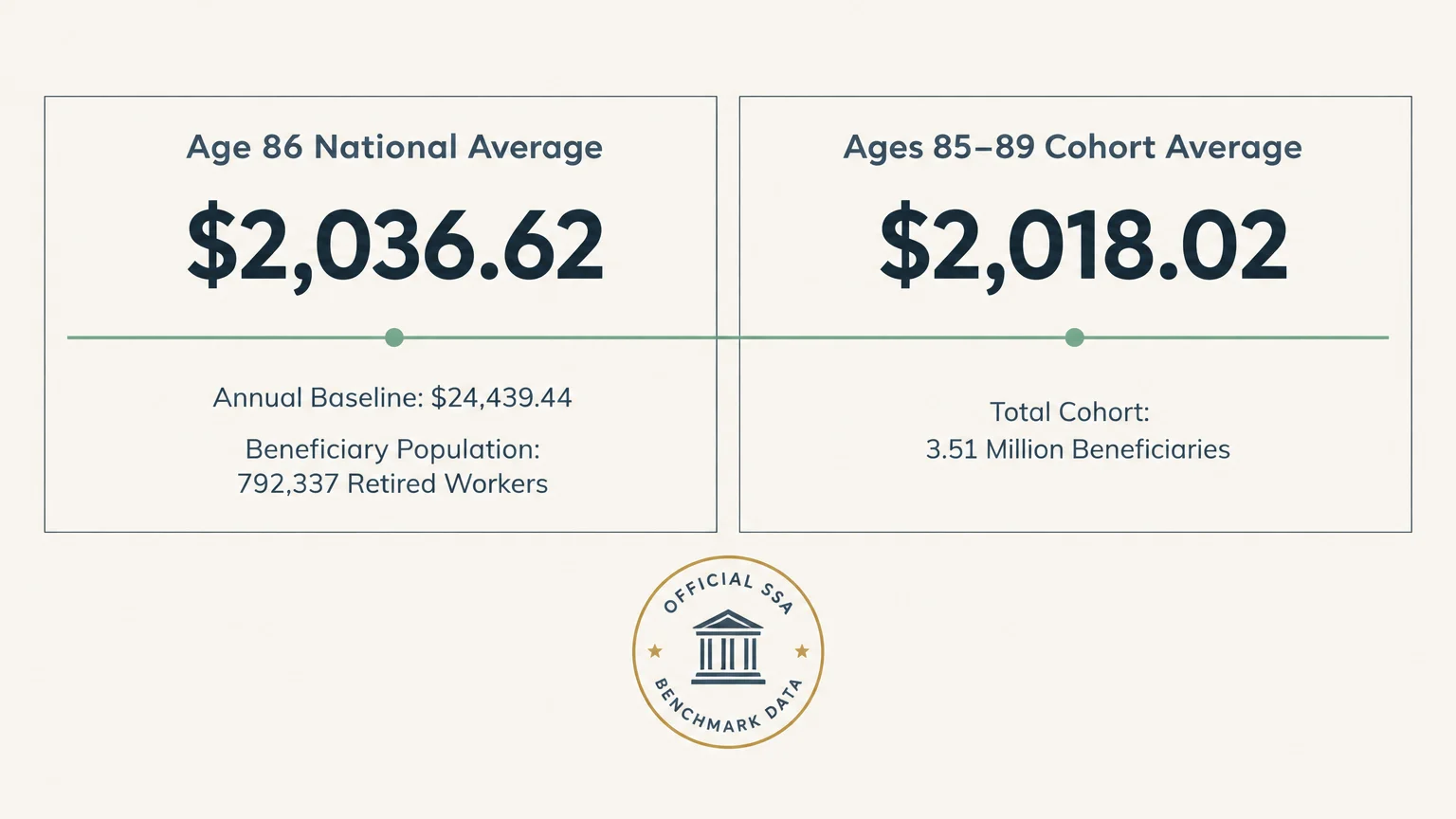
You can see exactly how your monthly retirement income stacks up against your peers across America today. The average 86-year-old retired worker receives $2,036.62 each month from Social Security.
That baseline totals roughly $24,439.44 per year in guaranteed federal support. However, individual monthly checks vary widely depending on gender, lifetime earnings, and the age when benefits started.
Exploring these official benchmarks gives you clarity and confidence in managing your household budget. Use this guide to evaluate your monthly payment and strengthen your long-term financial security.
Tip #1: Benchmark Your Monthly Check Against the National Average
Understand the Core Baseline Figures
The federal government sends monthly payments to 792,337 retired workers who have reached age 86. The overall average monthly check for this group stands at exactly $2,036.62.
Over a full calendar year, that baseline provides approximately $24,439.44 in guaranteed financial support. This predictable revenue helps millions of seniors handle everyday living expenses with greater confidence.
If your monthly check sits near this figure, your income reflects the standard national experience. You are receiving a benefit amount that aligns closely with hundreds of thousands of fellow retirees.
Examine the Broader Age Bracket
Expanding your view to the broader 85-to-89 age bracket reveals consistent payment patterns. Across all 3.51 million retired workers in this five-year group, the average monthly benefit is $2,018.02.
This broader average proves that retirement income remains remarkably steady throughout your late eighties. Regular federal adjustments help protect your baseline against prolonged inflation over time.
These monthly Social Security benefits seniors rely on create stability across the country. Seeing these numbers confirms that your benefit fits within a predictable demographic pattern.
Review Your Personal Award Notice
Take a moment to locate your most recent annual statement from the Social Security Administration. Check your gross benefit before any automatic deductions occur.
Many seniors see a net bank deposit that looks smaller than the national average. Standard deductions for Medicare Part B premiums directly lower your take-home cash deposit each month.
Comparing your gross benefit rather than your net check ensures an accurate comparison. Gross income reflects your true federal entitlement before healthcare premiums come out.
Understand Living Costs and Direct Deposits
Housing costs, regional utility rates, and medical co-pays vary dramatically across the United States. A payment of $2,036.62 stretches much further in low-cost rural areas than in major metropolitan centers.
Build a spending plan that honors your personal circumstances and geographic location. Knowing where every dollar goes helps you maintain control over your financial wellness.
Ensure your monthly payments arrive through reliable direct deposit into an insured bank account. Direct electronic transfers protect older adults from paper check delays and mail theft.
Setting up automatic bill payments for essential utilities from that account removes unnecessary monthly stress. That simple step ensures your vital bills get paid on time every month.

Tip #2: Evaluate the Gender Gap and Review Survivor Options
Acknowledge the Payment Disparity Between Men and Women
The Social Security Administration records a substantial payment gap between men and women aged 86. Men in this age cohort receive an average monthly benefit of $2,210.33 across 367,536 beneficiaries.
In contrast, 424,801 women aged 86 collect an average monthly benefit of $1,886.32. That creates an average difference of roughly $324 each month between male and female retirees.
Looking at the broader 85-to-89 age category shows a similar trend. Men average $2,182.80 per month, while women in the same age band receive an average of $1,877.27.
Recognize the Historical Factors Behind the Gap
This disparity does not reflect personal choices made today. Instead, it stems from economic conditions that existed decades ago when you built your career.
Women born in 1940 encountered lower average wages and fewer career advancement opportunities. Many also stepped away from paid employment to raise children or care for aging parents.
Social Security calculates benefits from your highest 35 years of indexed earnings. Career interruptions or lower historical wages naturally lead to a lower final calculation.
Understanding this historical context brings helpful clarity to your monthly benefit statement. The numbers reflect past societal wage structures rather than your personal dedication or worth.
Investigate Potential Survivor Benefits
If you are widowed, confirm that you receive the maximum allowable survivor benefit. Social Security rules permit surviving spouses to step up to 100% of their late partner’s benefit.
When a spouse passes away, the household loses the smaller check, but keeps the larger payment. Many older women continue receiving their own lower earned benefit simply because they never filed.
Applying for survivor support can increase your monthly cash flow significantly. This adjustment can provide hundreds of additional dollars each month to support your living expenses.
Review Divorced Spousal Rules and Audit Your Record
Divorced individuals may also qualify for survivor payments if their prior marriage lasted at least ten years. Claiming on an ex-spouse does not impact their benefits or their current family.
Contact the Social Security Administration directly to request a comprehensive benefit audit. Reviewing your record ensures you receive every dollar of spousal or survivor support you earned.
Have your marriage certificates and former spouse’s details ready when you speak with a representative. Taking this practical step can permanently strengthen your monthly retirement income.

Tip #3: Examine How Your Claiming Age Shaped Your Monthly Benefit
Understand the Rules for Your Birth Cohort
If you are 86 years old today, you were born in 1940. Federal retirement regulations established specific milestones tailored directly to your birth year.
Your Full Retirement Age was set at exactly 65 years and 6 months. That milestone determined when you could claim full, unreduced retirement benefits.
Evaluating your Social Security at 86 requires looking back at that initial milestone date. Different generations face different retirement age benchmarks under federal law.
The Long-Term Impact of Early Claiming
Retirees born in 1940 who claimed benefits early at age 62 accepted a permanent reduction. Their monthly check was set at 77.5% of their Primary Insurance Amount.
That 22.5% reduction stays with you for life. Fortunately, that penalty was less severe than the 30% reduction applied to workers born in 1960 or later.
Early claimers accepted lower checks in exchange for receiving income years sooner. That decision provided immediate financial security during their early sixties.
The Enduring Value of Delayed Credits
Workers who delayed collecting benefits past Full Retirement Age received an enduring reward. For your birth cohort, waiting earned a 7% increase for each year delayed up to age 70.
Delaying until age 70 allowed beneficiaries born in 1940 to collect up to 131.5% of their primary benefit. That decision continues paying generous dividends each month today.
Younger generations now receive an 8% annual credit for delaying benefits. However, your 7% annual bonus created substantial permanent income growth that compounds with annual adjustments.
Real-World Numbers for 86-Year-Old Beneficiaries
Official Social Security data demonstrates the lasting power of claiming timing. The 168,890 retirees aged 86 who claimed right at Full Retirement Age average $2,297.62 per month.
Within that cohort, men average $2,541.67 monthly, while women collect an average of $2,003.28. Claiming on time secured a strong, steady foundation for retirement.
The 47,445 retirees aged 86 who delayed past Full Retirement Age enjoy even higher payments. This group collects an average of $2,344.57 per month.
Men who delayed receive an impressive average of $2,594.96 each month. Women who delayed benefits earn an average monthly payment of $2,181.91.
These figures clearly illustrate why your payment may differ from your peers. Your original claiming age remains one of the most powerful factors shaping your current check.

Tip #4: Compare Your Payment to National Percentiles and Other Ages
Compare With the Overall National Average
Across all 53.62 million retired American workers, the overall average monthly benefit was $2,071.30. Men across all age groups averaged $2,282.28, while women averaged $1,872.43.
By late 2026, the overall average drifted slightly higher to $2,088.79 per month. At $2,036.62, the average 86-year-old sits just a few dollars below the general national benchmark.
When you compare Social Security checks across different cohorts, small variations are normal. Newer retirees enter the system with higher lifetime earnings, which gently nudges the national average upward.
Check Your Standing Against Benefit Percentiles
National median figures provide a clearer snapshot of typical retirement earnings. The median monthly check for all retired workers is $1,990.
Because the average 86-year-old receives $2,036.62, typical beneficiaries in your cohort collect more than half of all retired workers. You hold a solid position on the national income ladder.
Looking at broader percentiles helps you evaluate high and low payment tiers. The 25th percentile sits at approximately $1,370 per month.
If your monthly check exceeds $1,370, you receive more income than a quarter of all retirees. That knowledge can give you greater gratitude for your current financial foundation.
Meanwhile, the 75th percentile reaches $2,645, and the 90th percentile climbs to $3,290. Reaching these higher brackets required exceptionally high lifetime earnings subject to Social Security taxes.
Inspect Benefit Averages Across Different Ages
Reviewing the average Social Security by age illustrates how benefits shift throughout retirement. Beneficiaries who claimed early at age 62 receive an average of $1,424.40 per month.
Retirees aged 67 average $2,016.48, while 70-year-olds reach the peak average benefit of $2,274.68. Those aged 75 collect an average of $2,144.88 per month.
Retirees aged 80 receive $2,106.29, while 85-year-olds collect an average of $2,077.11 monthly. Beneficiaries aged 87 record an average check of $2,015.54.
Benefit averages gradually peak around age 70 before tapering slightly among older cohorts. Examining older retirees benefits reveals how historical wage levels and claiming patterns influence lifetime payments.
Note the Maximum Allowable Benefit Limits
In 2026, the maximum possible monthly benefit for someone retiring at Full Retirement Age is $4,152. For someone claiming at age 70 in 2026, the maximum payment reaches $5,181 per month.
Achieving those ceilings requires earning at the taxable maximum wage limit for 35 full years. Very few workers ever reach those rare statistical caps.
Do not measure your personal success against these theoretical upper limits. Your benefit reflects your dedicated service and provides dependable support every single month.

Tip #5: Apply Upcoming Cost-of-Living Adjustments to Your Budget
Reflect on the 2026 Adjustment
The Social Security Administration evaluates inflation data every autumn to calculate annual adjustments. Beneficiaries received a 2.8% boost starting in January 2026.
That increase helped offset higher grocery bills, rising energy prices, and essential household repairs. Regular adjustments help preserve your purchasing power against ongoing price pressures.
Prepare for the 2027 COLA Increase
On October 14, 2026, federal officials announced a 3.6% COLA for 2027. This increase takes effect with your January 2027 payment.
Across all retired workers, this 3.6% boost raises the average check by approximately $76 per month. That shifts the national average from an estimated $2,094 up to $2,170.
This adjustment represents a meaningful increase designed to help seniors manage persistent inflation. Planning ahead ensures you take full advantage of this upcoming raise.
Calculate Your New Monthly Total
If you receive the average 86-year-old benefit of $2,036.62, a 3.6% boost adds roughly $73.32 each month. That raises your monthly gross income to approximately $2,109.94.
Over a full calendar year, that adjustment provides an extra $879.84 in direct financial support. You can allocate these additional funds toward healthcare needs or family celebrations.
To estimate your personal increase, multiply your current gross monthly check by 1.036. That simple calculation shows what you can expect when January arrives.
Watch for Medicare Premium Updates
Always remember that changes to Medicare Part B premiums affect your final deposit amount. Federal agencies announce new Part B premiums late each autumn.
When Medicare premiums rise, they absorb a small portion of your cost-of-living raise. Review your official December COLA notice to confirm your exact net deposit for January.
If your Medicare premium increases, the hold harmless provision prevents your net benefit from decreasing. This federal protection ensures your take-home check will not drop year over year.

Tip #6: Maximize Additional Income Without Benefit Penalties
Enjoy Complete Freedom From the Earnings Test
Many seniors worry that earning outside money will trigger severe penalties on their Social Security checks. That concern is completely unnecessary once you pass Full Retirement Age.
The federal government enforces the retirement earnings test only on younger retirees who claim benefits before Full Retirement Age. In 2026, younger workers face an earnings cap of $24,480.
That earnings limit rises to $25,560 in 2027 for those under Full Retirement Age. However, once you cross your full retirement milestone, all earnings limits vanish permanently.
Earn Additional Funds on Your Own Terms
Because you are 86, you can earn unlimited income without losing a single cent of your benefit. You may work part-time, consult in your previous field, or run a small enterprise.
Every dollar you earn from personal labor remains yours to keep alongside your regular Social Security checks. This financial flexibility empowers you to stay active and financially comfortable.
Working in retirement can also refresh your earnings record. If your current earnings rank among your top 35 years, the agency automatically recalculates and raises your benefit.
Monetize Your Lifelong Passions
Consider transforming a favorite pastime into a rewarding source of extra retirement funds. Crafting, writing, gardening, and music instruction provide wonderful ways to share your talents with others.
Tutoring local students or guiding younger professionals offers mental stimulation and social connection. Earning extra spending money while mentoring others enriches your weekly routine.
Selling handmade goods at community markets or offering local consulting keeps your mind engaged. Staying active in your community provides profound emotional and physical benefits.
Understand Provisional Income and Taxes
While you face no earnings penalty, outside income can influence whether your Social Security benefits face federal taxes. Check your provisional income with a tax professional each year.
Single filers with provisional income over $25,000 may pay income taxes on up to 50% of their benefits. If provisional income exceeds $34,000, up to 85% may become taxable.
For married couples filing jointly, those thresholds stand at $32,000 and $44,000 respectively. Structuring your income carefully helps you keep more money in your pocket.

Tip #7: Optimize Medicare and Direct Extra Funds Toward Wellness
Audit Your Out-of-Pocket Healthcare Costs
Healthcare represents one of the largest ongoing expenses for adults in their eighties. Reviewing your Medicare coverage annually ensures you do not overpay for vital prescriptions.
Compare your Medicare Advantage or Medicare Supplement options during open enrollment periods. Choosing plans with lower prescription co-pays protects more of your monthly Social Security check.
Request a medication review with your local pharmacist to identify generic drug alternatives. Swapping brand names for generics often saves hundreds of dollars every year.
Explore Extra Support Programs
If your monthly income feels tight, several government assistance programs offer valuable relief. The Extra Help program through Social Security lowers prescription medication costs for qualifying individuals.
State Medicare Savings Programs can also pay your monthly Medicare Part B premiums directly. That assistance returns over $170 directly to your monthly bank account.
Check your eligibility for the Supplemental Nutrition Assistance Program and local utility support. These programs free up cash from your benefit check for other personal needs.
Leverage Community and Senior Resources
Local Area Agencies on Aging provide specialized programs designed specifically for older adults. Many offer affordable transportation vouchers, meal delivery, and wellness classes.
Participating in senior center events keeps you connected with active peers in your neighborhood. Social connections contribute significantly to longevity, happiness, and mental clarity.
Invest in Daily Joy and Comfort
Once you secure your essential bills, allocate a portion of your benefit toward daily wellness. Investing in nutritious meals, comfortable footwear, and engaging hobbies supports your vitality.
A healthy body and an inspired mind form the true heart of a fulfilling retirement. Celebrate the financial foundation your lifetime of hard work has created.

The Takeaway: Living a More Blissful Retirement
Your monthly Social Security payment represents decades of personal effort, resilience, and dedicated service. The national average of $2,036.62 provides a dependable reference point for your household budget.
Whether your check is higher or lower than this benchmark, you possess the tools to manage your finances wisely. Understanding claiming rules, cost-of-living adjustments, and survivor protections empowers your decision-making.
Take pride in the financial base you built over a long lifetime. Use your guaranteed monthly income to cultivate comfort, community, and joy throughout your golden years.
Staying informed about your benefits brings confidence and peace of mind. When you take charge of your financial details, you create space to enjoy life fully.
Connect with trusted advisors, explore available community resources, and celebrate every milestone along the way. Your retirement journey deserves to be peaceful, purposeful, and thoroughly rewarding.
Embrace each day with optimism and gratitude for the road you have traveled. You have earned this chapter, and you have the power to make it wonderful.
For a wide range of resources for older adults, visit AARP and the National Council on Aging (NCOA). Health information is available from the National Institute on Aging.
Disclaimer: This article is for informational and inspirational purposes only. It is not a substitute for professional medical, financial, or psychological advice. Please consult with a qualified expert for guidance tailored to your individual needs.
Frequently Asked Questions
Why do 86-year-olds average less than 70-year-olds?
Recent retirees often earned higher nominal wages during their peak career years than those who retired decades ago. Social Security wage indexing formulas reflect these broader economic trends over time.
Additionally, more recent retirees delayed claiming until age 70 at higher incentive rates. Those factors combine to give 70-year-olds a higher current average of $2,274.68 per month.
Can an 86-year-old switch to a deceased spouse’s benefit?
Yes, you can step up to a survivor benefit if your late spouse earned a larger monthly payment. Social Security allows widows and widowers to receive 100% of their deceased partner’s benefit.
You cannot combine both benefits into one double payment, but you automatically receive the higher amount. Contact your local Social Security office to submit an application.
Does working at age 86 reduce Social Security payments?
No, working at age 86 will never reduce or penalize your Social Security benefits. The earnings penalty applies only to younger retirees who have not yet reached Full Retirement Age.
Because you are well past your full retirement milestone, you may earn any amount without penalty. You keep every dollar of your wages alongside your full monthly benefit check.
How will the 2027 COLA change an average 86-year-old’s benefit?
The 3.6% COLA announced for 2027 adds approximately $73.32 to the average 86-year-old’s monthly check. This adjustment raises the average benefit from $2,036.62 to roughly $2,109.94.
Your exact increase depends on your gross benefit amount before Medicare deductions. Look for your official annual COLA notice in your online account each December.