

You can safeguard your hard-earned retirement savings from unexpected tax spikes in your 70s by implementing proactive tax planning strategies today. Understanding how mandatory withdrawals interact with your income tax bracket, Medicare premiums, and Social Security taxation allows you to maintain financial control and enjoy your golden years with complete peace of mind. As you transition into your 70s, mandatory distribution rules from tax-deferred savings accounts often trigger a sudden jump in your tax rate, creating a financial surprise that catches many retirees unprepared. Fortunately, by leveraging tools like Qualified Charitable Distributions, strategic Roth conversions, and precise Medicare threshold management, you can keep more money in your pocket and preserve your lifelong wealth.
Tip #1: Master Required Minimum Distributions Before Age 73 Arrives
When you reach age 73, the tax landscape undergoes a major shift that requires your direct attention. Under current federal guidelines established by the SECURE 2.0 Act, individuals born between 1951 and 1959 must begin taking Required Minimum Distributions (RMDs) from their traditional IRAs, 401(k)s, and other tax-deferred retirement accounts at age 73. If you were born in 1960 or later, your compulsory starting age moves to age 75 in 2033. For decades, your tax-deferred investments grew without tax intervention; however, the Internal Revenue Service eventually requires you to withdraw a specific percentage each year. The IRS calculates your mandatory payout based on your combined account balances and life expectancy factors published in official distribution tables.
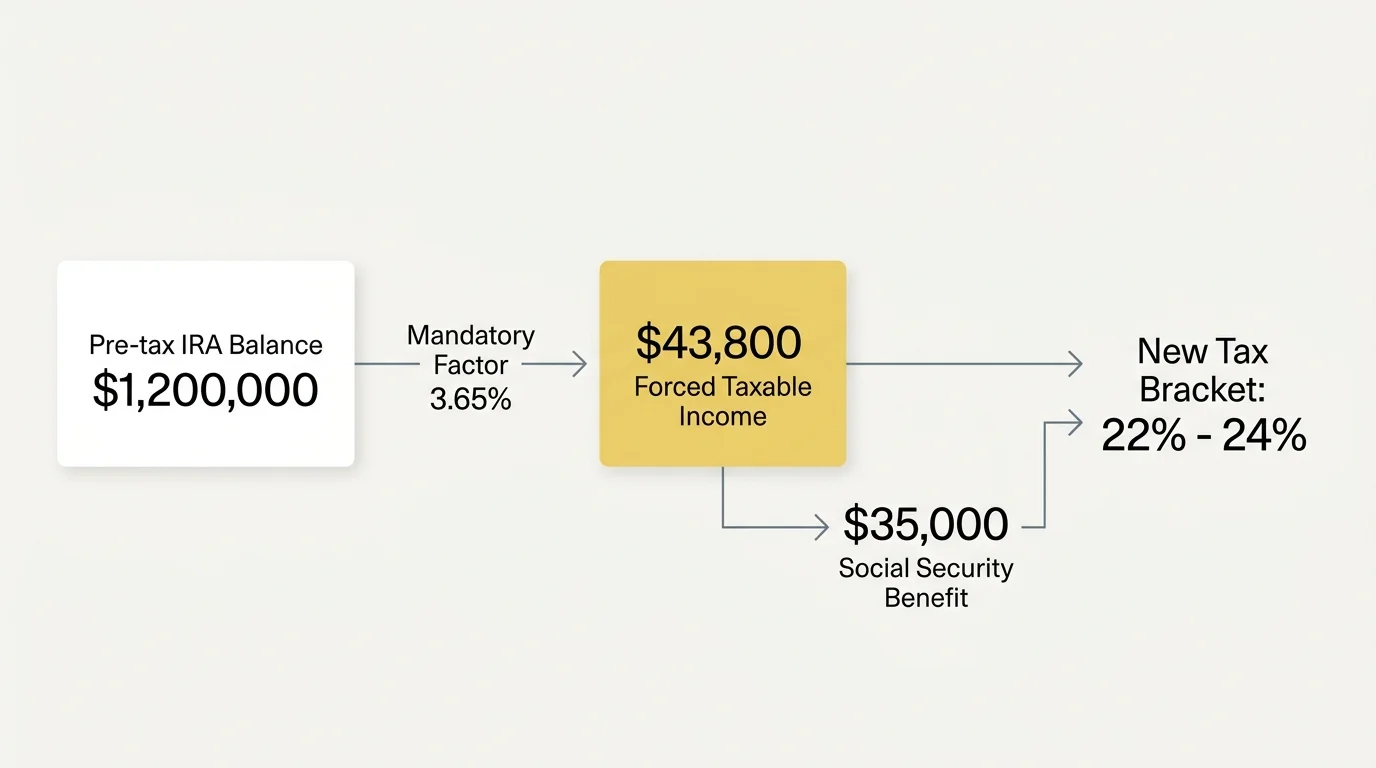
This sudden influx of forced distributions frequently creates the retirement tax bracket trap, driving up your income tax rate without your active choice. If you accumulated $1,200,000 across pre-tax accounts by age 73, your initial mandatory distribution factor requires withdrawing roughly 3.65% during year one. This single calculation forces $43,800 of taxable income onto your yearly tax return. When added to a $35,000 Social Security benefit and a modest annual pension, your baseline reported income rapidly leaps from moderate to high. This sudden bump can easily move you from the 12% marginal bracket into the 22% or 24% tax brackets, forcing you to pay a much higher percentage on every additional dollar you receive.
Understanding the rules surrounding missed distributions helps you protect your account from unnecessary statutory penalties. Under older legislation, failing to take a full RMD triggered a harsh 50% federal penalty on the unwithdrawn amount. Fortunately, the SECURE 2.0 Act reduced this missed-RMD penalty to 25% of the unwithdrawn funds; furthermore, if you correct the oversight in a timely manner within a typical two-year correction window, the penalty drops to 10%. While this lower penalty offers better flexibility, avoiding errors completely remains the most effective financial path. By calculating your mandatory distribution schedule well before your 73rd birthday, you prevent last-minute accounting errors and retain control over your overall retirement income tax strategy.
For a wide range of resources for older adults, visit AARP and the National Council on Aging (NCOA). Health information is available from the National Institute on Aging.
Tip #2: Utilize Qualified Charitable Distributions to Shield Your Income
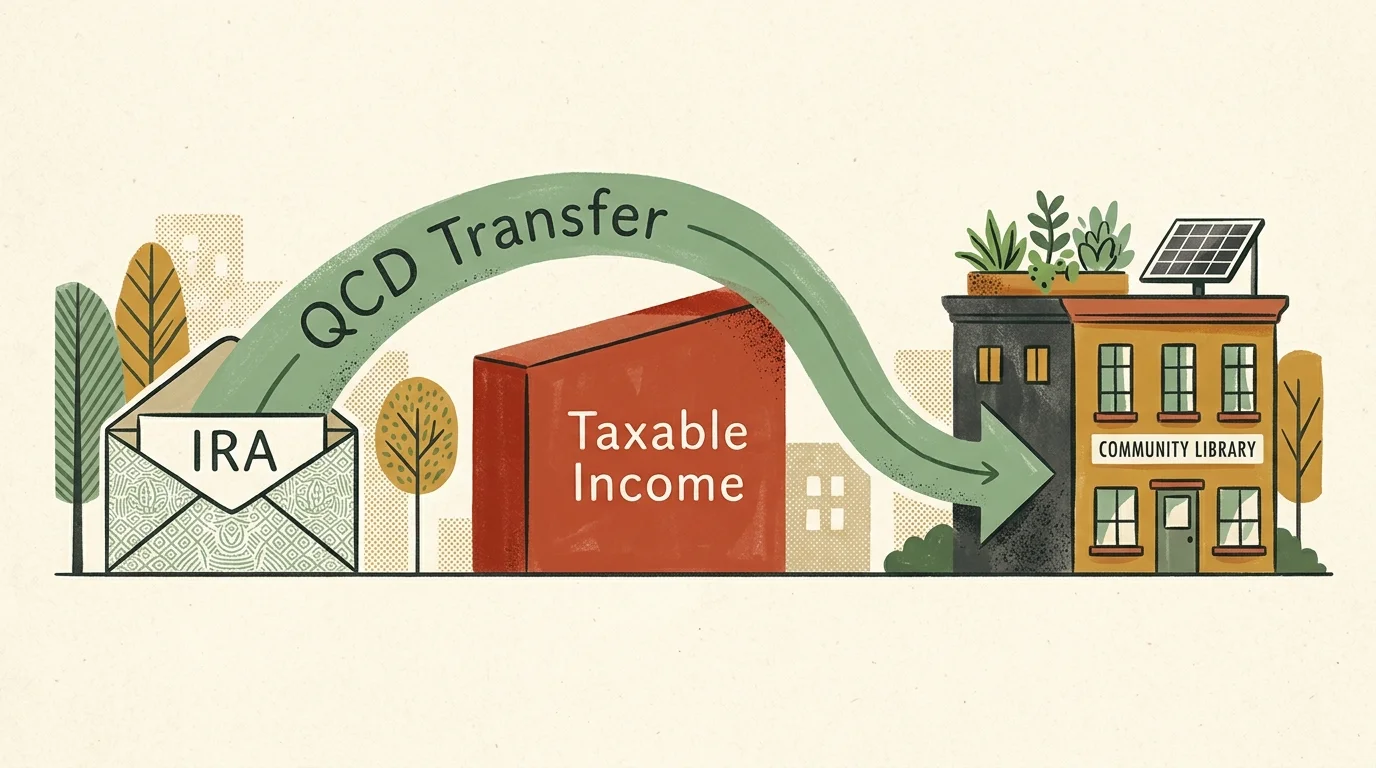
If you regularly support charitable organizations, Qualified Charitable Distributions (QCDs) serve as one of the most practical tools for avoiding higher tax brackets retirement forces upon you. While forced mandatory distributions start at age 73, federal tax law permits you to initiate QCDs starting at age 70½. This critical age gap provides a valuable window to streamline your tax strategy early. Through a QCD, you instruct your traditional IRA custodian to transfer funds directly from your account to a qualified 501(c)(3) nonprofit charity. Because the money moves straight to the charity without entering your personal bank account, the gift counts directly toward your required minimum distribution without adding a single dollar to your Adjusted Gross Income (AGI).
The annual transfer limits for QCDs offer plenty of flexibility for generous retirees aiming to minimize taxable income. In 2026, eligible account owners can transfer up to $111,000 per year directly to qualifying charities—an increase from $108,000 in 2025 and $105,000 in 2024. If you and your spouse both maintain individual traditional IRAs, each of you can utilize this tax provision up to the annual limit. A married couple can redirect up to $222,000 combined in 2026. By removing these funds from your reported gross income, you systematically suppress your top-line taxable income while providing significant financial backing to non-profit causes close to your heart.
Using a QCD offers a distinct mathematical advantage over claiming standard itemized charitable deductions. Recent expansions in the standard deduction mean that most older adults take the standard deduction on their annual tax returns rather than itemizing deductions. Consequently, direct donations paid out of personal checkbooks often yield zero extra tax reduction. In contrast, a QCD lowers your AGI directly at the source. Keeping your AGI suppressed protects you from secondary income spikes, keeps your baseline income safely within lower marginal tax brackets, and shelters your household from retirement tax planning mistakes that often inflate healthcare costs.
For a wide range of resources for older adults, visit AARP and the National Council on Aging (NCOA). Health information is available from the National Institute on Aging.
Tip #3: Implement Strategic Roth Conversions in Your 60s and Early 70s
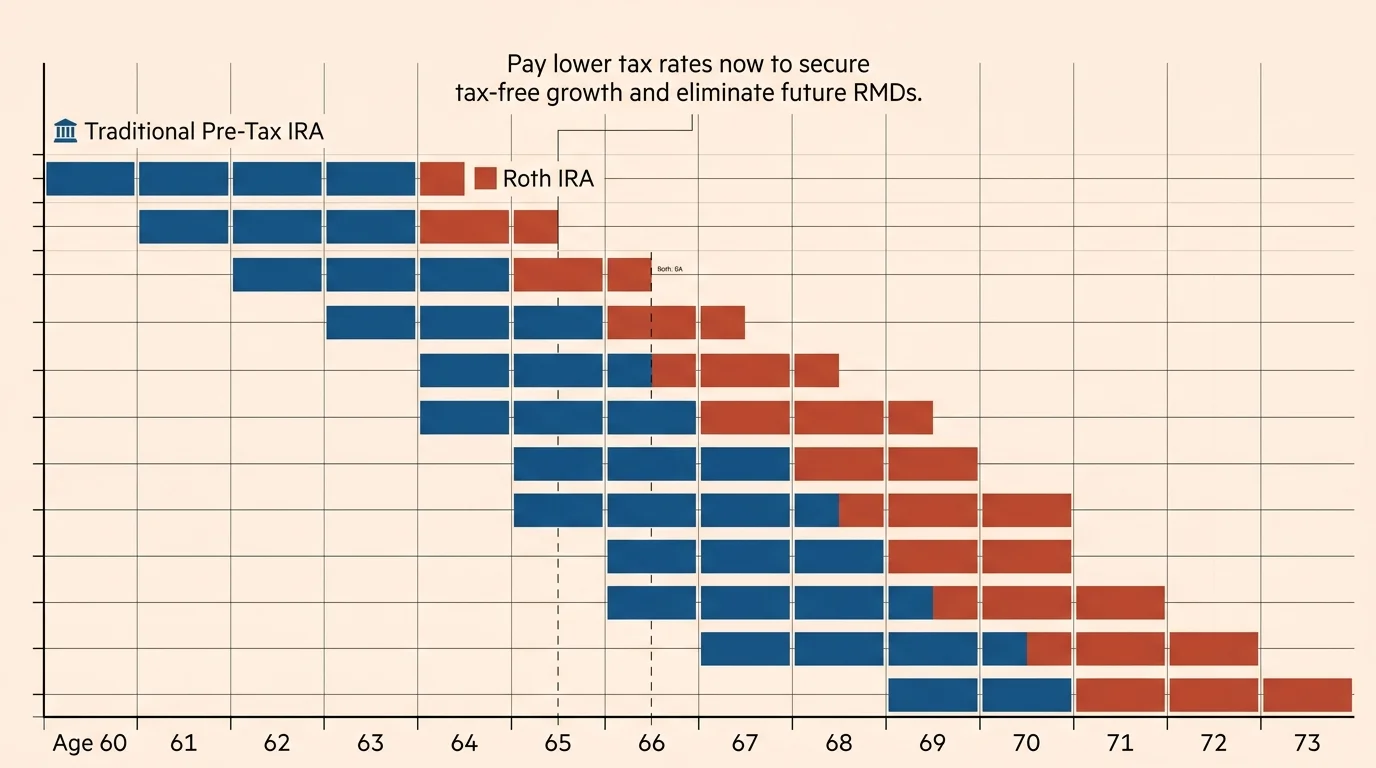
Smart long-term wealth preservation relies heavily on maximizing your low-income gap years. The gap years represent the window between your initial retirement date and the age when mandatory withdrawals kick in at age 73. During this transition, your earned salary stops, which often places you in the lowest marginal income tax brackets of your adult life. You can take advantage of this temporary window by executing targeted Roth conversions. When you transfer funds from a traditional pre-tax IRA or 401(k) into a Roth IRA, you pay standard income tax on the converted amount during that tax year; however, all future investment growth and subsequent distributions from the Roth account remain completely tax-free.
Financial experts call this method filling your tax bracket. For example, if your baseline retirement income places you comfortably in the middle of the 12% marginal tax bracket, you can convert traditional IRA assets up to the ceiling of that 12% bracket each year. By systematically converting portions of your pre-tax balances during your late 60s and early 70s, you intentionally reduce the size of your traditional pre-tax IRA. When you turn age 73, the IRS applies its mandatory distribution calculation to a much smaller pre-tax balance, effectively preventing forced withdrawals from creating an RMD tax bracket increase later in life.
Additionally, key rules under the SECURE 2.0 Act make workplace Roth savings accounts even more advantageous for modern retirees. Effective starting in tax year 2024, designated Roth 401(k), Roth 403(b), and governmental Roth 457(b) accounts no longer mandate lifetime pre-death RMDs. This regulatory change brings employer-sponsored Roth accounts into exact alignment with traditional Roth IRAs. Eliminating mandatory lifetime withdrawals across all Roth vehicles allows your converted assets to compound tax-free throughout your entire life, giving you complete flexibility to withdraw funds whenever you choose or pass wealth smoothly to your heirs.
For a wide range of resources for older adults, visit AARP and the National Council on Aging (NCOA). Health information is available from the National Institute on Aging.
Tip #4: Sidestep the Medicare IRMAA Surcharge Cliff
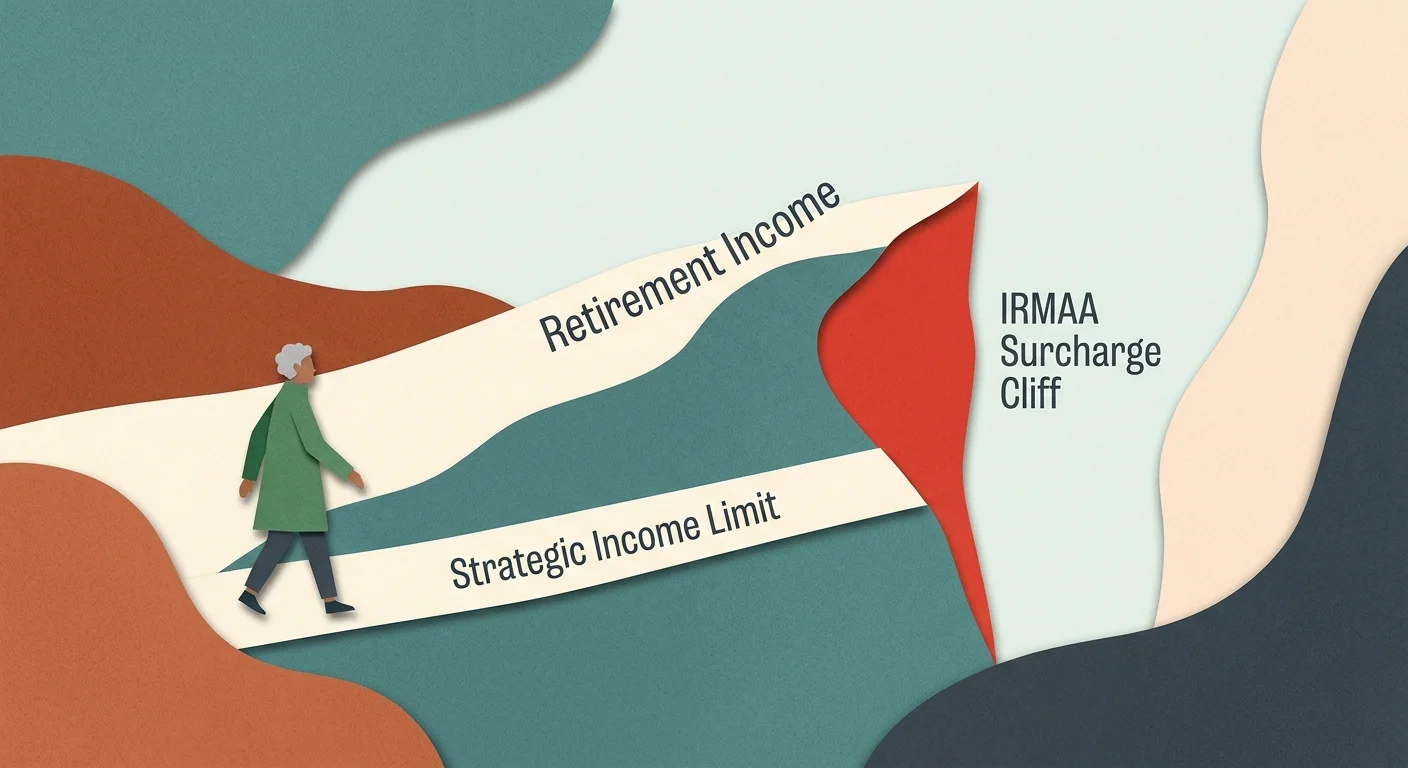
Another major component of the retirement tax bracket trap hitting people in their 70s involves the Medicare Income-Related Monthly Adjustment Amount (IRMAA). IRMAA acts as a mandatory surcharge added directly to your standard Medicare Part B and Part D monthly premiums if your annual income surpasses specific statutory boundaries. What makes IRMAA particularly challenging is its strict cliff design. Unlike progressive income tax brackets—where higher tax rates apply only to the portion of income that exceeds the threshold—crossing an IRMAA threshold by even $1 triggers the full monthly surcharge tier for the entire calendar year, adding hundreds or thousands of dollars to your annual medical expenses.
To avoid IRMAA surprises, you must monitor the federal two-year tax lookback period. The Social Security Administration determines your Medicare premium rates for any given year based directly on your federal tax return from two years prior. For example, your 2024 Modified Adjusted Gross Income (MAGI) dictates your 2026 Medicare Part B and Part D premium costs. In 2026, IRMAA surcharges take effect when your MAGI exceeds $109,000 for single filers and $218,000 for married couples filing jointly. A single large distribution from a traditional IRA or an unexpected capital gain in 2024 can inadvertently trigger a sharp increase in your 2026 healthcare overhead.
You can protect your monthly budget by monitoring your MAGI as each tax year progresses. If your income approaches the $109,000 or $218,000 thresholds late in the year, you can pause pre-tax IRA distributions and cover remaining expenses using tax-free Roth withdrawals or cash reserves. Furthermore, using Qualified Charitable Distributions helps maintain your income safely below IRMAA cliffs because QCD transfers do not enter your MAGI calculation. If you experience a major life-changing event that permanently reduces your household income—such as work reduction, retirement, or the loss of a spouse—you can submit Form SSA-44 to request an official reduction of your IRMAA assessment.
For a wide range of resources for older adults, visit AARP and the National Council on Aging (NCOA). Health information is available from the National Institute on Aging.
Tip #5: Protect Your Social Security Benefits from the Combined Income Trap
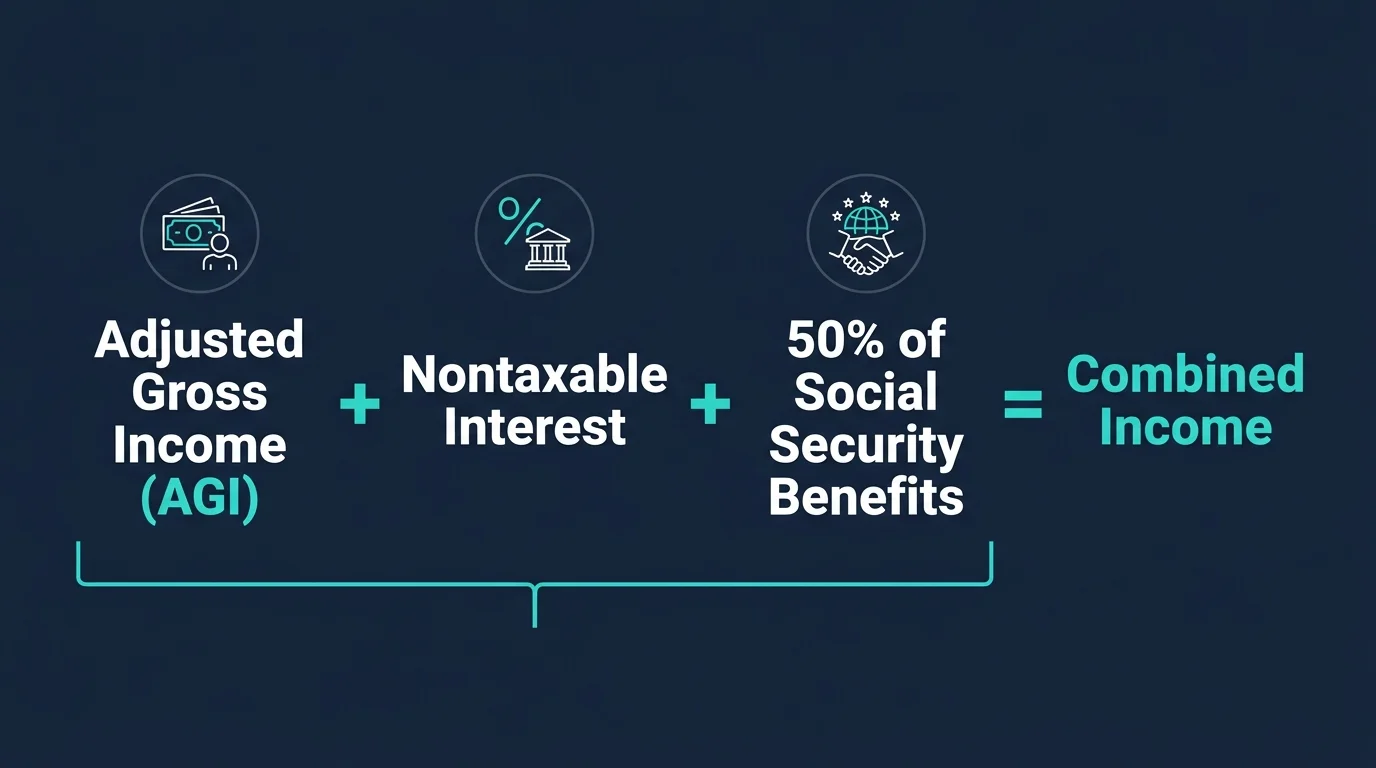
Forced withdrawals from tax-deferred retirement accounts often activate an unexpected secondary tax hit on your Social Security benefits. The federal government uses a specific formula called combined income to determine whether your Social Security benefits face taxation. The IRS defines combined income as your Adjusted Gross Income plus non-taxable interest plus 50% of your total annual Social Security benefit. When compulsory distribution payouts force your AGI higher, your calculated combined income easily crosses statutory thresholds, causing up to 85% of your Social Security payments to become taxable as standard income.
The rules governing Social Security taxation feature strict income boundaries. For single filers, a combined income between $25,000 and $34,000 subjects up to 50% of Social Security benefits to income tax; crossing $34,000 causes up to 85% of your benefits to become taxable. For married couples filing jointly, combined income between $32,000 and $44,000 subjects up to 50% of benefits to taxation, while combined income above $44,000 triggers the 85% tax tier. The underlying trap facing retirees in taxes in your 70s stems from the fact that these statutory thresholds—enacted in 1983 and 1993—are not indexed for inflation. As inflation pushes Social Security payouts higher, forced RMDs easily pull average middle-income retirees into the 85% taxation bracket.
You can manage this taxation overlap by coordinating withdrawals across your various financial accounts. Balancing your retirement income with tax-free distributions from Roth IRAs or tax-aware capital gains from taxable brokerage accounts keeps your top-line AGI low. Keeping your combined income under tight control preserves a larger portion of your monthly Social Security benefit. By managing these mechanics early, you maintain an effective defense against compound taxation and protect your overall household cash flow.
For a wide range of resources for older adults, visit AARP and the National Council on Aging (NCOA). Health information is available from the National Institute on Aging.

The Takeaway: Living a More Blissful Retirement
Managing your personal finances during your 70s does not have to cause unnecessary stress or financial worry. By taking proactive, informed steps—such as organizing distribution schedules before age 73, utilizing Qualified Charitable Distributions, executing multi-year Roth conversions during low-income gap years, and tracking IRMAA income tiers—you stay entirely in control of your financial legacy. Navigating these tax provisions carefully preserves your lifelong wealth and frees up resources for family travel, hobbies, home projects, and peaceful living.
Retirement offers a wonderful opportunity to celebrate your career accomplishments and enjoy well-earned personal freedom. Educating yourself on current tax legislation ensures that your savings continue to serve your personal vision rather than going toward avoidable tax penalties or elevated tax brackets. Consider scheduling a review with a trusted tax professional or certified financial planner to create a customized withdrawal calendar tailored specifically to your needs. With a clear strategy in place, you can move forward confidently and experience the blissful, worry-free retirement you deserve.
Disclaimer: This article is for informational and inspirational purposes only. It is not a substitute for professional medical, financial, or psychological advice. Please consult with a qualified expert for guidance tailored to your individual needs.
For a wide range of resources for older adults, visit AARP and the National Council on Aging (NCOA). Health information is available from the National Institute on Aging.
Frequently Asked Questions
What happens if I miss taking my Required Minimum Distribution on time?
If you fail to take your full required distribution by the annual deadline, the IRS assesses a federal penalty on the unwithdrawn amount. Following updates under the SECURE 2.0 Act, the standard penalty is 25% of the unwithdrawn balance. However, if you correct the error promptly and file Form 5329 within the official correction window—typically two years—the penalty reduces to 10%. Taking quick corrective action minimizes the financial impact on your account.
Can I use a Roth IRA to avoid the retirement tax bracket trap altogether?
Yes, Roth IRAs serve as an excellent defense against tax bracket inflation. Money inside a Roth IRA grows tax-free, and qualified withdrawals generate zero reported income on your federal tax return. Roth distributions do not raise your Adjusted Gross Income, trigger Medicare IRMAA surcharges, or increase taxes on your Social Security benefits. Additionally, original account holders face no lifetime mandatory distributions from Roth IRAs.
How does Medicare learn about my income, and can I appeal an IRMAA surcharge?
The Social Security Administration receives your income data directly from the IRS using a two-year tax lookback period. Your 2024 tax return determines your 2026 Medicare premiums. If your household income drops significantly due to a qualifying life-changing event—such as work reduction, retirement, marriage, or loss of income-producing property—you can formally appeal an IRMAA surcharge by submitting Form SSA-44 along with supporting documentation.
At what age should I start planning for mandatory distribution tax impacts?
You should start planning in your late 50s or early 60s, prior to leaving the workforce. Planning during the gap years between your initial retirement date and age 73 gives you ample time to execute gradual Roth conversions, plan charitable gifts, and structure account balances to prevent massive forced distributions later in life.