
If you were married for at least a decade before divorcing, you can boost your retirement income using your former partner’s earnings record. You may qualify for up to 50% of your ex-spouse’s Social Security benefit without their knowledge or consent.
This federal entitlement does not reduce your former partner’s monthly checks by a single penny. It simply provides the vital financial support you earned through years of shared life and mutual effort.
Learning how to claim ex’s benefits ensures you collect every dollar you deserve. You can navigate the application process with complete confidence and total privacy.
Tip #1: Verify Your 10-Year Marriage Milestone
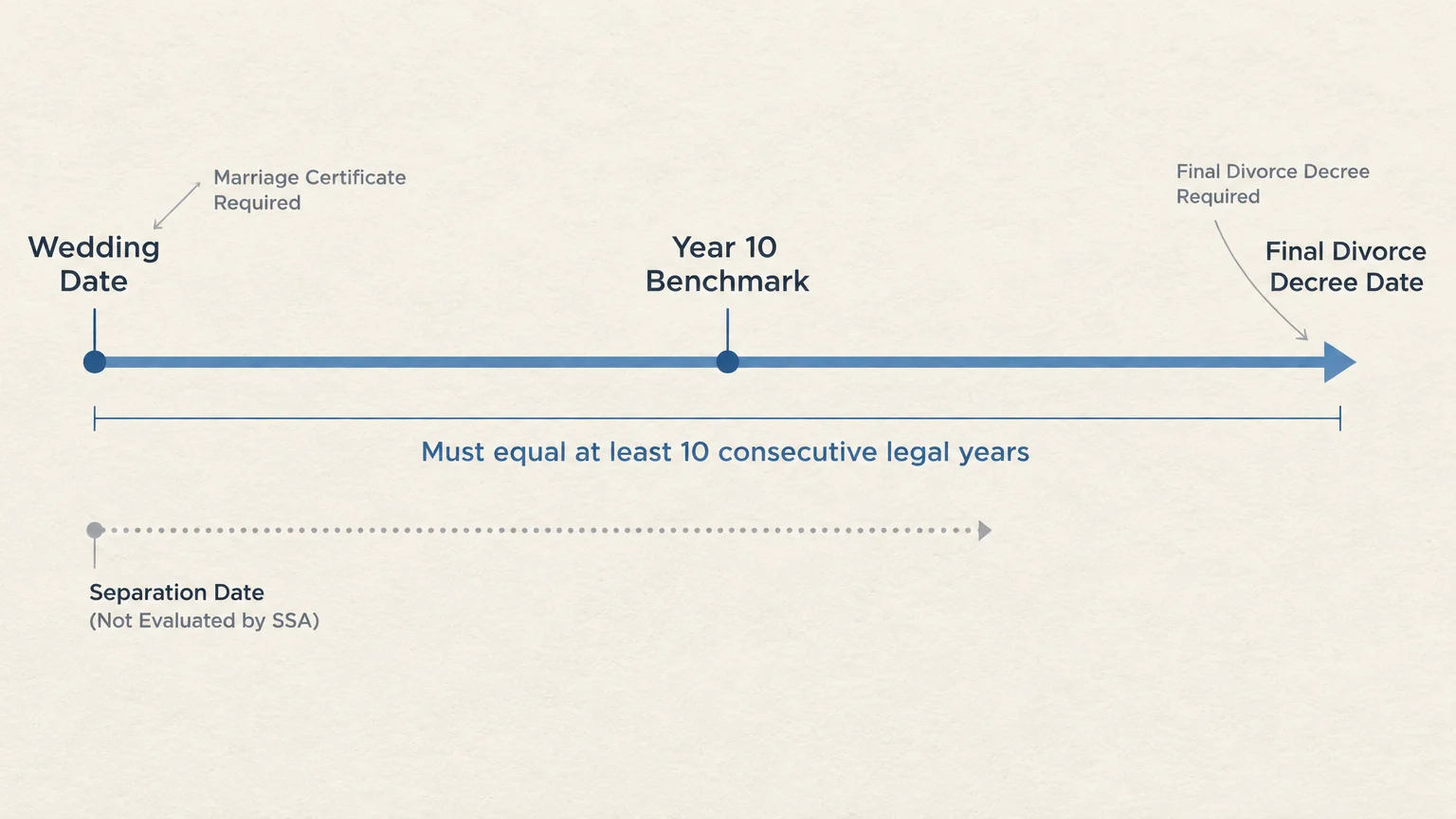
To qualify for divorced spouse benefits, your marriage must have lasted at least 10 consecutive years. The Social Security Administration measures this period strictly from your wedding day to the date your divorce became final.
If your legal union ended even a single day before your tenth anniversary, you cannot collect these spousal payments. For this reason, you should review your official documents carefully before filing an application.
Locate your official marriage certificate and final divorce decree to confirm your exact dates. These legal records provide the essential proof the federal government requires to establish your claim.
If you misplaced your documents, contact the county clerk or vital statistics office where you married or divorced. Securing certified copies in advance prevents unnecessary administrative delays.
Couples who separated long before their divorce became final often meet this rule easily. The government focuses entirely on the legal divorce date rather than when you stopped living together.
If you were married multiple times for at least 10 years each, you can pick the record that yields the largest check. The agency allows you to claim on whichever former spouse provides the highest monthly payment.
Confirming you were divorced after 10 years gives you immediate access to this valuable retirement safety net. It represents an earned right that can enhance your financial independence for years to come.

Tip #2: Protect Your Complete Financial Privacy
Many older adults hesitate to claim divorced spouse social security because they fear awkward interactions with an ex-partner. Fortunately, federal privacy laws protect your personal business through strict confidentiality rules.
The Social Security Administration never notifies your former spouse when you file on their earnings record. Your ex will not receive a phone call, letter, or digital notification about your application.
Furthermore, your claim has zero effect on your former partner’s monthly checks. They will continue to receive their full retirement benefit without any deductions or adjustments.
If your former spouse remarried, your filing will not diminish their new partner’s spousal payments either. Both of you can draw benefits simultaneously without causing any financial conflict.
The federal government disburses these payments directly from the Social Security trust fund. You can apply with absolute peace of mind knowing your finances remain entirely private.
Your former spouse has no legal authority to block, protest, or contest your application. The agency determines your eligibility based solely on federal statutory requirements.
You can schedule a private appointment over the phone or submit paperwork through the official government portal. Your financial journey remains entirely within your control.
Tip #3: Calculate Your 50% Spousal Maximum Accurately
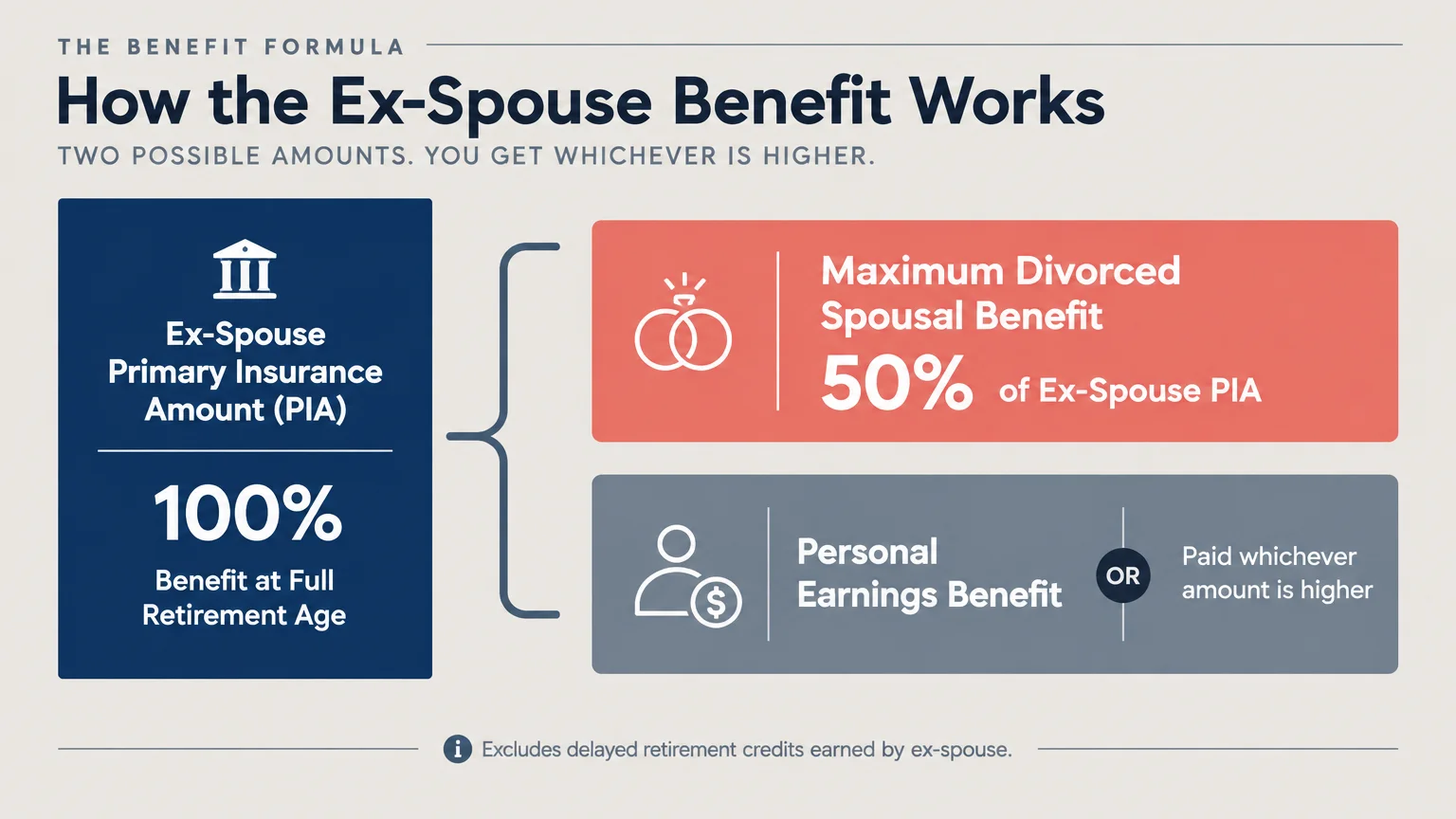
Under federal regulations, the maximum divorced spousal benefit equals 50% of your ex-partner’s Primary Insurance Amount. This figure reflects the full monthly benefit your former spouse earned at their Full Retirement Age.
It does not include any delayed retirement credits your former spouse might accumulate by working until age 70. Your 50% calculation always stems from their baseline full retirement number.
The agency applies a strict deemed filing rule whenever you submit your retirement application. This policy means you cannot collect your personal retirement benefit alongside your ex spouse benefits.
Instead, Social Security calculates your personal retirement entitlement first. If half of your ex’s benefit exceeds your personal amount, the government adds a spousal supplement to bridge the difference.
Suppose your own retirement benefit equals $800, while your former partner’s Primary Insurance Amount is $2,400. In that scenario, your 50% spousal maximum totals $1,200.
The agency pays your $800 personal check first, followed by a $400 spousal supplement. Your combined monthly payment equals the full $1,200 spousal target.
If your own worker benefit exceeds half of your ex’s primary amount, you simply collect your higher personal benefit. You always receive the largest monthly check for which you legally qualify.

Tip #4: Reach Full Retirement Age to Avoid Permanent Reductions
You can file for benefits starting at age 62, but claiming early causes a permanent reduction in your monthly payments. For anyone born in 1960 or later, Full Retirement Age is exactly 67.
If you claim divorced spousal payments at age 62, your monthly benefit permanently drops to as little as 32.5% of your ex-partner’s primary amount. That represents a significant reduction in lifetime income.
To receive the full 50% of ex social security, you must wait until your own Full Retirement Age. Patience allows you to secure the maximum spousal payment guaranteed by federal law.
Unlike your personal retirement record, divorced spousal benefits do not grow if you delay claiming past age 67. Spousal payments stop increasing the moment you reach your Full Retirement Age.
Waiting until age 70 provides no additional spousal income. The optimal claiming window for spousal benefits closes as soon as you reach age 67.
Review your birth year to confirm your exact Full Retirement Age milestone before making any claiming decisions. Careful timing ensures you maximize your monthly cash flow.
Claiming precisely at your Full Retirement Age ensures you capture maximum value without leaving money on the table. Every month you wait between 62 and 67 permanently boosts your check.
Tip #5: Leverage the Two-Year Independent Eligibility Rule
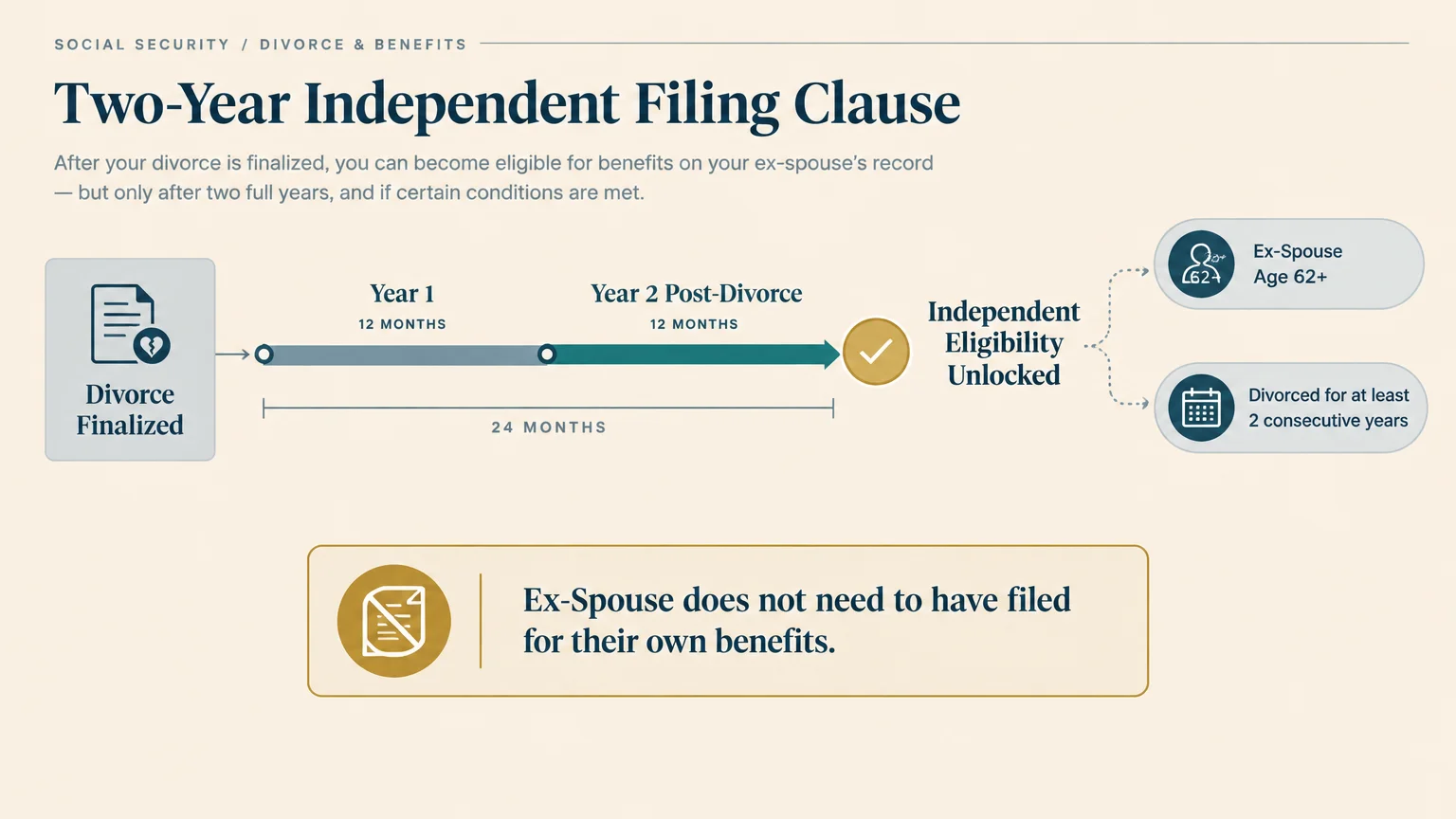
You do not have to wait for your former partner to retire before accessing your benefits. The independently entitled divorced spouse rule lets you file even if your ex continues working.
To use this provision, your former partner must be at least 62 years old and fully insured. Additionally, your divorce must have been finalized for at least two continuous years.
This two-year rule grants you complete financial independence from your former spouse’s future career decisions. Their choice to delay retirement will not derail your personal retirement plans.
You never need to request pay stubs or financial records from your former partner to apply. The Social Security Administration retrieves their employment data directly from official federal records.
Simply provide your ex-spouse’s legal name, birth date, and Social Security number during your appointment. If you do not have their Social Security number, provide their parents’ names and place of birth.
The agency uses those biographical details to locate the correct earnings file in their master database. The process remains seamless, professional, and discreet.
This statutory protection ensures that uncooperative former partners cannot hinder your financial stability. You control your retirement timetable regardless of their choices.

Tip #6: Navigate Remarriage Rules to Preserve Your Rights
To collect divorced spousal benefits on a living ex-partner’s record, you must remain currently unmarried. Entering a new legal marriage terminates your eligibility to receive payments from your former spouse.
If you remarry, you must inform Social Security, and they will transition you to your new marital status. You can then explore spousal benefits under your new partner’s record once eligible.
However, if your subsequent marriage ends due to divorce, annulment, or death, your eligibility returns immediately. You can reapply under your original 10-year marriage record without penalty.
Meanwhile, your former spouse’s marital status has no impact on your benefits. Your ex can marry multiple times, and your legal claim remains completely protected.
Many older adults choose long-term partnership or cohabitation rather than legal marriage to protect their monthly payments. Evaluating the financial consequences of marriage helps you protect your retirement cash flow.
Before planning a wedding in your golden years, compare your potential spousal benefits carefully. Understanding how remarriage affects your bottom line prevents costly financial surprises.
Preserving your unmarried status keeps your access to your former spouse’s record intact for life. Weigh your legal choices thoughtfully to protect your living standards.
Tip #7: Capitalize on the Repeal of GPO and WEP
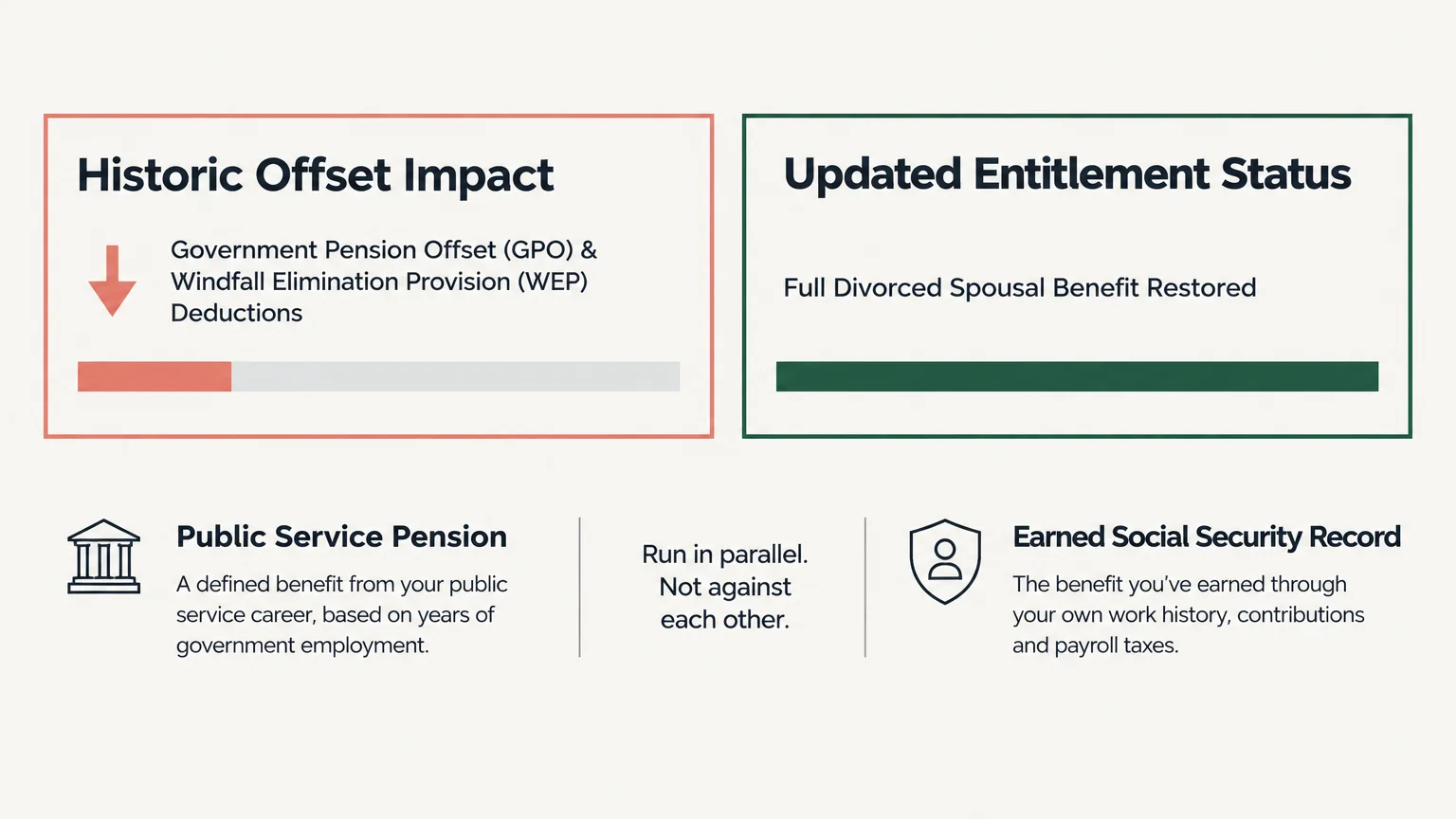
Retired public servants recently gained access to substantial financial relief. The Social Security Fairness Act became law on January 5, 2025, and applied retroactively to January 2024.
This legislation eliminated the Government Pension Offset and the Windfall Elimination Provision. These outdated policies previously reduced or wiped out spousal benefits for individuals with government pensions.
If you worked as a teacher, firefighter, police officer, or civil servant, your public pension no longer reduces your divorced spousal payments. You can now collect both payments in full.
In past years, the Government Pension Offset reduced spousal benefits by two-thirds of the public pension amount. This harsh offset eliminated spousal support for hundreds of thousands of retirees.
Under the current law, your earned government pension remains entirely separate from your Social Security entitlements. You receive every dollar you earned through public service alongside your spousal entitlement.
This legislative breakthrough provides thousands of dedicated public servants with the retirement income they rightly earned. It restores fair access to spousal benefits regardless of your previous state or local government employment.
If a government pension previously prevented you from claiming ex’s benefits, contact Social Security to update your file immediately. Reapplying can provide an immediate and permanent boost to your monthly income.
Tip #8: Plan Around the Retirement Earnings Test if Working
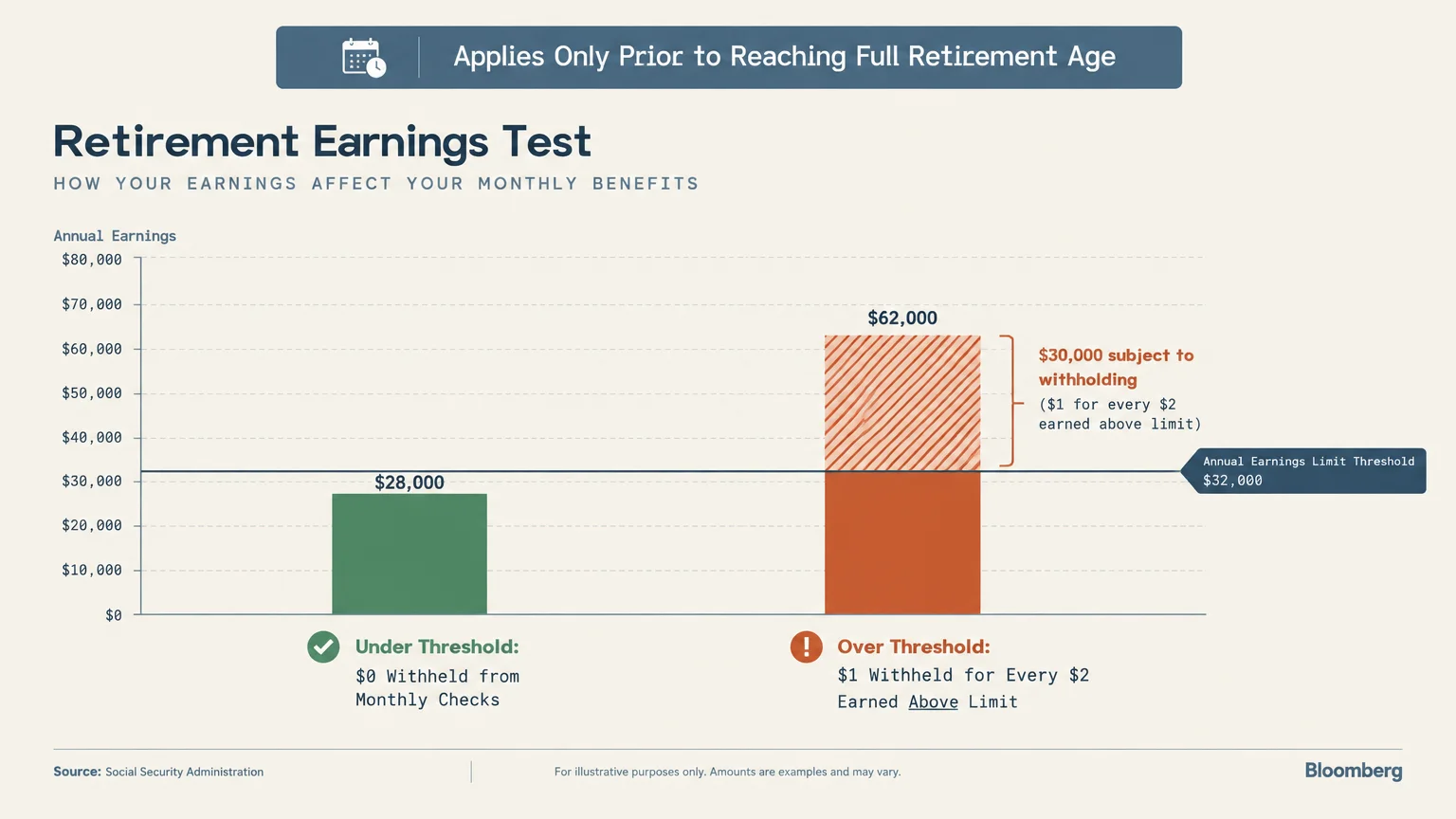
Continuing to work while claiming benefits before Full Retirement Age requires careful planning. The Social Security Administration enforces an earnings test that temporarily withholds benefits if your wages exceed annual thresholds.
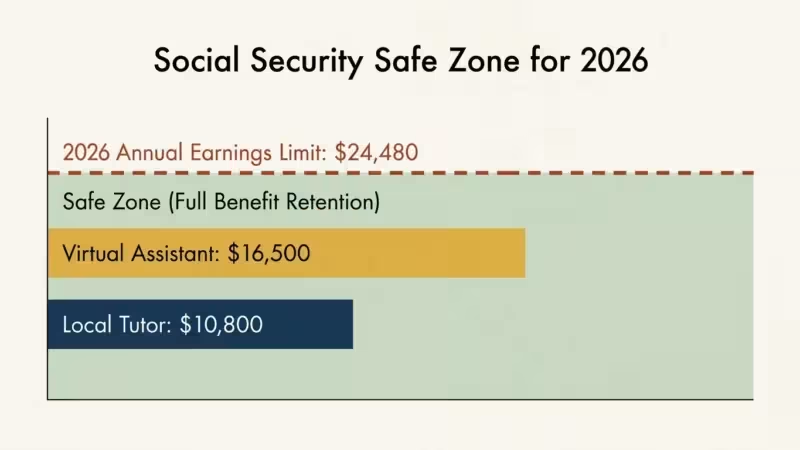
If you remain under Full Retirement Age for the entire year, the earnings limit is $24,480 in 2026. This cap increases to $25,560 in 2027 to reflect wage growth.
The government withholds $1 of benefits for every $2 you earn above these established thresholds. These withheld amounts are not lost permanently; they boost your monthly checks once you reach Full Retirement Age.
During the calendar year you reach Full Retirement Age, the earnings ceiling expands dramatically. The limit rises to $65,160 in 2026 and climbs further to $67,920 in 2027.
In that milestone year, the agency withholds only $1 for every $3 earned above the limit. Furthermore, the agency only counts wages earned during the months prior to your birthday.
Once you reach your Full Retirement Age birthday, earnings restrictions disappear completely. You can earn an unlimited salary without losing a single dollar of your monthly benefit.
When you reach Full Retirement Age, the agency recalculates your benefit to account for all withheld funds. Your future monthly checks increase permanently to repay the withheld money.
Balancing your working hours against these earnings limits ensures you keep your cash flow predictable and steady. Strategic planning helps you avoid unexpected withholding during early retirement.

Tip #9: Understand Survivor Benefits if Your Ex Passes Away
If your former spouse passes away, your financial support options expand significantly. As a surviving divorced spouse, you can claim up to 100% of your deceased ex-partner’s full retirement benefit.
Survivor benefits include any delayed retirement credits your former partner earned by postponing their claim until age 70. This can result in a much larger monthly deposit than living spousal benefits.
You can file for survivor benefits as early as age 60, or at age 50 if you have a qualifying disability. Claiming before your Full Retirement Age results in a percentage reduction, but provides immediate cash flow.
Remarriage rules are also far more generous for surviving divorced spouses. If you remarry after reaching age 60, you continue to receive survivor benefits without any penalty.
Survivor benefits also offer valuable claiming flexibility. You can claim survivor benefits first while letting your own retirement benefit grow, or collect your own benefit and switch to survivor payments later.
This switching strategy allows you to maximize your long-term monthly check. Speaking with a representative can help you sequence these benefits for optimal lifetime value.
Surviving divorced spouse benefits provide a vital safety net during difficult life transitions. Knowing these rules ensures you collect the full financial legacy available to you.
Tip #10: Track Maximum Benefit Ceilings and Annual Cost-of-Living Adjustments
Understanding official benefit ceilings helps you set realistic expectations for your monthly household budget. In 2026, the maximum Social Security benefit for a worker retiring at Full Retirement Age is $4,152 each month.
Because divorced spousal payments cap at half of that baseline, your maximum possible benefit in 2026 is $2,076 per month. This provides a dependable financial foundation throughout your golden years.
In 2027, the maximum worker retirement benefit at Full Retirement Age rises to $4,188 per month. That adjustment lifts the maximum divorced spousal payment to $2,094 per month in 2027.
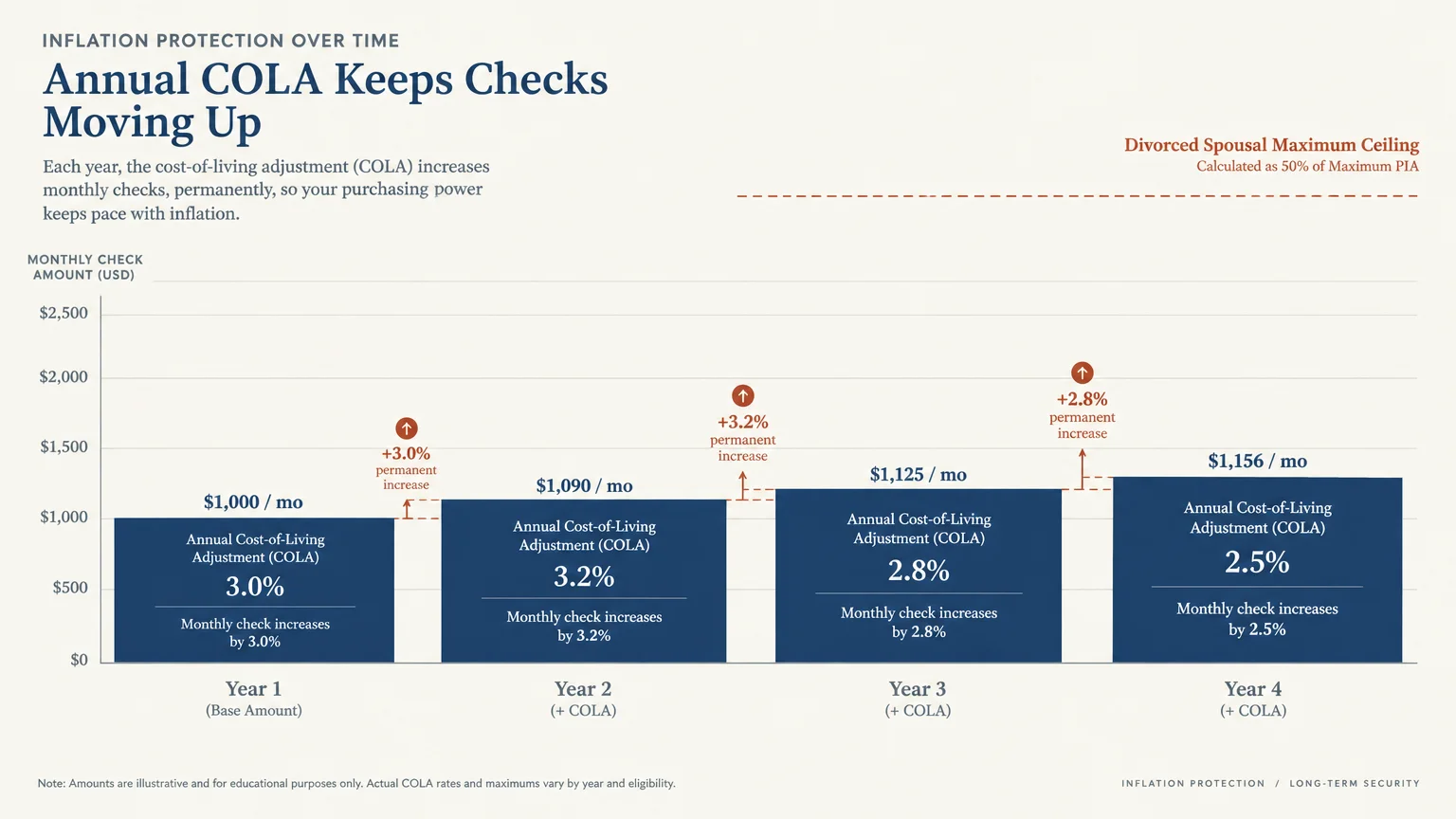
Annual Cost-of-Living Adjustments ensure your benefits keep pace with everyday living expenses. The COLA for 2026 was set at 2.8%, bringing average worker benefits to approximately $2,095 per month.
On October 14, 2026, the Social Security Administration announced a 3.6% COLA for 2027. This increase lifts average retired worker checks by about $75 to $2,170 per month starting in January 2027.
Cost-of-living increases apply automatically to your spousal benefit payments every January. You do not need to submit any paperwork to receive these annual inflation adjustments.
Tracking these adjustments helps you anticipate changes in your annual retirement cash flow. These predictable increases protect your purchasing power across your retirement years.
Combining these cost-of-living adjustments with smart claiming strategies positions you for lasting financial comfort. You deserve to reap the full economic rewards established under federal law.

The Takeaway: Living a More Blissful Retirement
Securing your financial future requires knowing the rules and claiming what you earned. Decades of marriage represent a major contribution to your former household, and the law honors that dedication.
You do not need your former spouse’s permission, signature, or awareness to file this claim. The process remains strictly between you and the Social Security Administration.
Take proactive steps today by gathering your marriage license and final divorce decree. Scheduling an appointment with your local Social Security office can unlock funds that enhance your retirement freedom.
With this reliable financial boost, you can travel more, pursue creative passions, and enjoy greater peace of mind. Your golden years should be filled with comfort, autonomy, and genuine happiness.
Step forward with confidence and claim the financial support designed to sustain you. Empowering yourself with knowledge turns your retirement dreams into reality.
Embrace the freedom that comes with financial clarity and independence. You built the foundation for this benefit, and now is the time to enjoy its rewards.
Frequently Asked Questions
What documents do I need to apply for divorced spouse benefits?
You need your official birth certificate, proof of United States citizenship or legal residency, and your Social Security card. Additionally, bring your original marriage certificate and your final divorce decree.
You also need your former spouse’s legal name, date of birth, and Social Security number if available. If you lack their number, provide their parents’ full names and city of birth.
The Social Security Administration accepts certified copies from vital records offices if you cannot locate your originals. Gathering these papers ahead of time makes your appointment quick and stress-free.
Can multiple ex-spouses claim benefits on the same worker’s record?
Yes, multiple former spouses can claim benefits on the same worker’s earnings record. Each ex-spouse must have been married to the worker for at least 10 consecutive years.
One former partner’s claim does not reduce the payment amount for any other ex-spouse or current partner. Social Security pays each eligible individual their full statutory entitlement independently.
The system treats each claim separately, ensuring that every qualified spouse receives their lawful share. Your monthly income remains entirely unaffected by other claimants.
What happens if my ex-spouse hasn’t applied for Social Security yet?
You can still collect benefits under the independently entitled divorced spouse rule. Your ex-spouse must be at least 62, and your divorce must be final for at least two consecutive years.
Once you meet these criteria, you can begin receiving payments regardless of when your ex plans to retire. Their career choices will not delay your monthly income.
The agency accesses their tax earnings history directly to establish your monthly payment amount. You do not need any input or approval from your former partner.
Can I switch from my own benefit to a divorced spousal benefit later?
Under deemed filing rules, you automatically apply for both personal and spousal benefits simultaneously. You cannot choose to take one benefit now and switch to the other living benefit later.
However, if your former spouse passes away, you can switch to surviving divorced spouse benefits. Survivor benefits allow strategic switching options that living spousal benefits do not permit.
Consult with a Social Security representative to determine the exact timing that produces your highest lifetime income. Expert guidance ensures you navigate these complex rules successfully.
Does receiving divorced spousal benefits affect Medicare enrollment?
Claiming divorced spousal benefits does not negatively impact your Medicare coverage. You remain eligible to enroll in Medicare at age 65 regardless of your Social Security claiming strategy.
If you collect Social Security benefits at 65, the government automatically enrolls you in Medicare Part A and Part B. Your monthly Medicare premiums can be deducted directly from your spousal payment.
This automated deduction simplifies your healthcare budgeting and keeps your coverage current. You enjoy continuous health protection alongside your monthly retirement income.
For a wide range of resources for older adults, visit AARP and the National Council on Aging (NCOA). Health information is available from the National Institute on Aging.
Disclaimer: This article is for informational and inspirational purposes only. It is not a substitute for professional medical, financial, or psychological advice. Please consult with a qualified expert for guidance tailored to your individual needs.