
Picking up a side job after leaving full-time work brings fresh purpose, social connection, and extra spending money for travel or grandkids. Whether you tutor, consult, or sell crafts, smart tax planning keeps more of that cash in your pocket.
Federal rules treat freelance and contract pay differently from regular retirement checks, yet the system rewards anyone who learns a few key thresholds. Knowing how self-employment tax, 1099 forms, and benefit limits interact lets you work on your own terms.
Use these five practical rules to protect your retirement income and enjoy every dollar you earn.
Lifestyle Idea #1: Master Self-Employment Tax Before Taking Your First Gig
Launching an encore career—from walking neighborhood dogs to offering part-time bookkeeping—gives your week structure and keeps your mind sharp. Before you cash your first check, though, you need to understand how side job taxes retirees face work at the federal level.
When you work for a traditional employer, the company splits payroll taxes with you down the middle. Once you step into independent contract work, the IRS treats you as both the employer and the employee.
The $400 Trigger and the 15.3% Rate
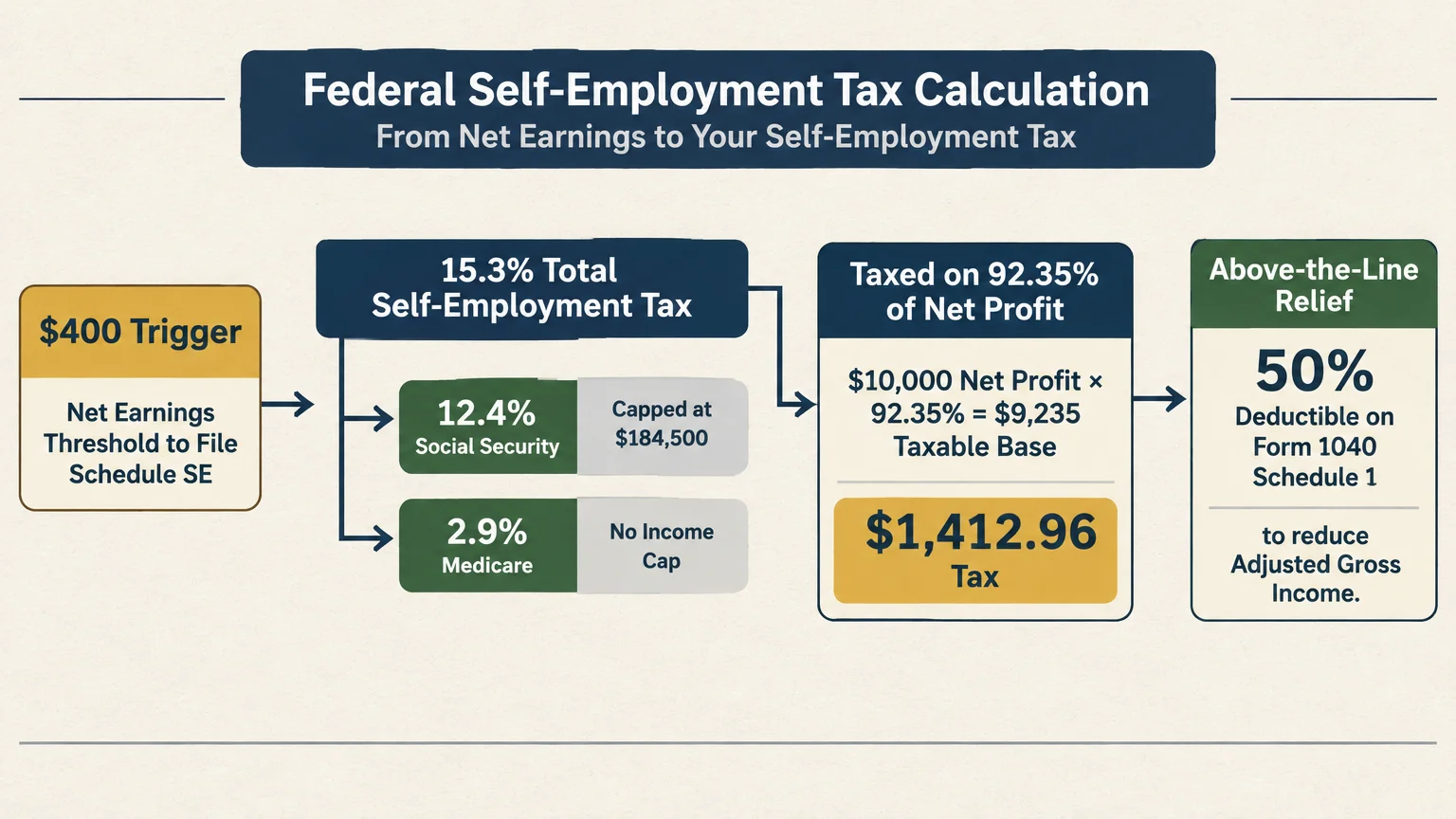
You owe federal self-employment tax and must file Schedule SE as soon as your net earnings from side work reach $400 or more in a calendar year. Notice the word net, because you subtract legitimate business expenses before checking that threshold.
The federal self-employment tax rate stands at 15.3%, combining 12.4% for Social Security and 2.9% for Medicare. Fortunately, you do not pay that 15.3% on every dollar of profit.
Under Internal Revenue Code rules, you calculate the tax on 92.35% of your net self-employment earnings rather than 100%. Suppose you clear $10,000 in profit from seasonal consulting; you apply the 15.3% rate to $9,235, which produces a $1,412.96 self-employment tax bill.
Income Caps and High-Earner Thresholds
If you also hold a part-time W-2 job or earn substantial consulting fees, watch the Social Security wage base cap. For 2026, the 12.4% Social Security portion applies only up to $184,500 of combined wages and net self-employment earnings.
That Social Security cap rises to $192,300 in 2027, according to the Social Security Administration. Every dollar of net profit above those limits avoids the 12.4% tax, though the 2.9% Medicare portion has no income cap at all.
High-earning working retirees must also watch for the 0.9% Additional Medicare Tax on combined earned income. That extra surcharge kicks in above $200,000 for single filers or heads of household, $250,000 for married couples filing jointly, and $125,000 for married individuals filing separately.
How the 50% Deduction Really Works
Many newcomers assume the standard deduction erases self employment tax retirees owe on modest profits, but that is a costly myth. Your standard deduction and the 20% Qualified Business Income deduction lower your federal income tax only—they never reduce Schedule SE tax.
You do catch one helpful break on Form 1040 Schedule 1, however. You can deduct 50% of your regular self-employment tax as an above-the-line adjustment to income.
That write-off lowers your adjusted gross income and trims your regular income tax bill, even though it leaves the self-employment tax figure itself unchanged. Factoring that 15.3% obligation into your hourly rate or product pricing protects your profit margin from day one.
Lifestyle Idea #2: Track Every Dollar Even Under the Higher 1099 Thresholds
Selling handmade woodwork at weekend markets or advising former colleagues feels rewarding, and recent federal law changes cut down some of your paperwork. Even with fewer tax forms arriving in your mailbox, clean recordkeeping remains your best friend.
New Form 1099-NEC and 1099-K Rules
Under the One Big Beautiful Bill Act of 2025, Congress raised the reporting floor for Form 1099-NEC and certain Form 1099-MISC payments. For payments made after December 31, 2025, clients generally issue those forms only when they pay you $2,000 or more, up from the old $600 rule.
That $2,000 threshold begins adjusting for inflation in 2027, while specialized items like the $10 royalty reporting threshold remain untouched. Meanwhile, payment apps and online marketplaces follow an even higher standard for Form 1099-K.
Lawmakers permanently repealed the old $600 1099-K rule and restored the original threshold. Third-party payment networks issue Form 1099-K only when your gross payments exceed $20,000 and you complete more than 200 transactions in a single year.
Reporting Income Without a Tax Form
Here is one of the most critical rules for 1099 income seniors often misunderstand: missing paperwork never turns side pay into tax-free cash. The IRS requires you to report all taxable self-employment income, whether a client sends a 1099 form or pays you in cash.
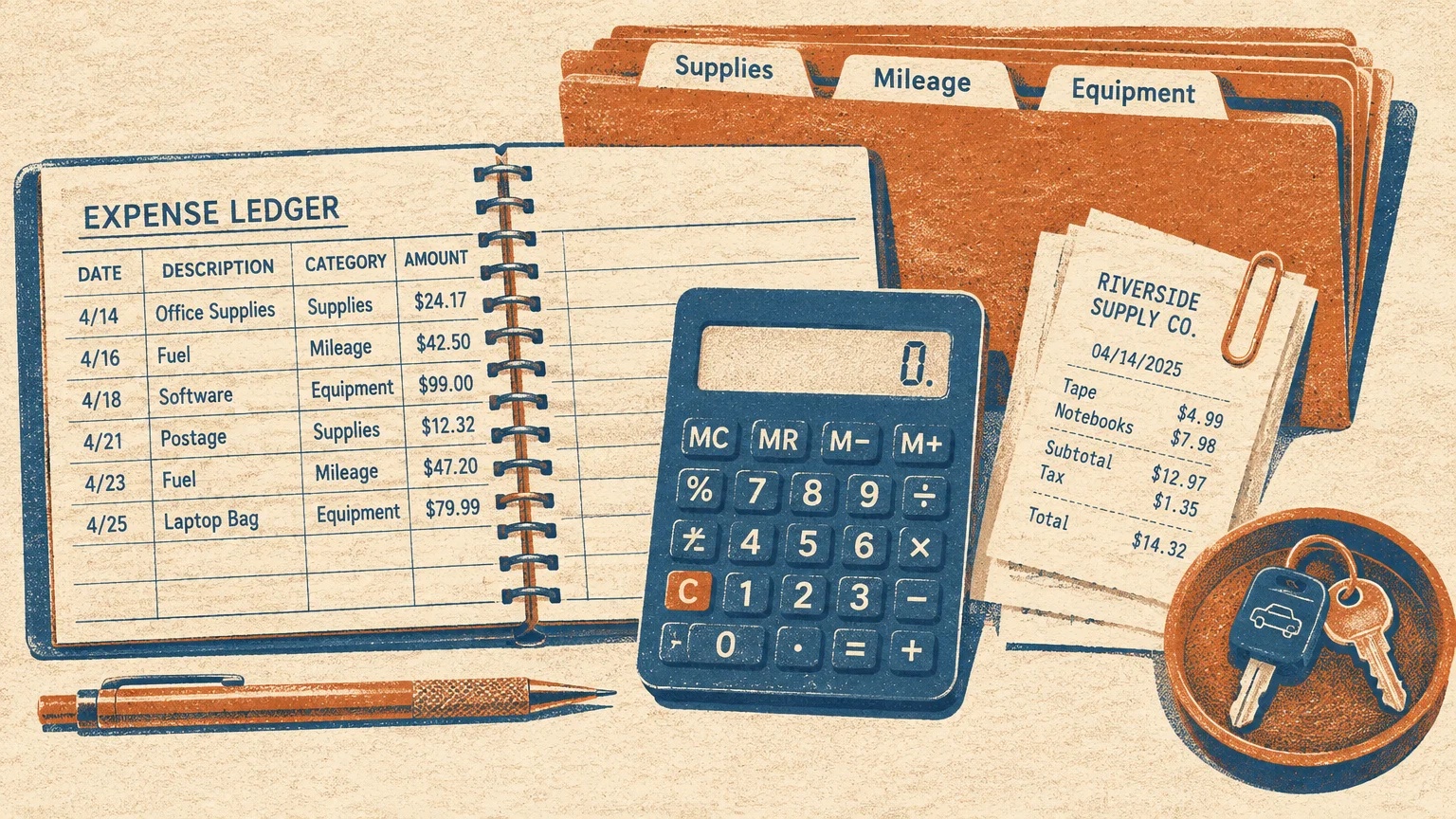
Keep a simple dedicated checking account and a spreadsheet or notebook where you log every payment by date and client. When April arrives, you avoid frantic bank statement searches and report accurate totals with total confidence.
Deductions That Shrink Your Taxable Profit
Good records also capture every ordinary and necessary expense that lowers both your income tax and your self-employment tax. If you drive to tutor students, deliver floral arrangements, or visit clients, track every business mile.
Because fuel costs climbed during the year, the IRS raised the 2026 business standard mileage rate midyear. You can deduct 72.5 cents per mile for driving between January 1 and June 30, 2026, and 76 cents per mile from July 1 through December 31, 2026.
Do not overlook the permanent 20% Qualified Business Income deduction under Section 199A either. For eligible sole proprietors and freelancers, this rule lets you deduct up to 20% of your net business income when calculating federal income tax.
Phase-in limits for that 20% deduction start at $208,300 for single filers and $416,600 for joint filers in 2027, so most part-time retirees qualify easily. Starting in 2026, non-itemizers can also deduct up to $1,000 in eligible cash charity gifts, or $2,000 for married couples filing jointly.
Lifestyle Idea #3: Set Up Quarterly Estimated Taxes to Keep Cash Flow Stress-Free
Nothing spoils a fun autumn road trip faster than discovering a surprise tax bill and underpayment penalties the following spring. Unlike a regular paycheck, retirement side income taxes rarely include automatic federal withholding.
The $1,000 Rule and the 25% to 30% Habit
You generally must send quarterly estimated payments using Form 1040-ES if you expect to owe $1,000 or more in federal tax for the year after subtracting withholding and refundable credits. Moving money aside as soon as clients pay you turns a scary lump sum into an effortless routine.
Many tax advisors suggest transferring 25% to 30% of your net 1099 income into a separate high-yield savings account immediately after each deposit. That cushion covers both your 15.3% self-employment tax and your marginal income tax bracket, with any leftover balance becoming a nice year-end bonus.
Key Payment Dates and Safe Harbor Shields
For the 2026 tax year, the IRS sets four quarterly estimated tax deadlines: April 15, 2026; June 15, 2026; September 15, 2026; and January 15, 2027. You can submit payments electronically in minutes through IRS Direct Pay or the Electronic Federal Tax Payment System.
If your side earnings bounce up and down seasonally, use the IRS safe harbor rules to dodge underpayment penalties. You generally avoid penalties by paying at least 90% of your current year’s tax liability or 100% of your prior year’s total tax during the year.
That prior-year safe harbor jumps to 110% if your adjusted gross income topped $150,000 in the previous year, or $75,000 if married filing separately. Meeting either safe harbor gives you total peace of mind even when an unexpected consulting project surges in December.
A Smart Shortcut Using Retirement Withholding
Writing four estimated tax checks feels tedious to some retirees, especially if you already receive pension payments or take distributions from an IRA. Here is a clever tax tip retirees love: you can ask your pension administrator or IRA custodian to withhold extra federal tax instead.
Because the IRS treats tax withholding from retirement distributions and W-2 wages as paid evenly throughout the year, boosting withholding in November or December can erase an earlier quarterly shortfall. Always check with your tax preparer before relying on year-end withholding, since state rules sometimes differ.
Lifestyle Idea #4: Coordinate Side Income With Social Security and Senior Deductions
Working part-time in your sixties or seventies keeps your social circle vibrant and lets you delay tapping investment accounts. Still, extra earned dollars interact directly with Social Security checks and special age-based tax breaks.
Navigating the Social Security Earnings Test
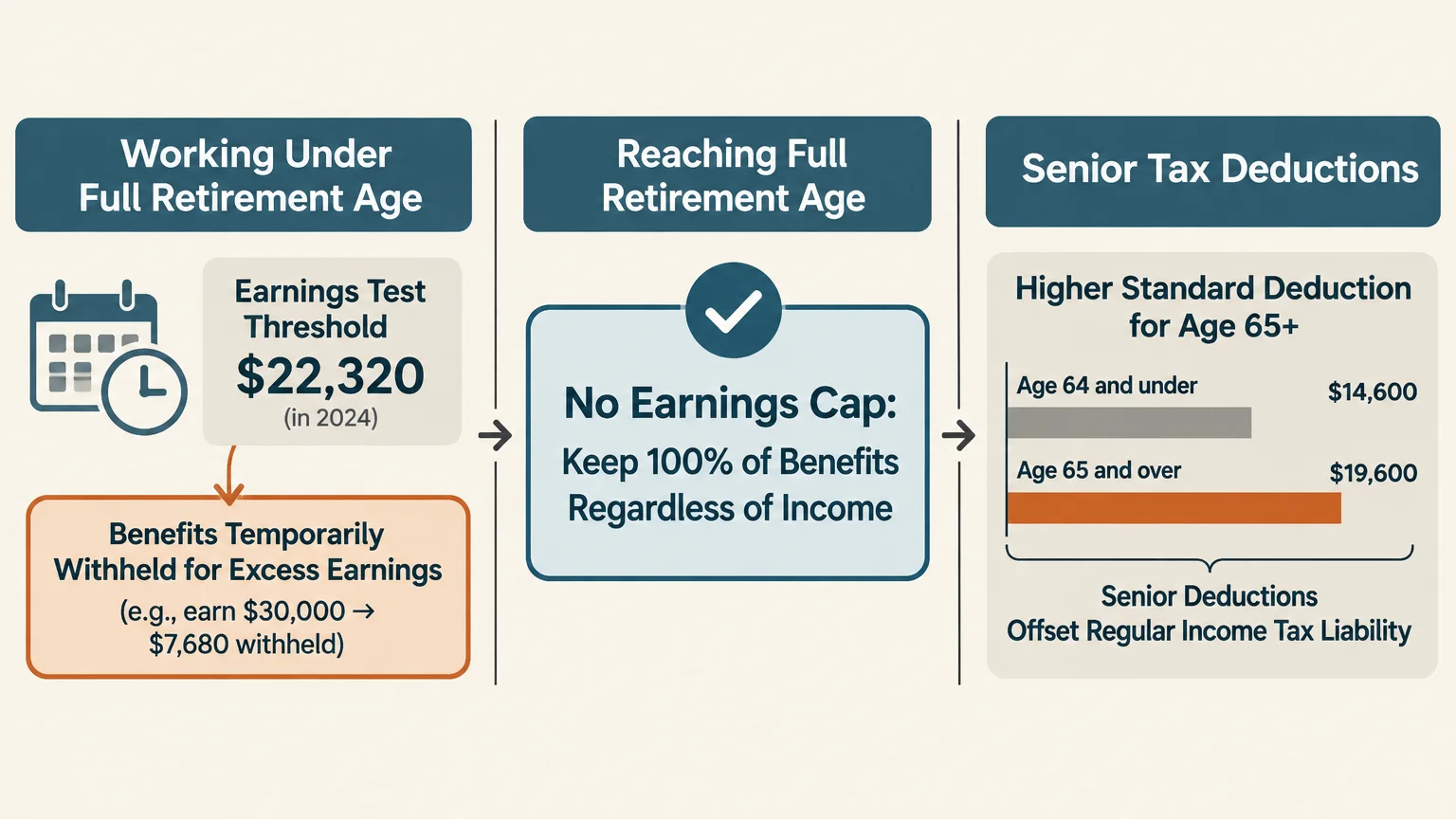
If you have already reached your Full Retirement Age—age 67 for anyone born in 1960 or later, with the 1960 birth cohort hitting that milestone in 2027—you can earn unlimited income without losing a penny of Social Security. Claiming benefits early changes the math significantly.
When you collect Social Security while under Full Retirement Age for the entire year, the Social Security Administration withholds $1 in benefits for every $2 you earn above $24,480 in 2026. That annual earnings limit rises to $25,560 in 2027.
During the calendar year you reach Full Retirement Age, a much friendlier threshold applies to the months before your birthday milestone. The agency withholds $1 for every $3 earned above $65,160 in 2026, increasing to $67,920 in 2027.
Only earned wages and net self-employment profits count toward those limits; investment dividends, pension payouts, and IRA withdrawals stay completely excluded. Once your Full Retirement Age month arrives, the earnings cap vanishes and the agency recalculates your monthly check upward to credit back withheld benefits.
Keep those annual adjustments in mind as benefits climb alongside inflation, too. Social Security and SSI benefits rose by 2.8% in 2026 and will increase by another 3.6% in 2027.
Provisional Income and Benefit Taxation
Despite widespread rumors online, the One Big Beautiful Bill Act of 2025 did not eliminate federal income taxes on Social Security benefits. The IRS still uses a formula called provisional income, which adds your adjusted gross income excluding Social Security, tax-exempt interest, and 50% of your Social Security benefits.
For single filers, benefits stay 0% taxable when provisional income sits below $25,000, become up to 50% taxable between $25,000 and $34,000, and reach up to 85% taxable above $34,000. Married couples filing jointly face thresholds of $32,000 for 50% taxation and $44,000 for 85% taxation.
Because Congress never indexed those statutory dollar limits for inflation, even modest side income can push more of your Social Security check onto your Form 1040. At the state level, at least, only nine states tax Social Security benefits in 2026, and most offer generous income exemptions.
Stacking Standard Deductions and the Temporary Senior Bonus
On the bright side, generous deductions offset a large chunk of your side-gig income once you reach age 65. For 2026, the baseline standard deduction reaches $16,100 for single filers, $32,200 for married couples filing jointly, and $24,150 for heads of household.
Those baseline amounts rise in 2027 to $16,600 for single filers, $33,200 for joint filers, and $24,925 for heads of household. Taxpayers age 65 or older also receive an extra standard deduction of $2,050 if unmarried or $1,650 per qualifying spouse in 2026, rising to $2,100 and $1,700 in 2027, and doubling if you are also blind.
Best of all, OBBBA created a temporary $6,000 Senior Deduction per eligible person age 65 or older for tax years 2025 through 2028. Married couples where both spouses qualify can claim $12,000 on Schedule 1-A, whether they itemize deductions or take the standard deduction.
Watch your income ceiling carefully, because this $6,000 bonus phases out at a 6% rate once modified adjusted gross income exceeds $75,000 for single filers or $150,000 for joint filers. Keeping your side-gig profit trimmed with valid expenses helps you hold onto every dollar of that deduction.
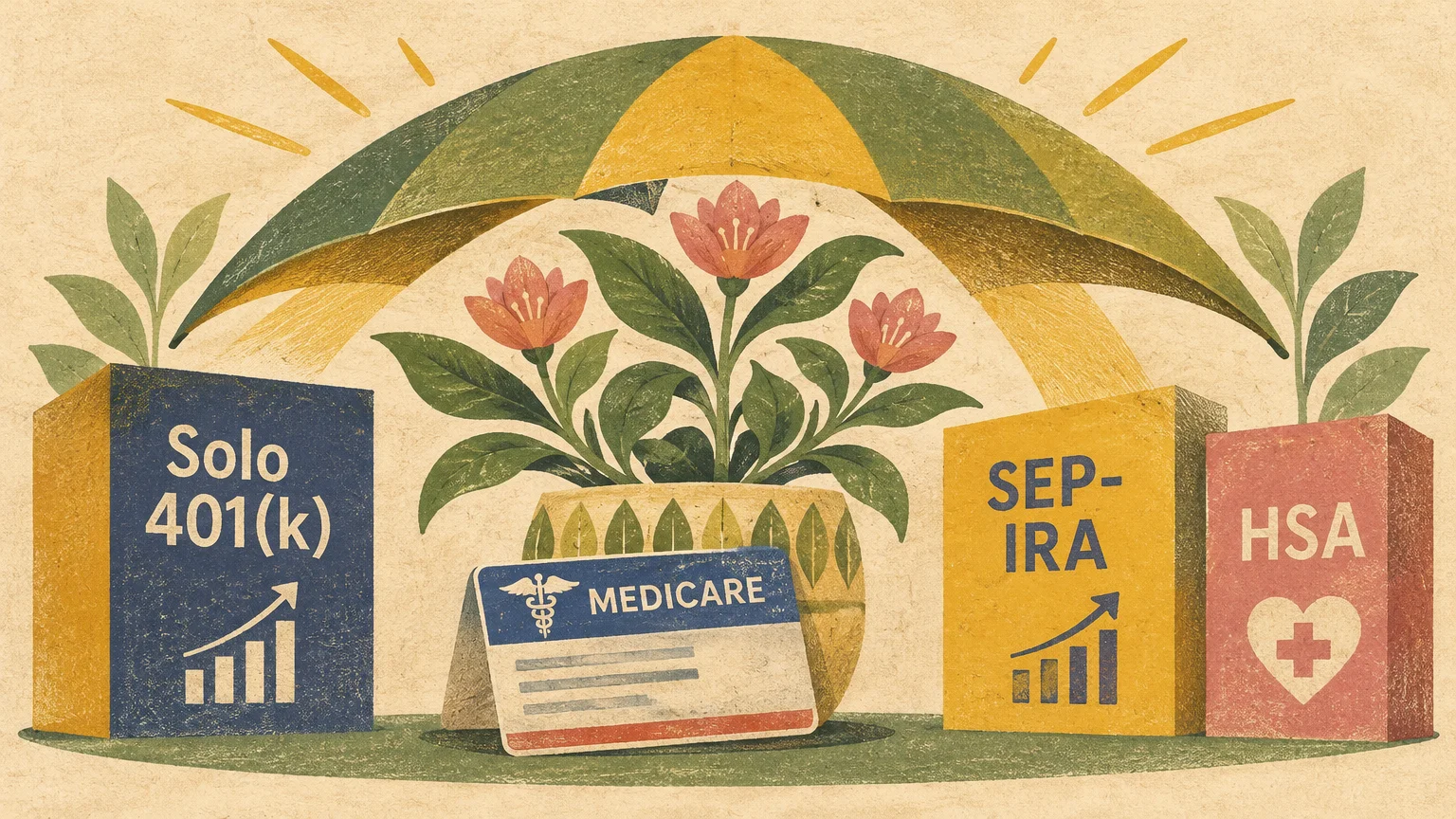
Lifestyle Idea #5: Protect Medicare Premiums and Grow Tax-Advantaged Savings
Enjoying a thriving second act means balancing today’s fun money against tomorrow’s healthcare costs. One of the smartest tax tips retirees can follow involves guarding against steep Medicare surcharges while funneling side earnings into retirement accounts.
Beware the Two-Year Medicare IRMAA Lookback
Medicare Part B and Part D premiums include Income-Related Monthly Adjustment Amounts, known as IRMAA, whenever your modified adjusted gross income crosses specific brackets. Crucially, the Centers for Medicare and Medicaid Services relies on a two-year lookback.
Your 2024 tax return sets your 2026 Medicare premiums, your 2025 return dictates your 2027 premiums, and every extra dollar you earn on a side job in 2026 shapes what you pay in 2028. Standard monthly Part B premiums sit at $202.90 with a $283 annual deductible in 2026, climbing to $209.40 with a $292 deductible in 2027.
IRMAA surcharges start once modified adjusted gross income exceeds $109,000 for single or separate filers and $218,000 for joint filers in 2026. Those starting brackets rise slightly to $112,000 for single filers and $224,000 for joint filers in 2027.
Crossing even one dollar into a higher bracket triggers a sharp cliff that raises every monthly premium for the entire year. For 2027, Part B IRMAA adds anywhere from $83.70 to $502.40 per month, while Part D IRMAA adds $15.40 to $96.40 per month, up from $14.50 to $91.00 in 2026.
If a one-time surge happened right before you scaled back your hours, you do not have to absorb that surcharge silently. You can file Form SSA-44 with the Social Security Administration to request a recalculation based on qualifying life-changing events such as work stoppage or work reduction.
Shelter Side Earnings in IRAs and Solo 401(k)s
Earning taxable compensation from a side gig unlocks a huge perk: you can contribute to retirement accounts again, regardless of your age. Traditional and Roth IRAs share a $7,500 annual contribution limit in both 2026 and 2027, plus a $1,100 catch-up contribution for savers age 50 and older, totaling $8,600.
Remember that your IRA contribution cannot exceed your taxable earned income for the year. Direct Roth IRA contributions also phase out at modified adjusted gross incomes of $153,000 to $168,000 for single filers and $242,000 to $252,000 for joint filers in 2026, rising to $158,000–$173,000 and $250,000–$260,000 in 2027.
If your side business brings in serious money, a Solo 401(k) or SEP IRA offers dramatically higher shelter limits. Total combined contributions reach $72,000 in 2026 and $75,000 in 2027, with employer profit-sharing generally capped around 20% of net self-employment earnings after your 50% self-employment tax deduction.
While SEP IRAs omit catch-up provisions, a Solo 401(k) lets you make employee deferrals up to $24,500 in 2026 and $25,500 in 2027, plus an $8,000 catch-up in 2026 or $8,500 in 2027 for ages 50 and up. Under SECURE 2.0, savers ages 60 through 63 qualify for a super catch-up of $11,250 in 2026 and $11,750 in 2027.
Keep one rule in mind if you also earn high corporate wages: employees with prior-year FICA wages above $150,000 in 2026, or $155,000 in 2027, must direct 401(k) catch-up contributions into a Roth account. Contributing pretax dollars to a Traditional IRA, SEP IRA, or Solo 401(k) lowers your adjusted gross income immediately, helping you stay under IRMAA cliffs and preserve your $6,000 Senior Deduction.
Coordinate Required Distributions and Charitable Giving
Finally, coordinate side-gig savings with Required Minimum Distributions so your tax bracket never spikes unexpectedly. Under SECURE 2.0, mandatory withdrawals start at age 73 for people born between 1951 and 1959, and age 75 for those born in 1960 or later beginning in 2033.
Missing an RMD triggers a 25% excise tax, though correcting the shortfall within two years cuts that penalty to 10%, and Roth 401(k)s carry no lifetime RMDs. If you are age 70½ or older and support favorite causes, you can donate up to $111,000 in 2026 via Qualified Charitable Distributions directly from your IRA to satisfy RMDs without inflating your modified adjusted gross income.

Putting It into Practice: Small Steps for Big Changes
You do not need an accounting degree to turn a joyful side hustle into a smooth financial win. Take thirty minutes this week to organize your paperwork before tax season creeps closer.
Start by opening a separate checking account and high-yield savings bucket exclusively for your freelance deposits and expenses. Move 25% to 30% of every client payment into savings right away, and write the four IRS quarterly due dates on your calendar.
Next, grab a mileage logbook or smartphone app so you capture every deductible trip at 76 cents per mile for the second half of 2026. Finally, sketch out your projected adjusted gross income to check where you stand relative to the Social Security earnings limit, the $6,000 Senior Deduction phase-out, and Medicare IRMAA brackets.
Frequently Asked Questions
Do I really have to report cash payments if my neighbor pays me less than $2,000?
Yes, you must report all net self-employment earnings on your tax return once your combined business profits reach $400 or more. The $2,000 Form 1099-NEC threshold only controls when a business sends a tax form, not whether the income is taxable.
Can I contribute to a Roth IRA from my consulting income if I am over 70?
Yes, federal law places no upper age limit on contributing to either a Traditional IRA or a Roth IRA as long as you have taxable earned income. For 2026 and 2027, you can contribute up to $8,600 if your income stays under the Roth phase-out caps.
What happens if my side job pushes me over the Social Security earnings limit before age 67?
The Social Security Administration temporarily withholds $1 for every $2 earned above $24,480 in 2026, or $1 for every $3 above $65,160 in the year you reach Full Retirement Age. Once you reach Full Retirement Age, the agency recalculates your monthly check to credit back those withheld months.
How can I avoid a Medicare IRMAA surcharge after a single high-earning consulting year?
Because Medicare checks your tax return from two years earlier, lowering your modified adjusted gross income today protects future premiums. Consider making deductible Solo 401(k) contributions, using Qualified Charitable Distributions at age 70½ or older, or filing Form SSA-44 if you later cut back your work hours.
For resources on retirement living, travel, and finance, visit AARP. Official information on Social Security is available at SSA.gov. For travel advisories, consult the U.S. Department of State.
Disclaimer: This article provides lifestyle suggestions for informational purposes. Financial, legal, or travel decisions should be made in consultation with qualified professionals.