

Your monthly pension stretches very differently depending on which state pays it, taxes it, and sets your daily expenses. Understanding pensions by state helps you budget smarter, protect your income, and plan more adventures in retirement.
Across the country, top-paying states distribute over five times more pension dollars per resident than the lowest-ranking states. Meanwhile, over a dozen states charge zero income tax on qualifying pension checks.
Whether you stay close to grandkids or scout a sunnier zip code, knowing where your state stands unlocks real freedom. These eight practical strategies show you how to turn state pension rankings into a richer daily life.
Lifestyle Idea #1: Benchmark Your Check Against National and Public Pension Averages
Before comparing state rankings, it helps to see how your own check measures up against national baselines. Traditional pensions remain a cornerstone for millions of retirees, even as fewer private companies offer them.
According to the U.S. Census Bureau’s 2025 Annual Survey of Public Pensions, there are 311 state-administered and 4,061 locally administered defined-benefit public pension systems nationwide. Together, those plans hold $6.49 trillion in assets—up 8.46% from $5.98 trillion in 2024.
Public Plans Data notes these systems serve more than 37 million participants, including roughly 15.5 million active workers and 12.4 million retirees. In 2025 alone, public pensions paid out $418.25 billion in benefits, rising 3.40% from $404.46 billion the year before.
Still, having a pension puts you in a fortunate group. U.S. Census Bureau data cited by Annuity.com shows 25% of Americans age 65 and older received income from a company, union, government, or military pension in 2025.
Similarly, the Pension Rights Center notes that roughly 1 in 3 older adults received pension, veterans, or railroad benefit income in 2024. In the private sector, Kiplinger reports that only 15% of workers had access to a traditional defined-benefit plan.
How Different Pension Types Compare
Your former career heavily shapes your monthly payout. Data from the 2026 CPS ASEC cited by Boldin shows sharp differences in 2025 median payouts for recipients age 65 and older.
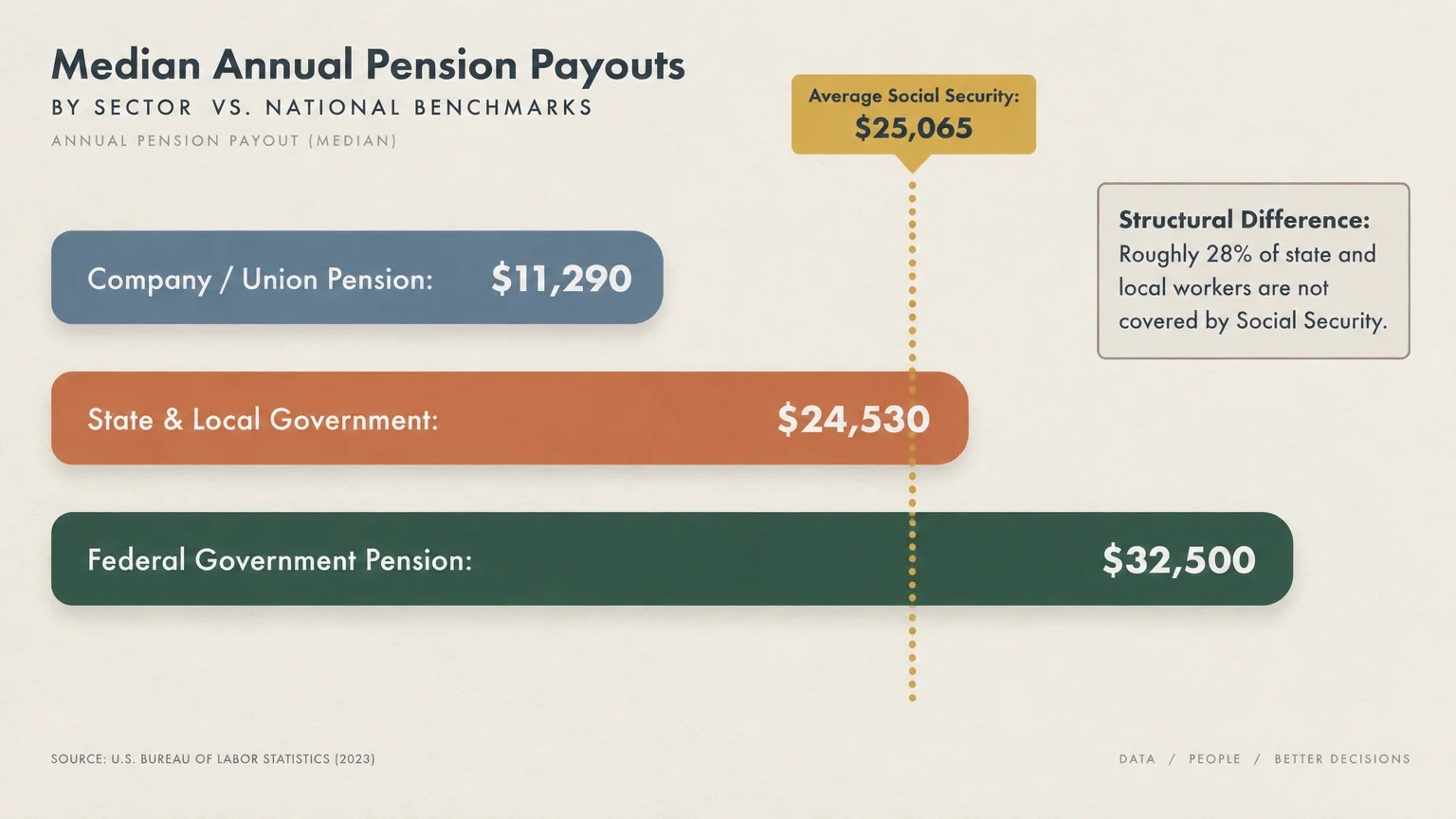
A median company or union pension paid $11,290 per year—about $941 per month. By contrast, a median state or local government pension paid $24,530 per year, while a median federal government pension reached $32,500 annually.
Figures from the 2025 CPS cited by the Pension Rights Center show a similar pattern for 2024 income. Private pensions and annuities paid a median of $11,440, state and local plans paid $24,930, military pensions paid $26,310, and federal pensions hit $33,310.
Public payouts look noticeably larger for one key structural reason. The Bipartisan Policy Center and Pension Rights Center point out that roughly 28% of state and local government employees—about 6.5 million workers—are not covered by Social Security.
Because those employees skipped Social Security payroll taxes, their state or local pension was designed to replace Social Security benefits as well. Keeping that distinction in mind stops you from comparing apples to oranges.
Put Your Numbers Side by Side
Take ten minutes this week to add your annual pension to your Social Security income. As of September 2026, the Social Security Administration reports an average retired-worker benefit of $2,088.79 per month, or roughly $25,065 per year.
Compare your combined total against the $61,989 median annual income for households headed by someone age 65 and older, reported in the U.S. Census Bureau’s 2025 American Community Survey. Knowing your exact spot lets you plan hobbies and travel without guessing.
Lifestyle Idea #2: See Why Alaska and Delaware Lead the Highest Pensions in US Rankings
When you search for the highest pensions in us states, two very different leaders stand out. One state tops the chart for total pension dollars paid per resident, while another leads in sheer household participation.
According to a September 2026 StatsPanda analysis of U.S. Census Bureau and federal data, Alaska ranks first nationwide in total state pension benefits paid per capita. Alaska distributes $2,300 per state resident, towering above the 50-state average of $990.10.
High per-capita payouts often reflect a large share of public-sector retirees, generous legacy formulas, or higher regional wages during working years. For retirees living there, steady pension checks pump reliable spending money into local shops, diners, and community programs.
Meanwhile, Delaware claims the top spot for how many residents actually collect retirement payouts. The Western & Southern Financial Group 2026 Retirement Readiness Index ranks Delaware first nationally, with 34.3% of households receiving income from pensions, annuities, or retirement distributions.
How High-Pension Communities Boost Your Social Life
Living in—or visiting—a state with strong pension participation brings surprising lifestyle perks. Towns with large clusters of retired teachers, civil servants, and corporate pensioners often boast vibrant social calendars.
You will frequently find active lifelong learning institutes, weekday golf leagues, and well-organized volunteer corps. When neighbors share predictable monthly incomes, it becomes much easier to find friends up for Tuesday lunches or group road trips.
If your own state ranks near the top, tap into those built-in networks right away. Check your local retiree association newsletter for walking clubs, museum outings, and seasonal potlucks where you can meet peers in the same life stage.

Lifestyle Idea #3: Look Behind the Numbers in States With the Lowest Pensions
Seeing your home state near the bottom of a national chart can feel discouraging at first glance. Yet rankings for lowest pensions rarely tell the whole story about your personal comfort or local quality of life.
StatsPanda’s September 2026 data places Indiana lowest in the nation for state pension benefits paid per capita at $410 per resident. Compared with Alaska’s $2,300 per capita, that represents a dramatic 5.6-to-1 gap.
Why does the average pension by state swing so wildly between places like Alaska and Indiana? Several practical factors push a state’s per-capita figure downward without reflecting poor retirement prospects for individual households.
States with leaner public-sector workforces naturally distribute fewer total government pension dollars across their overall population. Likewise, states dominated by manufacturing, farming, or small businesses tend to rely more heavily on 401(k) plans, personal savings, and Social Security.
Cost of living plays an equally important role in the equation. A smaller monthly check in a quiet Midwestern town often covers housing, groceries, and entertainment more comfortably than a much larger check in a pricey coastal metro.
Turn Modest Checks Into Flexible Living
Instead of worrying about your state’s per-capita ranking, focus on what your household controls directly. Pair a smaller private or public pension with low-stress activities that bring both joy and extra pocket money.
Consider seasonal consulting, tutoring grandchildren’s classmates, or working part time at a local botanical garden or golf course. Many seniors also trim monthly expenses by swapping paid memberships for free library passes, senior center fitness classes, and community theater ushering.
Lifestyle Idea #4: Check Your Public Pension Fund’s Health Before Planning Big Milestones
If you collect or expect a public pension, knowing how well your state funds its promises gives you peace of mind. Strong investment gains have improved the national outlook, though wide gaps remain from state to state.
According to Equable Institute’s State of Pensions 2026 report, the national funded ratio for state and local plans reached an estimated 85.0% as of June 30, 2026—up from 81.2% in 2025. By September 30, 2026, that average climbed to 86.0%, the highest level since 2007 and 2009.
Solid investment returns averaging between 9.4% and 11.4% against a 6.9% assumed target helped drive that recovery. As a result, total unfunded public pension liabilities fell to $1.13 trillion in 2026, down from $1.37 trillion the year before.
States With the Strongest Funded Ratios
Equable Institute’s June 30, 2026 estimates show several systems sitting above 100% funded status. Washington, D.C. leads the group at 111.7%, joined above full funding by Nebraska, Tennessee, Washington, South Dakota, Wisconsin, and West Virginia.
Earlier fiscal year 2024 Reason Foundation data similarly highlighted Tennessee at 104.2%, Washington at 102.9%, and South Dakota at 100.2% as the top three. Retirees in well-funded plans generally face fewer political battles over benefit adjustments.
States Facing Pension Funding Stress
On the opposite end, Equable Institute identifies Illinois at 56.3% funded and New Jersey at 56.7% funded as the lowest-funded systems nationwide as of June 30, 2026. Both sit in the distressed tier below 60% funded.
Kentucky and Mississippi also remain near the bottom, though both edged out of distressed status into the 60% to 90% fragile range in 2026. Measured by total dollar debt, Illinois, California, New Jersey, and Texas carry the largest unfunded liabilities.
Paying down past debt strains state and local budgets everywhere. Equable Institute notes that governments contributed a record 31.8% of payroll toward pensions in 2026—triple the 9.3% rate in 2001—with 22.4% paying past debt and only 9.4% funding new benefits.
Smart Steps When Your Plan Is Underfunded
While constitutional and legal protections guard earned public benefits in most states, strained budgets can affect future cost-of-living adjustments or local tax rates. Stay proactive rather than anxious.
Read your pension system’s annual member newsletter so you never miss updates on health insurance subsidies or COLA freezes. Keep three to six months of discretionary travel and emergency cash in a high-yield savings account so your plans stay insulated.

Lifestyle Idea #5: Claim Your Social Security Fairness Act Boost Without Leaving Money Behind
If you spent years teaching, firefighting, policing, or working in pre-1984 federal civil service, a major federal change may have already boosted your retirement budget. Make sure you are receiving every dollar you earned.
Signed into law on January 5, 2025, the Social Security Fairness Act permanently repealed both the Windfall Elimination Provision and the Government Pension Offset. Those rules previously slashed Social Security retirement, disability, spousal, and survivor checks for workers with non-covered pensions.
While the law does not alter your state or local pension amount, it restores full Social Security benefits retroactive to January 2024. By July 7, 2025, the Social Security Administration had sent over 3.1 million retroactive payments totaling $17 billion to roughly 2.8 million beneficiaries.
The agency completed that massive payout five months ahead of schedule and processed 92% of more than 278,000 new claims by July 2025. Congressional Budget Office estimates cited in a September 2026 Congressional Research Service report show life-changing gains.
On average, affected workers saw increases of $360 per month from the WEP repeal. GPO-affected spouses gained an average of $700 per month, while GPO-affected widows and widowers averaged $1,190 more per month.
Do Not Miss the Non-Filer Deadline Trap
Here is a critical warning if you never filed for spousal or survivor benefits because the old GPO rule wiped them out. According to Social Security Administration guidance reported by BenefitsUSA, non-filers generally receive back pay for at most six months before their application date rather than back to January 2024.
Every month you wait costs real money that could fund family reunions, home upgrades, or hobby gear. Contact Social Security immediately if you skipped applying years ago, and double-check your benefit letter if you recently started receiving restored checks.
Lifestyle Idea #6: Compare Pension-Friendly Tax States Against Property and Sales Taxes
Two states can send identical pension checks, yet leave you with dramatically different spending power after taxes. Understanding state tax rules helps you keep more money for the experiences you love.
In 2026, 13 states charge zero state income tax on all retirement income. Nine of those states impose no broad-based state income tax at all: Alaska, Florida, Nevada, New Hampshire, South Dakota, Tennessee, Texas, Washington, and Wyoming.
New Hampshire solidified its spot on that list by repealing its interest and dividends tax in 2025. That change made New Hampshire even friendlier for retirees living off investments alongside pensions.
Four additional states tax earned wages or other income while fully exempting qualifying pension, IRA, and 401(k) distributions. Those states are Illinois with its 4.95% flat tax, Iowa with its 3.9% flat tax, Mississippi at 4.0%, and Pennsylvania at 3.07%.
Keep Iowa’s age rule in mind before packing boxes. Iowa’s full retirement income exemption applies once you reach age 55, qualify due to disability, or collect as a surviving spouse.
Special Rules for Traditional Pensions and Social Security
AARP notes that Alabama and Hawaii also fully exempt employer-funded traditional pension payouts, bringing the total to 15 states that do not tax pension payouts. However, Alabama taxes 401(k) and IRA withdrawals above a $12,000 exclusion at age 65 and older, which doubled for 2026.
Other states split their treatment depending on where you worked. Income Lab highlights New York, which exempts 100% of government pensions while capping private pension exemptions at $20,000 once you reach age 59 and a half.
Meanwhile, Kiplinger reports that only 8 states still tax Social Security benefits in 2026. Checking both your pension rules and Social Security rules prevents nasty April surprises.
Watch Out for Hidden Property and Sales Tax Tradeoffs
State governments still need revenue to fix roads and run schools, so pension-friendly states often collect higher taxes elsewhere. AARP’s March 2026 findings reveal sharp tradeoffs you should factor into any move.
Illinois exempts retirement income completely, yet ties for the highest average property tax rate at 1.88% in 2024 and carries the eighth-highest average combined sales tax at 8.96%. On the bright side, Illinois repealed its 1% state grocery tax on January 1, 2026.
Tennessee charges zero state income tax on pensions, too, yet imposes the second-highest average combined sales tax nationwide at 9.61%. Always weigh your projected property taxes, homeowner insurance, and everyday sales taxes against what you save on income tax.

Lifestyle Idea #7: Stretch a Modest Pension in Low-Cost Retirement Havens
Once you look past income taxes, overall cost of living becomes your biggest lever for retirement happiness. Your pension’s true rank depends heavily on what housing, groceries, utilities, and healthcare cost in your neighborhood.
Plootus Research’s 2026 analysis—built on Bureau of Labor Statistics expenditures for adults 65 and older alongside cost-of-living index data—shows a stunning spread across the map. Annual retirement living costs range from roughly $46,200 per year in Arkansas, the lowest nationwide, to $102,000 in California.
Costs climb even steeper in New York at $112,000 per year and peak in Hawaii at $129,296 per year. Even a generous pension can feel tight when everyday living expenses cross six figures.
Now flip that math around in your favor. Combine a median $24,530 state or local pension with an average $25,065 annual Social Security check, and you bring in nearly $49,600 per year before touching personal savings.
In an affordable state like Arkansas, Iowa, or Mississippi, that combination covers baseline living expenses with breathing room left for weekend getaways and grandkid gifts. Even if your private pension sits closer to $11,290, pairing it with Social Security and a modest home equity cushion goes far in lower-cost towns.
Test-Drive a New Town Before Moving
Never relocate purely for a tax break or cost-of-living chart. Book a two-week short-term rental during an off-peak month in any town on your shortlist.
Shop at the local grocery store, test the drive to nearby medical clinics, and drop by the community senior center. Seeing how friendly the neighbors feel—and how easy it is to pursue your favorite hobbies—matters just as much as saving a few thousand dollars.
Lifestyle Idea #8: Turn Your Pension Clarity Into Richer Hobbies, Travel, and Social Connections
Understanding pensions by state is never just an accounting exercise. Knowing exactly where your income stands gives you permission to spend joyfully on the people and passions that make retirement feel vibrant.
Many new retirees hold back on joining clubs or booking trips because they worry silently about running short. Once you verify your state’s tax rules, confirm your Social Security Fairness Act status, and map out living costs, that fog lifts.
Create a dedicated fun fund from a small slice of your monthly pension—even $100 to $200 a month makes a huge difference. Earmark that money strictly for experiences like watercolor classes, community theater tickets, pickleball tournaments, or train trips with friends.
You can also tap directly into the social circle tied to your former pension system. Retired teachers, municipal workers, and union chapters regularly host regional luncheons, volunteer days, and discounted group tours.
Reconnecting with former colleagues—or welcoming new neighbors into a monthly potluck—turns steady pension checks into shared memories. Retirement thrives when financial clarity fuels real-world connection.
Putting It into Practice: Small Steps for Big Changes
You do not need to overhaul your entire budget or pack a moving truck this afternoon. Pick one or two small steps this week to put your state’s pension picture to work for you.
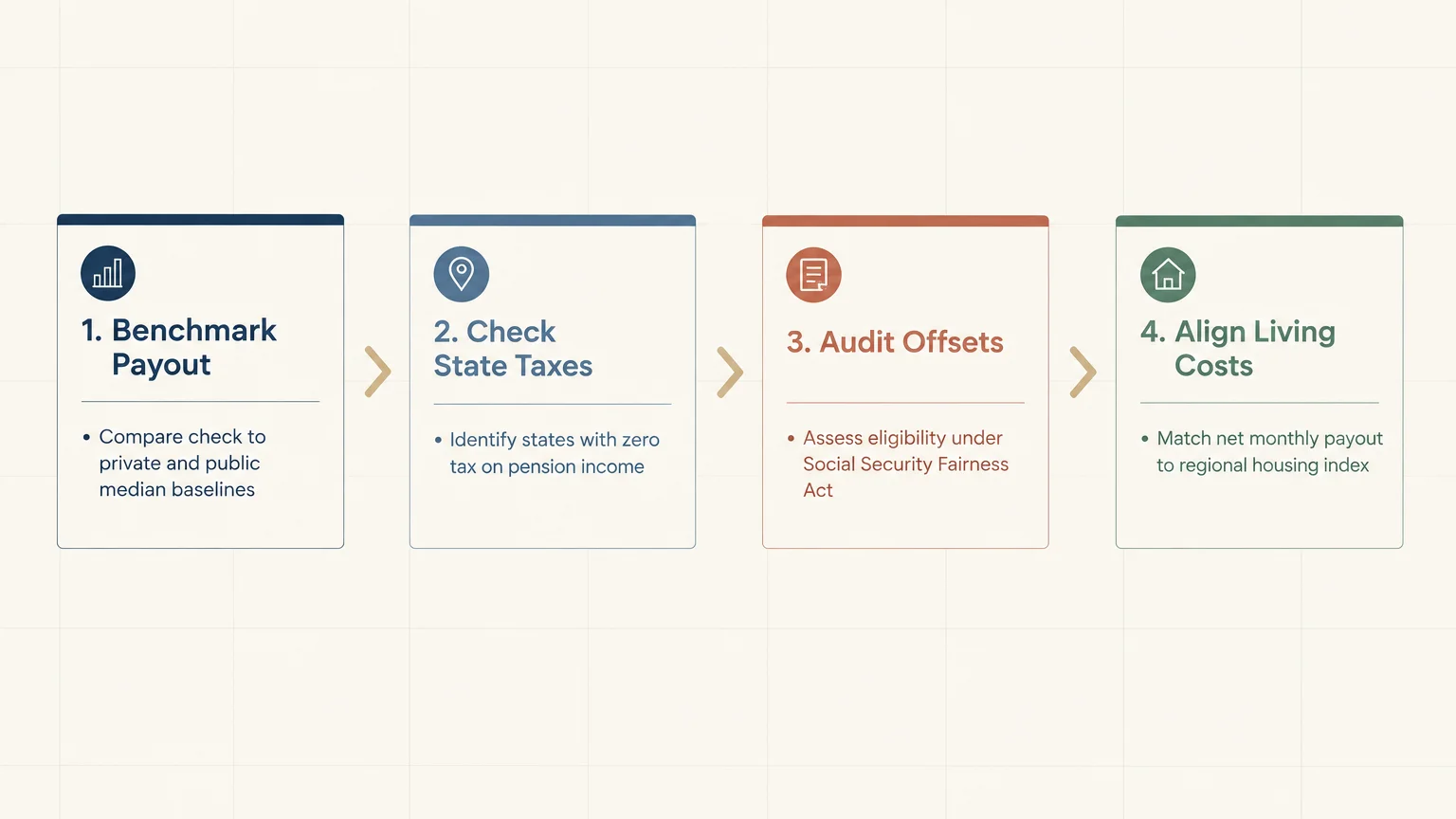
First, pull your most recent pension statement and Social Security benefit letter so you know your exact combined monthly income. Second, look up your state’s pension tax exclusion and check whether local property or sales taxes offset those savings.
Third, if you worked in public service not covered by Social Security, confirm whether the Social Security Fairness Act entitles you or your spouse to higher monthly checks. Finally, pick one joyful activity this month—a museum day, a class, or dinner with friends—and fund it guilt-free.
For resources on retirement living, travel, and finance, visit AARP. Official information on Social Security is available at SSA.gov.
For travel advisories, consult the U.S. Department of State.
Frequently Asked Questions
Can I keep my state pension if I move to a lower-tax or lower-cost state?
Yes, your earned state, local, federal, or private pension follows you wherever you move inside the United States. Your new state’s tax rules—not your former state’s rules—generally determine how your pension income is taxed once you establish residency.
How can I enjoy retirement if I collect one of the lowest pensions or a small private check?
Start by stacking every income source available, including Social Security, small retirement account withdrawals, and senior property tax relief programs. Focus your budget on low-cost social joys like library clubs, parks, and part-time passion work that keeps you connected.
Should I panic if my state’s public pension system is below 60% funded?
No, because legal protections in most states guard already-earned base pension payments for current retirees. Instead, stay informed about potential cost-of-living adjustment pauses or local tax hikes, and keep an emergency savings cushion for extra peace of mind.
What if I never applied for Social Security spousal benefits because of the old GPO rule?
Contact Social Security promptly to submit an application now that the Government Pension Offset has been repealed. Non-filers generally receive retroactive pay for up to six months prior to applying, so waiting costs you monthly benefits.
Disclaimer: This article provides lifestyle suggestions for informational purposes. Financial, legal, or travel decisions should be made in consultation with qualified professionals.