
Leaving the working world behind hands you the ultimate travel superpower: a flexible calendar. When you skip peak holiday rushes, you unlock the cheapest months to travel and keep far more money in your pocket.
Empty museum halls, unhurried café tables, and deeply discounted flights turn ordinary trips into memorable adventures. Better yet, quieter seasons make it easier to strike up conversations with locals and fellow travelers.
Explore how timing your getaways around off season travel lets you see more of the world without straining your retirement savings.
Lifestyle Idea #1: Escape the Winter Blues in January and February
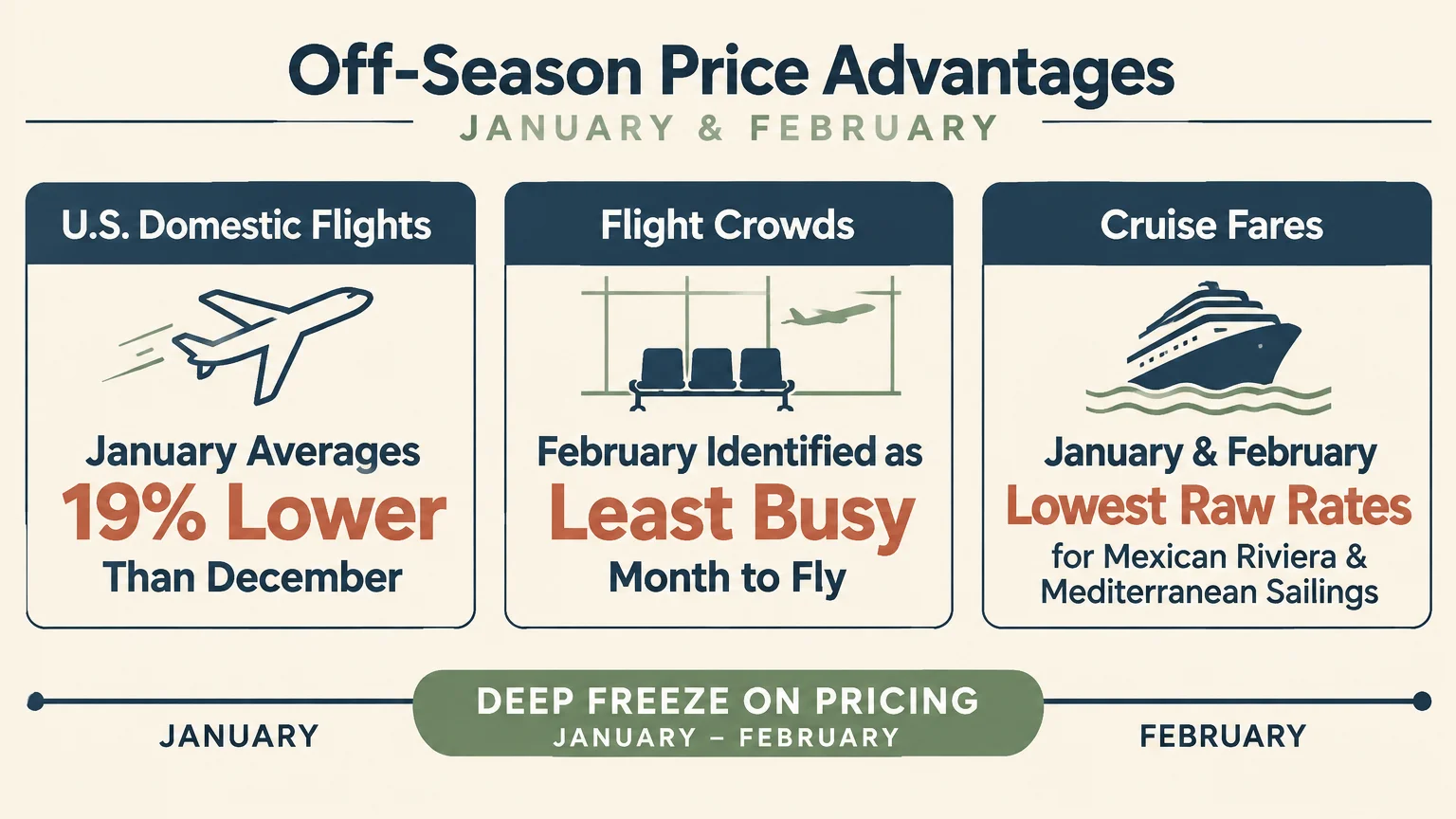
Once the December holiday rush wraps up, the travel industry enters a deep freeze on pricing. Going’s November 2026 data identifies January and February as the cheapest months to fly overall, while July and December remain the priciest.
Domestic airfares drop especially sharply right after New Year’s Day. According to Expedia’s 2026 Air Hacks Report, January is the cheapest month for U.S. domestic flights, averaging 19% lower than December.
Lodging follows a remarkably similar winter pattern across the country. KAYAK noted in April 2026 that hotel rates are generally lowest during winter months, giving you room to upgrade without overspending.
Swap Shovels for Calm Airports and Sunny Decks
Lower fares are only half the benefit when you travel in midwinter. Expedia’s 2026 Air Hacks Report also found that February is the least busy month to fly, making airport security lines far less stressful.
If warm ocean breezes sound better than snowy sidewalks, look southward toward Mexico’s Pacific coast. NerdWallet and Cruise Critic data for 2027 sailings shows February is the cheapest month for Mexican Riviera interior cabins, compared to pricey snowbird-heavy December.
You can even find rock-bottom cruise pricing across the Atlantic during midwinter. That same NerdWallet and Cruise Critic analysis lists January as having the lowest raw fares for Mediterranean sailings, while August tops the price chart.
Turn Winter Trips Into Social Connections
Traveling during quiet winter weeks naturally brings retirees together at resort pools, walking tours, and hotel lobbies. Check local community boards or cruise ship daily schedules for morning coffee meetups and card games.
Consider inviting a longtime neighbor or sibling along to split a vacation rental or double-occupancy cabin. Sharing costs during winter’s lowest rates makes budget travel seniors can enjoy feel effortless and celebratory.
Lifestyle Idea #2: Chase European Charm from October Through March
Many travelers assume Europe is only enjoyable under bright July sunshine, yet summer crowds and steep prices often steal the joy from classic cities. Moving your transatlantic trip to cooler months reveals a warmer, friendlier side of the continent.
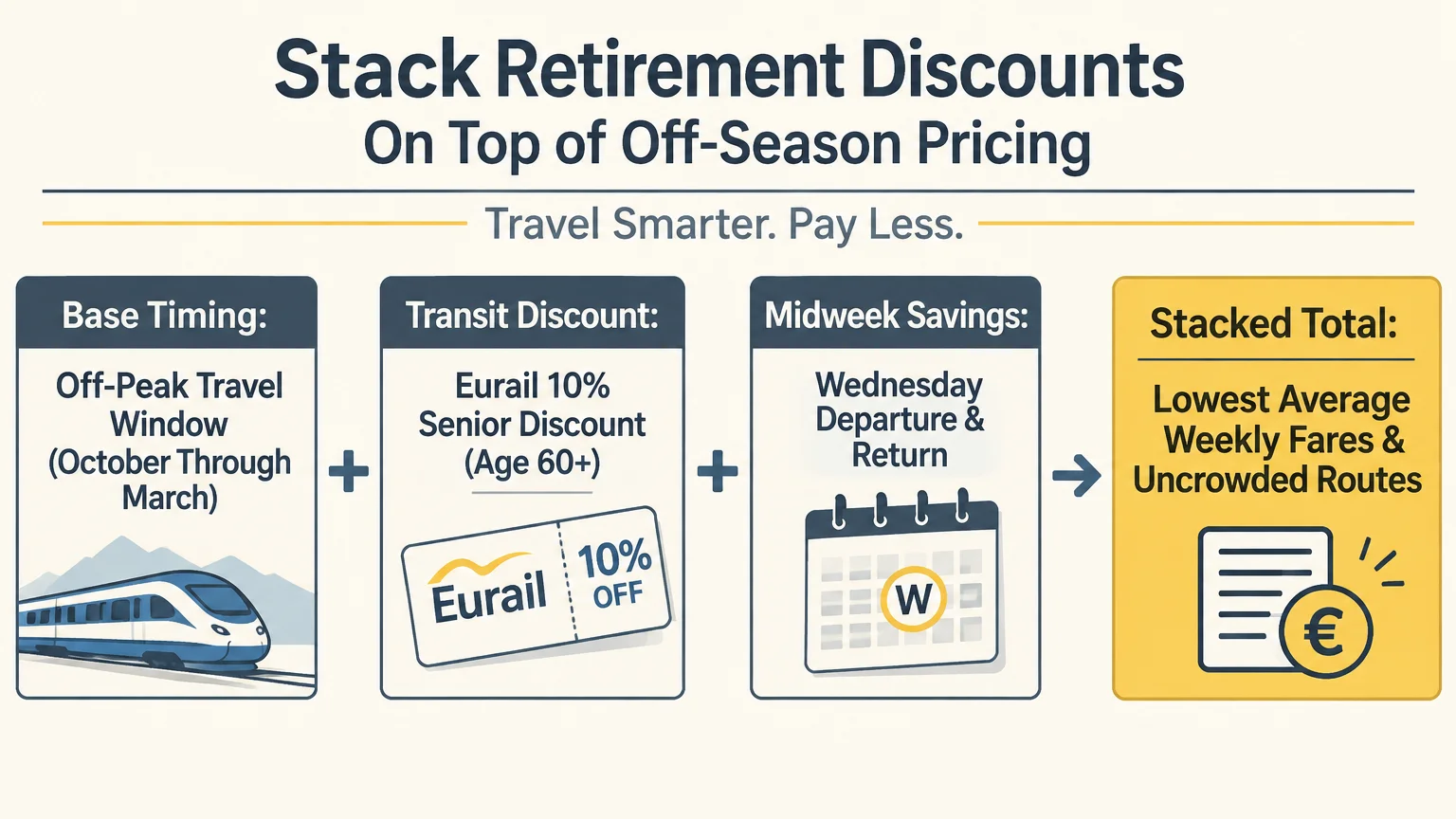
Hopper reports that the cheapest period to fly from the U.S. to Europe runs from October through March, averaging $942 round-trip. Choosing Wednesday departures and returns during those months delivers the lowest average weekly fares.
Hotel owners in cities like Lisbon, Rome, and Paris also trim rates once autumn arrives. You can stay steps away from historic neighborhoods for a fraction of what summer visitors pay for suburban rooms.
Find the Cruise and Rail Sweet Spots
If unpacking once on a ship appeals to you, autumn brings a standout Mediterranean bargain. NerdWallet and Cruise Critic highlight November as a practical shoulder sweet spot for Mediterranean cruises with fewer crowds and mild weather.
Once your feet touch European soil, train travel makes hopping between towns simple and scenic. Travelers age 60 and older receive an automatic 10% discount on Eurail Global and One Country Passes in both first and second class.
Planning a multigenerational autumn break with family works seamlessly with those rail rules, too. Eurail Senior Passes include free passes for up to two children ages 4 to 11, though high-speed seat reservations cost extra.
Know the New Entry Rules Before You Pack
Before booking a trip to London or Edinburgh, check the United Kingdom’s entry requirements. Since April 2, 2025, visa-exempt visitors—including U.S., Canadian, Australian, and EU citizens—need a UK Electronic Travel Authorisation costing £20 and lasting two years.
Mainland Europe is preparing its own entry system, though your age may save you money there. The European Commission’s official ETIAS portal notes the upcoming €20 fee across 30 European countries is waived for travelers over age 70.
As of late 2026, ETIAS is not yet operational after officials moved its target timeline toward 2027. Always verify current entry requirements a few months before departure so nothing delays your boarding pass.

Lifestyle Idea #3: Book May and Early June for Mild Weather and Thin Crowds
Late spring offers a magical middle ground for retirees who dislike bitter cold and blistering heat alike. During this classic shoulder season, gardens bloom, coastal ferries resume full schedules, and families are still tied to school calendars.
Royal Caribbean notes that most Mediterranean cruises operate from April through October, with May, early June, and September offering the best balance of mild weather and thinner crowds. You can stroll cobblestone plazas in comfort before summer tour buses arrive.
Stateside travelers also win big by heading north before school lets out in mid-June. Holland America identifies May and September as Alaska’s primary shoulder seasons, while NerdWallet and Cruise Critic report April is the cheapest month to sail.
Plan Ahead for Denali and U.S. National Parks
Checking park updates early prevents surprises on your itinerary when exploring America’s wilderness. In 2026, National Park Service bus tours on Denali Park Road were capped at Mile 43 due to Pretty Rocks landslide bridge construction.
Before visiting any federal park in May or early June, pick up your National Parks Senior Pass. Available to U.S. citizens and permanent residents age 62 and older, it costs $80 for a Lifetime Pass or $20 annually.
That single pass covers entrance and standard day-use fees across more than 2,000 federal recreation sites managed by six agencies. Buying four $20 annual passes even lets you upgrade in person to a lifetime pass later.
Turn Early June Into Grandparenting Gold
Early June creates an easy opening right as your grandchildren finish elementary or middle school classes. Booking a cabin near a national park or lake right before peak July rates hit keeps family reunions surprisingly affordable.
You get long daylight hours for campfire storytelling, ranger talks, and junior ranger badge ceremonies. Meanwhile, you avoid the steep mid-summer hotel surcharges that quickly drain vacation budgets.
Lifestyle Idea #4: Tap Into August International Airfare Drops
Conventional wisdom tells retirees to stay home all summer, yet late summer holds a surprising airfare secret for overseas adventures. While domestic beaches stay packed, international flight prices often tumble as European and North American families wrap up vacations.
According to Expedia’s 2026 Air Hacks Report, August is the cheapest month overall for international airfare—29% lower than December, saving roughly $120 per ticket. That single price break covers several nice dinners or museum passes once you land.
The same Expedia report highlights July, October, and November as featuring the most flights discounted by 20% or more below typical averages. Watching late-summer fare alerts opens up destinations you might otherwise assume sit out of reach.
Pick Cooler Climates or Breezy Coasts
Traveling overseas in August feels best when you match your destination to the weather. Look toward Scotland, Ireland, Scandinavia, or Canada’s Maritime provinces, where crisp evening air makes walking tours a pleasure.
Alternatively, flip the calendar by flying below the equator to Argentina, Chile, Australia, or New Zealand. August falls squarely in the Southern Hemisphere’s winter, bringing mild daytime temperatures in northern regions and peaceful vineyard towns.
For warm-water cruising closer to home, late summer also delivers overlooked value on the Pacific coast. NerdWallet and Cruise Critic note that alongside February, August and September remain consistently low for Mexican Riviera interior cabins.
Make Late Summer Social and Stress-Free
By the second half of August, many U.S. school districts have already reopened their doors. Airports feel noticeably calmer than during June and July, except on peak holiday-adjacent weekends.
Expedia’s 2026 data warned that May 22, July 3, and August 29 stood out as peak crowd days. Shifting your departure to late August midweek lets you capture low international fares without fighting crowded terminals.

Lifestyle Idea #5: Claim September and October as Your Prime Shoulder Season
Ask seasoned retirees about their favorite time to explore, and early autumn usually wins by a landslide. Kids are back in classrooms, summer humidity fades, and crisp air returns to mountain trails and historic city squares.
Going’s November 2026 airfare tracking names September and October as the cheapest months to fly right behind January and February. Pairing those lower fares with autumn foliage transforms simple domestic trips into unforgettable road adventures.
Alaska shines especially bright if you wait until the tail end of its cruise season. Fairbanks aurora season begins August 21, giving September visitors a real chance to watch northern lights dance above golden tundra.
Weigh Deep Caribbean Cruise Savings Against Weather
Autumn also delivers steep discounts on tropical cruises for travelers who stay flexible. NerdWallet and Cruise Critic data for 2027 sailings shows October is the cheapest month for Caribbean, Bahamas, and Bermuda cruises, averaging $716 inside and $1,064 for balconies.
Compare that to July, the priciest month at $1,092 inside and $1,545 for a balcony cabin. Even September inside cabins cost over 30% less than June sailings, leaving plenty of room in your budget for shore excursions.
Smart travelers balance those travel deals retirees love against seasonal storm patterns. NOAA defines Atlantic hurricane season as running from June 1 through November 30, with activity peaking in mid-September.
Cruise lines routinely reroute ships safely around storms, though ports of call may change on short notice. Buying solid travel protection and staying easygoing about your exact island stops lets you pocket big savings comfortably.
Join Autumn Clubs and Cultural Festivals
September and October pack the calendar with harvest festivals, art walks, and outdoor jazz concerts across small towns. Staying in walkable downtown neighborhoods makes it easy to mingle with locals at farmers markets and community tastings.
Because autumn is peak shoulder season across the Mediterranean too, historic sites in Greece, Spain, and Italy feel far more relaxed. You can linger over lunch on a sunlit terrace without feeling rushed for the next seating.
Lifestyle Idea #6: Fly Midweek and Time Your Booking Window
Picking the right month gets you halfway to major savings, while choosing the right day of the week finishes the job. Because you no longer rush home on Sunday night for Monday morning meetings, midweek schedules belong entirely to you.
Expedia reported in February 2026 that Tuesday is the cheapest day to fly domestically—up to 14% cheaper than Sunday—and the least crowded airport day of the week. For overseas trips, Friday is both the cheapest day to book and fly internationally, saving about 8% compared to Sunday.
Google Flights data from October 2026 backs up the power of flexible midweek round-trips. Departing Monday and returning Tuesday or Wednesday saves about 14% versus weekend flights, and up to 20% domestically compared to Sunday-to-Sunday itineraries.
Embrace Calm Dates and Smart Connections
If you prefer serene terminals and smoother boarding, circle specific quiet dates on your calendar. Expedia’s 2026 Air Hacks Report identified February 25, March 4, and November 18 among the calmest individual travel days of the year.
Do not automatically rule out one-stop itineraries when you have time to spare. Google Flights found in October 2026 that connecting flights average 20% less than nonstops, making a relaxed coffee break between gates pay handsomely.
Master the Sweet-Spot Booking Windows
Booking too early can cost nearly as much as waiting until the final week before departure. Google Flights’ five-year U.S. analysis found domestic fares hit their lowest averages 39 days out, Mexico and Caribbean routes at 43 days, and international flights at 89 days.
Expedia’s 2026 Air Hacks Report points to slightly tighter windows of 15 to 30 days for domestic trips and 31 to 45 days for international flights—saving $190 on average versus booking six months ahead. Going similarly advises one to three months ahead domestically and two to eight months internationally, noting prices usually climb during the final three weeks.
Hotels play by a surprisingly spontaneous rulebook when you travel off-peak. KAYAK’s 2025–2026 analysis revealed rates fluctuate by 34% in the 30 days before check-in, and booking within seven days saved up to 26% domestically and 27% internationally.
Hotels.com’s 2026 Hotel Price Index reported similar savings of 23% when booking within days of arrival compared to four or more months ahead. Booking a refundable room early and rechecking rates a week out protects your spot while capturing last-minute price drops.
Lifestyle Idea #7: Stack Age-Based Discounts on Top of Off-Season Rates
Off-season pricing already slashes standard travel costs, and your age unlocks another layer of reliable savings. Combining low seasonal rates with senior memberships turns good deals into extraordinary value.
Per January 2026 tracking from The Flight Expert and Marriott’s booking portal, major hotel brands reward mature travelers generously. Caesars Rewards offers up to 30% off starting at age 50, while Best Western offers up to 15% and Fairmont offers 10% to 20% at age 55.
Once you hit 60, Radisson offers up to 10% off, and turning 62 unlocks discounts at Hilton (up to 7%), Hyatt (up to 15%), and Marriott (up to 15%). Always compare the senior rate against member prepay promos so you book whichever price comes out lower.
Stretch Every Dollar With Rails and Memberships
If scenic train rides appeal to you more than highway traffic, check Amtrak’s official policy before buying tickets. Passengers age 65 and older receive a 10% discount on most Amtrak trains, while cross-border Amtrak and VIA Rail Canada routes offer 10% starting at age 60.
Keep in mind that Amtrak’s senior discount does not apply to sleeping accommodations, so factor that in on overnight trips. Still, regional rail journeys during shoulder season offer relaxed sightseeing and easy conversation in café cars.
An AARP membership costs just $15 per year starting at age 50 and includes a free second household membership. Perks include 5% to 10% off hotels like Hilton, Choice, Wyndham, and Best Western, up to 35% off Avis or Budget rentals, and a $50 gift card on flight packages through AARP Travel Center Powered by Expedia.
Know the Truth About Airline Senior Fares
Do not waste hours hunting online portals for hidden senior airfare checkboxes. Most U.S. airlines have eliminated public online senior discounts.
Skyscanner and Kiplinger noted in 2026 that Delta, United, and American on select routes may still offer fares for passengers 65 and older only if you call reservations directly. Even then, off-season promotional sales frequently beat phone-only senior rates.
AARP also clarified as of April 2026 that it no longer offers direct flight discounts on British Airways, American, Delta, United, Alaska, Frontier, or JetBlue. Focusing on January, February, August, September, and October flight sales remains your strongest airfare strategy.
Lifestyle Idea #8: Protect Your Budget and Health Before You Depart
Traveling smarter has never mattered more for retirees watching every household dollar. NerdWallet’s Travel Price Index reported in November 2026 that overall U.S. travel costs climbed 9% year-over-year, pushed upward by a 27% surge in airfares, even though lodging dipped 0.1%.
Holidays felt the sharpest squeeze of all as jet fuel costs climbed. Hopper’s 2026 Holiday Travel Index tracked round-trip domestic holiday airfares hitting 10-year highs at $402 for Thanksgiving and $452 for Christmas, alongside $170 and $197 nightly hotel averages.
Retirees clearly value seeing the world despite higher prices. AARP’s 2026 Travel Trends Survey showed 64% of U.S. adults age 50 and older expected to travel in 2026, with 86% ranking travel among their top three discretionary spending priorities.
Align Your Travel Budget With Real Numbers
AARP reported in September 2026 that expected annual travel budgets among adults 50 and older climbed from $6,847 in 2025 to $7,292 in 2026, led by an 11.6% jump among ages 60 to 69. Yet cost pressures remain very real for households on fixed incomes.
Nearly half of respondents earning under $100,000 cite cost as a travel barrier, and AARP’s October 2026 Holiday Travel Survey showed 52% rank cost as their top holiday concern ahead of flight delays at 36%. Meanwhile, 45% of retirees report overall retirement expenses running higher than expected, according to AARP and the 2025 EBRI Retirement Confidence Survey.
Shifting your trips into cheap off-season windows directly solves that squeeze without forcing you to stay home. You protect your nest egg while enjoying richer, slower-paced experiences.
Plan Coverage and Comfort Before Takeoff
According to AARP survey data, 15% of travelers age 50 and older require accommodations for a disability or health condition. Booking during quiet shoulder months makes securing ground-floor rooms, roll-in showers, and wheelchair assistance at airports dramatically easier.
Finally, never cross an international border assuming your domestic health coverage travels in your suitcase. Medicare.gov states clearly that Original Medicare generally does not cover healthcare or prescription drugs outside the United States, aside from rare border or cruise exceptions.
At home, the 2026 Part A inpatient hospital deductible stands at $1,736 per benefit period, while overseas emergencies can bring steep upfront bills. Check whether your Medigap plan covers foreign travel emergencies or buy dedicated travel medical insurance before you depart.

Putting It into Practice: Small Steps for Big Changes
You do not need to overhaul your entire year to capture off-season travel savings right away. Start by picking one destination you have dreamed about for years and checking its cheapest months on your calendar.
Set free fare alerts for Tuesday or Wednesday departures roughly one to three months ahead for domestic trips, or two to eight months ahead for overseas routes. Watching prices dip for a week or two builds your confidence fast.
Next, gather your age-based cards and passes before you book a single night. Order your $80 National Parks Lifetime Senior Pass if you are 62 or older, verify your hotel loyalty profiles, and check your health coverage.
Invite a friend, sibling, or local retirement club acquaintance to join you for coffee and brainstorm one spring or fall getaway together. Having a travel buddy doubles the laughs and halves lodging expenses from day one.
Frequently Asked Questions
How can I afford off-season travel on a tight retirement budget?
Start with midweek domestic trips in January, February, September, or October using a National Parks Senior Pass and hotel senior rates. Choosing driving destinations or Amtrak routes with your 65+ 10% discount eliminates steep airfares while keeping trips restorative and social.
What if I feel anxious about traveling solo during quieter months?
Off-season group cruises, small-group walking tours, and local senior center day trips remove the pressure of planning alone. Quieter restaurants and uncrowded tours also make it far easier to chat naturally with guides and fellow guests.
Is booking an October Caribbean cruise too risky because of hurricane season?
NOAA’s Atlantic hurricane season runs from June 1 through November 30 and peaks in mid-September, so storms are possible. Cruise ships steer safely around weather systems, though buying travel insurance and staying flexible about port changes protects your trip.
How do I balance cheap shoulder-season trips with seeing my grandchildren?
Take your long romantic or solo adventures in January, February, May, or October when flights and hotels hit their lows. Then reserve early June—right as school ends and before July peak rates hit—for budget-friendly family lake houses or park trips.
For resources on retirement living, travel, and finance, visit AARP. Official information on Social Security is available at SSA.gov. For travel advisories, consult the U.S. Department of State.
Disclaimer: This article provides lifestyle suggestions for informational purposes. Financial, legal, or travel decisions should be made in consultation with qualified professionals.