

Planning your golden years should center on adventure, quality time with loved ones, and personal fulfillment. Handling your required minimum distributions properly protects your hard-earned wealth so you can fund the active retirement you deserve.
Overlooking complex distribution rules creates unexpected friction with tax authorities and drains your nest egg. Sidestepping common rmd mistakes preserves your cash flow and leaves more room for creative hobbies and memorable travels.
Discover how you can manage your retirement distributions with confidence this year. These practical strategies will keep your financial plan sound and your lifestyle goals right on schedule.
Lifestyle Idea #1: Timing Your First Withdrawal to Dodge the Double Tax Trap
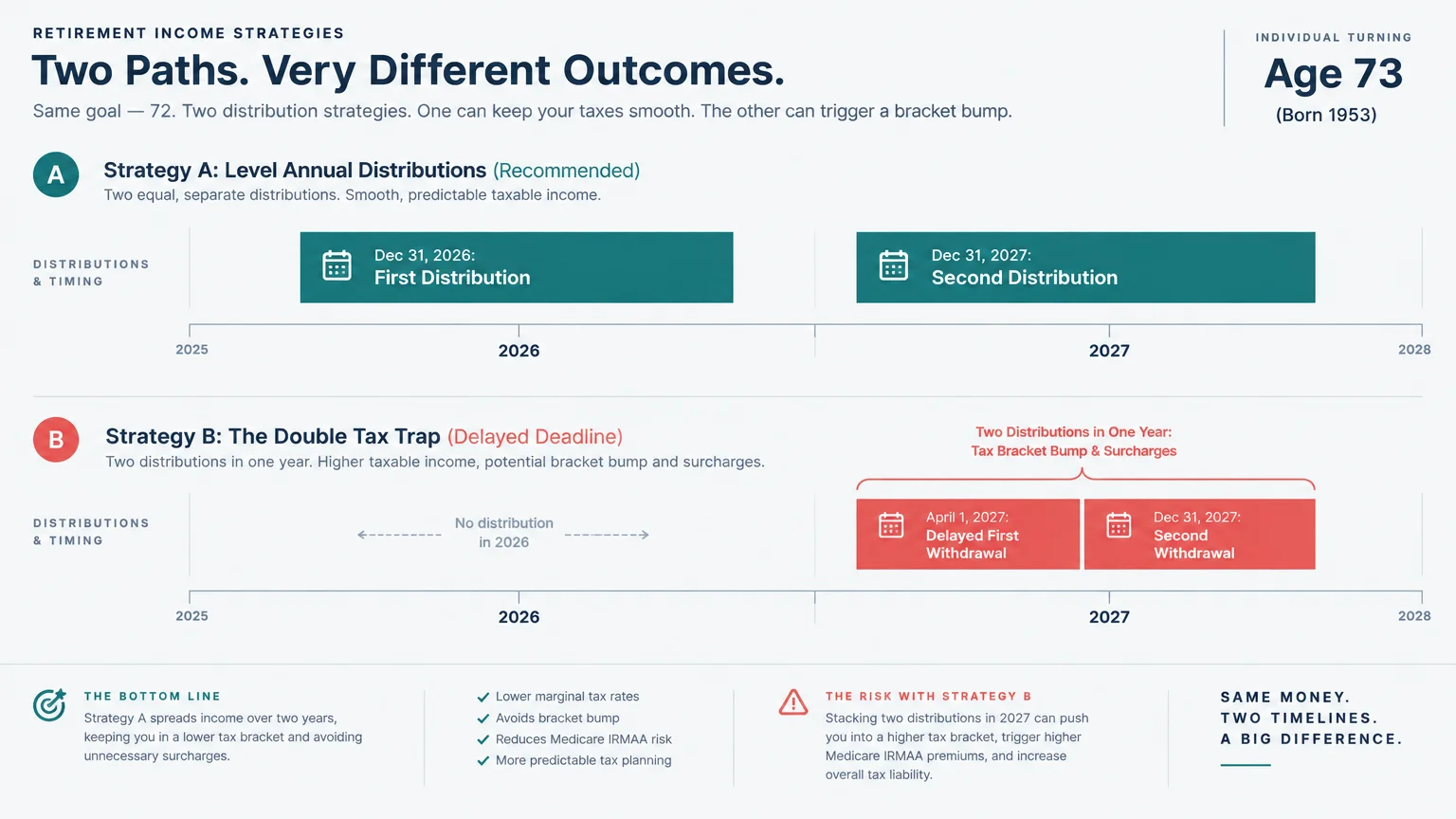
Reaching age 73 marks an exciting new stage in your personal retirement journey. Under current federal legislation, individuals born in 1953 celebrate their 73rd birthday in 2026 and must begin taking annual withdrawals.
You have the legal right to delay your first distribution until April 1, 2027. While postponing that initial payment feels convenient, doing so often triggers an expensive financial headache.
When you delay your first withdrawal into early 2027, you must still take your second withdrawal by December 31, 2027. That means packing two full distributions into a single calendar year.
Stacking two distributions into one year can easily bump you into a significantly higher federal income tax bracket. The resulting spike in your adjusted gross income erodes the funds you set aside for leisure.
Higher income also exposes you to Medicare Income-Related Monthly Adjustment Amount surcharges. These extra healthcare fees drain resources that you could otherwise spend on travel adventures or fitness classes.
Taking your initial distribution before December 31, 2026, keeps your taxable income level and predictable. Smooth income levels let you plan your personal budget without unexpected tax surprises.
Predictable finances give you the freedom to book seasonal getaways and host family dinners without anxiety. Steady cash flow forms the foundation of a joyful, stress-free retirement lifestyle.
You can set up automatic bank transfers with your custodian early in the autumn season. Scheduling withdrawals ahead of time ensures you never bump up against the strict rmd deadline.
Some retirees prefer receiving monthly installments throughout the year rather than taking one lump sum in December. This structured cadence creates a dependable paycheck feeling that supports your everyday social outings and creative hobbies.
Coordinate with your tax advisor early in the year to estimate your exact liability. Proactive distribution timing shields your nest egg and preserves your hard-earned dollars for the experiences that bring you joy.
Lifestyle Idea #2: Mastering Account Aggregation to Protect Your Travel Fund
Retirement gives you the freedom to explore new hobbies, but managing multiple financial accounts can feel overwhelming. Many retirees hold several retirement accounts accumulated over decades of productive professional work.
A frequent pitfall involves misunderstanding the IRS aggregation rules across your various retirement balances. Withdrawing your total required amount from the wrong account can trigger severe tax penalties.
You must calculate your distribution amount separately for each Traditional IRA, SEP IRA, and SIMPLE IRA you own. Fortunately, you can withdraw the total combined sum from any single IRA or combination of IRAs.
This flexible rule allows you to streamline your accounts and simplify your personal bookkeeping. Pulling your annual distribution from a single IRA frees up mental space for your creative pursuits.
Different aggregation rules apply if you hold 403(b) retirement plans from past public service or education roles. You can calculate amounts across each 403(b) and withdraw the total from one 403(b) account.
Workplace 401(k) and 457(b) plans operate under much stricter distribution guidelines. You cannot combine required distributions across multiple 401(k) plans under any circumstances.
Each 401(k) requires its own distinct withdrawal calculated specifically for that individual plan. Pulling a combined sum from just one workplace account leaves your other plans delinquent in the eyes of the IRS.
Failing to satisfy the distribution for a specific 401(k) exposes your savings to an unexpected penalty. Keeping each plan compliant protects the funds you earmarked for road trips and family celebrations.
Maintain a clean master binder or digital spreadsheet detailing each institution holding your retirement funds. Having your account numbers and custodian contact details organized in one secure place eliminates year-end scrambling.
Take a quiet afternoon to build a clear inventory of all your workplace and individual accounts. Organizing your portfolio now ensures hassle-free withdrawals and leaves your weekends open for fun.

Lifestyle Idea #3: Funding Causes You Love with Qualified Charitable Distributions
Living a purpose-driven retirement often means supporting the non-profit causes and local charities closest to your heart. Making charitable gifts enriches your social life, connects you with inspiring people, and strengthens your local community.
A Qualified Charitable Distribution allows you to donate directly from your IRA to an eligible 501(c)(3) charity. This giving strategy counts toward your distribution requirement without counting as taxable income.
Anyone who has reached age 70½ can take advantage of this powerful tax-advantaged giving strategy. You do not even have to wait until age 73 to begin using this charitable tool.
For 2026, the IRS sets the annual Qualified Charitable Distribution limit at $111,000 per person. A married couple with separate individual retirement accounts can donate up to $222,000 collectively this year.
You can also take advantage of a one-time $55,000 limit to fund a split-interest entity in 2026. This option includes charitable remainder trusts and charitable gift annuities that provide ongoing income streams.
Standard withdrawals increase your adjusted gross income, which can trigger taxes on your Social Security benefits. Charitable transfers bypass your taxable income entirely, shielding your benefits while maximizing your philanthropy.
Direct gifts to animal shelters, museums, or community arts programs create profound joy and lasting community connections. Giving back allows you to build a legacy that enriches lives today and tomorrow.
Many active retirees pair their financial contributions with hands-on volunteer work at the organizations they fund. Working alongside fellow volunteers creates warm friendships and keeps you actively engaged in your neighborhood.
Ensure your IRA custodian transfers the funds directly to the charity before the end of the year. If the custodian sends the check to you first, the IRS treats it as taxable income.
Use this rewarding avenue to align your retirement wealth with your deeply held personal values. Generosity enriches your golden years while keeping your tax profile beautifully efficient.
Lifestyle Idea #4: Pinpointing Your Prior-Year Balance for Accurate Calculations
Planning your dream vacations and funding social outings requires knowing exactly how much you can comfortably spend. Pulling the wrong amount from your accounts creates needless anxiety and risks IRS scrutiny.
A remarkably common error involves calculating your distribution using your current portfolio balance. Many retirees check their balances in November or December and base their math on those current figures.
The IRS explicitly requires you to use your account balance as of December 31, 2025. Using your current market value produces an inaccurate distribution figure that could shortchange your legal requirement.
You calculate your distribution by dividing that prior year-end balance by your life expectancy factor. The IRS provides these specific demographic factors in the published Uniform Lifetime Table.
If your spouse is more than 10 years younger and serves as your sole primary beneficiary, different math applies. In that situation, you use the Joint Life and Last Survivor Expectancy Table instead.
Using the joint table provides a larger life expectancy divisor, which results in a smaller required withdrawal. A smaller mandatory distribution allows more of your nest egg to compound undisturbed for later adventures.
Most financial institutions post your official year-end fair market value directly onto your January statement. Pull that statement from your files or download it from your secure custodian portal today.
Double-check automated withdrawal calculations provided by your financial custodian before signing off on distributions. Verifying the underlying 2025 numbers yourself guarantees that human error or computer glitches never compromise your plan.
Relying on guesswork creates unnecessary stress that takes time away from your favorite pastimes. Taking thirty minutes to verify your official 2025 year-end balance guarantees complete financial accuracy.
Accurate calculations give you complete confidence in your financial plan. When your mandatory numbers are settled, you can relax and focus on enjoying your retirement lifestyle.
Lifestyle Idea #5: Managing Inherited Accounts Without Triggering Strict Penalties
Receiving an inherited retirement account can provide wonderful opportunities to enrich your retirement years. However, navigating the legal distribution rules for inherited assets requires close attention and thoughtful planning.
Most non-spouse beneficiaries who inherited an account after January 1, 2020, must follow the 10-year rule. This standard requires you to empty the entire inherited account by December 31 of the tenth year.
A critical trap catches many beneficiaries when the original owner had already reached their required beginning date. In that scenario, you cannot simply wait until year ten to empty the account balance.
You must take annual required distributions during years one through nine, in addition to emptying the account by year ten. Skipping these annual withdrawals violates IRS regulations and leads to swift financial penalties.
The IRS previously offered temporary grace periods, waiving penalties on missed inherited distributions from 2021 through 2024. Those administrative relief programs ended, and the IRS strictly enforces all inherited distribution rules in 2026.
Failing to take an inherited withdrawal triggers a harsh 25% rmd tax penalty on the untaken amount. That steep penalty directly deprives you of funds you could use for travel, hobbies, or family gifts.
You can reduce that penalty down to 10% if you correct the error within a two-year window. To qualify, you must withdraw the full shortfall and submit IRS Form 5329 promptly.
Communicate openly with siblings and fellow beneficiaries who share the inherited estate. Sharing information about these strict distribution guidelines ensures everyone protects their share of the family legacy.
Protecting your family inheritance from unnecessary penalties honors the legacy of your loved one. Managing inherited funds wisely provides lasting peace of mind and expands your personal lifestyle opportunities.
Review your inherited account paperwork with a trusted advisor to verify your exact annual obligations. Clearing up inherited obligations lets you enjoy your retirement years without lingering legal worries.

Lifestyle Idea #6: Preserving Roth Workplace Assets for Long-Term Joy and Growth
Designing a vibrant retirement lifestyle means letting your investments work for you while you enjoy your favorite activities. Roth accounts offer unique tax advantages that make funding future milestones and family celebrations much easier.
For many years, workplace retirement rules forced savers to withdraw money from designated Roth 401(k) accounts. Those outdated rules caused confusion because Roth IRAs have never required lifetime mandatory distributions.
Thanks to the SECURE 2.0 legislation, original owners face no lifetime distribution requirements from Roth 401(k) and Roth 403(b) accounts. This protective rule permanently aligned workplace Roth plans with traditional Roth IRAs.
A costly mistake occurs when retirees mistakenly believe they must liquidate their Roth workplace accounts this year. Pulling funds out prematurely removes your money from an environment of tax-free compounding growth.
Leaving your designated Roth funds untouched allows your balances to generate tax-free returns well into your senior years. You can let those assets grow to fund ambitious travel adventures or future healthcare needs.
Roth accounts also serve as exceptionally generous inheritance assets for children or grandchildren. Beneficiaries receive distributions from inherited Roth accounts completely free of federal income taxes.
Check with your plan administrator to make sure your Roth balances are categorized correctly. Separating pre-tax contributions from post-tax Roth dollars ensures you only calculate distributions on taxable balances.
Keeping your post-tax funds invested gives you immense psychological freedom as you map out long-term retirement dreams. You can dream bigger about bucket-list vacations knowing a pool of tax-free capital stands ready.
Preserving your Roth assets gives you powerful financial flexibility whenever special life opportunities arise. Knowing you have tax-free wealth available brings immense security and excitement to everyday living.
Lifestyle Idea #7: Leveraging the Still Working Exception While Pursuing Your Passion
Many seniors discover that staying active in the workforce provides stimulating social interactions, intellectual engagement, and personal purpose. Continuing your professional career into your seventies can be deeply rewarding for your health and well-being.
If you remain employed at age 73, you may qualify for the valuable still working exception. This rule allows you to postpone mandatory withdrawals from your current employer’s qualified workplace retirement plan.
Under this provision, you can delay distributions from your current workplace plan until April 1 following your retirement year. Delaying distributions keeps your workplace savings compounding tax-deferred while you continue earning your professional salary.
A dangerous error happens when retirees assume this exemption applies to all of their retirement holdings. The still working exception never applies to Traditional IRAs, SEP IRAs, or SIMPLE IRAs.
Even if you work forty hours a week, you must take your required distributions from your personal IRAs. Neglecting your IRA distributions while employed leads directly to costly penalties and tax notices.
The still working rule also excludes individuals who own 5% or more of the company sponsoring the retirement plan. If you own a significant stake in the business, you must take distributions at age 73 regardless.
Additionally, workplace accounts from previous employers do not qualify for this delay. You must take distributions from old 401(k) plans or roll them into your current workplace plan if permitted.
Working later in life allows you to mentor younger associates and share your wealth of life experience. These cross-generational workplace friendships enrich your daily routine and keep your mind remarkably sharp.
Understanding these specific workplace boundaries protects your hard-earned wages and benefits. You can consult your human resources coordinator to confirm whether your company plan supports this distribution delay.
Balancing rewarding work with smart distribution planning gives you the best of both worlds. You enjoy meaningful professional connections while keeping your retirement nest egg fully compliant and growing.

Putting It into Practice: Small Steps for Big Changes
Transforming complex financial rules into simple routines frees up your calendar for active living and joyful moments. Taking structured, bite-sized actions eliminates anxiety and keeps your financial foundation rock solid.
Start by logging into your various custodian accounts to record your December 31, 2025 balances. Keeping a single written summary of these prior-year figures makes calculating your current obligations straightforward and painless.
Review which accounts allow aggregation so you can plan the most convenient withdrawal path. Choosing to satisfy your distribution from a single IRA minimizes paperwork and cuts down administrative hassles.
Mark your calendar well ahead of the December 31 rmd deadline to prevent rushed year-end decisions. Initiating your distributions by mid-autumn gives custodians ample processing time before holiday closures begin.
If charitable giving inspires you, contact your favorite non-profit organizations to arrange direct transfers. Fulfilling your required amounts through charitable giving enriches your community while reducing your taxable income burden.
Examine any inherited accounts to ensure you do not trigger the newly enforced 25% penalty. If an error occurred in past years, file Form 5329 quickly to secure the reduced 10% penalty rate.
Set aside dedicated time each month to celebrate small personal victories along your financial journey. Treating yourself to lunch with friends after reviewing your portfolio transforms administrative tasks into positive social events.
Align your withdrawal amounts with your lifestyle dreams, whether funding an overseas cruise, tending a garden, or spoiling grandchildren. When you control your distribution plan, your money actively serves your happiest life.
Pairing disciplined distribution habits with fulfilling personal goals creates a retirement that is both secure and inspiring. Enjoy the peace of mind that comes from mastering your financial journey.
Frequently Asked Questions
What should I do if I discover that I missed an RMD deadline?
Discovering a missed withdrawal can cause immediate stress, but taking quick action resolves the problem effectively. You must withdraw the full distribution shortfall from your account as soon as you identify the oversight.
Submit IRS Form 5329 along with your federal tax return to disclose the shortfall to the IRS. If you correct the missed withdrawal within two years, the standard 25% penalty drops to 10%.
You can also request a complete waiver of the penalty if the error resulted from reasonable cause. Attach a brief written statement explaining the circumstances and documenting that you have taken the corrective distribution.
Can I reinvest my distribution back into another retirement plan?
Many retirees wonder if they can roll their required distributions directly into a Roth IRA or traditional retirement account. The IRS strictly prohibits rolling over any required distribution amounts back into tax-advantaged accounts.
Once money leaves your account as a required distribution, it cannot return to a retirement vehicle. However, you can invest those funds into a regular taxable brokerage account to continue growing your wealth.
You can also deposit the funds into high-yield savings accounts dedicated to upcoming vacations or creative hobby gear. Deploying that cash into your personal lifestyle helps you make the most of your golden years.
How do IRA withdrawals impact my Social Security and Medicare costs?
Understanding how ira withdrawals retirement interact with government benefits protects your monthly spending budget. Every dollar you take as a taxable distribution increases your overall adjusted gross income for the tax year.
A higher gross income can subject up to 85% of your Social Security benefits to federal income taxation. It can also trigger income-related monthly adjustment surcharges on your Medicare Part B and Part D premiums.
Using Qualified Charitable Distributions helps reduce your taxable income and protects you from these surcharges. Consulting an advisor ensures you structure distributions in a manner that protects your essential healthcare benefits.
Can I use my required withdrawals to fund memorable family trips?
Using your retirement savings to create unforgettable memories with family represents one of the finest rewards of retirement. Once you satisfy the required taxes on your distribution, you can spend those funds entirely as you wish.
Consider dedicating a portion of your annual distribution toward hosting an intergenerational family reunion or beach getaway. Shared experiences bring families closer together and provide precious moments that children and grandchildren will always treasure.
You can also use distributions to support family hobbies, fund music lessons for grandchildren, or pursue culinary classes together. Spending your distributions on meaningful shared adventures enriches your retirement with lasting joy and connection.
For resources on retirement living, travel, and finance, visit AARP. Official information on Social Security is available at SSA.gov. For travel advisories, consult the U.S. Department of State.
Disclaimer: This article provides lifestyle suggestions for informational purposes. Financial, legal, or travel decisions should be made in consultation with qualified professionals.