The Social Security Administration announced significant policy updates for next year, and your paycheck may soon reflect these adjustments. High earners will shoulder increased payroll taxes starting on January 1, 2027, while average earners keep their usual baseline.
Knowing where your personal income falls against the rising wage base allows you to protect your retirement savings. You can take smart financial steps now to optimize your cash flow and preserve your peace of mind.
This detailed guide explains who will pay more, how the caps work, and what proactive moves you can make today.

Tip #1: Understand the New 2027 Wage Base Limit
The Social Security Administration officially announced the updated figures on October 14, 2026. These annual adjustments ensure the retirement program keeps pace with national income shifts.
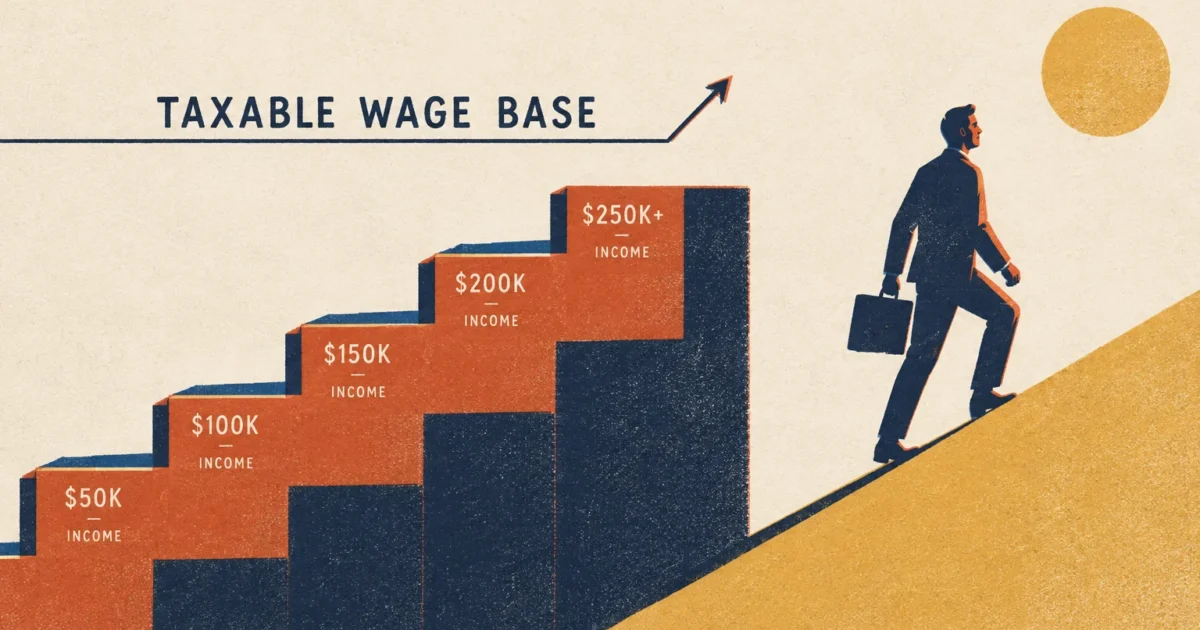
Starting January 1, 2027, the social security wage base 2027 climbs to $192,300. This benchmark represents a substantial jump from the 2026 taxable maximum of $184,500.
To put this change into perspective, the wage base was $176,100 in 2025. The threshold continues an upward trajectory as economic conditions evolve.
This new cap represents an annual increase of $7,800 in subject earnings. In percentage terms, the taxable wage cap expands by roughly 4.23%.
How the Government Determines the Increase
Federal law ties the social security taxable maximum directly to the National Average Wage Index. When national wage data shows growth, the government raises the wage base accordingly.
This automatic indexing prevents inflation from eroding the financial strength of the Social Security trust funds. It also ensures that revenue collections reflect realistic compensation trends across the nation.
Who Pays More and Who Remains Unaffected
The payroll tax cap establishes an absolute ceiling on wages subject to Social Security taxation. Any dollars you earn beyond $192,300 are completely exempt from this tax.
If your annual earnings remain below $184,500 in 2027, this policy update will not increase your taxes. Your withholding rate and total tax liability remain completely unchanged.
Only workers with earned income exceeding $184,500 will see additional payroll taxes withheld from their paychecks. Understanding this distinction provides immediate clarity for your personal household budget.
Reviewing Your Compensation Ahead of Time
Take a close look at your expected compensation for the coming year. Remember to account for annual merit raises, performance bonuses, and sales commissions.
These additional income streams count as earned compensation under federal guidelines. Anticipating your total earnings prevents any unpleasant cash flow surprises later in the year.
Tracking the National Wage Growth Pattern
Understanding historical trends helps put this latest increase into perspective. The wage base stood at $176,100 in 2025 before rising to $184,500 in 2026.
The leap to $192,300 in 2027 reflects sustained wage growth in key sectors of the American economy. While changes vary from year to year, the direction remains predictably upward.
Tracking these trends allows you to anticipate tax shifts long before they take effect. You can align your personal compensation targets with changing federal guidelines.

Tip #2: Calculate Your Exact Payroll Tax Exposure
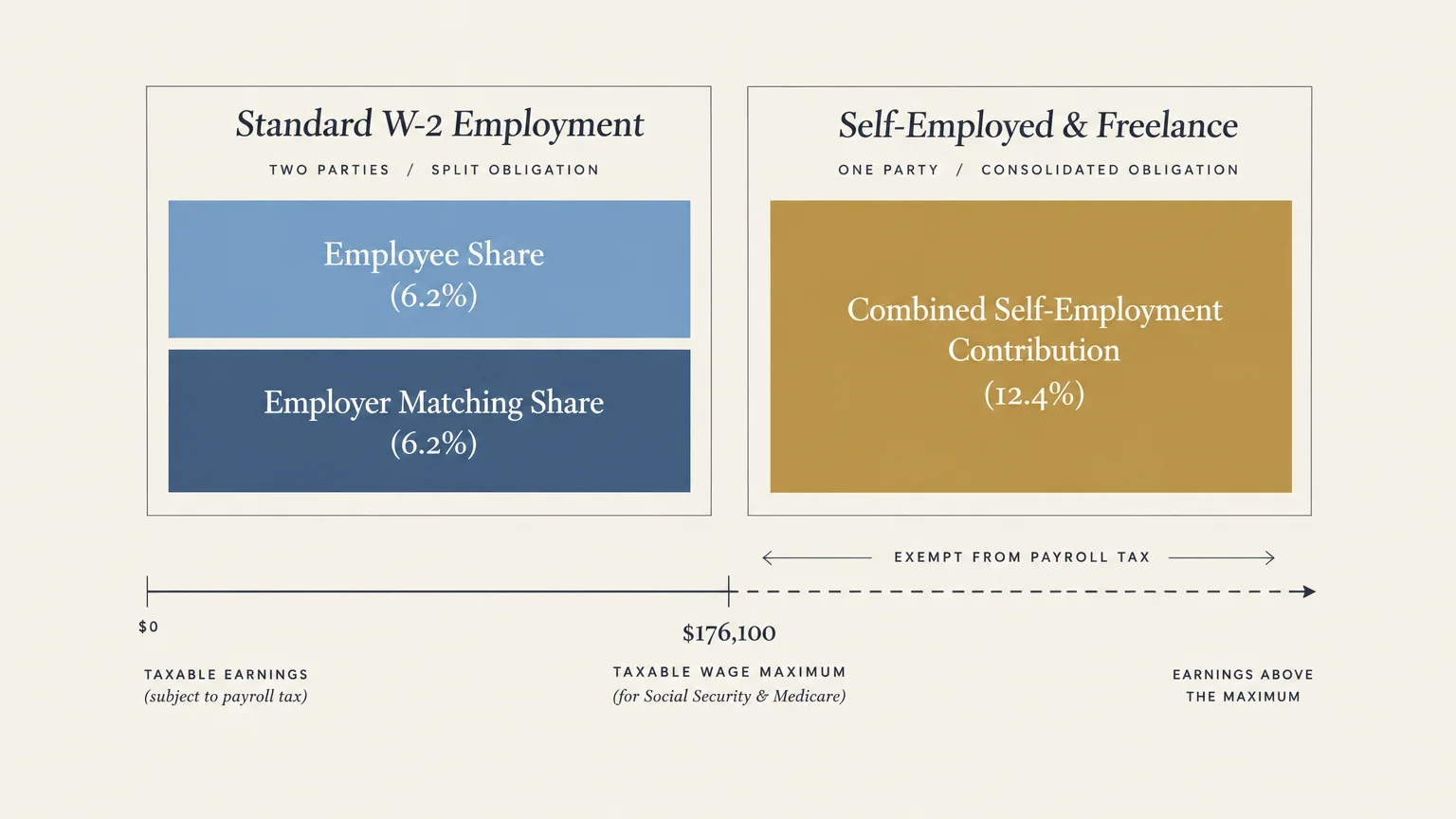
You can calculate your personal tax impact by reviewing the standard statutory withholding rates. The employee payroll tax rate remains fixed by statute at 6.2%.
Your employer contributes an identical 6.2% match on your covered wages. Together, these contributions fund the nation’s core retirement and disability programs.
The Employee Tax Increase Broken Down
In 2026, an employee earning at or above the cap paid a maximum tax of $11,439.00. That figure represented the maximum annual employee contribution.
For 2027, the maximum employee tax reaches $11,922.60. Your employer matches that exact $11,922.60 on your behalf throughout the year.
This adjustment means high earners social security tax bills will increase by up to $483.60 for the year. Your exact increase depends on where your income falls between the old and new caps.
Understanding How Withholding Functions
Payroll departments withhold the 6.2% tax on your wages starting with your first paycheck of the year. This deduction continues until your cumulative earnings hit the $192,300 cap.
Once your pay reaches that threshold, Social Security deductions stop entirely for the remainder of the year. High earners typically notice a welcome increase in take-home pay during late autumn.
Because the cap rose by $7,800, your deductions will continue for several extra weeks. Planning for this delayed bump in net income keeps your monthly cash flow steady.
Practical Budgeting Adjustments
Spread the maximum $483.60 increase across your annual spending plan. For most high earners, this change represents a modest adjustment of roughly $40 each month.
Reviewing your year-to-date earnings boxes on each paystub ensures complete accuracy. Proactive monitoring guarantees you maintain full control over your ongoing financial goals.
What Happens If You Work for Multiple Employers?
If you work for more than one employer during 2027, each employer must withhold Social Security tax independently. Neither company coordinates withholding with the other.
As a result, your combined earnings may exceed the $192,300 cap, leading to excess withholding. Fortunately, you will not lose that overpaid money.
You can easily claim any excess Social Security tax paid as a refundable credit on your annual federal income tax return. The IRS returns those funds directly to you when you file.
Tip #3: Plan Ahead If You Are Self-Employed or Freelancing
Many active adults over 50 embrace consulting, freelance work, or small business ownership. Operating your own enterprise offers fantastic lifestyle freedom, but it carries distinct tax responsibilities.
When you work for yourself, you act as both the employee and the employer. Therefore, you pay the combined self-employment tax rate of 12.4%.
The 2027 Cap for Business Owners
In 2026, a self-employed professional earning at or above the cap paid up to $22,878.00 in Social Security taxes. That figure set the previous benchmark.
For 2027, the maximum Social Security tax for a self-employed individual climbs to $23,845.20. This shift represents a maximum tax increase of $967.20.
This increase applies only to net self-employment earnings that fall between $184,500 and $192,300. Net earnings below $184,500 face no additional Social Security tax burden.
Adjusting Your Quarterly Estimated Taxes
You should review your quarterly estimated tax payments on Form 1040-ES. Adjusting your quarterly payments prevents frustrating underpayment penalties from the Internal Revenue Service.
Spreading the extra tax across four equal quarterly installments eases cash management. A regular check-in with your tax professional ensures you remain fully compliant.
Valuable Deductions for the Self-Employed
Federal tax law allows you to deduct half of your self-employment tax when computing your adjusted gross income. This above-the-line deduction helps cushion the impact of the higher tax cap.
You can also explore establishing a solo 401(k) or a Simplified Employee Pension plan. These tax-deferred accounts let you shelter substantial business earnings while building your retirement nest egg.
Taking advantage of these legal shelters transforms tax obligations into long-term personal wealth. You protect your immediate profits while preparing for a fulfilling future.
Evaluating Business Structure Options
If you run an incorporated business, talk with your CPA about your corporate structure. Operating as an S-Corporation allows owners to split revenue between a reasonable W-2 salary and shareholder distributions.
Only your W-2 salary is subject to the 12.4% self-employment tax. Shareholder distributions remain exempt from payroll taxes, though they are subject to standard income taxes.
Maintaining strict compliance with federal salary guidelines ensures your structure withstands scrutiny. This strategy can optimize your tax liability while keeping you firmly on the right side of tax regulations.

Tip #4: Coordinate Your Work Income with the Retirement Earnings Test
Many individuals continue working even after filing for monthly retirement benefits. If you choose this path before reaching full retirement age, you must understand the earnings test rules.
The earnings test temporarily withholds benefits if your earned wages surpass specific annual thresholds. Fortunately, the Social Security Administration increased these limits for 2027.
Thresholds for Workers Under Full Retirement Age
If you remain under full retirement age throughout 2027, your annual earnings limit rises to $25,560. This increase lets you earn more wages than in prior years.
The agency withholds $1 in benefits for every $2 you earn above that $25,560 limit. Balancing your work hours against this ceiling helps you avoid unexpected benefit reductions.
Rules for the Year You Reach Full Retirement Age
A much more generous limit applies if you reach full retirement age during 2027. The earnings limit rises to $67,920 for the months leading up to your birthday month.
In this window, the government withholds only $1 for every $3 earned above $67,920. Once you reach your birth month, the earnings test ceases entirely.
Complete Freedom at Full Retirement Age
Workers at or above full retirement age face no earnings limitations whatsoever. You can earn an unlimited salary without losing a single cent of your Social Security payments.
Furthermore, withheld benefits are never permanently lost. The Social Security Administration recalculates your monthly check at full retirement age to credit every withheld dollar back to you.
Strategic Timing for Working Seniors
Evaluate your projected earnings carefully before deciding when to claim your benefits. If your active salary remains high, delaying your claim often yields substantially larger lifetime benefits.
Every year you delay claiming beyond full retirement age earns delayed retirement credits. These credits permanently increase your monthly check until age 70.
The First-Year Retirement Grace Period
If you retire mid-year after earning high wages, a special monthly earnings test rule protects your benefits. Under this rule, you can receive full benefits for any month you earn under the monthly limit.
This monthly rule applies regardless of how much you earned earlier in that calendar year before retiring. It provides a smooth financial transition into full retirement living.
Taking advantage of this special rule lets you step away from work whenever you choose without penalty. You can launch your golden years on your own timeline.

Tip #5: Maximize Tax-Advantaged Retirement Accounts to Lower Your Burden
Rising statutory caps highlight the tremendous value of tax-advantaged retirement accounts. Strategic contributions help you offset higher payroll taxes by lowering your overall income tax liability.
Directing income into pre-tax accounts reduces your taxable income dollar for dollar. This simple move provides immediate financial relief and strengthens your future security.
Utilize Traditional Workplace Retirement Plans
Contributing to a traditional 401(k) or 403(b) plan lowers your adjusted gross income immediately. You defer federal and state income taxes until you take distributions in retirement.
While pre-tax contributions do not reduce Social Security payroll taxes, they produce substantial income tax savings. Those savings directly compensate for the modest increase in the payroll tax cap.
Leverage Health Savings Accounts for Triple Savings
If your health insurance qualifies as a high-deductible healthcare plan, contribute to a Health Savings Account. HSAs offer an extraordinary triple-tax advantage that savvy retirees love.
Contributions made through payroll deductions escape federal income taxes, state income taxes, and FICA payroll taxes. This unique feature shields your hard-earned dollars from the rising wage cap entirely.
Your funds grow tax-free, and distributions for qualified medical expenses remain completely tax-free. Building a healthy medical reserve provides exceptional peace of mind for your golden years.
Take Advantage of Catch-Up Contributions
Workers aged 50 and older can utilize valuable catch-up contribution allowances in retirement accounts. These elevated contribution limits let you accelerate your wealth accumulation during peak earning years.
Funneling surplus earnings into tax-sheltered accounts turns an evolving tax policy into personal advantage. You build a resilient financial foundation that supports vibrant, worry-free retirement living.
Coordinate Your Tax Diversification Strategy
Creating a balanced mix of taxable, tax-deferred, and tax-free accounts gives you immense flexibility. You can selectively pull funds from different buckets to manage your reported taxable income each year.
Controlling your taxable income helps keep you below critical thresholds for Medicare surcharges and tax brackets. This intentional strategy safeguards your hard-won wealth throughout retirement.
Review your account balances annually with a qualified financial planner. Thoughtful adjustments today create enduring financial freedom for your future.
Tip #6: Prepare for Medicare Surtaxes on Higher Earned Income
When analyzing the social security tax limit 2027, you must also evaluate Medicare payroll taxes. Both taxes fund vital safety nets, but they operate under completely different statutory structures.
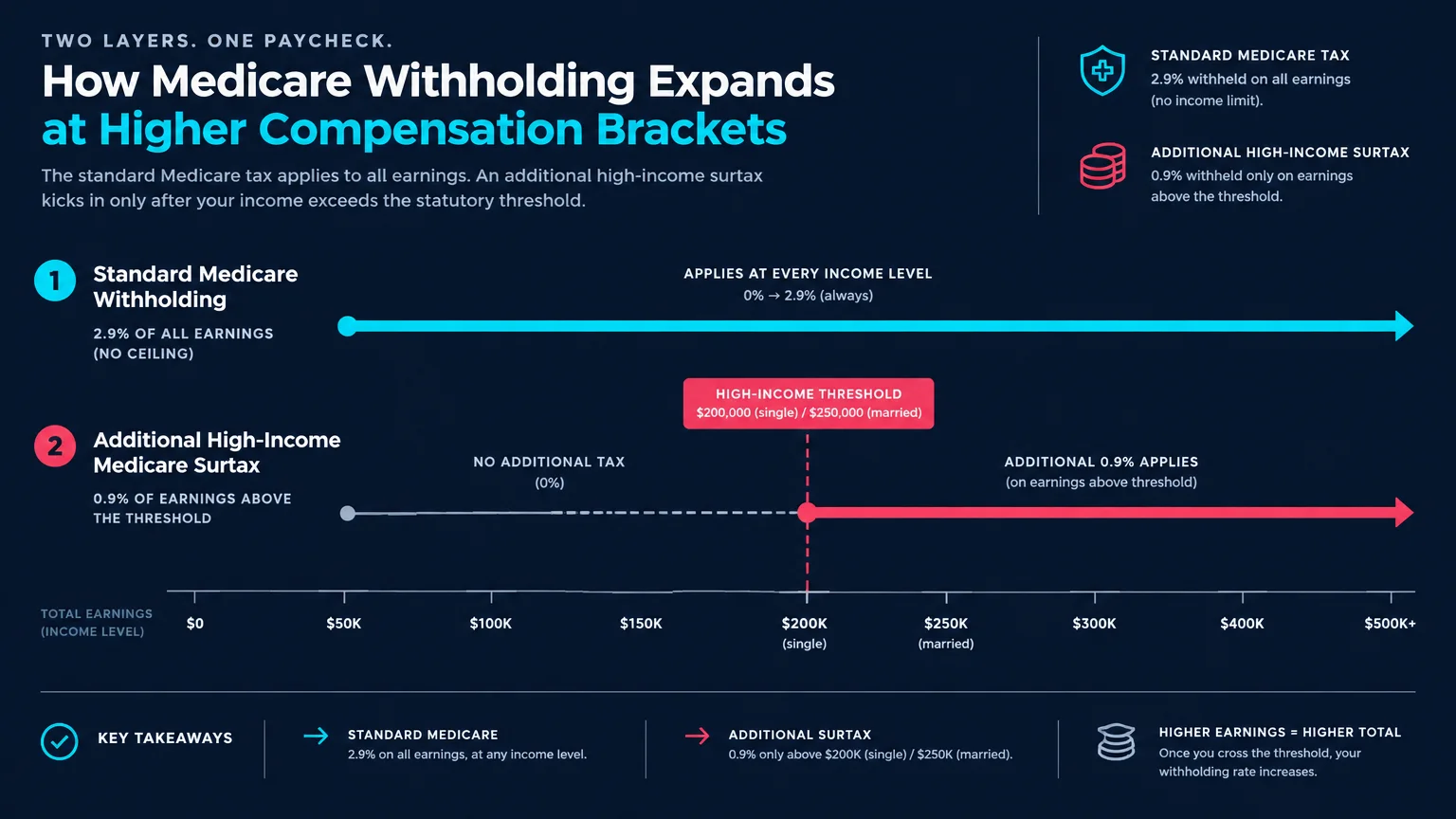
Unlike Social Security, the Medicare Hospital Insurance tax features no wage cap whatsoever. Every dollar of earned income you generate is subject to Medicare withholding.
Baseline Medicare Withholding Rates
The standard Medicare tax rate remains 1.45% for employees and 1.45% for employers. This brings your standard combined employee payroll tax rate to 7.65%.
Self-employed professionals pay the complete 2.9% standard Medicare tax on all net earnings. This baseline tax applies continuously across your entire annual income.
Understanding the Additional Medicare Surtax
High earners must also prepare for the Additional Medicare Tax of 0.9%. This surtax applies to earned income that surpasses specific statutory thresholds.
Single taxpayers pay the 0.9% surtax on earned income exceeding $200,000. Married couples filing jointly trigger the tax on combined wages above $250,000.
Employers do not match this additional 0.9% surtax. You carry this tax responsibility individually through payroll withholding or your annual tax return.
Coordinating Spousal Incomes
Employers withhold the surtax once an individual’s wages cross $200,000, regardless of marital status. However, two high-earning spouses might each earn under $200,000 but exceed $250,000 combined.
In that situation, you might owe the Additional Medicare Tax when filing your joint return. Planning ahead prevents surprising liabilities when April arrives.
The Difference Between Earned Income and Investment Surcharges
Do not confuse the 0.9% Additional Medicare Tax on wages with the 3.8% Net Investment Income Tax. The 0.9% tax applies strictly to earned compensation from active employment.
Conversely, the 3.8% Net Investment Income Tax targets passive investment income like capital gains and dividends. Keeping these two distinct taxes separate helps you build an accurate annual tax estimate.
Clear knowledge of these distinct rules removes financial anxiety. You can confidently structure your portfolio to minimize unnecessary tax burdens.

Tip #7: Factor the 2027 Cost-of-Living Adjustment into Your Budget
The annual wage cap update coincided with welcome news for benefit recipients. Social Security and Supplemental Security Income benefits will receive a 3.6% cost-of-living adjustment in 2027.
This 3.6% boost improves upon the 2.8% adjustment delivered in 2026. The increase helps seniors protect their household purchasing power against inflation.
Real Dollar Impacts on Your Monthly Benefits
A 3.6% COLA increases the average monthly retirement benefit by approximately $75 per month. Over the course of the full year, you gain roughly $900 in extra cash.
You can use these additional funds to cover healthcare, invest in hobbies, or explore new travel destinations. Every additional dollar adds comfort and joy to your daily life.
How the Wage Cap Supports Benefit Growth
The rising wage cap directly reinforces the financial health of the Social Security system. When high earners contribute on a broader wage base, system solvency improves for everyone.
Paying taxes on higher covered wages also increases your personal lifetime earnings record. The government calculates your future monthly retirement check using your highest thirty-five earning years.
Higher taxed wages translate directly into higher primary insurance amounts when you claim benefits. What feels like a tax increase today can produce richer retirement checks tomorrow.
Recalibrate Your Monthly Cash Flow Plan
Receiving an extra $75 per month from the 3.6% COLA presents a great opportunity to fine-tune your retirement budget. Consider reallocating those funds toward wellness routines, home upgrades, or family experiences.
Alternatively, you can direct the extra funds into an emergency high-yield savings account. Having a dedicated cash reserve protects your peace of mind when unexpected expenses arise.
Every positive adjustment to your monthly cash flow compounds your sense of financial confidence. You can savor every moment of your golden years knowing your finances are strong.

The Takeaway: Living a More Blissful Retirement
A fulfilling retirement is built on financial clarity, proactive planning, and an optimistic outlook. Annual adjustments to the payroll tax cap may seem complex, but their direct impact remains focused on higher earners.
If your annual earnings exceed the new threshold, remember that these extra contributions strengthen your future benefits. Your lifetime earnings history actively fuels your monthly checks for decades to come.
If your earnings sit below the threshold, your payroll tax withholding stays completely steady. You can continue managing your household budget with confidence and calm assurance.
Take time this week to review your pay statements, coordinate your retirement accounts, and celebrate your achievements. Small, deliberate financial moves today ensure you enjoy a vibrant, blissful retirement tomorrow.
Frequently Asked Questions
Does everyone have to pay higher Social Security taxes in 2027?
No, the vast majority of American workers will not experience any tax increase. Only workers earning more than $184,500 in 2027 will see higher Social Security deductions.
If you earn less than that benchmark, your payroll tax rate and total tax liability remain exactly the same. Your regular paycheck schedule continues without change.
Why does the Social Security wage base increase each year?
Federal law automatically ties the wage base to the National Average Wage Index. When national wage averages rise, the Social Security Administration raises the taxable maximum proportionally.
This statutory formula ensures that trust fund revenues keep pace with real wage growth. It protects the financial foundation of the program for current and future generations.
Do pensions, dividends, or capital gains count toward the tax limit?
No, the Social Security payroll tax applies strictly to earned income from wages, salaries, and net business earnings. Investment returns, dividends, capital gains, and pension payments remain completely exempt.
You never have to worry about paying Social Security payroll taxes on passive retirement portfolio withdrawals. This rule preserves your accumulated savings during your distribution phase.
Will paying more tax under the higher cap increase my future checks?
Yes, paying taxes on higher earnings directly improves your lifetime earnings record. The Social Security Administration bases your monthly benefit check on your top thirty-five years of indexed earnings.
When you pay taxes on higher wages, the agency credits those amounts toward your benefit calculation. This mechanism ensures your extra contributions generate higher monthly income in retirement.
What happens if I work for two employers and pay too much Social Security tax?
If you work for multiple employers and your combined earnings exceed $192,300, both employers will withhold taxes up to the limit. You will end up overpaying Social Security taxes for that calendar year.
You recover that excess payment by claiming a credit on Schedule 3 of your federal income tax return. The Internal Revenue Service applies the overage toward your income taxes or refunds it directly.
For a wide range of resources for older adults, visit AARP and the National Council on Aging (NCOA). Health information is available from the National Institute on Aging.
Disclaimer: This article is for informational and inspirational purposes only; it is not a substitute for professional medical, financial, or psychological advice. Please consult with a qualified expert for guidance tailored to your individual needs.