

Seasonal work lets you pad your travel fund, spoil your grandkids, or ease everyday bills without a full-year schedule. You keep your favorite hobbies and family routines while enjoying a lively workplace for a few months.
Saying yes without checking the fine print, however, can backfire on your wallet and health. Extra paychecks can affect your Social Security checks, tax bill, and healthcare costs.
Weighing the perks and pitfalls upfront helps you pick a role that truly fits your retirement goals. Use this guide to match your budget, energy, and calendar before you apply.
Lifestyle Idea #1: Enjoy Flexible Extra Income Without a Year-Round Commitment
Short-term gigs give you quick cash for holiday gifts, home projects, or winter getaways without tying down your entire calendar. You clock in during peak months and walk away guilt-free when the season ends.
Financial breathing room drives many older adults back into the workforce. A 2026 AARP Research report found that 6% to 7% of retirees returned to work within the previous six months, with 48% citing money or economic need as their main reason.
Everyday expenses matter even more for adults 50 and older who are actively working or job hunting. In that same research, 41% pointed to daily living costs as their primary motivation for seeking a paycheck.
The seasonal hiring landscape also gives you plenty of variety. For November and December 2026, the National Retail Federation projects 325,000 to 375,000 seasonal retail hires as holiday sales climb 4.2% to $1.013 trillion.
Outplacement firm Challenger, Gray & Christmas forecasts roughly 450,000 fourth-quarter retail seasonal gains, slightly below the 461,500 roles added in late 2025. Even with tighter hiring, dependable workers with strong people skills stand out quickly.
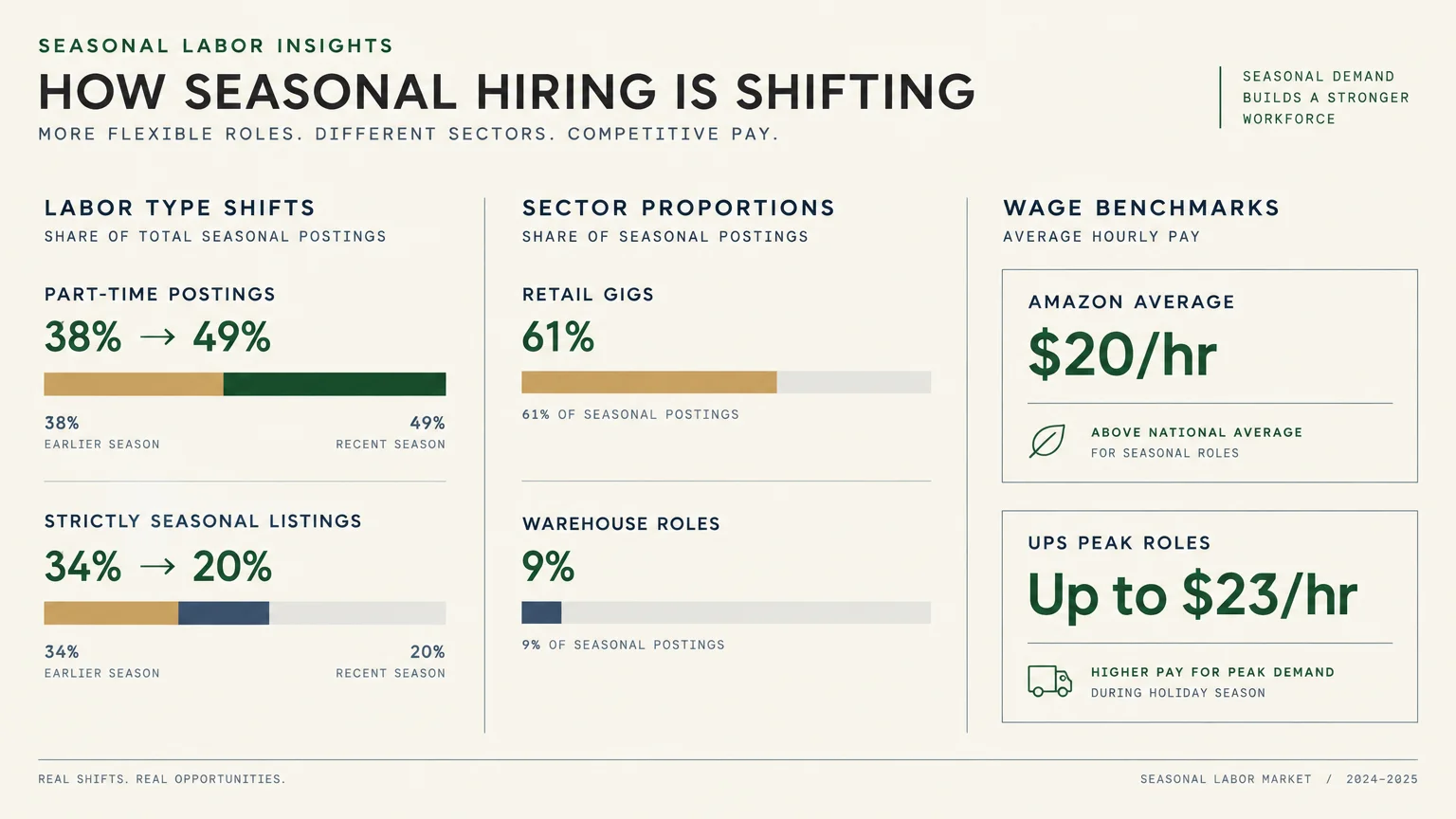
Major logistics and retail employers compete hard for seasonal reliability. Amazon announced 300,000 seasonal, part-time, and full-time holiday hires in 2026—up 20% from 2025—paying seasonal staff an average of $20 per hour after a September 2026 raise.
Those Amazon roles also include store and Whole Foods discounts that stretch your grocery budget. Meanwhile, UPS announced 100,000 seasonal hires in 2026, offering driver helpers and seasonal support drivers up to $23 per hour.
Hiring trends are also shifting away from strictly temporary badges toward steadier schedules. Indeed hiring data reported by eMarketer shows strictly seasonal holiday postings dropped from 34% to 20%, while part-time listings rose from 38% to 49%.
Customer-facing retail still accounts for just over 61% of holiday postings, down from roughly 67% in 2019, while warehouse roles climbed from 3.5% to nearly 9%. That mix gives you choices between helping shoppers, packing orders, or welcoming guests at resorts and parks.
Before you apply, decide exactly what your extra paycheck will fund. Naming a specific goal—like a spring cruise or paying off property taxes—keeps seasonal jobs retirees choose fun rather than stressful.
Lifestyle Idea #2: Boost Your Social Circle, Daily Structure, and Sense of Purpose
Retirement can feel surprisingly quiet once the novelty of sleeping in wears off. Stepping into a busy seasonal shop, museum, or garden center gives you fresh faces, light banter, and a shared daily goal.
You join a growing movement when you keep one foot in the working world. Bureau of Labor Statistics data shows 23.1% of men and 15.7% of women age 65 and older participated in the labor force in 2025.
Overall participation among adults 65 and older reached 18.7% in October 2026. Between 2025 and 2035, the Bureau of Labor Statistics projects labor force participation will rise from 26.7% to 29.1% for ages 65 to 74, and from 8.5% to 10.1% for ages 75 and older.
Staying active on the job does more than fight cabin fever. In the 2026 AARP survey, 14% to 18% of returning retirees said they went back to work specifically to beat boredom or stay active.
Research backs up the connection between well-chosen work and well-being. A systematic review of 17 studies published in BMC Public Health found beneficial or neutral effects on overall and physical health when people work past age 64.
Those positive health links showed up most consistently in part-time arrangements and higher-quality roles. The Centers for Disease Control and Prevention and the National Institute for Occupational Safety and Health also note that work supports social interaction, financial security, and quality of life for older adults.
Look for holiday jobs seniors enjoy that match your favorite hobbies. Book lovers thrive at independent bookstores during December rushes, while avid golfers love working starter shacks at resort courses.
Set clear boundaries around your grandkids and social calendar from day one. Tell hiring managers which weekdays you reserve for babysitting, volunteer clubs, or morning walks so part time work retirees take enhances life instead of crowding it out.

Lifestyle Idea #3: Raise Future Social Security Checks and Claim Bigger Tax Breaks
Seasonal paychecks can strengthen your long-term retirement picture even when you already collect benefits. Each year, the Social Security Administration reviews your W-2 wages and self-employment records automatically.
If your new seasonal earnings exceed one of the lowest years in your highest 35 years of earnings, Social Security recalculates and increases your monthly benefit. That automatic boost rewards steady part-time work over time, especially if you spent earlier years out of the workforce.
Those inflation adjustments compound nicely on a bigger base. Social Security benefits will rise by a 3.6% cost-of-living adjustment starting in January 2027, adding roughly $75 per month on average for retired workers.
Recent IRS tax rules also cushion the extra income you earn after age 65. For the 2026 tax year, the base standard deduction sits at $16,100 for single filers and $32,200 for married couples filing jointly.
Taxpayers 65 and older receive an additional standard deduction on top of that base. In 2026, that extra deduction equals $2,050 for single filers or $1,650 per qualifying spouse.
Those amounts climb again for the 2027 tax year, when the base standard deduction reaches $16,600 for single filers and $33,200 for joint filers. The age-65-and-older bonus rises to $2,100 for singles and $1,700 per qualifying spouse.
Between 2025 and 2028, older adults get an even larger temporary break under the 2025 tax law. Eligible taxpayers age 65 and older can claim an extra $6,000 enhanced senior deduction per person, or $12,000 for joint filers when both spouses qualify.
You can claim that $6,000 deduction whether you take the standard deduction or itemize. Keep in mind that it phases out by 6% once modified adjusted gross income tops $75,000 for single filers or $150,000 for joint filers.
This temporary break helps shield moderate seasonal wages from federal income tax. Just remember that IRS guidance notes this enhanced deduction does not directly exempt your Social Security benefits from federal taxation.
Lifestyle Idea #4: Watch Out for the Social Security Earnings Limit Before Full Retirement Age
Before you sign a seasonal offer letter, check your birth year and benefit start date. Earning above the social security earnings limit while collecting early benefits can shrink your monthly checks temporarily.
Under Social Security Administration rules, full retirement age is 67 for anyone born January 2, 1960 or later. Once you reach full retirement age, the earnings limit disappears completely and you can earn any amount with zero benefit deductions.
If you remain younger than full retirement age for all of 2026, you can earn up to $24,480 for the year, or $2,040 per month, without reduction. In 2027, that annual ceiling rises to $25,560, or $2,130 per month.
Earn more than those limits, and Social Security withholds $1 in benefits for every $2 you earn above the cap. For an intense holiday rush or lucrative summer consulting gig, those withholdings can add up quickly.
A more generous threshold applies during the calendar year you reach full retirement age. In 2026, that limit is $65,160, or $5,430 per month, rising to $67,920, or $5,660 per month, in 2027.
During that transition year, Social Security deducts $1 for every $3 earned above the limit, counting only the money you earn in months before your birthday month. Only W-2 wages and net self-employment income count toward the test, not pensions, investment gains, or IRA withdrawals.
Retiring mid-year also unlocks a helpful exception called the special earnings limit rule. Under this rule, you receive full Social Security checks for any whole month you earn under the monthly threshold—$2,040 in 2026 if under full retirement age—and stay under self-employment hour limits.
Social Security defines substantial self-employment services as working more than 45 hours in a month, or 15 to 45 hours in a highly skilled occupation. Even if benefits get withheld, they are not lost forever because Social Security recalculates and increases your monthly check at full retirement age.
Still, short-term withholdings can disrupt your monthly cash flow when bills come due. Track your gross seasonal wages on a simple spreadsheet so you stop picking up shifts before crossing your threshold.
Lifestyle Idea #5: Calculate Payroll Taxes and the Hidden Social Security Tax Trap
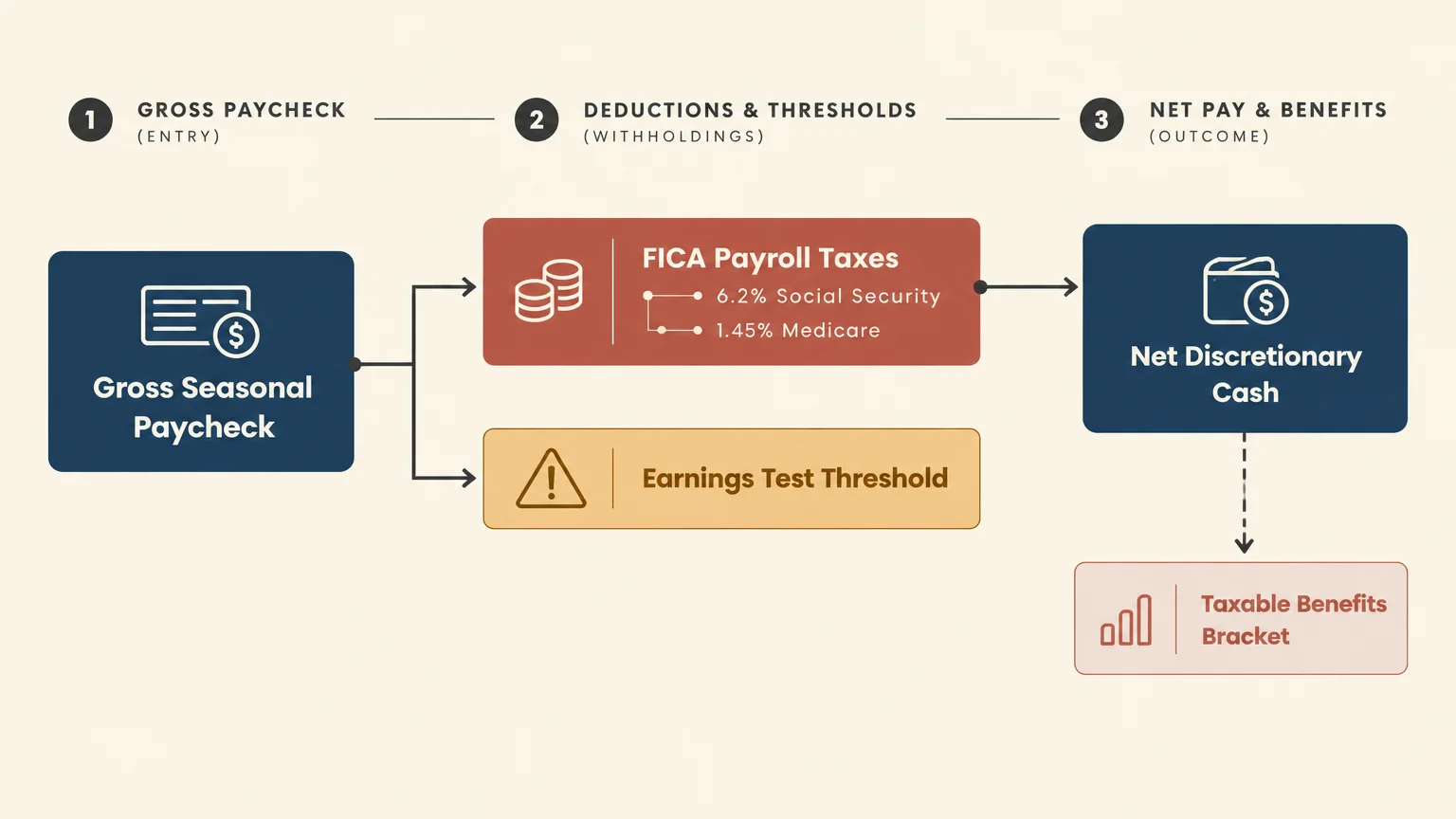
Seeing a $20 hourly rate on a job board feels exciting until your first paycheck arrives smaller than expected. Even if you already collect Social Security, your seasonal wages still face standard federal payroll taxes.
According to IRS and Social Security rules, W-2 seasonal employees pay 6.2% in Social Security tax and 1.45% in Medicare tax, totaling 7.65% out of every dollar earned. That Social Security tax applies up to an annual taxable maximum of $184,500 in 2026 and $192,300 in 2027.
If you work as an independent contractor—such as seasonal event photography, delivery driving, or tax prep—you pay both halves of those payroll taxes. Self-employed workers owe 15.3% before factoring in deductible business expenses.
Extra seasonal pay can also push more of your Social Security benefits into taxable territory. Up to 85% of your benefits become federally taxable if your combined income crosses statutory thresholds that have never been adjusted for inflation.
Combined income equals your adjusted gross income excluding Social Security, plus any tax-exempt interest, plus half of your annual Social Security benefits. For single filers, benefit taxation starts at $25,000 and climbs sharply above $34,000.
For married couples filing jointly, taxation begins at $32,000 and reaches the 85% tier above $44,000. Because those thresholds sit relatively low, even a $4,000 holiday retail stint can trigger unexpected federal taxes on your benefits.
State taxes add one more line item to verify before you say yes. Only nine states still tax Social Security benefits in 2026, though most states tax regular W-2 seasonal wages.
Run a quick tax estimate before accepting a seasonal offer, or ask your employer to withhold slightly more federal tax from each paycheck. Planning ahead protects you from an unwelcome surprise next April.
Lifestyle Idea #6: Guard Against the ACA Subsidy Cliff and Medicare IRMAA Surcharges
Healthcare costs represent one of the biggest financial blind spots in retiree employment. Depending on whether you are under or over age 65, a few thousand dollars of seasonal income can trigger steep premium hikes.
If you retired early and buy coverage on the Affordable Care Act Marketplace, watch the 400% federal poverty level line closely. Enhanced ACA subsidies expired on December 31, 2025, bringing back the strict subsidy cliff for 2026 and 2027.
Earning just $1 above that 400% cutoff eliminates your federal premium tax credits completely. In 48 states and Washington, D.C., that hard ceiling stands at $62,600 for a single person or $84,600 for a couple in 2026.
For 2027 coverage, the cliff sits at $63,840 for a single adult and $86,560 for a couple. KFF estimates that a 64-year-old who crosses the cutoff pays roughly $11,000 more per year, while a 60-year-old pays about $9,600 more.
Starting with the 2026 tax year, federal rules also removed the cap on repaying excess advance premium tax credits. You must pay back every dollar of subsidy you received if seasonal wages push your final income over the line.
Once you turn 65 and enroll in Medicare, your focus shifts to Income-Related Monthly Adjustment Amount surcharges, known as IRMAA. Medicare sets standard Part B premiums at $202.90 per month in 2026, with a $283 annual deductible.
Seasonal wages raise your modified adjusted gross income, which drives IRMAA surcharges on both Part B and Part D on a two-year lookback. Extra income you earn in 2026 directly affects what you pay for Medicare in 2028.
In 2026, those surcharges begin above $109,000 in modified adjusted gross income for single filers or $218,000 for joint filers, based on 2024 tax returns. If your income drops later because you stop working or experience another qualifying life change, you can appeal IRMAA using Form SSA-44.
Check where your projected income sits relative to ACA and IRMAA thresholds before you accept extra shifts. If you sit close to a cutoff, capping your seasonal hours or contributing to an eligible retirement account can save thousands.

Lifestyle Idea #7: Protect Your Physical Health, Energy, and Schedule Boundaries
Not every seasonal paycheck treats your body kindly. That BMC Public Health review of working past age 64 also warned that high-demand, low-reward jobs can produce adverse health impacts.
Standing on concrete floors for eight hours, lifting heavy boxes, or rushing through crowded aisles wears down joints quickly. According to CDC and NIOSH data updated in February 2026, arthritis and hypertension affect nearly half of workers over age 55.
Older adults actually experience lower overall rates of nonfatal workplace injuries than younger workers. However, NIOSH and Bureau of Labor Statistics findings show that workplace injuries after age 60 are more likely to be severe or fatal.
Recovery also takes longer when an accident happens on the clock. Bureau of Labor Statistics data shows workers age 55 and older needed a median of 35 days to recover from a fracture caused by a same-level fall, compared with 25 days for workers under 55.
Benefit exclusions add another layer of risk to temporary gigs. Employers frequently exclude seasonal and temporary staff from health insurance, retirement plans, paid time off, and paid sick leave.
A few large companies offer exceptions if you work enough hours—for example, Amazon offers medical coverage starting January 1, 2027 for seasonal staff averaging 30 or more hours per week. Still, most short-term roles leave you unpaid whenever you catch a winter cold or need time off.
Protect yourself by asking concrete physical questions during your interview. Ask how much weight you must lift regularly, whether cashiers can use anti-fatigue mats or stools, and how many consecutive days you might work during peak weeks.
Invest in supportive footwear before your first shift, and never push through dizziness or sharp joint pain to finish a rush. Choosing low-impact roles like greeting, ticketing, tutoring, or customer phone support keeps your body feeling great.
Lifestyle Idea #8: Navigate Age Bias and Spot Burnout Before It Starts
Landing the right seasonal role can take more patience than you expect, even when stores hang help-wanted signs in every window. In the 2026 AARP survey, 67% of older workers said finding a new job feels difficult.
Workplace bias plays a real role in that frustration. About 35% of surveyed older workers cited age discrimination as their main hurdle, and 64% reported seeing or experiencing age bias on the job, while 22% pointed to health issues or disability.
When older adults do lose or leave a job and look for new work, searches tend to stretch out. Bureau of Labor Statistics figures cited by AARP show average unemployment durations of 30.5 weeks for adults 65 and older and 34.1 weeks for ages 55 to 64, compared with 28.1 weeks overall.
You can sidestep many of those hurdles by targeting seasonal employers who actively prize mature dependability. Resorts, tax firms, convention centers, garden nurseries, and specialty retailers love hiring punctual adults who stay calm during holiday rushes.
Tailor your application to highlight seasonal flexibility rather than an exhaustive 30-year career summary. Keep your resume focused on the past 10 to 15 years, spotlight recent technology comfort, and mention that you welcome evening or weekend shifts when younger students head home for school breaks.
Watch out for bait-and-switch schedules once you start working. If a part-time posting quietly turns into 40-hour weeks of high-pressure warehouse quotas, speak up early or step back politely.
Seasonal work succeeds only when it leaves you happier and better off than before you applied. Knowing your exit date before your start date prevents a fun temporary chapter from morphing into year-round burnout.
Putting It into Practice: Small Steps for Big Changes
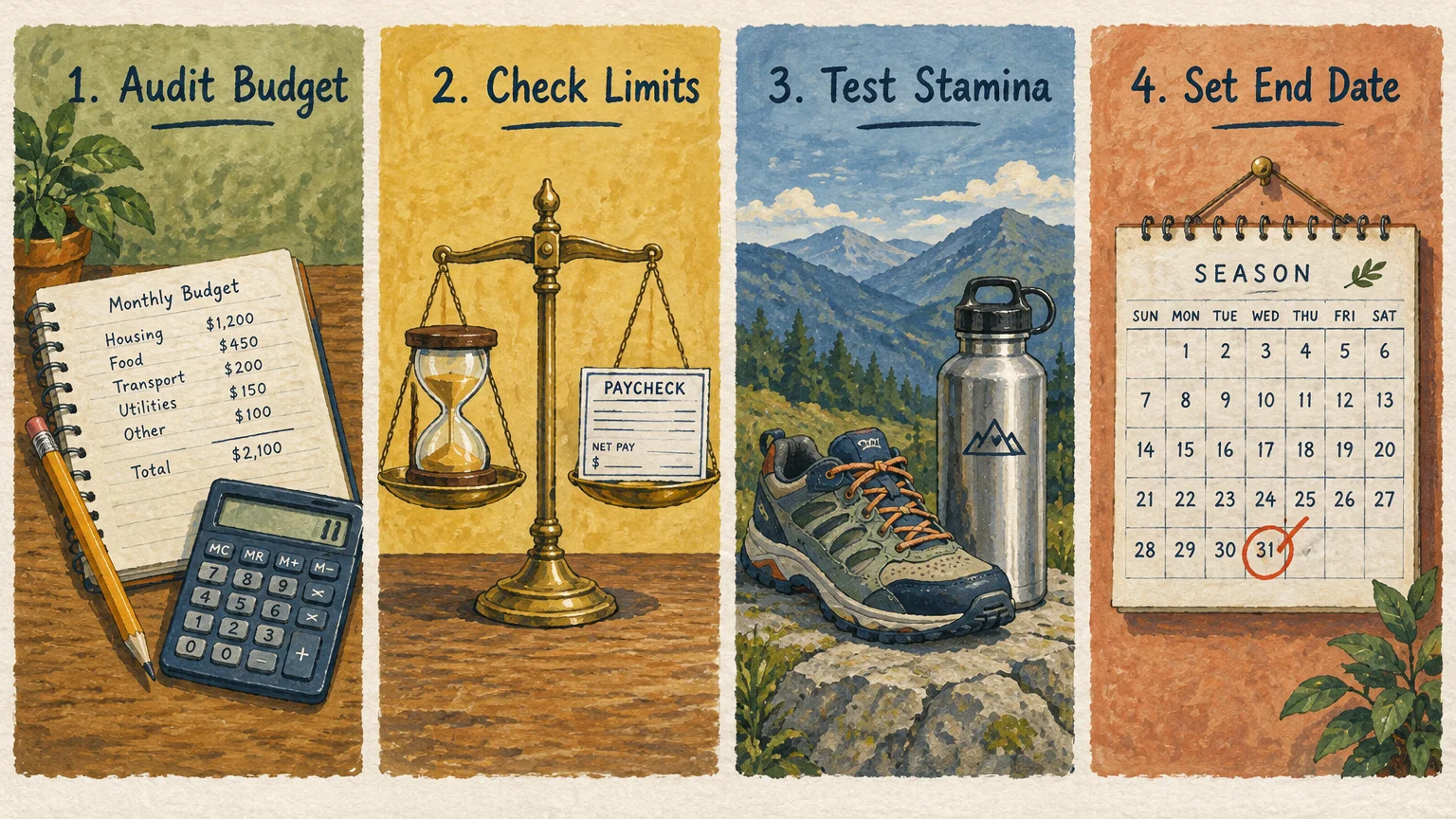
You do not need to overhaul your entire retirement to test whether seasonal work fits your life. Start with a quick 15-minute money check before browsing a single job listing.
Write down your current gross income, check whether you are under full retirement age, and locate your exact Social Security, ACA, or IRMAA income limits. Knowing your personal ceiling turns guesswork into a clear green light.
Next, list three physical non-negotiables and two social goals for your ideal role. Maybe you want seated or light-walking duties, shifts under five hours, and coworkers who love chatting with customers.
Apply early—September or October for winter holiday roles, and late winter for spring parks, golf courses, and summer tourism. Early applicants get first pick of daytime schedules and lower-stress stations.
For resources on retirement living, travel, and finance, visit AARP. Official information on Social Security is available at SSA.gov. For travel advisories, consult the U.S. Department of State.
Disclaimer: This article provides lifestyle suggestions for informational purposes. Financial, legal, or travel decisions should be made in consultation with qualified professionals.
Frequently Asked Questions
Will a seasonal job reduce my Social Security if I am already 67 or older?
No, once you reach full retirement age—67 for anyone born January 2, 1960 or later—the Social Security earnings limit disappears entirely. You can earn any seasonal wage without monthly benefit withholdings, though payroll taxes and income tax rules on benefits still apply.
How can I protect my ACA Marketplace subsidy while working a part-time holiday job?
Track your modified adjusted gross income all year so you stay strictly under the 400% federal poverty level cliff—$62,600 single or $84,600 for a couple in 2026, and $63,840 single or $86,560 couple in 2027. Stopping shifts before crossing that dollar line protects thousands in tax credits.
What if I feel anxious about working alongside much younger seasonal coworkers?
Lean into your natural strengths—calm communication, patience with stressed shoppers, and steady reliability—which younger teammates and busy managers genuinely appreciate. Starting with just two or three short shifts per week eases social nerves while letting relationships build naturally.
What seasonal jobs work best if I have arthritis or mild mobility limits?
Look for seated or low-impact seasonal roles such as box office ticketing, museum docent work, remote customer support, tax preparation assistance, or gift wrapping stations. Always ask about stools, anti-fatigue mats, and lifting limits during your interview before accepting.