

Taking smart financial steps before the calendar turns can shield your retirement nest egg from unnecessary taxes. You can protect your wealth and fund your favorite lifestyle activities by securing key deductions before December 31, 2026.
Strategic moves give you the financial freedom to travel, invest in family milestones, and embrace creative personal passions. Taking control of your accounts today ensures your retirement remains vibrant, adventurous, and completely stress-free.
Recent legislative updates offer generous perks, but seizing these opportunities requires proactive planning before time runs out. Knowing how to navigate these rules will help you keep more money for what matters most.
Lifestyle Idea #1: Optimize Distributions and Charitable Giving
Connecting Purpose with Smart Distributions
Retirement offers you the freedom to align your daily values with meaningful causes. Thoughtful philanthropy enriches your social life while simultaneously helping you reduce taxes in retirement.
When you support local charities, you create lasting bonds in your community. You also gain immense satisfaction from seeing your resources make an immediate local impact.
Navigating Required Minimum Distributions
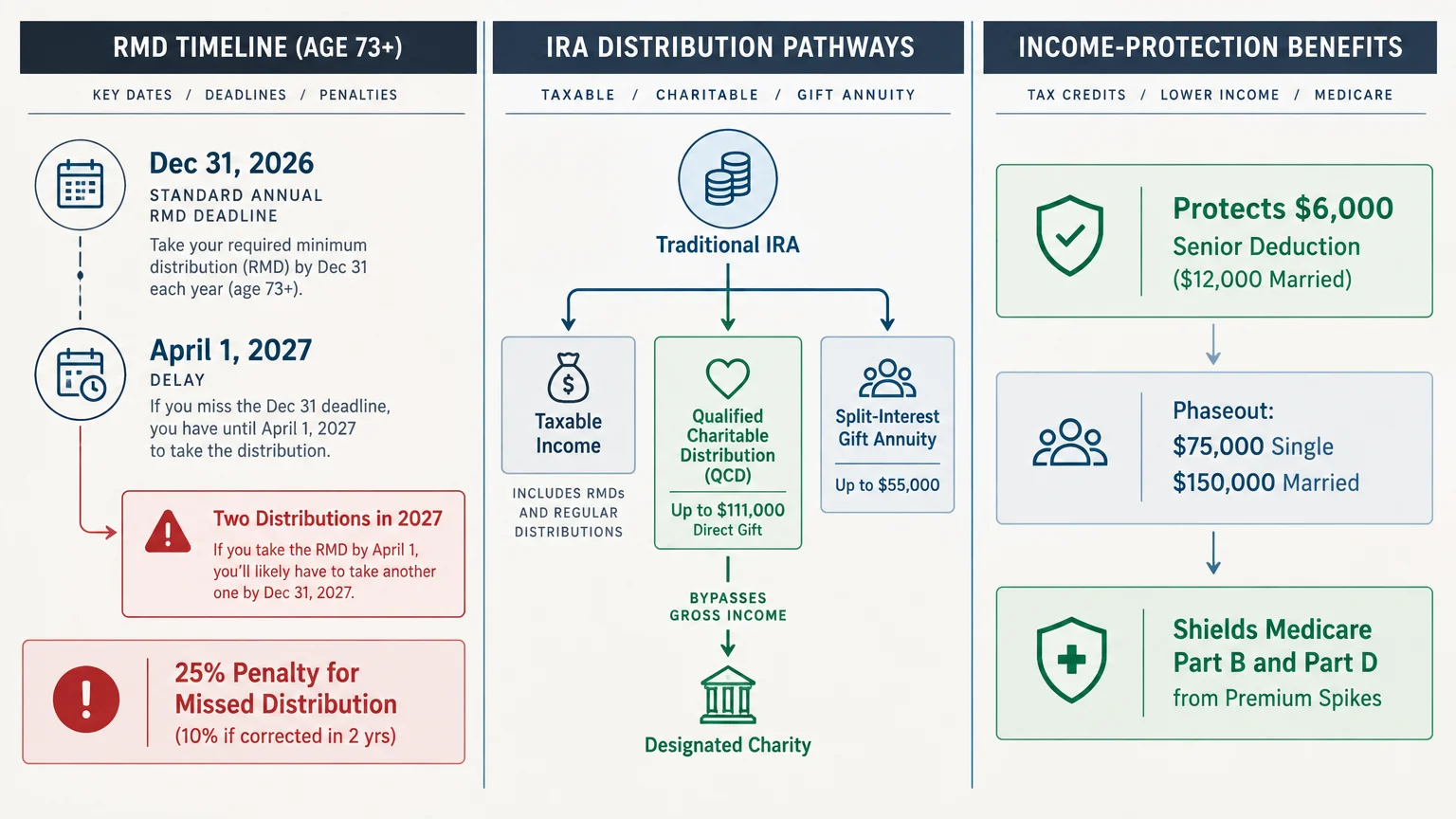
Federal rules require retirees aged 73 and older to take annual withdrawals from traditional retirement accounts. You must complete your annual distribution before the critical 2026 tax deadlines arrive on December 31.
If you celebrated your 73rd birthday during 2026, you can wait until April 1, 2027, for your first withdrawal. However, delaying means you must take two full distributions in 2027.
Taking two payouts in a single year can easily push your income into a higher bracket. For most retirees, taking the initial distribution before year end prevents unnecessary tax friction.
Overlooking your required withdrawal brings a harsh 25% penalty on the amount you failed to distribute. Correcting the mistake within two years reduces that penalty to 10%.
Unlocking the Power of Qualified Charitable Distributions
If you are age 70½ or older, you can utilize Qualified Charitable Distributions to support causes you love. This strategy allows you to donate up to $111,000 per person directly from your IRA.
Your charitable transfer counts directly toward satisfying your mandatory distribution for the year. Because the money bypasses your bank account, it never appears in your taxable income.
Excluding these funds keeps your adjusted gross income down, which brings multiple lifestyle and financial benefits. Lower reported income shields you from unexpected spikes in Medicare Part B and Part D premiums.
A lower income also safeguards your eligibility for the new enhanced senior deduction. Under current rules, individuals aged 65 and older can claim up to an extra $6,000 deduction.
A qualifying married couple can deduct up to $12,000 together on Schedule 1-A. This deduction begins phasing out at a 6% rate once modified adjusted gross income exceeds $75,000 for singles.
For married couples filing jointly, that phaseout threshold begins at $150,000. Using charitable transfers keeps your income safely below these caps so you retain every dollar of tax relief.
Exploring Split-Interest Gifts and Annual Deductions
You can also use a one-time lifetime transfer to fund a charitable gift annuity. For 2026, federal guidelines permit you to direct up to $55,000 toward these split-interest arrangements.
This approach supports a worthy organization while securing a predictable lifetime income stream for your golden years. It delivers both personal fulfillment and financial predictability as you plan your future travels.
Even if you do not use an IRA, everyday donations offer valuable year end tax moves. Taxpayers claiming the standard deduction can deduct cash gifts up to $1,000 for single filers.
Married couples filing jointly who take the standard deduction can deduct up to $2,000 in cash donations. This provision allows you to lower your tax liability without needing to itemize deductions.
If you prefer to itemize, remember that a 0.5% adjusted gross income floor applies to charitable contributions. Only the portion of your donations that exceeds this floor is eligible for a deduction.
Making Giving a Vibrant Social Experience
Philanthropy can become one of the most rewarding social outlets in your retirement schedule. You might invite close friends to join you for an annual charity gala or museum fundraiser.
Organizing a small holiday donation drive with your neighborhood club builds wonderful memories and deepens friendships. Giving together creates shared purpose and energizes your entire social calendar.
These active tax tips before december 31 help you strengthen community connections while keeping your finances pristine. You protect your hard-earned assets while making a tangible difference in the lives of others.
Engaging with local non-profit boards also offers retirees an intellectually stimulating hobby. You can lend your lifelong professional expertise to help guide meaningful youth or environmental initiatives.
Volunteering alongside passionate peers brings a fresh sense of camaraderie and shared achievement. You expand your social network while witnessing firsthand how your financial gifts transform lives.
Consult your IRA custodian well before late December to ensure all paperwork processes smoothly. Charitable transfers often take several weeks during the busy holiday season.
Taking prompt action guarantees that your distribution clears properly before the clock strikes midnight. You will enter the new year with total peace of mind and pride in your contributions.
Lifestyle Idea #2: Master Strategic Roth Conversions and Bracket Management
Seizing Predictable Tax Rates for Future Freedom
Retirement gives you the time to embark on exciting cross-country road trips and international journeys. Having tax-free money available in a Roth IRA makes spontaneous travel effortless and stress-free.
The One Big Beautiful Bill Act permanently extended lower individual federal income tax brackets. With rates steady at 10%, 12%, 22%, and 24%, you can plan future withdrawals with immense confidence.
You no longer have to worry about tax brackets abruptly resetting to higher rates next year. This permanent structure allows you to execute precise retiree tax planning without unexpected surprises.
Executing a Year-End Roth Conversion
Converting traditional retirement funds into a Roth account is one of the most effective year end tax moves. You must complete your conversion transaction before December 31, 2026, for it to count this year.
When you convert funds, you pay taxes on the converted amount at today’s rates. In exchange, those dollars grow completely tax-free and will never face mandatory distributions in your later years.
Many proactive retirees use bracket topping to strategically convert funds up to the ceiling of their current bracket. Filling up the 12% or 22% bracket prevents large future tax hits when distributions occur.
For example, married couples filing jointly can take full advantage of generous bracket space before jumping to higher tiers. This gradual conversion method keeps your overall lifetime tax burden remarkably low.
Balancing Conversions with Senior Deductions
When planning your conversion amount, you must carefully monitor your total income to protect valuable senior deductions. For the 2026 tax year, the base standard deduction is $16,100 for single filers.
Married couples filing jointly receive a base standard deduction of $32,200, while heads of household receive $24,150. In addition, taxpayers aged 65 and older qualify for extra standard deductions.
Single seniors can claim an extra $2,050 standard deduction, while married filers receive $1,650 per qualifying spouse. Furthermore, the enhanced senior deduction offers up to $6,000 per person on Schedule 1-A.
A married couple over age 65 can claim up to a combined $12,000 through this enhanced provision. However, this deduction phases out at a 6% rate above certain income caps.
Single filers see this deduction decrease once modified adjusted gross income surpasses $75,000. For joint filers, the phaseout begins once your income crosses $150,000.
Calibrate your Roth conversion so your income remains below these thresholds whenever possible. Preserving the full $6,000 or $12,000 deduction saves you significant cash that you can spend on hobbies.
Maximizing Savings for Working Seniors
Many older adults choose to work part-time or pursue rewarding consulting gigs during their retirement years. Continuing to work keeps your mind sharp, expands your social circle, and provides extra cash.
If you have workplace retirement plans like a 401(k) or 403(b), you can contribute up to $24,500 in 2026. Workers aged 50 and older can also add a standard catch-up contribution of $8,000.
Under SECURE 2.0 guidelines, workers aged 60 to 63 can utilize a super catch-up contribution. This special provision allows you to save up to $11,250 on top of the base limit.
Be aware of a crucial rule change regarding catch-up contributions that takes effect in 2026. If you earned more than $150,000 in FICA wages during 2025, your catch-up contributions must go into a Roth account.
This requirement directs your catch-up savings into after-tax accounts, providing substantial tax-free income for your future adventures. Workplace plan contributions must be completed through payroll deductions before December 31.
Boosting Individual Retirement Accounts
You can also bolster your nest egg through Traditional or Roth IRAs outside of your employer plan. The annual contribution limit for 2026 is $7,500 for eligible individuals.
Savers aged 50 and older can add an indexed catch-up contribution of $1,100, reaching an $8,600 total. Unlike workplace plans, you have until the April 2027 tax filing deadline to make this contribution.
Funding these accounts gives you total autonomy over your investment choices and lifestyle goals. You build a strong financial cushion that supports your dream retirement adventures and exciting social gatherings.
Tax-free Roth assets give you the confidence to say yes to impromptu vacation invitations from dear friends. You can withdraw funds without triggering extra taxes or increasing your reported annual income.
Having dedicated tax-free savings also helps you cover unexpected medical costs or home remodeling projects with ease. You safeguard your peace of mind while maintaining your preferred comfortable lifestyle.
Start reviewing your year-to-date earnings now to calculate your remaining bracket space before the holidays arrive. Taking action early prevents rushed calculations and ensures your conversion stays within your target bracket.
A well-timed conversion today creates enduring financial serenity for decades of active retirement living. You protect your wealth, reduce your future tax burden, and enjoy complete control over your assets.
Lifestyle Idea #3: Rebalance Portfolios Through Tax-Loss Harvesting and Family Gifting
Harvesting Losses to Offset Gains and Income
Rebalancing your investment portfolio keeps your asset allocation aligned with your retirement risk tolerance and personal goals. As market conditions shift, year end tax moves offer a prime chance to clean up taxable accounts.
Through tax-loss harvesting, you sell underperforming investments at a loss to balance out realized capital gains. Any trades designed to offset gains must be executed before the market closes on December 31, 2026.
If your capital losses exceed your capital gains, you can offset up to $3,000 of ordinary income. Married couples filing separately can each offset up to $1,500 of ordinary income.
Any remaining net capital losses carry forward into future tax years to offset upcoming profits. This tool turns market dips into practical tax savings that preserve your retirement wealth.
Capitalizing on the Zero Percent Capital Gains Rate
Many retirees overlook the incredibly advantageous 0% federal tax bracket for long-term capital gains. If your taxable income falls below specific limits, you can sell appreciated assets without owing any federal capital gains tax.
For the 2026 tax year, the 0% long-term capital gains rate applies to taxable income up to $49,450 for singles. Married couples filing jointly can enjoy this 0% rate on taxable income up to $98,900.
Strategically harvesting gains within this window allows you to step up the cost basis of your investments tax-free. You lock in profits and reset your portfolio while keeping your tax liability at zero.
The money saved can fund your favorite bucket list experiences, like a river cruise or a winter cabin retreat. You enjoy your wealth today rather than leaving it idle.
Enriching Family Bonds Through Annual Gifting
Sharing your wealth with children and grandchildren is one of the most joyful aspects of senior living. Watching family members thrive brings immense personal fulfillment that far outweighs accumulating numbers on a statement.
The annual gift tax exclusion for 2026 permits you to give up to $19,000 per recipient without filing a gift tax return. Married couples can combine their allowances to gift up to $38,000 per recipient.
You must complete all gift transfers before midnight on December 31, 2026, for the exclusion to apply. Unused annual gift exclusions do not roll over into the following calendar year.
Under the One Big Beautiful Bill Act, the federal lifetime estate and gift tax exemption stands at $15 million per individual. A married couple can shield up to $30 million from federal estate taxes.
These elevated lifetime limits give you total freedom to support your loved ones without federal tax penalties. You can contribute toward a grandchild’s college fund or assist your children with a home down payment.
You might also use annual gifts to sponsor a multi-generational family vacation at a scenic resort. Gathering your entire family creates cherished memories and strengthens emotional ties that last for generations.
Maximizing Deductions with Itemizing Strategies
Recent legislation significantly raised the State and Local Tax deduction cap to $40,400 for the 2026 tax year. This notable increase makes itemizing deductions attractive again for many homeowners in higher-tax regions.
If you pay substantial property taxes, paying your property tax bill before December 31 may boost your deductions. Pairing property taxes with significant medical expenses can push your total deductions well above the standard deduction threshold.
Retirees can deduct qualifying medical expenses that exceed 7.5% of their adjusted gross income. Bunching planned dental work, new hearing aids, or vision procedures into a single calendar year maximizes this deduction.
Taking proactive care of your physical health while simultaneously reducing your tax burden is a genuine win-win. You feel healthier, remain more active, and keep more money in your personal account.
Always coordinate your itemizing strategy with your overall retiree tax planning before the year comes to a close. A balanced strategy ensures every financial move enhances your personal freedom and lifestyle comfort.
Financial generosity often opens doors for meaningful family conversations about values, heritage, and future goals. Talking openly about wealth helps younger generations develop prudent money management habits early in life.
You can even establish a small family tradition of discussing charitable priorities together over holiday dinners. Inviting your grandchildren to choose causes to support fosters empathy and shared family pride.
Review your brokerage accounts with an advisor to identify any lingering unrealized losses before December 31. Taking prompt action ensures you capture these write-offs before the annual window shuts.
Smart tax moves provide the resources you need to live retirement on your own terms. You create lasting family harmony while keeping your investment portfolio operating at peak financial efficiency.

Putting It into Practice: Small Steps for Big Changes
Creating Your Year-End Action Checklist
Transforming complex tax concepts into a manageable checklist removes all anxiety from retiree tax planning. Start by gathering your recent account statements and reviewing your total year-to-date income.
Identify whether you have fulfilled your mandatory distributions for the year or if you want to execute charitable transfers. Reviewing your withdrawals early prevents rushed decisions during the hectic holiday season.
Next, evaluate your tax bracket space to determine if a partial Roth conversion makes sense for your household. Keep the $75,000 and $150,000 phaseout thresholds in mind to preserve your enhanced senior deduction.
Finally, examine your taxable brokerage accounts to spot loss-harvesting opportunities and finalize any intended family gifts. Completing transfers before December 31 ensures you meet all official 2026 tax deadlines.
Turning Financial Maintenance into an Enjoyable Ritual
Reviewing your finances does not need to feel like a tedious chore or a cold business exercise. Pair your planning session with an enjoyable lifestyle outing to make the task pleasant and rewarding.
Schedule an afternoon review at your favorite cafe accompanied by a warm pastry and artisanal coffee. You can also turn financial checkups into a relaxed date night with your spouse at a quiet bistro.
Celebrate each completed task by planning your next vacation or booking tickets to a local theater production. Rewarding yourself reinforces positive habits and connects smart money management directly to life satisfaction.
Collaborating with Trusted Advisors and Community Resources
Navigating modern tax laws is easiest when you partner with certified financial planners and tax professionals. An experienced advisor can calculate exact bracket thresholds and tailor strategies to your unique family situation.
For resources on retirement living, travel, and finance, visit AARP. Official information on Social Security is available at SSA.gov. For travel advisories, consult the U.S. Department of State.
Staying informed through reputable organizations empowers you to make confident choices throughout your golden years. You protect your lifestyle, stay ahead of regulatory changes, and make the most of every retirement milestone.
Frequently Asked Questions
How can I reduce taxes in retirement if I live on a modest, fixed budget?
Even on a modest income, you can benefit significantly from careful year-end planning. Taking the enhanced senior deduction of up to $6,000 per individual provides substantial relief on Schedule 1-A.
Additionally, non-itemizers can deduct cash donations up to $1,000 for singles or $2,000 for married couples. These straightforward deductions lower your taxable income without requiring complex investment accounts or major expenses.
What should I do if managing tax deadlines triggers anxiety or feels overwhelming?
Financial anxiety is very common among retirees, especially with evolving tax rules and strict annual deadlines. Breaking large tasks into bite-sized, ten-minute steps helps you regain a sense of clarity and control.
Consider inviting a supportive friend or family member to sit with you while you organize your paperwork. Sharing the process over a cup of herbal tea turns an intimidating chore into a calming activity.
You can also consult a fee-only fiduciary advisor who specializes in senior finances to handle technical calculations. Delegating complex moves gives you peace of mind and frees your schedule for enjoyable hobbies.
Can I execute a Roth conversion and contribute to an IRA during the same tax year?
Yes, you can execute a Roth conversion and make an annual IRA contribution in the same year. However, you must have qualifying earned income to make regular IRA contributions up to the $8,600 maximum.
Roth conversions, by contrast, do not require earned income and can be funded using existing traditional retirement assets. Remember that conversions must finish by December 31, while IRA contributions extend until April 2027.
How do these year-end tax deadlines affect seasonal living or travel plans?
If you split your year between different regions or travel extensively during winter, plan early. Financial custodians often experience backlogs in late December, which can delay urgent distribution requests or gifting paperwork.
Process all IRA distributions, charitable gifts, and portfolio trades before leaving for extended holiday travels. Finalizing transactions before mid-December ensures you meet every deadline while relaxing comfortably in your winter getaway.
Disclaimer: This article provides lifestyle suggestions for informational purposes. Financial, legal, or travel decisions should be made in consultation with qualified professionals.