

You can overturn an improper denial and secure the healthcare coverage you earned through years of hard work. Mastering fundamental Medicare appeals rules gives you the power to challenge rejected claims with total confidence.
A Medicare denial is not a permanent barrier; it is simply an initial determination in a structured review process. You possess strong Medicare rights designed to protect both your health and your retirement savings.
Understanding these practical steps helps you navigate deadlines and assert your coverage effectively. Here are nine essential rules every retiree should know to advocate for their medical care.
Tip #1: Master the Five Levels of Original Medicare Appeals
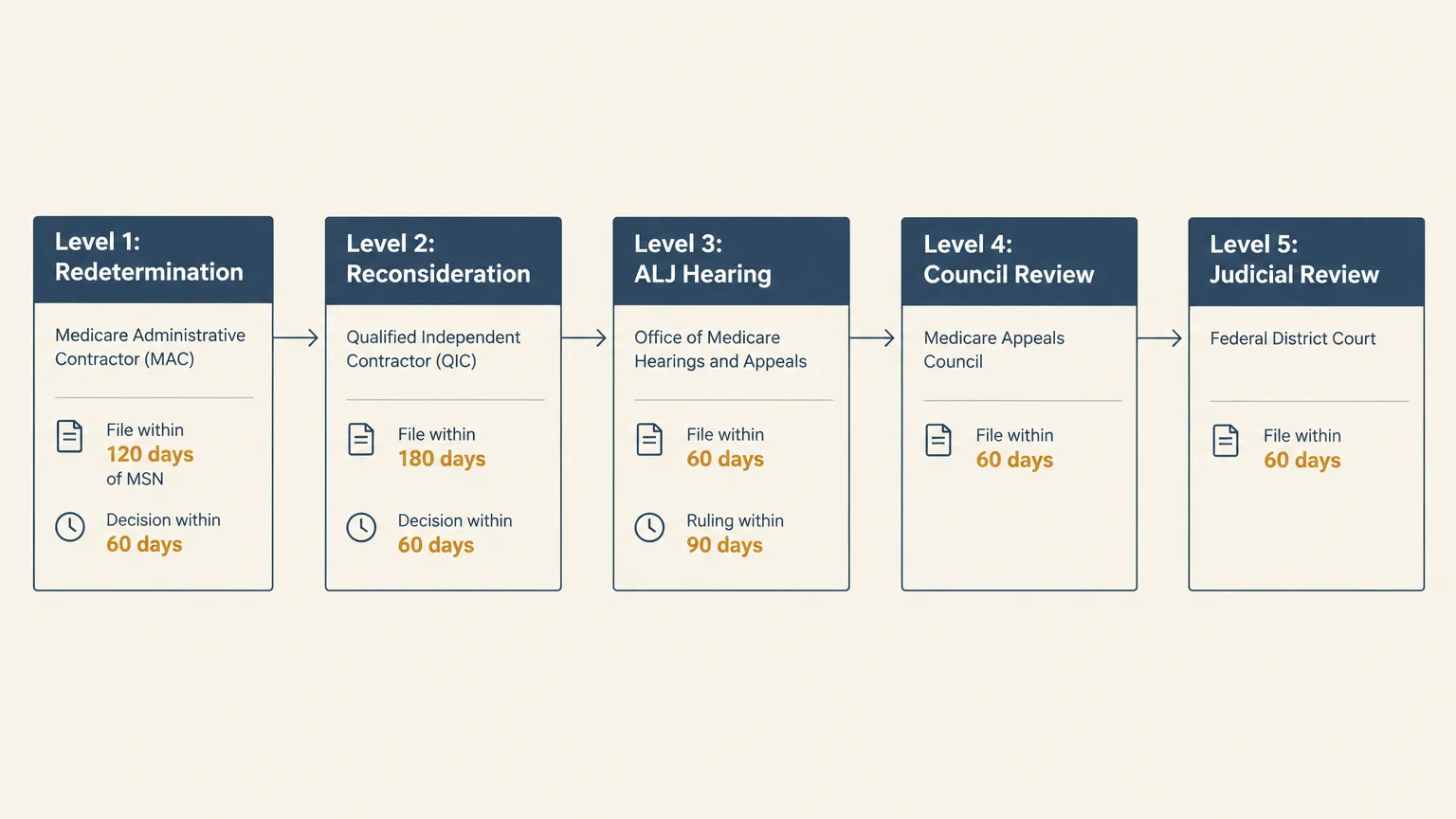
Original Medicare Parts A and B provide a structured five-level appeals process to resolve billing disputes. Understanding each successive tier ensures you never miss a procedural step or forfeit your claim.
Your journey begins at Level 1 with a redetermination request filed through your Medicare Administrative Contractor. You must submit this written appeal within 120 days of receiving your quarterly Medicare Summary Notice.
Federal regulations officially presume you receive any mailed Medicare document five calendar days after the printed date. Your contractor then has 60 days to evaluate your documentation and issue an official decision.
If your contractor upholds the denial, you can advance to a Level 2 reconsideration appeal. A Qualified Independent Contractor evaluates this second stage to provide an entirely objective, independent review.
You must file your Level 2 request within 180 days of receiving the Level 1 denial letter. The independent contractor evaluates your clinical records and renders a binding determination within 60 days.
Unfavorable Level 2 rulings can be appealed to Level 3 before an Administrative Law Judge. You must submit this hearing request within 60 days of receiving your Level 2 reconsideration notice.
Administrative Law Judges work within the Office of Medicare Hearings and Appeals to evaluate disputed claims. These judges typically issue their formal rulings within 90 days of receiving your completed request.
If the judge denies your claim, you can pursue Level 4 review before the Medicare Appeals Council. Beneficiaries must file this written review petition within 60 days of the judge’s formal decision.
The fifth and final level allows you to file a civil lawsuit in federal district court. You must file this judicial action within 60 days of the appeals council’s ruling.
Always send your appeal documents by certified mail with return receipt requested. This simple postal step creates indisputable proof that you met every required filing deadline.

Tip #2: Know Your 65-Day Window for Medicare Advantage Denials
Medicare Advantage plans operate under distinct administrative guidelines that differ from traditional Medicare. Recognizing these private plan requirements protects you from accidental filing mistakes and unexpected coverage denials.
When an Advantage plan denies coverage, you must file a Level 1 plan redetermination. Current federal rules give you 65 calendar days from the date printed on the denial notice to file.
This 65-day timeframe provides a predictable timeline by measuring directly from the printed letter date. Always check the postmark and letter date immediately upon opening correspondence from your insurance carrier.
Missing this critical 65-day cutoff allows your insurer to dismiss the appeal without reviewing medical necessity. However, plans may excuse late filings if you demonstrate good cause, such as a serious illness.
You can submit your initial appeal in writing or contact your plan directly over the telephone. Documenting the date, time, and name of every customer representative strengthens your administrative record.
Always ask your carrier for written confirmation whenever you submit appeal paperwork. Having verifiable confirmation ensures your appeal moves forward through the formal review system without bureaucratic delays.
For standard preservice requests, Medicare Advantage organizations must render a formal decision within 30 days. When an appeal involves payment for care you already received, insurers have 60 days to respond.
This same 65-day appeal deadline also governs prescription drug coverage denials under Medicare Part D. Acting swiftly protects your prescription benefits and prevents costly out-of-pocket medication bills.
Collaborate with your doctor’s office immediately to assemble clinical notes and diagnostic test results. Presenting robust medical evidence during this initial 65-day period significantly improves your chance of approval.
Tip #3: Meet the Dollar Thresholds for Higher-Level Hearings
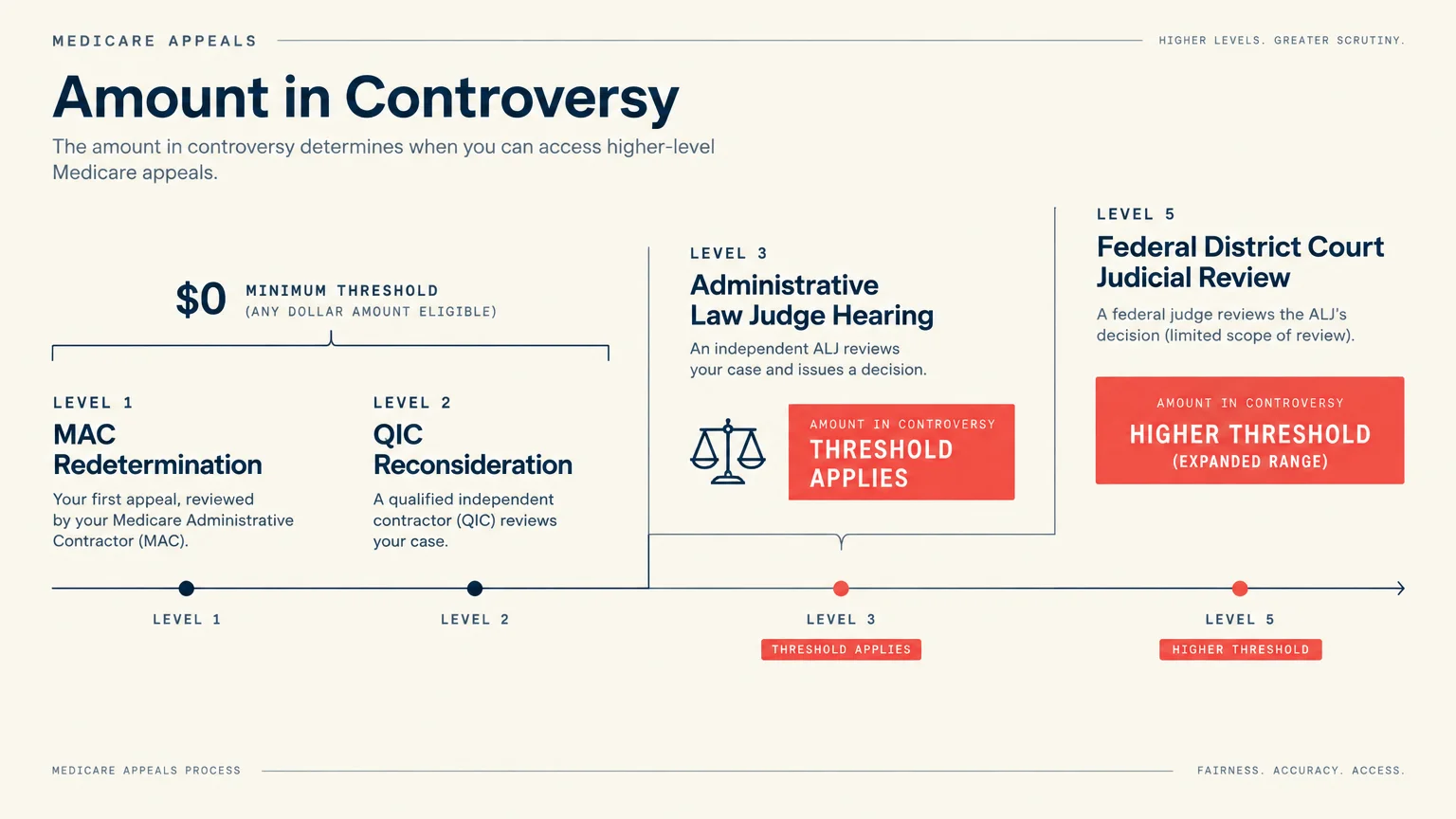
Accessing the upper levels of the Medicare appeals system requires meeting specific financial criteria. Disputed claims must satisfy statutory Amount in Controversy thresholds that adjust annually to reflect economic inflation.
To request a Level 3 Administrative Law Judge hearing in 2026, your claim must total at least $200. This threshold represents an increase from the $190 minimum required during calendar year 2025.
Federal authorities confirmed that the Level 3 hearing threshold will remain at $200 for calendar year 2027. Knowing this financial standard helps you decide whether to escalate your formal appeal.
Reaching Level 5 judicial review in federal district court requires a much higher financial stake. For calendar year 2026, your disputed medical claim must meet an Amount in Controversy of at least $1,960.
CMS announced that this federal district court threshold will increase to $2,000 for calendar year 2027. This higher standard reserves federal court dockets for substantial legal and financial disputes.
Fortunately, you do not have to abandon an appeal if an individual claim falls below these figures. Medicare allows you to aggregate multiple claims that involve similar medical issues or related treatments.
Combining several related service denials helps you reach the required dollar threshold for an administrative hearing. This aggregation rule provides a practical pathway to justice for retirees with recurring medical needs.
In contrast, Level 4 review by the Medicare Appeals Council requires no minimum dollar threshold. You can pursue council review regardless of the disputed claim amount if an administrative judge denies coverage.
Review your billing statements closely to calculate the exact financial amount remaining under dispute. Understanding these figures ensures you choose the most effective legal path for your situation.

Tip #4: Exercise Your Fast-Track Rights During Hospital Observation Stays
Hospitals sometimes classify admitted patients as receiving outpatient observation services rather than formal inpatient admission. This administrative distinction historically created severe financial hardships by preventing Medicare coverage for skilled nursing facility care.
Following landmark court proceedings in Alexander v. Azar, historic federal appeal protections became operational on February 14, 2025. These rules grant Original Medicare beneficiaries the legal right to challenge improper observation reclassifications directly.
When a hospital reclassifies you from an inpatient to an outpatient receiving observation services, staff must deliver Form CMS-10868. This notice, titled the Medicare Change of Status Notice, explains your right to appeal immediately.
You can file an expedited fast appeal while you remain in the hospital setting. Submitting this appeal prompts an outside clinical review to determine whether you qualify for formal inpatient status.
Keep in mind that the retrospective appeal window for historical hospital stays officially closed on January 2, 2026. That 365-day retrospective period allowed patients to challenge observation stays dating all the way back to 2009.
Retrospective appeals for past stays now face automatic denial unless you establish good cause for late filing. Establishing good cause requires showing extraordinary obstacles, such as severe physical incapacity or misleading hospital guidance.
Retirees should focus their energy on asserting fast-track appeal rights during active hospitalizations. Challenging your status while admitted protects your right to subsequent skilled nursing coverage under Medicare Part A.
Outpatient observation status also shifts billing to Medicare Part B, which can generate unexpected coinsurance costs. Filing an immediate appeal helps safeguard your retirement savings from these surprising out-of-pocket medical bills.
Always ask hospital staff to clarify your formal admission status within hours of arriving in a room. Staying alert to your status ensures you can exercise your appeal rights at the earliest opportunity.

Tip #5: Request Expedited 72-Hour Decisions for Urgent Health Needs
Standard Medicare reviews take weeks or months, but acute health conditions demand immediate medical intervention. When delays threaten your health, you do not have to wait through standard processing timelines.
You have the legal right to request an expedited appeal whenever standard waiting periods jeopardize your life. Fast reviews also apply if delays threaten your physical health or your ability to regain maximum function.
Under federal regulations, Medicare Advantage and Part D plans must decide expedited appeals within 72 hours. This rapid turnaround ensures you receive urgent therapies, surgical treatments, or diagnostic procedures without delay.
When you face an urgent prescription drug determination under Medicare Part D, plans must decide within 24 hours. This vital safeguard protects retirees from dangerous gaps in lifesaving maintenance medications.
You can submit an expedited request directly, or your treating physician can file the petition for you. When your doctor certifies that a standard review harms your health, your plan must grant expedited processing.
If you request an expedited review without medical certification, your insurer decides whether your condition qualifies. Plans must evaluate your clinical situation carefully before refusing to grant fast-track processing.
If an insurer denies your request for an expedited review, they must notify you immediately. The plan must then transfer your claim into the standard review process and render an answer within normal timeframes.
Clearly state that you are requesting an expedited 72-hour appeal when you contact your insurance plan. Using this exact terminology ensures intake staff route your paperwork to the urgent review team immediately.
Securing urgent approval protects your physical well-being and restores your peace of mind. Taking swift action transforms a stressful medical emergency into a manageable, well-supported recovery.
Tip #6: Distinguish Between a Formal Appeal and a Grievance
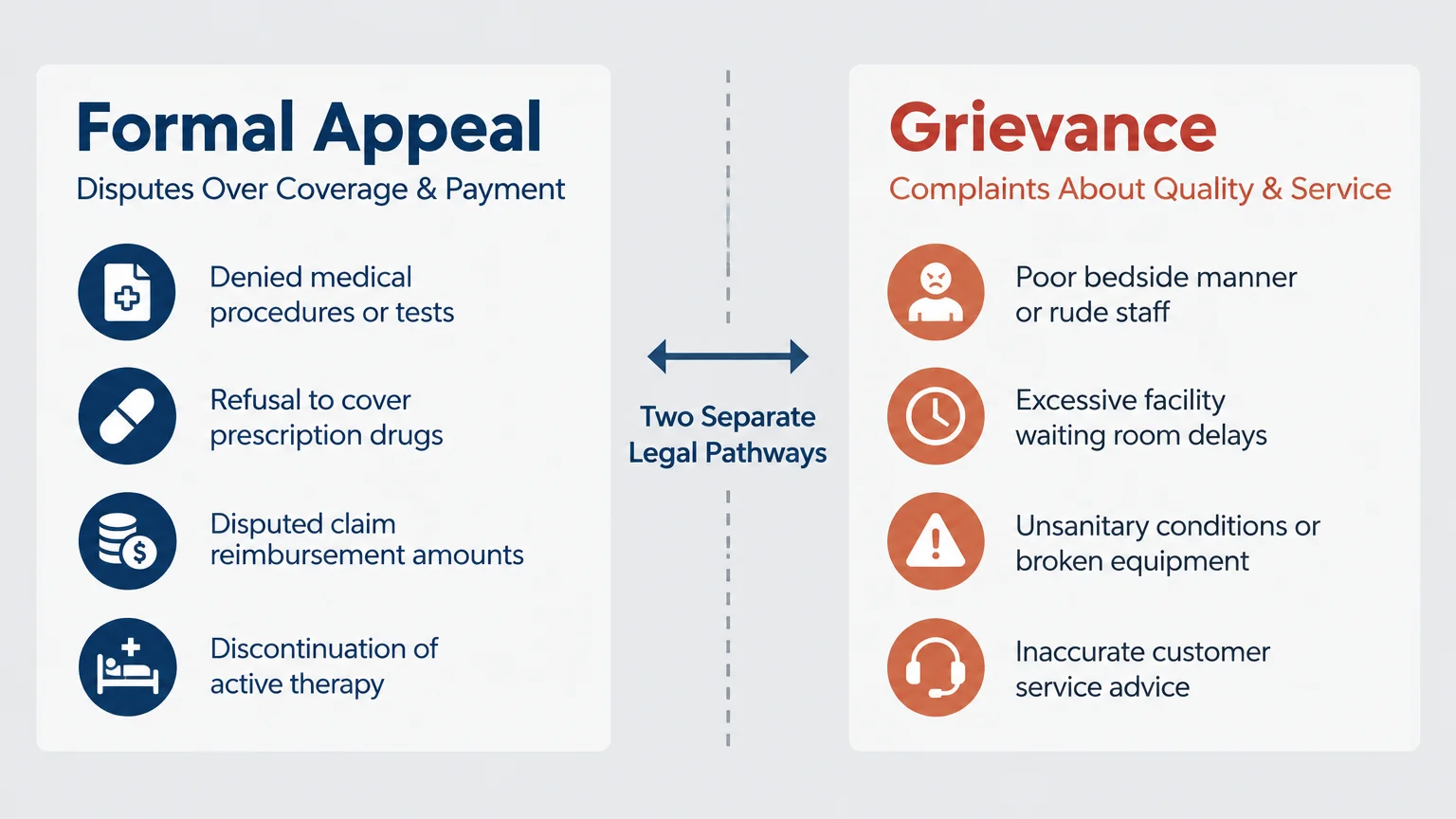
Retirees often confuse appeals with grievances, but Medicare treats these complaints through two distinct administrative pathways. Understanding the proper channel ensures plan administrators handle your concerns promptly and appropriately.
You must file an appeal whenever you dispute a plan’s decision regarding medical coverage or payment. Appeals address denied services, discontinued therapies, refused prescription refills, or rejected prior authorization requests.
In contrast, you should file Medicare grievance submissions when you experience dissatisfaction with your service experience. Grievances cover operational issues, including staff rudeness, poor facility cleanliness, billing confusion, or excessive waiting times.
Under the Medicare complaints process, you must file a grievance within 60 days of the triggering event. Missing this 60-day deadline can forfeit your right to have the plan formally investigate the incident.
You can submit a grievance orally by calling your plan or by sending a detailed written letter. Mailing a written complaint creates an undeniable record that outlines the date, location, and nature of the occurrence.
Medicare Advantage and Part D plans must investigate your grievance and deliver a formal response within 30 days. If your grievance involves an urgent matter, your plan must provide a resolution within 24 hours.
Submitting a complaint never affects your covered healthcare benefits or your relationship with your medical providers. Federal regulations strictly prohibit insurance carriers from retaliating against enrollees who exercise their consumer rights.
Plans must send an official written resolution letter detailing the outcome of their internal investigation. This document explains the corrective actions the organization took to resolve your operational complaint.
Voicing your concerns helps improve the quality of care and customer service for all seniors in your community. Holding healthcare organizations accountable ensures better experiences throughout your retirement years.

Tip #7: Track the Updated Part C Independent Review Entity
If your Medicare Advantage plan upholds its initial denial during Level 1, your appeal is far from finished. The law prevents private insurers from having the final word on your healthcare needs.
Your insurer must automatically forward any adverse Level 1 reconsideration decision to an independent review contractor. You do not need to file a separate request to advance your claim to this second level.
Effective May 1, 2026, C2C Innovative Solutions, Inc. became the official Part C Independent Review Entity. This independent organization replaced MAXIMUS to process Level 2 Medicare Advantage reconsideration appeals across the nation.
C2C Innovative Solutions employs medical specialists and billing analysts who operate entirely independent of your insurance carrier. Their specialized staff reviews your complete file to verify that the initial denial complied with federal Medicare guidelines.
You have the legal right to submit additional evidence directly to C2C Innovative Solutions during Level 2. Providing updated clinical notes and specialist evaluations significantly enhances the strength of your case.
The Independent Review Entity must issue its reconsideration decision within 30 days for standard medical care appeals. For expedited appeals involving urgent medical necessity, the contractor must render a decision within 72 hours.
If C2C Innovative Solutions overturns the initial denial, your Medicare Advantage plan must authorize the care immediately. This independent review mechanism serves as an essential check against improper insurer denials.
Keep a careful record of your case reference number when communicating with the new independent contractor. Tracking your case number allows you to check your claim status quickly by telephone or online.
Staying informed about contractor changes ensures you direct inquiries to the proper organization without confusion. Understanding who evaluates your file helps you navigate Level 2 appeals with complete assurance.
Tip #8: Harness Quality Care Protections Through Your Regional BFCC-QIO
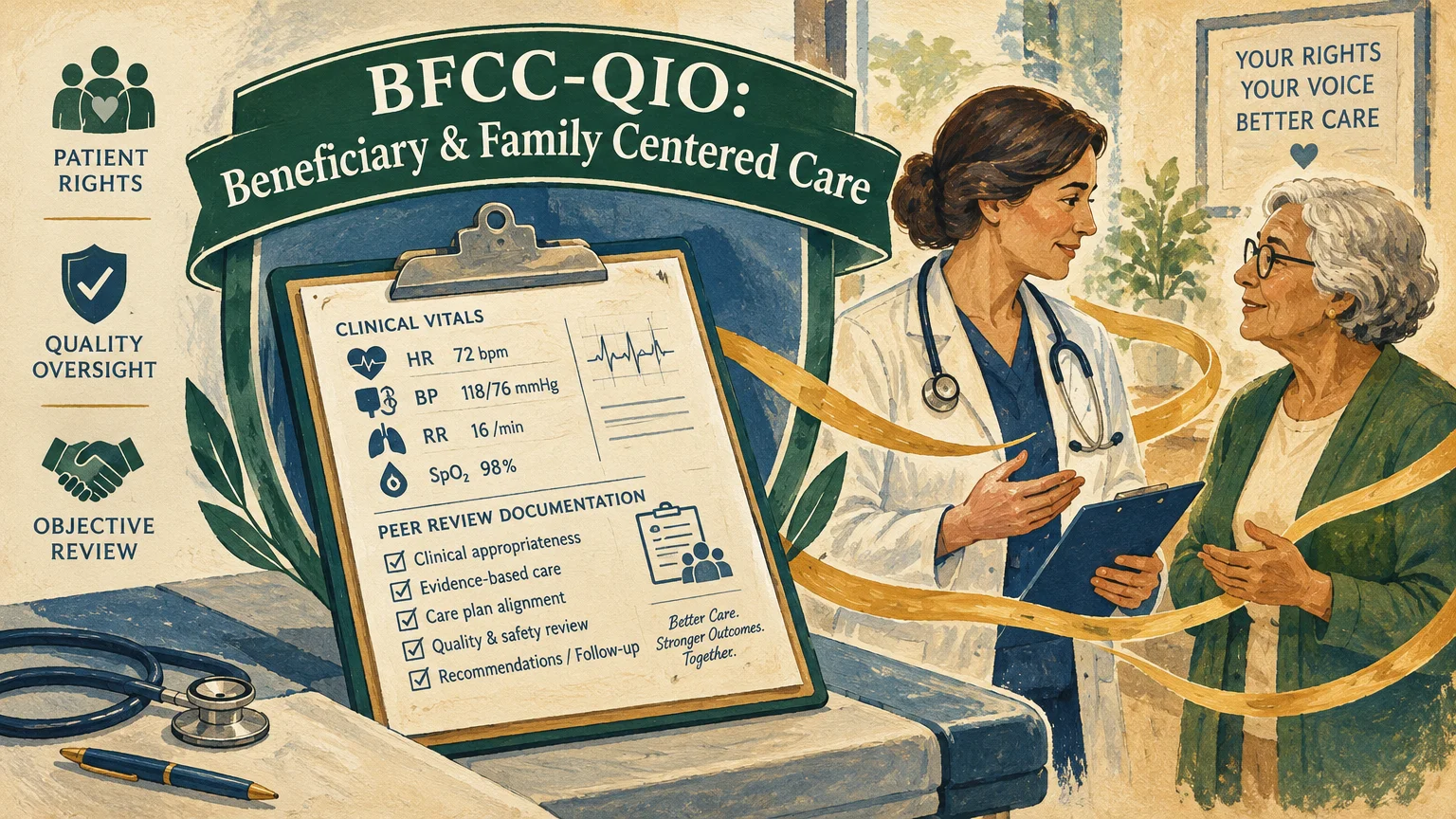
Maintaining high clinical standards is essential for a healthy, happy, and fulfilling retirement. Beneficiary and Family Centered Care Quality Improvement Organizations oversee the quality of healthcare delivered to Medicare beneficiaries nationwide.
Known as BFCC-QIOs, these independent entities protect older adults from premature medical discharge and unsafe clinical care. They work independently from both insurance plans and medical facilities to provide unbiased clinical evaluations.
Two specialized regional contractors administer these quality improvement organizations throughout the country. Acentra Health and Commence Health, formerly known as Livanta, manage cases depending on your specific state of residence.
If a hospital, skilled nursing facility, or home health agency attempts to end care prematurely, contact your BFCC-QIO. Filing an immediate appeal halts your planned discharge while medical experts review your clinical condition.
The facility cannot discharge you or charge you for care while the QIO evaluation remains underway. Board-certified physicians examine your medical charts to determine whether your discharge meets professional safety standards.
Your BFCC-QIO also investigates formal quality of care complaints regarding clinical mistakes, poor nursing, or medication errors. Filing a quality complaint triggers an official peer review of the treating medical staff.
The organization uses these clinical reviews to identify systemic errors and mandate corrective quality improvements at healthcare facilities. This oversight ensures hospitals and clinics uphold patient safety standards for all retirees.
Family members and caregivers can assist with this process by registering as your authorized representative. Having an advocate speak on your behalf ensures your discharge appeal proceeds smoothly during an unexpected illness.
Keep the direct telephone number for Acentra Health or Commence Health in an accessible location at home. Having this resource ready provides peace of mind whenever you or a loved one enters medical care.
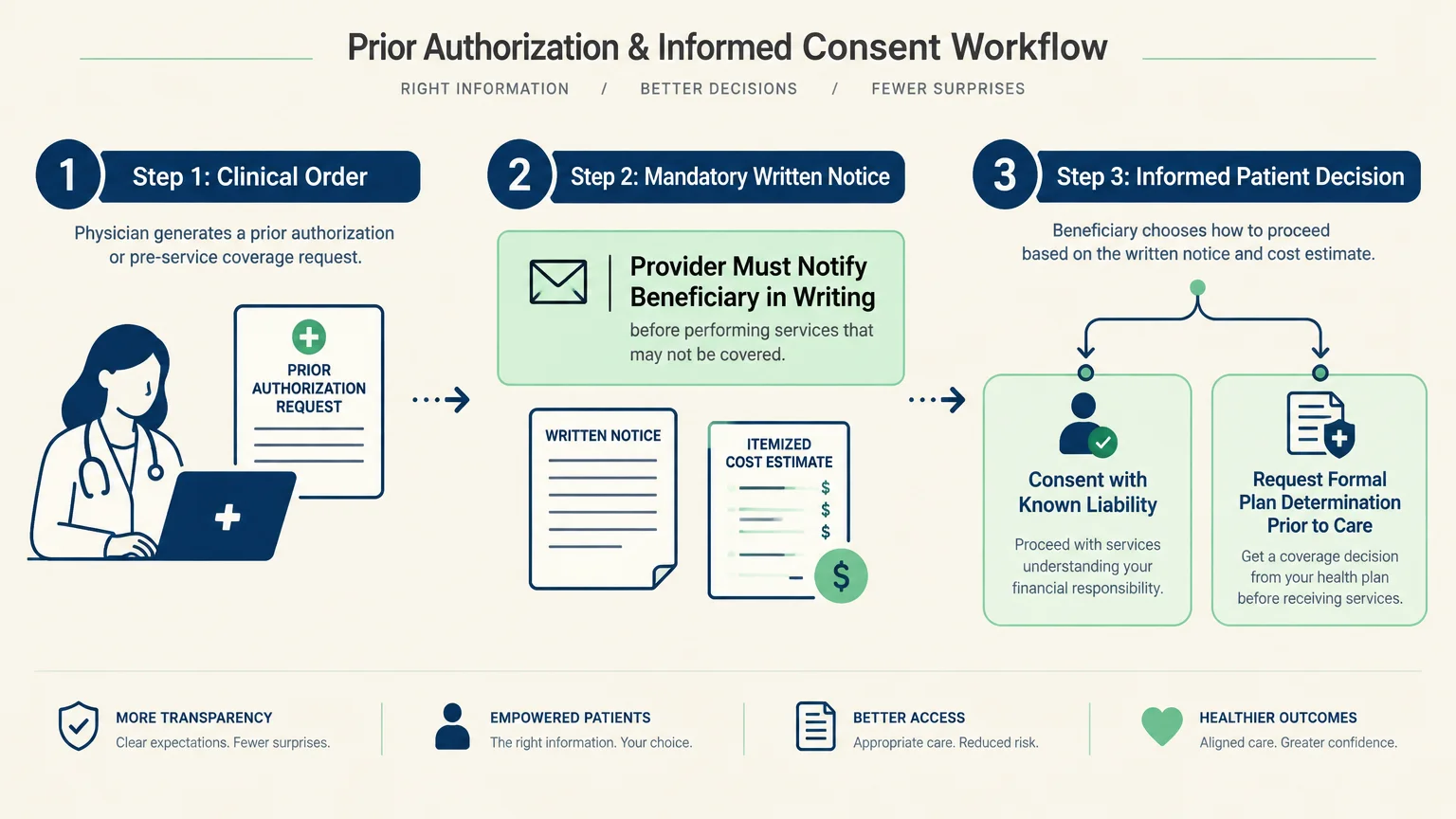
Tip #9: Leverage New Provider Notification Rules for Coverage Requests
Securing prior authorization from private insurers has historically presented major administrative challenges for seniors and their physicians. Fortunately, federal regulatory updates have dramatically expanded transparency and consumer safeguards for Medicare Advantage enrollees.
Under the Contract Year 2026 Medicare Advantage and Part D Final Rule (CMS-4208-F), key consumer protections were codified. CMS clarified that Medicare Advantage appeals rules apply to adverse decisions made before, during, or after treatment.
This comprehensive rule prevents insurers from avoiding appeals oversight by classifying denied care under alternative administrative headings. Every adverse determination must follow established statutory review procedures.
Additionally, updated CMS guidance effective July 6, 2026, established vital communication requirements for private plans. Insurers must now notify both the provider and the enrollee whenever a doctor submits a coverage request.
You will no longer face surprises regarding whether your doctor submitted prior authorization documents for an upcoming therapy. This dual-notification requirement keeps you fully informed alongside your treating medical team.
Receiving prompt notice enables you to collaborate with your physician before an initial denial occurs. You can review your clinical documentation together and gather additional diagnostic records to support your coverage request.
If your plan issues an adverse determination, you receive the exact clinical rationale cited by the insurer. This detailed insight helps you formulate a targeted, persuasive appeal Medicare denial submission.
Work with your specialist to supply comprehensive clinical notes that counter automated denial algorithms under CMS-4208-F. Providing personalized clinical evidence overcomes rigid insurer guidelines and supports medical necessity.
These new notification rules give you the administrative tools needed to defend your healthcare coverage proactively. Staying informed transforms you into an empowered partner in managing your ongoing wellness.

The Takeaway: Living a More Blissful Retirement
Navigating the healthcare system can feel overwhelming, but knowing your rights changes the dynamic entirely. Each regulation exists to ensure you receive the high-quality care you earned over a lifetime.
An initial denial letter is simply an invitation to present your case with clearer clinical evidence. Many retirees successfully overturn adverse rulings by providing detailed physician letters and organized medical records.
Keep your health records organized in labeled files, and document every telephone conversation with insurance representatives. Recording names, dates, and discussion summaries gives your appeal immense credibility.
Track your calendar diligently to meet statutory deadlines, such as the 65-day filing limit for Medicare Advantage plans. Staying ahead of procedural deadlines ensures administrative technicalities never derail your coverage.
Enlist your healthcare providers as active partners throughout every stage of the review process. When doctors and patients collaborate, insurance carriers take notice and reevaluate denied claims far more seriously.
Standing up for your benefits protects your financial security, physical vitality, and overall peace of mind. You have the right to demand fair treatment and excellent medical care throughout your golden years.
Embrace your retirement with optimism, knowing that these nine rules give you complete control over your healthcare journey. When you understand the appeals system, you can protect your health and live with total confidence.
Frequently Asked Questions
What should you do first after receiving an initial Medicare denial notice?
Carefully read the denial notice to identify the exact medical or administrative reason cited for the rejection. Understanding the specific justification helps you gather the appropriate clinical evidence to dispute the finding.
Contact your treating physician immediately to request a detailed letter explaining the medical necessity of the treatment. Your doctor’s clinical notes and expert opinion form the foundation of a successful appeal.
Check the date printed on the letter and calculate your deadline to submit a timely redetermination request. Submitting your appeal well before the cutoff ensures your claim remains active and viable.
Can your healthcare provider file an appeal on your behalf?
Yes, your doctor or medical provider can file an appeal and advocate directly for your care. You must complete an Appointment of Representative form to grant them official legal authorization to represent you.
Under updated regulations effective July 6, 2026, plans must notify both you and your doctor regarding coverage requests. This mandate ensures you remain fully informed throughout every phase of the appeals process.
What is the difference between an appeal and a Medicare grievance?
An appeal specifically challenges an insurer’s decision to deny coverage, authorization, or payment for medical services. You file an appeal when you believe Medicare or your plan should pay for your care.
In contrast, a grievance addresses dissatisfaction regarding customer service, clinic cleanliness, operational delays, or physician communication. You must submit a grievance within 60 days of the incident that triggered your complaint.
Which organization handles quality of care complaints in your state?
Regional Beneficiary and Family Centered Care Quality Improvement Organizations investigate clinical care quality and premature discharge disputes. Two national contractors, Acentra Health and Commence Health, divide these responsibilities across all fifty states.
You can identify your state’s designated organization by calling 1-800-MEDICARE or checking your Medicare handbook. These independent groups review clinical records objectively to protect your consumer rights and medical safety.
For a wide range of resources for older adults, visit AARP and the National Council on Aging (NCOA). Health information is available from the National Institute on Aging.
Disclaimer: This article is for informational and inspirational purposes only. It is not a substitute for professional medical, financial, or psychological advice. Please consult with a qualified expert for guidance tailored to your individual needs.