

Taking control of your end of year financial checklist clears away holiday stress and protects your hard-earned wealth. Wrapping up essential paperwork before the calendar flips guarantees that you enter the new year with clarity and complete peace of mind.
Deadlines for tax benefits, healthcare changes, and retirement rules arrive quickly in December. A proactive approach ensures you never miss lucrative opportunities or face needless IRS penalties.
Completing these essential year-end paperwork tasks takes only a few dedicated afternoons. Let us explore the eight vital paperwork tasks that will secure your finances and brighten your retirement.
Tip #1: Finalize Workplace Retirement Contributions and Catch-Up Elections
Maximize Your Workplace Deferral Limits
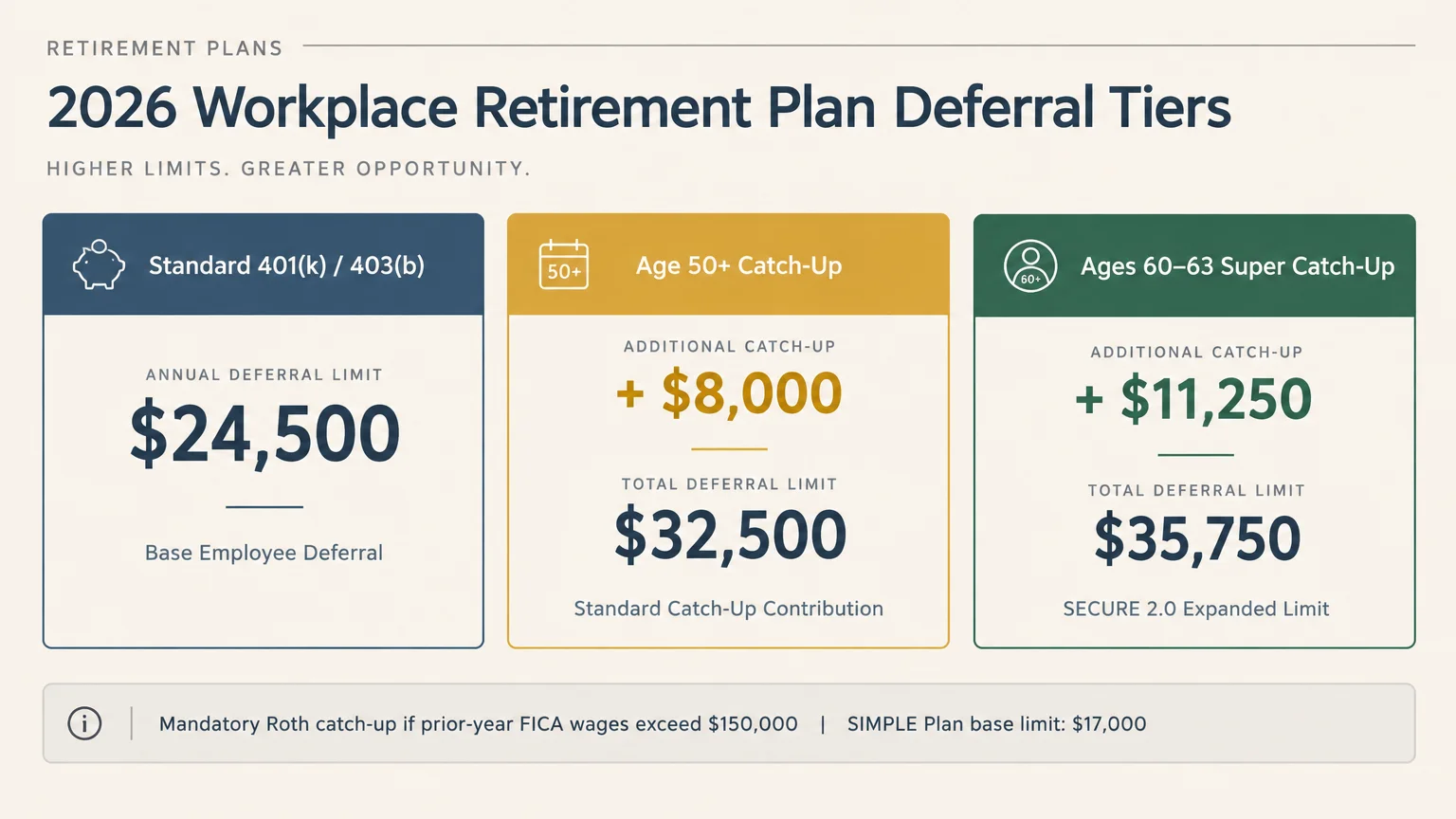
If you remain active in the workforce, your employer retirement plan provides an incredible vehicle for tax-advantaged growth. The standard employee deferral limit for 401(k), 403(b), and 457 plans is $24,500 in 2026.
Workers aged 50 and older can contribute an additional standard catch-up contribution of $8,000. This bonus allows you to shelter up to $32,500 from current-year taxable income.
Workplace plan contributions must be processed through payroll deferrals by December 31, 2026. Review your latest paystub today to confirm that your deductions reach your target before payroll processing ends.
Leverage the Super Catch-Up for Ages 60 Through 63
Under SECURE 2.0 legislation, employees aged 60, 61, 62, or 63 receive an expanded savings opportunity. In 2026, your higher catch-up limit increases to $11,250 instead of the standard catch-up.
This super catch-up enables qualifying savers to defer up to $35,750 into their workplace retirement plan. Contact your human resources team immediately to submit the paperwork required to activate this higher election.
If your employer offers a SIMPLE plan, the base contribution limit is $17,000 for 2026. The age 50 catch-up is $4,000, while the age 60 through 63 super catch-up reaches $5,250.
Comply With the Mandatory Roth Catch-Up Rule
High earners must adapt to a major tax change effective in the 2026 tax year. If your prior-year FICA wages from your current employer exceeded $150,000, your catch-up contributions must be Roth.
This requirement means your catch-up contributions are funded with after-tax dollars rather than pre-tax deferrals. While you pay tax now, these funds will grow and withdraw completely tax-free throughout your retirement.
Submit your paperwork to designate catch-up dollars correctly so payroll does not reject your final elections. Verifying this step now prevents frustrating tax corrections during the spring filing season.
Understand IRA Deadlines Versus Workplace Plans
While workplace deferrals close strictly on December 31, individual retirement accounts offer additional breathing room. For 2026, the traditional and Roth IRA contribution limit is $7,500.
Savers aged 50 and older can contribute an extra $1,100 catch-up contribution, bringing the total to $8,600. You have until the April 2027 tax deadline to fund your IRA for the 2026 tax year.

Tip #2: Complete Your Required Minimum Distributions and QCDs
Understand the Age 73 Mandate and Annual Deadlines
The IRS requires retirees aged 73 and older to take annual Required Minimum Distributions from traditional accounts. This requirement applies directly to individuals born between 1951 and 1959.
You must calculate and withdraw your 2026 RMD by December 31, 2026. Custodians face heavy transaction volumes late in the year, so submit your distribution paperwork well before the final week.
Avoid Hefty RMD Non-Compliance Penalties
Failing to withdraw your full RMD triggers significant penalties from the IRS. Under SECURE 2.0, the excise tax penalty equals 25 percent of the amount you failed to withdraw.
If you discover an accidental shortfall, act swiftly to rectify the mistake. The IRS reduces the penalty to 10 percent if you correct the error within two years using Form 5329.
Automating your distributions with your plan custodian removes the risk of forgetting this crucial task. Request that your financial institution set up automatic annual distributions for peace of mind.
Avoid the First-Time RMD Tax Trap
If you reached age 73 during 2026, special rules permit you to delay your first withdrawal until April 1, 2027. However, utilizing this extension can trigger an unexpected financial burden.
Delaying your initial distribution forces you to take two full RMDs in 2027. This double withdrawal can artificially inflate your taxable income, potentially pushing you into higher tax brackets and raising Medicare surcharges.
Most retirees achieve greater financial balance by completing their initial 2026 distribution before December 31. This spreads your income smoothly across both calendar years.
Optimize Giving With Qualified Charitable Distributions
Charitably inclined retirees aged 70½ or older possess a remarkably efficient tax strategy called a Qualified Charitable Distribution. In 2026, you can transfer up to $111,000 directly from your IRA to a qualified charity.
Married couples filing jointly can donate up to $222,000 from their separate IRAs. These direct donations count toward your required distribution without increasing your adjusted gross income.
You can also take advantage of a one-time lifetime QCD limit of $55,000 to fund a split-interest entity like a charitable gift annuity. Ensure your brokerage executes the charitable transfer before December 31, 2026.
Tip #3: Review Medicare Coverage and Update Prescription Plans
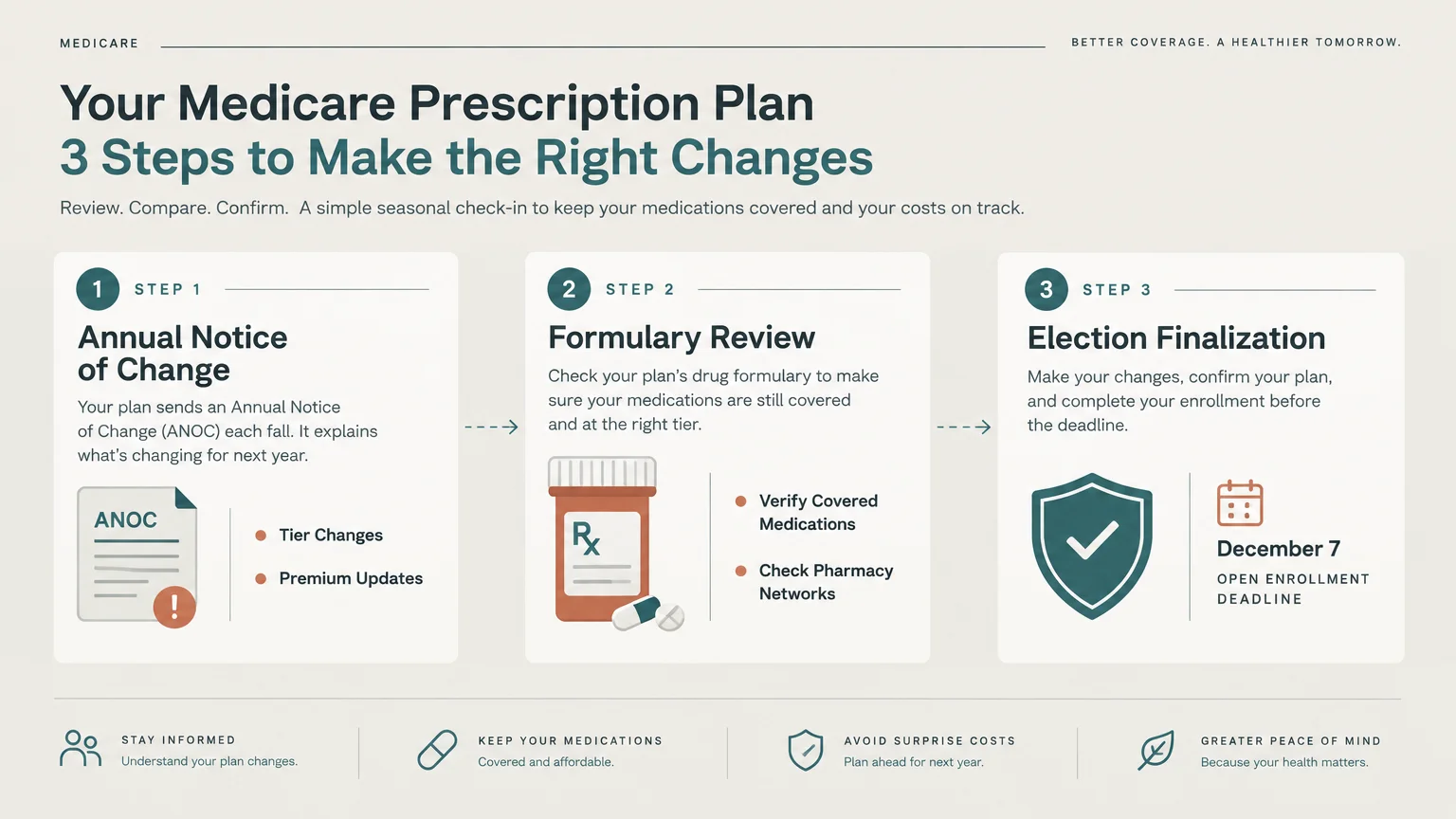
Act Before the December 7 Open Enrollment Deadline
Medicare Annual Open Enrollment begins every year on October 15 and concludes promptly on December 7, 2026. Any adjustments you make to your health coverage take effect on January 1, 2027.
Missing this enrollment deadline locks you into your existing plan for the entire upcoming year. Taking time to review your policy paperwork ensures your coverage matches your changing health needs.
Prepare for Rising 2027 Prescription Drug Caps
Careful healthcare planning requires tracking evolving out-of-pocket spending limits. For 2026, the Medicare Part D annual out-of-pocket spending cap is $2,100, but it rises to $2,400 in 2027.
In addition, the maximum standard deductible for Part D prescription drug plans rises to $700 in 2027. Factoring these updated statutory numbers into your household budget keeps you prepared for early-year pharmacy costs.
Scrutinize Your Annual Notice of Change
Your current insurance provider sends an Annual Notice of Change document in early autumn. Examine this vital paperwork to see whether your copayments, coinsurance rates, or covered medications have changed.
Insurers frequently alter their drug formularies, dropping coverage for specific brand-name medications or shifting them into higher pricing tiers. Checking these details prevents unpleasant surprises at the pharmacy counter next month.
Verify Provider and Hospital Networks
If you hold a Medicare Advantage plan, confirm that your preferred doctors and local specialists remain in-network. Provider directories shift annually, and out-of-network care can generate steep unexpected bills.
Use the plan finder tool on Medicare.gov to compare available options side by side. Once you select the best policy, file your electronic paperwork and print your confirmation receipt immediately.

Tip #4: Spend Flexible Spending Accounts and Maximize Health Savings Accounts
Exhaust Expiring FSA Balances Before December 31
Healthcare Flexible Spending Accounts operate under strict use-it-or-lose-it guidelines established by the IRS. For the 2026 plan year, the maximum employee contribution limit is $3,400.
Unless your employer offers a specific extension, any unused funds remaining on December 31, 2026, are forfeited. Check your account balance today through your online benefits portal to identify your surplus funds.
Under IRS rules, the maximum carryover allowed from 2026 into 2027 is capped at $680. Review your company plan documents to confirm whether your employer permits this carryover or provides a grace period.
Book Medical Appointments and Stock Up on Supplies
Put your remaining FSA dollars to work by booking long-postponed medical, dental, or vision appointments. Routine eye examinations, professional dental cleanings, and physical therapy sessions represent excellent uses of these pre-tax funds.
You can also purchase eligible healthcare necessities, including prescription eyeglasses, contact lenses, hearing aid batteries, and orthopedic supports. Many over-the-counter medical products qualify for reimbursement without a physician prescription.
Gather all itemized merchant receipts and submit your reimbursement forms before the plan deadline. Retain digital copies of your approved expense vouchers in your personal financial housekeeping folder.
Maximize Triple-Tax-Advantaged HSAs
Health Savings Accounts provide remarkable tax advantages for adults enrolled in qualifying high-deductible health plans. In 2026, maximum HSA contributions reach $4,400 for self-only coverage and $8,750 for family coverage.
Adults aged 55 and older who are not enrolled in Medicare can contribute an additional $1,000 catch-up amount. Unlike FSAs, HSA balances never expire and continue to compound tax-free year after year.
Adjust your contributions before December 31 to fully fund your account and capture maximum tax deductions. If needed, you have until the April 2027 tax deadline to make individual HSA contributions for 2026.

Tip #5: Complete Annual Gift Transfers and Formalize Family Gifting
Take Advantage of the Annual Gift Tax Exclusion
Sharing your financial blessings with family members provides immense emotional satisfaction while shrinking your taxable estate. In 2026, the IRS annual gift tax exclusion allows you to give up to $19,000 per recipient.
Married couples can combine their allowances through gift splitting, gifting up to $38,000 per recipient completely tax-free. You can distribute gifts to your children, grandchildren, or friends without triggering any reporting requirements.
All gifts must be completed and fully cleared by December 31, 2026. If you send paper checks, ask recipients to deposit them immediately so the transactions clear before the year ends.
Avoid Unnecessary IRS Gift Tax Filings
Staying within annual gift exclusion limits eliminates the paperwork chore of filing IRS Form 709. Gifting under the threshold preserves your unified lifetime estate and gift tax basic exclusion amount.
Under current federal legislation, the lifetime estate and gift tax exemption is $15,000,000 per individual for 2026. Married couples enjoy a generous joint lifetime exemption of $30,000,000.
Direct payments made directly to educational institutions for tuition or to medical facilities for healthcare costs bypass gift limits entirely. These direct payments carry an unlimited exclusion and require no tax paperwork.
Maintain Accurate Gifting Records
Keep a dedicated ledger detailing every monetary transfer, recipient name, and date of delivery. Retain bank statements confirming that checks cleared your account prior to the midnight deadline on December 31.
Transparent recordkeeping prevents misunderstandings and demonstrates complete compliance in the event of an IRS audit. Clear documentation protects your family and maintains harmony across generations.
Tip #6: Organize Tax Records and Claim Available Senior Deductions
Benefit From the Enhanced Senior Deduction
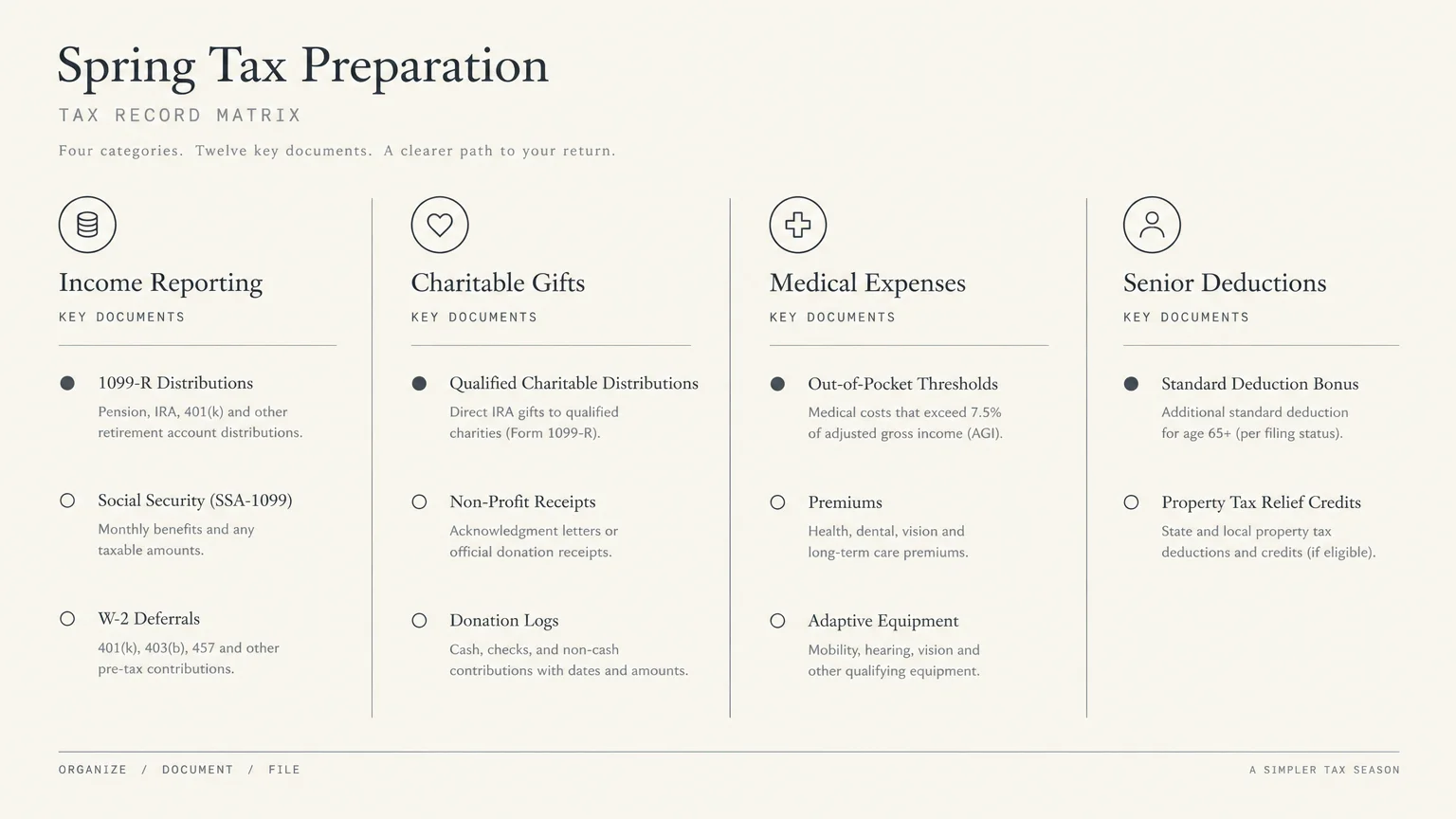
Tax preparation feels effortless when you organize your records and paperwork before year-end. Recent legislation provides qualifying older adults with a valuable tax-saving benefit known as the Enhanced Senior Deduction.
Taxpayers aged 65 and older can claim an additional deduction of $6,000 per person for the 2026 tax year. Married couples who both meet the age requirement can claim a remarkable $12,000 total deduction.
You can claim this deduction whether you itemize deductions or take the standard deduction on your return. The deduction begins phasing out at a modified adjusted gross income of $75,000 for single filers and $150,000 for joint filers.
To qualify for 2026, the taxpayer must celebrate their 65th birthday on or before December 31, 2026. Evaluating your income now helps you structure your end of year financial checklist to stay below phaseout thresholds.
Claim the Standard Age 65 and Older Deduction
Older Americans also qualify for the longstanding IRS additional standard deduction. For the 2026 tax year, this deduction provides an extra $2,050 for single filers and heads of household.
For married couples filing jointly, the additional deduction is $1,650 per qualifying spouse, delivering a $3,300 joint benefit. Combining these statutory deductions significantly lowers your taxable income and protects your retirement cash flow.
Establish a Centralized Tax Documentation System
Create a dedicated physical folder and secure digital folder labeled for your upcoming 2026 tax filing. Gather receipts for deductible expenses, property tax statements, charitable gift acknowledgments, and clean energy improvement receipts.
Build a checklist to track incoming tax forms that arrive in January, such as Form 1099-R and Form SSA-1099. Sorting these documents before year end guarantees a smooth, stress-free tax preparation experience.

Tip #7: Audit Beneficiary Designations and Legal Estate Directives
Recognize That Beneficiary Forms Override Wills
Conducting an annual beneficiary review is one of the most critical paperwork tasks you can finish. Many retirees mistakenly believe that instructions written inside a traditional last will dictate who inherits their accounts.
In reality, valid beneficiary designations on retirement accounts, annuities, and life insurance policies override instructions in your will. Failing to update these documents can result in assets transferring to an ex-spouse or estranged relative.
Log into your 401(k), IRA, and insurance portals to inspect both primary and contingent beneficiary listings. Ensure the listed legal names, Social Security numbers, and allocation percentages accurately reflect your current wishes.
Review Payable on Death and Transfer on Death Accounts
Standard checking, savings, and non-retirement brokerage accounts do not automatically bypass probate without proper documentation. You can prevent costly legal delays by adding Payable on Death or Transfer on Death designations.
Contact your financial institutions to verify that active TOD or POD forms remain on file for every account. Request written confirmations of these designations and file them with your estate planning documents.
Refresh Powers of Attorney and Healthcare Proxies
Examine your durable financial power of attorney, healthcare proxy, and living will to confirm they remain up to date. Verify that the individuals you designated years ago are still capable and willing to serve.
Make sure your healthcare agents possess signed copies of your medical directives and HIPAA release forms. Provide updated copies to your primary care physicians to ensure seamless coordination during an unexpected medical crisis.
Tip #8: Conduct an Annual Insurance Audit and Update Vital Records
Adjust Coverage Limits for Modern Inflation
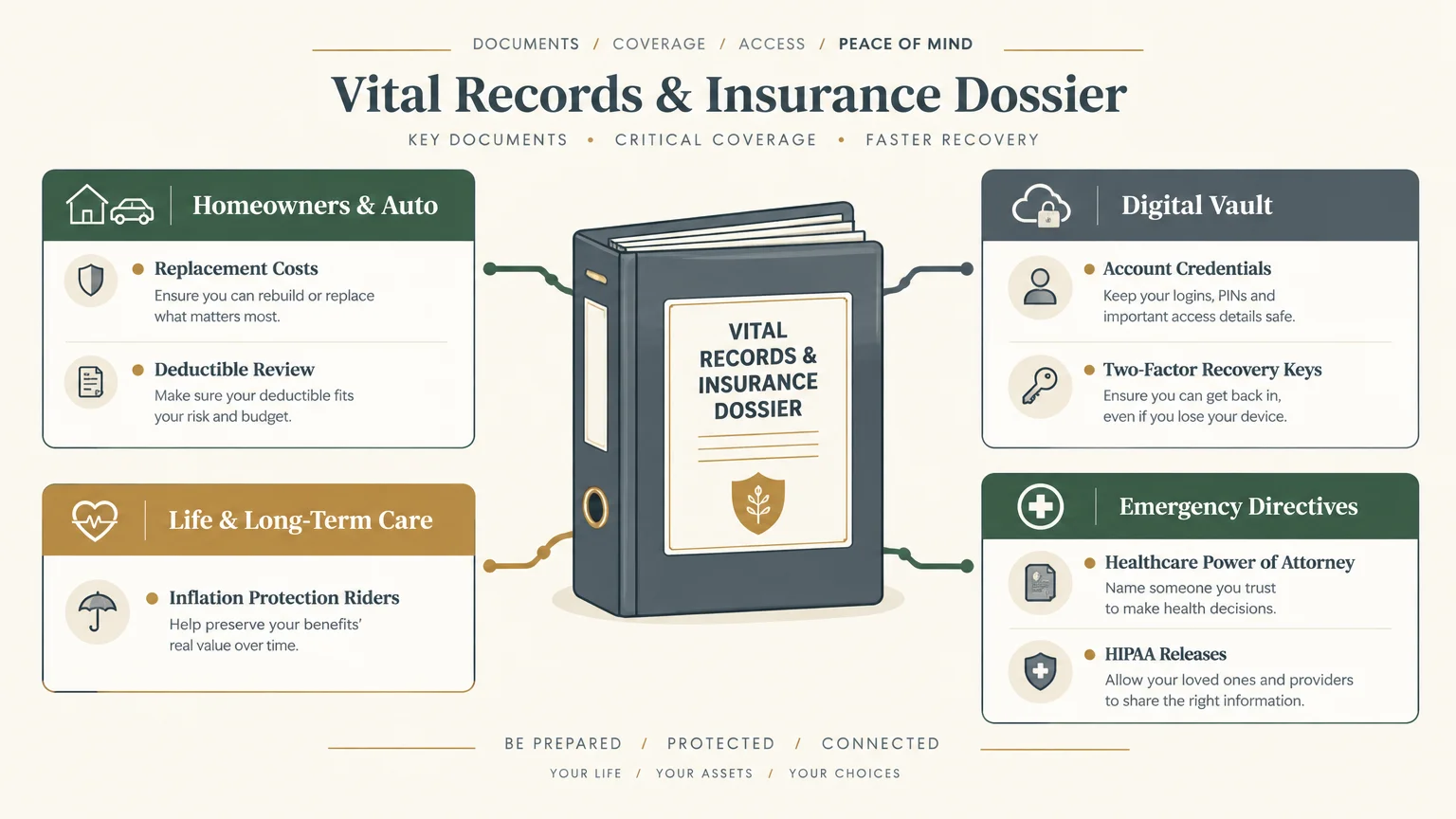
Inflation and rising building costs have caused property replacement values to climb dramatically across the country. Dedicate time to reviewing your homeowners, automobile, and personal umbrella liability policies before the year concludes.
Confirm that your homeowners policy provides sufficient dwelling coverage to rebuild your residence in today’s construction market. Inquire with your insurance broker about available multi-policy discounts or senior defensive driving credits.
Evaluate your personal umbrella liability insurance to ensure your accumulated retirement savings remain protected against catastrophic lawsuits. An affordable umbrella policy provides invaluable peace of mind for older adults.
Consolidate Vital Family Records
Gather essential legal and personal identity documents into a single, fireproof and waterproof home safe. This collection should contain birth certificates, marriage certificates, military discharge papers, real estate deeds, and vehicle titles.
Make high-resolution color copies of your passport, driver’s license, and Medicare identification card. Keep these photocopies accessible in case your original wallet or identification cards are lost or stolen during holiday travel.
Create an Emergency Digital Document Vault
Compile a secure digital index detailing all bank accounts, investment portals, recurring utility bills, and insurance policies. List the contact details for your estate attorney, certified public accountant, and trusted financial advisor.
Store master passwords inside an encrypted digital password manager rather than recording them on unsecured paper notes. Provide secure emergency access credentials to your designated executor or trusted adult child.

The Takeaway: Living a More Blissful Retirement
Tackling these essential paperwork tasks before the year ends removes hidden anxiety and shields your retirement wealth. Entering the new year with organized finances allows you to focus your attention on what matters most.
Proactive financial housekeeping ensures you capture every available tax deduction, avoid unnecessary penalties, and protect your family. Every form you sign and file strengthens your independence and secures your personal legacy.
Approach this end of year financial checklist one task at a time over the coming weeks. You possess the wisdom to organize your paperwork and welcome the upcoming year with radiant joy and confidence.
Frequently Asked Questions
What happens if I miss my RMD deadline on December 31?
Failing to withdraw your required minimum distribution by December 31 triggers an IRS excise tax penalty. Under SECURE 2.0 rules, the penalty equals 25 percent of the unwithdrawn distribution amount.
However, the IRS reduces this penalty to 10 percent if you correct the error within two years. To resolve the shortfall, withdraw the required funds immediately and file IRS Form 5329 with an explanation.
Can I contribute to both an IRA and a workplace 401(k) before the year ends?
Yes, you can contribute to both a workplace 401(k) and an individual retirement account in the same calendar year. Your 401(k) deferrals must occur through payroll by December 31, 2026.
In contrast, you have until the April 2027 tax filing deadline to make your 2026 IRA contributions. Review IRS income thresholds to verify whether your traditional IRA contributions remain fully tax-deductible.
How do I know if my Medicare prescription drug plan is changing next year?
Your Medicare plan carrier sends an Annual Notice of Change packet in the mail each September. This document outlines modifications to your premium, deductible, copayments, and the list of covered medications for 2027.
Carefully inspect this paperwork to confirm that your specific prescriptions remain covered at affordable pricing tiers. If your plan makes unfavorable changes, switch coverage during Open Enrollment before December 7, 2026.
Does gifting money to my grandchildren reduce my lifetime estate tax exemption?
Gifts that remain within the annual gift tax exclusion do not reduce your lifetime estate tax exemption. In 2026, you can give up to $19,000 per grandchild without filing any IRS tax paperwork.
If you exceed $19,000 for a single recipient, you must file IRS Form 709 to report the gift. The excess amount simply reduces your $15,000,000 lifetime exemption without generating an immediate tax bill.
For a wide range of resources for older adults, visit AARP and the National Council on Aging (NCOA). Health information is available from the National Institute on Aging.
Disclaimer: This article is for informational and inspirational purposes only. It is not a substitute for professional medical, financial, or psychological advice. Please consult with a qualified expert for guidance tailored to your individual needs.