
Tip #5: Manage Combined Income to Control Social Security Taxes
Collecting larger Social Security checks after age 70 provides wonderful financial security, but it can also push your overall income into taxable territory. Understanding how the IRS evaluates your income prevents unexpected tax bills and allows you to keep more of your money in your retirement account.
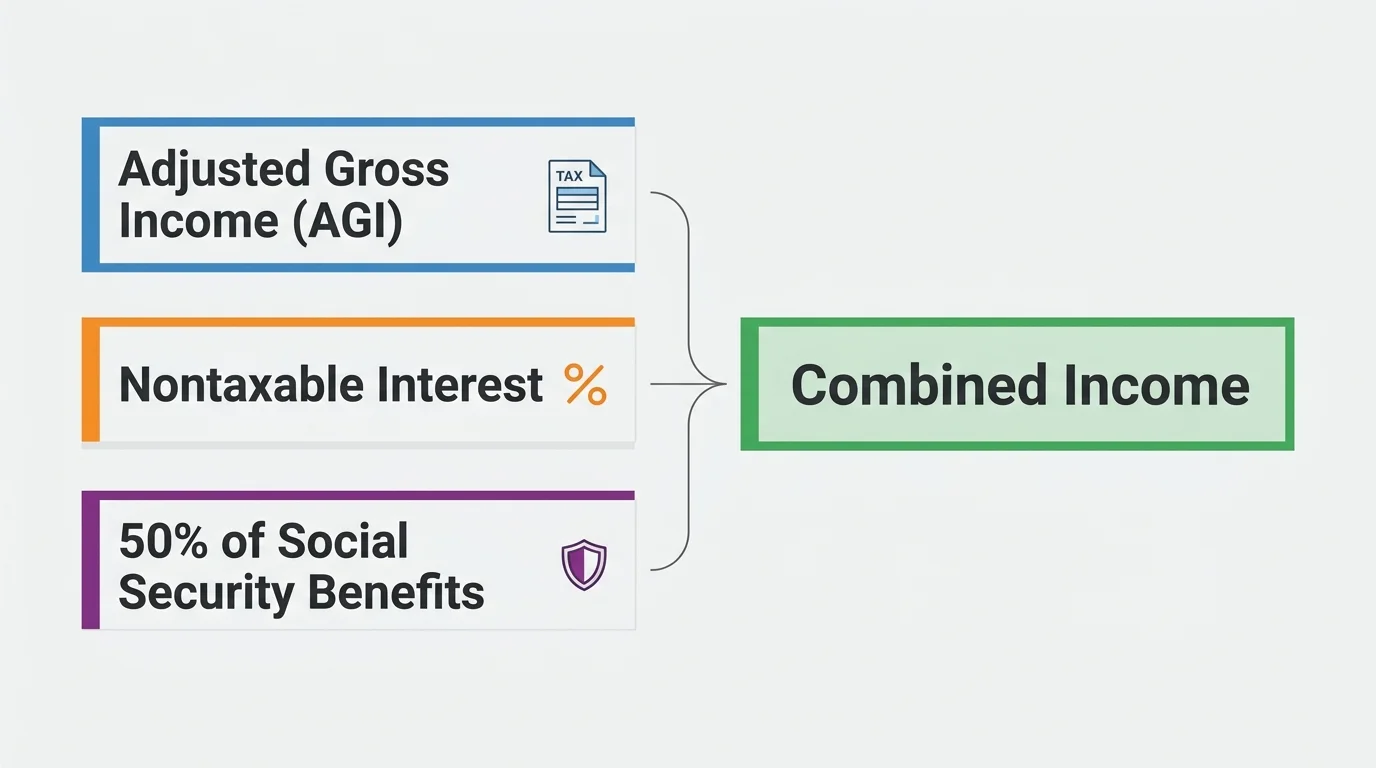
The IRS determines the taxability of your benefits using a calculation called Combined Income. Your Combined Income equals your Adjusted Gross Income (AGI), plus non-taxable interest, plus 50% of your total annual Social Security benefits. The statutory income thresholds governing benefit taxation have remained fixed for decades and are not indexed for inflation:
For individual tax filers, a Combined Income between $25,000 and $34,000 makes up to 50% of your Social Security benefits subject to federal income tax. If your Combined Income exceeds $34,000, up to 85% of your benefits become taxable. For married couples filing jointly, a Combined Income between $32,000 and $44,000 subjects up to 50% of benefits to income tax, while a Combined Income above $44,000 subjects up to 85% of benefits to taxation.
Smart tax planning helps mitigate this tax burden. Utilizing Qualified Charitable Distributions (QCDs) directly from your Traditional IRA once you pass age 70 and a half satisfies your Required Minimum Distributions (RMDs) without increasing your AGI. Additionally, factor in your automatic healthcare costs. In 2026, the standard Medicare Part B monthly premium of $202.90 is automatically deducted from your monthly Social Security check, simplifying your medical budgeting while keeping your cash flow predictable.






Very good and quite valuable information. THANK YOU for the article!