

Retirement brings fresh adventures, from new relationships and encore careers to extended travel abroad. Yet major milestones also trigger important benefit changes you need to plan around.
Understanding social security life events helps you protect your monthly income and avoid costly overpayment surprises. With the right roadmap, you can celebrate your next chapter while keeping your finances steady.
Knowing which milestones alter your check—and how to report them on time—puts you firmly in the driver’s seat. Let us explore six key transitions that reshape your retirement paycheck.
Lifestyle Idea #1: Navigating Marriage or Remarriage After 50
Finding love later in life adds tremendous joy, companionship, and shared purpose to your retirement years. Before you book the venue, take an afternoon together to review how tying the knot affects your monthly checks.
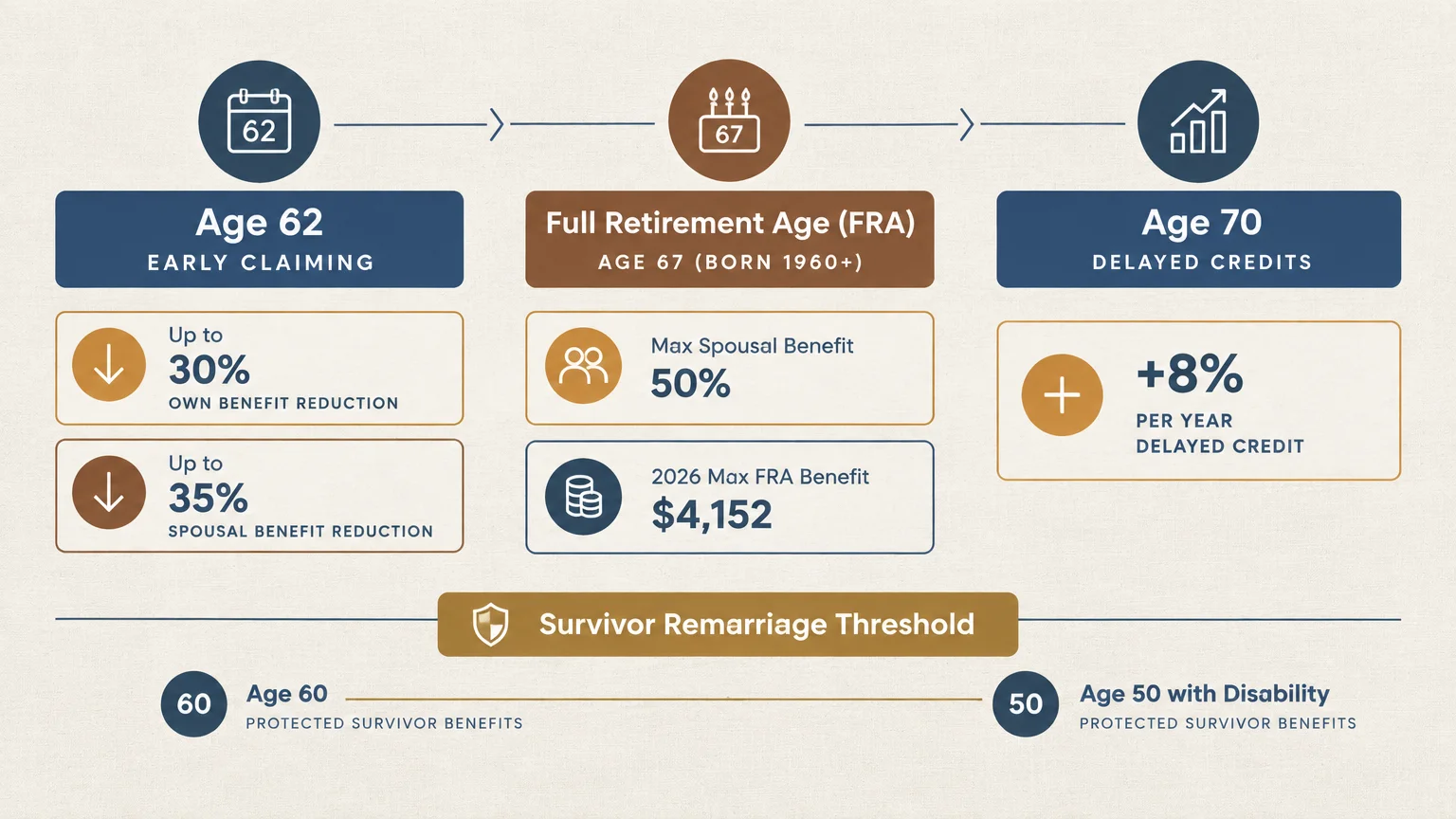
Your Social Security Administration (SSA) baseline sets the stage for any spousal planning. For anyone born in 1960 or later, full retirement age (FRA) is 67; for those born in 1959, it is 66 and 10 months.
Claiming as early as age 62 permanently reduces your own retirement benefit by up to 30 percent and trims a spousal benefit by up to 35 percent. Waiting past FRA earns delayed retirement credits of 8 percent per year—or two-thirds of 1 percent monthly—until age 70.
In 2026, the maximum monthly benefit at FRA reaches $4,152, rising to $4,188 in 2027. Meanwhile, an aged couple both receiving benefits sees their projected average check grow from $3,238 to $3,355 after the 3.6 percent cost-of-living adjustment (COLA) in 2027.
The One-Year Spousal Rule and Remarriage Traps
To collect spousal benefits on a current partner’s work record, SSA rules generally require at least one year of marriage. That one-year waiting period is waived only if you are the parent of your spouse’s child.
The maximum spousal benefit equals 50 percent of your partner’s FRA amount. That boost can significantly lift household cash flow if one spouse spent years caregiving or working part-time.
Remarriage carries different consequences if you currently collect benefits on an ex-spouse’s record. Under SSA rules, those divorced spouse payments generally stop as soon as you marry someone new, unless that later marriage eventually ends.
Disabled Adult Child (DAC) beneficiaries face a similar hurdle. Marriage typically ends DAC benefits unless a specific legal exception applies, such as marrying another DAC recipient.
The Age 60 Rule for Widows and Widowers
If you lost a previous spouse, timing your wedding date carefully preserves valuable survivor income. Remarrying before age 60—or before age 50 if you have a disability—disqualifies you from collecting survivor benefits on a deceased spouse’s record while married.
Wait until age 60 or older, or age 50 or older with a qualifying disability, and your new marriage will not block those survivor checks. Once you reach age 62, you can even switch to your new spouse’s record if that payment is higher.
Turn this planning step into a relaxing coffee date with your partner. Comparing benefit estimates early prevents awkward surprises and builds lasting financial harmony.
Special Rules for Supplemental Security Income
Marriage also shifts calculations for Supplemental Security Income (SSI) recipients. Rather than evaluating you individually, SSA applies a combined couple rate and stricter shared asset limits.
In 2026, the maximum federal SSI payment moves from $994 per month for an individual to $1,491 for a couple. Following the 2027 COLA, those limits rise to $1,029 for individuals and $1,544 for couples.
Federal SSI resource limits remain $2,000 for an individual and $3,000 for a couple across both 2026 and 2027. Review your combined bank balances before merging households so your monthly support stays intact.
Lifestyle Idea #2: Claiming Your Fair Share After a Divorce
Ending a long marriage later in life can feel overwhelming, yet it often opens the door to a more independent, fulfilling lifestyle. Smart planning around marriage divorce social security rules ensures you do not leave earned money on the table.
Many older adults assume a divorce severs every financial tie to a former partner’s work history. In reality, federal rules preserve generous protections for spouses who contributed at home or earned less during the marriage.
Qualifying Under the Ten-Year and Two-Year Rules
To collect divorced spouse benefits, you must be at least age 62 and currently unmarried. Your marriage also had to last at least 10 years immediately before the divorce decree became final.
Did you divorce and later remarry the exact same person? SSA combines both marriages toward the 10-year requirement only if you remarried no later than the calendar year after the first divorce became final.
You do not even have to wait for a reluctant ex-spouse to retire before filing. If you have been divorced for at least two years, you can apply on their record even if they have not yet claimed their own retirement benefits, provided they are eligible.
Your ex-spouse’s remarriage does not block your claim either. You can still collect up to 50 percent of their FRA benefit—reduced if you claim before your own FRA—regardless of their current marital status.
How Divorced Benefits Affect Your Ex-Spouse
Some retirees hesitate to apply on a former partner’s record because they fear sparking conflict or shrinking their ex’s check. Put that worry to rest right away.
Paying divorced spouse benefits never reduces the monthly amount paid to your former spouse or their current husband or wife. SSA calculates your payment independently without altering their household income.
Keep in mind that you cannot collect both your own retirement check and a divorced spouse benefit at the same time. SSA pays your own earned benefit first, then adds a supplemental amount only if the divorced spouse benefit is higher.
Gather your marriage certificate and final divorce decree in a labeled folder today. Having those documents ready streamlines your application and lets you focus on building vibrant new friendships and routines.

Lifestyle Idea #3: Protecting Your Income After Losing a Spouse
Losing a life partner brings deep grief, and navigating paperwork during mourning feels exhausting. Understanding survivor rules gives you breathing room to lean on family, join local support groups, and stabilize your budget.
Survivor benefits can replace a substantial share of household income, helping you stay in your home or afford travel to visit grandchildren. SSA projects the average monthly check for an aged widow or widower alone will climb from $1,936 to $2,005 with the 2027 COLA.
Eligibility Windows and the Nine-Month Rule
To qualify as a surviving spouse, you generally must have been married for at least nine months before your partner’s death. You can start collecting reduced survivor benefits as early as age 60, or between ages 50 and 59 if you have a disability.
Caregivers qualify even earlier. If you are caring for the deceased worker’s child who is under age 16 or became disabled before age 22, you can receive survivor benefits at any age.
Surviving divorced spouses enjoy nearly identical protections. If your prior marriage lasted at least 10 years, you qualify under the same age and disability rules, and your ex’s death could boost your monthly check.
Timing Your Claim for Maximum Flexibility
Depending on when you file, survivor benefits pay between 71.5 percent and 100 percent of your late spouse’s benefit. Waiting until your own full retirement age unlocks the full 100 percent rate.
Unlike regular retirement and spousal claims, survivor rules offer a powerful switching strategy. If you qualify on both your own work record and your late spouse’s record, you do not have to lock into one forever.
You can claim the smaller benefit first—such as a reduced survivor check at age 60—while allowing your own retirement benefit to grow by 8 percent annually until age 70. Later, you switch to the higher check for life.
Conversely, you might take your own reduced retirement benefit at 62 and switch to your full survivor benefit at FRA. Running both scenarios with an SSA representative helps you choose the strongest path.
Don’t Miss the Lump-Sum Death Payment
Eligible surviving spouses—or qualifying children if no eligible spouse exists—can also claim a one-time $255 lump-sum death payment. Be sure to apply within two years of your spouse’s passing so that payment does not expire.
Unlike standard retirement filings, you cannot apply for survivor benefits online. Call SSA directly to schedule a phone or in-person appointment, and ask a trusted relative or friend to sit with you during the call for support.

Lifestyle Idea #4: Balancing Encore Careers, Earnings, and Public Pensions
Retirement today rarely means sitting idle on the porch. Millions of older adults launch consulting gigs, teach part-time, run seasonal shops, or volunteer for paid stipends to stay socially active and mentally sharp.
Earning extra income brings fresh energy and new friends into your week. Just make sure you know how those paychecks interact with your benefits before you start.
Watching the Retirement Earnings Test
If you already reached full retirement age, celebrate freely—there is no limit on how much you can earn. You keep every dollar of your paycheck alongside your full monthly benefit.
If you claimed benefits early and remain under FRA for the entire calendar year, SSA withholds $1 in benefits for every $2 you earn above an annual limit. That threshold stands at $24,480 per year—or $2,040 monthly—in 2026, rising to $25,560 per year—or $2,130 monthly—in 2027.
During the specific calendar year you reach FRA, the rule becomes much more generous. SSA withholds $1 for every $3 earned above $65,160 per year ($5,430 monthly) in 2026, and $67,920 per year ($5,660 monthly) in 2027.
In that transition year, SSA counts only the wages you earn in months prior to the month you reach FRA. Best of all, withheld money is not lost forever; SSA permanently recalculates and increases your monthly check at FRA to credit back those withheld months.
Understanding Disability and SSI Work Limits
If you receive Social Security Disability Insurance (SSDI) or SSI, returning to work follows stricter monthly benchmarks. SSA tracks Substantial Gainful Activity (SGA) limits closely to determine ongoing disability eligibility.
In 2026, the monthly SGA limit is $1,690 for non-blind beneficiaries and $2,830 for blind beneficiaries. Those caps adjust upward in 2027 to $1,770 for non-blind individuals and $2,950 for blind individuals.
SSDI recipients can test their ability to rejoin the workforce using a nine-month Trial Work Period within a rolling 60-month window. Any month you earn at least $1,210 in 2026—or $1,270 in 2027—counts toward those nine trial months.
For SSI recipients, earned wages reduce monthly payments more directly. After standard exclusions, SSA generally trims your SSI check by about $1 for every $2 you earn from work.
Major Relief for Public-Sector Retirees
Former teachers, firefighters, police officers, and federal workers recently gained welcome relief from long-standing benefit cuts. Signed into law on January 5, 2025, the Social Security Fairness Act permanently eliminated the Windfall Elimination Provision (WEP) and the Government Pension Offset (GPO).
Previously, those rules slashed Social Security checks and survivor benefits for people receiving pensions from jobs not covered by Social Security. By July 2025, SSA had already adjusted records for roughly 2.8 million existing beneficiaries.
The agency also distributed over 3.1 million payments totaling $17 billion, including average retroactive payouts of $6,710 reported in March 2025. If you or a spouse worked in uncovered public service and delayed filing because of WEP or GPO, revisit your options now.
Lifestyle Idea #5: Lowering Medicare Deductions When Income Drops
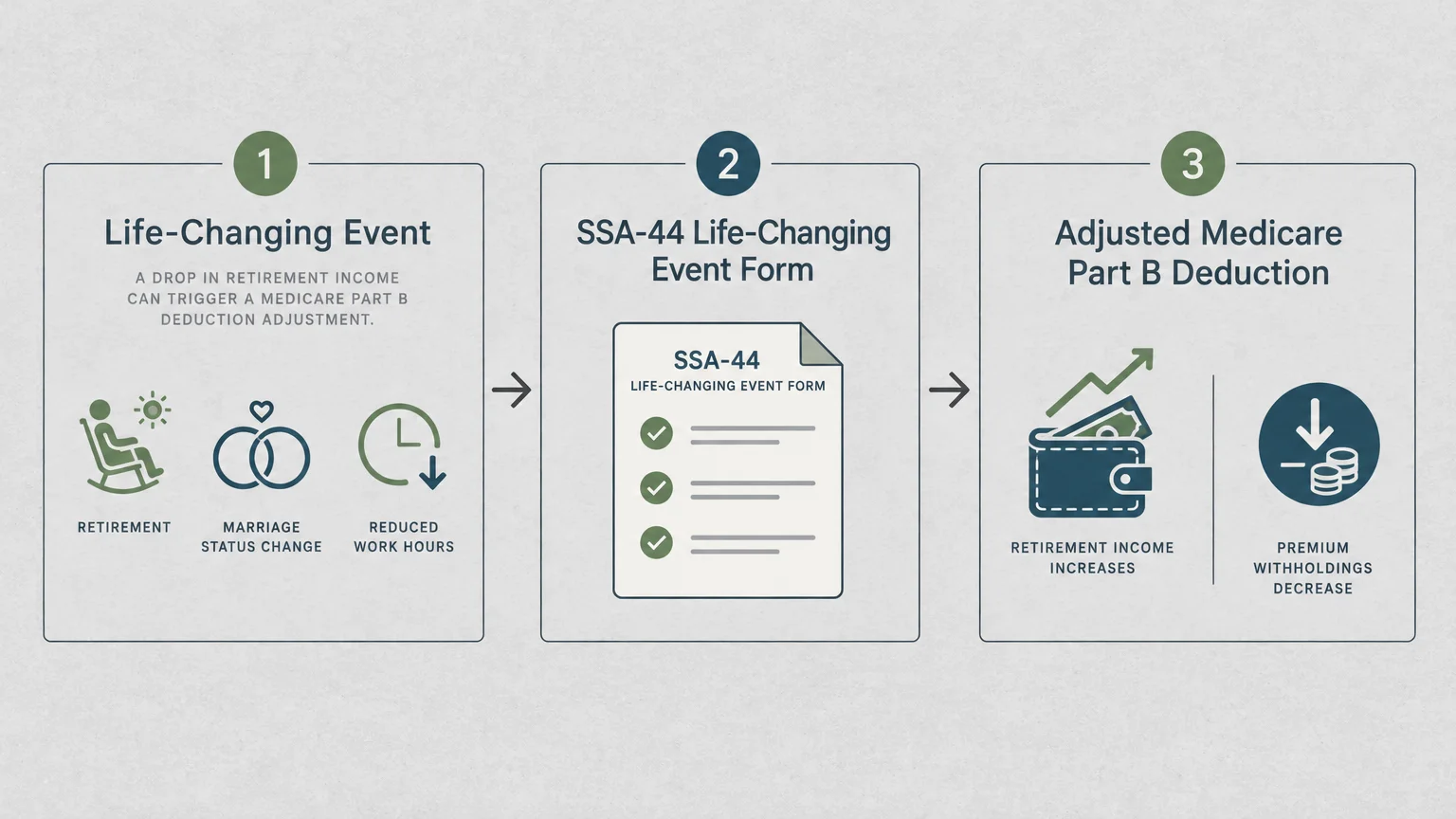
Your gross Social Security amount tells only half the story when Medicare premiums come directly out of your monthly deposit. Unexpected shifts in your household income can significantly change how much cash lands in your checking account.
According to the Centers for Medicare & Medicaid Services (CMS) and SSA, the standard Medicare Part B monthly premium is $202.90 in 2026. The 2027 standard Part B rate remains pending CMS’s fall 2026 announcement.
Many original Medicare enrollees also saw a welcome break in October 2026. The federal administration announced a one-time $90 Part B rebate payment for an estimated 20.8 million original Medicare beneficiaries who do not receive Medicaid premium assistance.
Why High-Income Surcharges Follow You Into Retirement
If you enjoyed peak earnings shortly before retiring, you might notice extra deductions called the Income-Related Monthly Adjustment Amount (IRMAA) on Medicare Part B and Part D. SSA calculates these surcharges using your tax return from two years earlier.
In 2026, IRMAA surcharges apply to single filers with a modified adjusted gross income (MAGI) above $109,000, or married couples filing jointly above $218,000. Paying surcharges based on a two-year-old salary feels frustrating once you have stepped back into a quieter retirement budget.
How Form SSA-44 Puts Cash Back in Your Pocket
You do not have to wait two years for your lower tax return to catch up with your current lifestyle. When your income drops due to a qualifying life-changing event, you can ask SSA to recalculate your Medicare premiums immediately.
Qualifying life-changing events include work stoppage, work reduction, marriage, divorce or annulment, death of a spouse, or an employer settlement payment. Simply complete Form SSA-44 and attach supporting proof, such as a retirement letter from your employer or a marriage certificate.
Once approved, removing or shrinking an IRMAA surcharge gives you an instant raise in your net monthly check. Redirect those saved dollars toward hobbies, fitness classes, or a weekend getaway with friends.
Lifestyle Idea #6: Reporting Moves, Travel Abroad, and Household Shifts
Retirement invites bold changes of scenery, from downsizing near your grandkids to spending winter months exploring new cities or overseas destinations. Yet changes in your address, household setup, or legal status can trigger immediate benefit changes, especially for SSI recipients.
Planning ahead keeps your wanderlust joyful and completely worry-free. Before packing your suitcases or signing a lease, check how your living arrangements affect your monthly deposit.
Shared Living Arrangements and SSI Payments
Moving in with adult children or roommates saves money on rent and prevents isolation, yet it alters federal SSI calculations. If you live in someone else’s household and receive free food or shelter, SSA trims your payment.
In 2026, that living arrangement lowers the maximum federal SSI payment to $662.67 per month for an individual or $994.00 per month for a couple. Entering a Medicaid-funded institution reduces the federal SSI limit to $30 per month.
If you contribute your fair share toward household rent, utilities, and groceries, keep written receipts and a simple cost-sharing agreement. Demonstrating that you pay your own way helps protect your full benefit rate.
Extended Travel Outside the United States
Dreaming of a month-long European river cruise or visiting family overseas? Leaving the United States for 30 consecutive days or more—or for a full calendar month—must be reported to SSA.
Regular Social Security retirement beneficiaries can generally receive payments in most countries, though specific rules apply depending on your citizenship and destination. For SSI recipients, however, leaving the country for 30 consecutive days or longer stops monthly payments.
Incarceration and Legal Holds
Legal troubles can also interrupt monthly benefits quickly. If a Social Security retirement or disability beneficiary is convicted of a crime and confined in a jail, prison, or penal institution for more than 30 continuous days, SSA suspends their payments.
Importantly, eligible spouses and children can continue receiving benefits on that worker’s record during the confinement. For SSI recipients, payments stop for any full calendar month of imprisonment and terminate permanently after 12 consecutive months, requiring a brand-new application upon release.

Putting It into Practice: Small Steps for Big Changes
Staying on top of social security rules does not require a finance degree—just a simple habit of timely communication. Keeping SSA updated protects your retirement budget from sudden clawbacks and preserves your peace of mind.
Follow the Ten-Day Reporting Rule
Whenever a major life shift occurs, remember the 10-day deadline. SSA directs beneficiaries to report changes by the 10th day of the month after the event happened.
For example, if you get married, finalize a divorce, start a new part-time job, or leave the country on January 27, report that change no later than February 10. Reporting changes SSA officials need on time also covers moving, household shifts, criminal convictions, and unsatisfied felony or arrest warrants.
Skipping this quick phone call creates expensive headaches down the road. Unreported changes in marriage, divorce, or remarriage alone contributed to $6.3 billion in projected retirement and disability overpayment deficiencies between fiscal years 2019 and 2023.
Your Simple Action Checklist
First, create a dedicated retirement binder—digital or paper—holding your birth certificate, marriage licenses, divorce decrees, and recent tax returns. Second, bookmark your online account or write down the toll-free reporting number: 1-800-772-1213 (TTY 1-800-325-0778), open Monday through Friday from 8 a.m. to 7 p.m. local time.
Third, schedule a 20-minute review every January after the annual COLA takes effect—such as the 2.8 percent bump in 2026 or the 3.6 percent increase for 2027—to verify your net deposit and Medicare deductions. Small, steady check-ins keep your focus where it belongs: enjoying every moment of your retirement.
Frequently Asked Questions
How can I report a life change if talking on the phone makes me anxious?
You do not have to navigate the call alone. Ask a trusted family member, friend, or caregiver to sit beside you, or submit your update in writing by mail or in person at a local SSA office.
Writing down your Social Security number, the exact date of the life event, and three bullet points before dialing also makes the conversation smooth and stress-free.
What happens if I realize too late that I forgot to report a marriage or job change?
Contact SSA immediately rather than waiting, because delays only allow potential overpayments to grow larger. Explain the timeline honestly and ask about your repayment options or whether a waiver applies if paying it back all at once would strain your essential living budget.
Can I enjoy travel or encore work without risking my benefits on a tight budget?
Yes—smart timing lets you stretch your dollars safely. Keep overseas trips under 30 consecutive days if you rely on SSI, and track part-time wages against the annual earnings limit if you claimed retirement benefits before full retirement age.
Do I need to hire an expensive lawyer to appeal a high Medicare IRMAA deduction?
No paid representative is necessary for a standard life-changing event appeal. You can download Form SSA-44 for free, check the box matching your income drop—such as stopping work or losing a spouse—attach your supporting document, and mail or hand-deliver it directly to SSA.
For resources on retirement living, travel, and finance, visit AARP. Official information on Social Security is available at SSA.gov. For travel advisories, consult the U.S. Department of State.
Disclaimer: This article provides lifestyle suggestions for informational purposes. Financial, legal, or travel decisions should be made in consultation with qualified professionals.