

If your pickleball group or morning coffee circle has been buzzing about taxes lately, you already know the question on everyone’s mind: should you still withhold federal taxes from your Social Security check?
Recent tax legislation sparked rumors that benefit taxes disappeared altogether, leaving millions of retirees unsure whether to touch their withholding settings. Getting the real answer protects your budget for travel, hobbies, and family adventures—without triggering an April tax surprise.
Here is how the latest deductions, income thresholds, and withholding options work together so you can enjoy retirement with total confidence.
Lifestyle Idea #1: Separate Tax Myths from Reality Before Touching Your Check
Every great retirement plan starts with accurate facts rather than rumor-mill headlines. Before you cancel your current tax withholding or rearrange your monthly spending budget, you need clarity on what federal lawmakers actually changed—and what stayed exactly the same.
On July 4, 2025, the One Big Beautiful Bill Act—also called the Working Families Tax Cuts by the IRS—became federal law. Despite widespread social media chatter, the IRS and the Tax Policy Center confirmed that this legislation did not repeal federal taxes on Social Security benefits.
So why did everyone start asking about dropping their withholding? On July 3, 2025, the Social Security Administration sent a mass email and published a blog post stating the law eliminated federal income taxes on benefits for nearly 90% of recipients.
Public scrutiny prompted the agency to revise that announcement soon afterward. What the law actually created was a temporary new deduction for older taxpayers, rather than a blanket repeal of benefit taxation.
Economists still look at the real-world impact through two different lenses. Before the 2025 law passed, the Social Security Administration reported that roughly 40% of beneficiaries owed federal income taxes on their benefits.
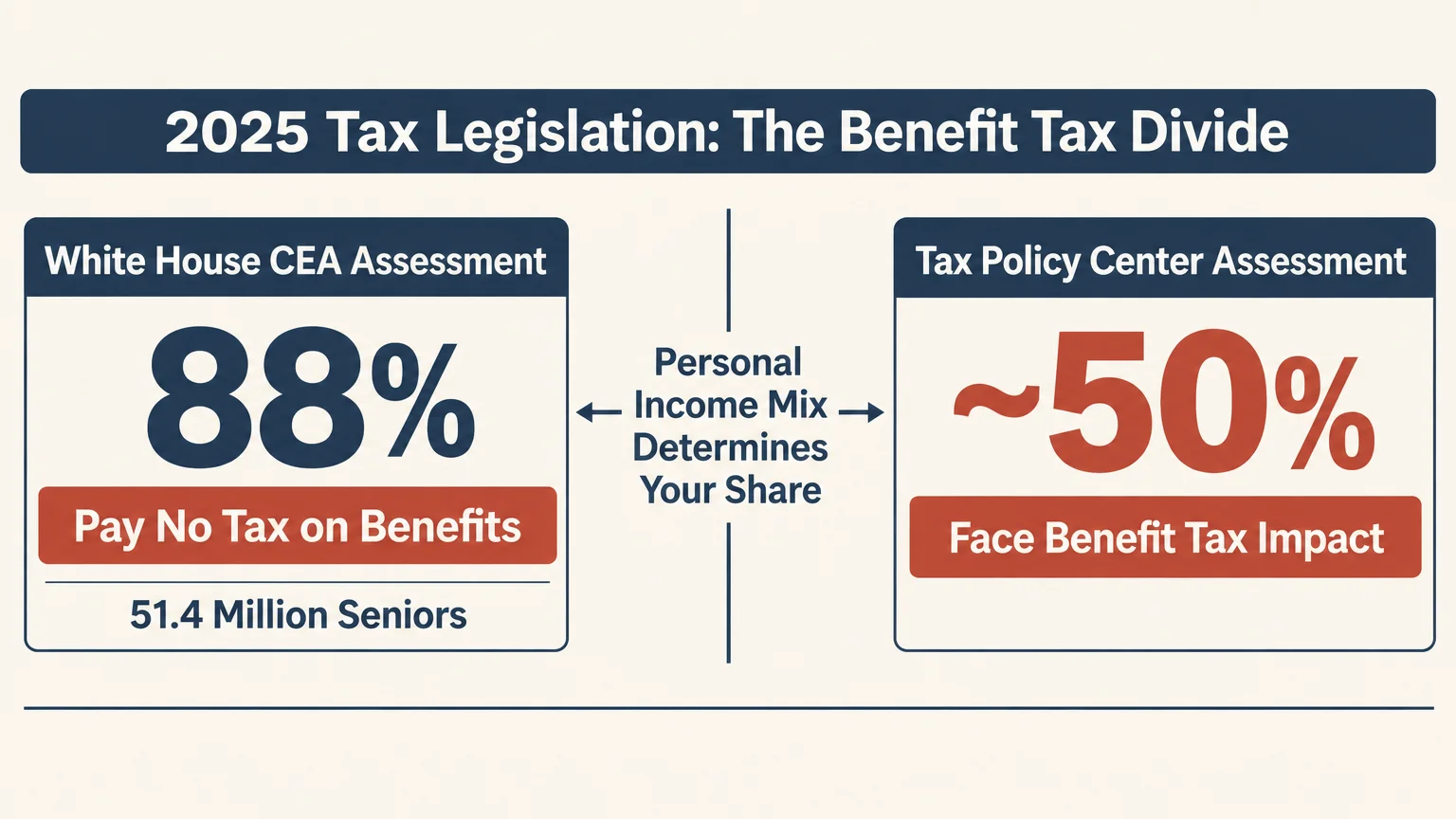
Following the new law, the White House Council of Economic Advisers estimated that 88% of seniors receiving Social Security—about 51.4 million people—would pay no tax on benefits thanks to larger deductions. Meanwhile, the nonpartisan Tax Policy Center found that roughly half of all recipients still face higher federal tax bills because of benefit taxation.
That split explains why your neighbor might owe zero dollars while you still see a tax impact. Your personal income mix—not a viral headline—determines whether your Social Security benefits trigger a federal bill.
Treating tax clarity like a practical lifestyle checkup saves both money and stress. Once you know the rules behind taxes on social security benefits, you can budget freely for weekend getaways, home projects, and hobbies without guessing what April will bring.
Lifestyle Idea #2: Run a Five-Minute Combined Income Checkup
Understanding how the IRS calculates taxable benefits takes less time than brewing a pot of coffee. Under Internal Revenue Code Section 86, the tax formula relies on a specific figure called combined income, sometimes referred to as provisional income.
According to IRS Publication 915, you find your combined income by adding three numbers together. Take your Adjusted Gross Income excluding Social Security, add any tax-exempt interest you earned, and then add 50% of your annual Social Security benefits.
That total determines what share of your benefits becomes subject to federal income tax. Notice that Supplemental Security Income, or SSI, works differently—those payments are never taxed at the federal level.
Single, Head of Household, and Qualifying Surviving Spouse Rules
If you file as Single, Head of Household, or Qualifying Surviving Spouse, your base threshold starts at $25,000. You also fall under this tier if you are married filing separately and lived apart from your spouse for the entire year.
When your combined income stays below $25,000, 0% of your Social Security benefits are taxable. If your combined income falls between $25,000 and $34,000, up to 50% of your benefits can be taxed.
Once your combined income crosses $34,000, up to 85% of your benefits become taxable. That does not mean you pay an 85% tax rate; rather, up to 85% of your benefit dollars count as ordinary taxable income.
Married Filing Jointly and Separate Filer Rules
Couples filing a joint return get slightly higher thresholds before benefits face taxation. When your combined income stays under $32,000, you owe federal tax on 0% of your benefits.
If your joint combined income lands between $32,000 and $44,000, up to 50% of your benefits may be taxable. Above $44,000 in combined income, up to 85% of your Social Security benefits enter the taxable column.
Be especially cautious if you choose Married Filing Separately after living with your spouse at any point during the year. IRS Publication 915 sets that base threshold at $0, making up to 85% of your benefits taxable regardless of how little you earn.
Because Congress never indexed these dollar thresholds for inflation, annual Cost-of-Living Adjustments quietly push more retirees above them each year. Benefits rose 2.8% in 2026 and climb another 3.6% starting in January 2027 for nearly 72 million Social Security beneficiaries.
That 2027 boost lifts the average monthly retired-worker check by $75—from $2,095 to $2,170—and arrives on December 31, 2026, for roughly 7.3 million SSI recipients. Running your quick five-minute calculation every January ensures those welcome raises never catch your tax plan off guard.
Lifestyle Idea #3: Stack the New Senior Tax Deduction to Lower Your Tax Bill
Here is the bright spot fueling so much optimism among retirees. Even though benefit taxation rules stayed intact, the Working Families Tax Cuts introduced a generous Enhanced Deduction for Seniors covering tax years 2025 through 2028.
If you reach age 65 by the final day of the tax year, you can claim an extra $6,000 senior tax deduction on Schedule 1-A of Form 1040. Married couples filing jointly can claim $12,000 when both spouses are 65 or older.
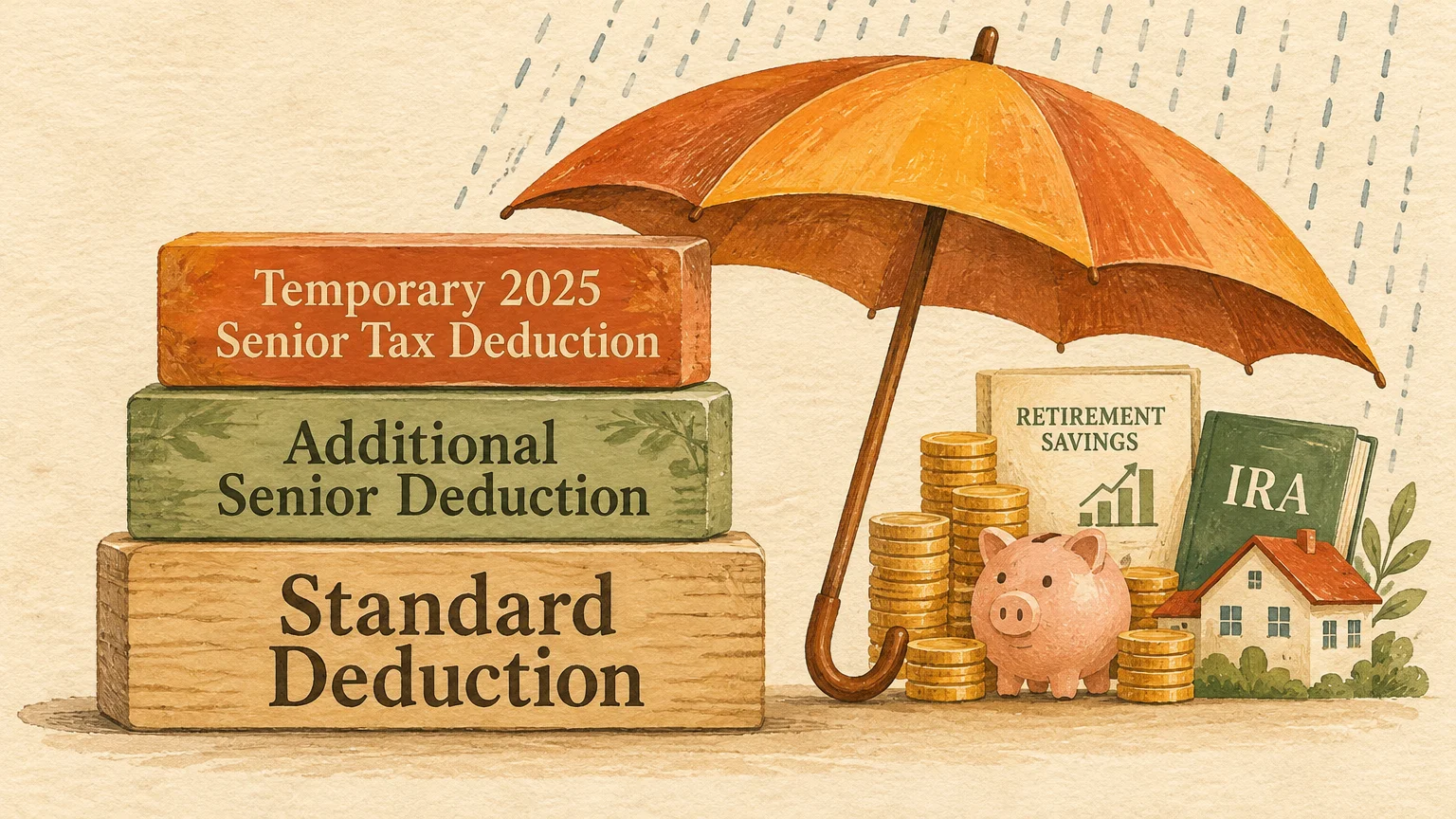
Best of all, this bonus deduction stacks directly on top of both the regular standard deduction and the long-standing age-65-and-older additional deduction. You can even claim it if you itemize deductions instead of taking the standard amount.
How Your Deductions Stack Up in 2026 and 2027
For tax year 2026, IRS Revenue Procedure 2025-32 sets the base standard deduction at $16,100 for single filers and $32,200 for married couples filing jointly. Head of household filers receive a $24,150 base standard deduction.
Taxpayers age 65 or older—or those who are blind—also receive an existing additional deduction of $2,050 for single or head-of-household filers in 2026. Married couples get $1,650 extra per qualifying spouse.
When you stack the new $6,000 bonus on top, a single retiree age 65 or older enjoys $24,150 in total deductions for 2026. A married couple with both spouses 65 or older reaches $47,500 in combined deductions before a single dollar faces federal tax.
Those figures climb again for tax year 2027 under IRS Revenue Procedure 2026-35, released in November 2026. The 2027 base standard deduction rises to $16,600 for single filers, $33,200 for joint filers, and $24,925 for heads of household.
The existing age-65-plus addition also inches up in 2027 to $2,100 for single taxpayers and $1,700 per qualifying spouse on joint returns. That means a 65-and-older couple filing jointly in 2027 can shield $48,600 in income with standard deductions alone.
Check Eligibility Limits and Income Phase-Outs
Before assuming this deduction wipes out your entire tax bill, review three strict eligibility boundaries set by the IRS. First, every claimant needs a valid Social Security number on the return.
Second, married taxpayers must file a joint return to claim the $6,000 or $12,000 bonus; Married Filing Separately returns are ineligible. Third, beneficiaries under age 65—including early retirees ages 62 to 64 and younger disability recipients—cannot claim it yet.
Income phase-outs also affect retirees with higher investment earnings or large retirement account withdrawals. The enhanced deduction shrinks at a 6% rate once Modified Adjusted Gross Income exceeds $75,000 for single filers or $150,000 for joint filers.
It phases out completely once Modified Adjusted Gross Income reaches $175,000 for single taxpayers or $250,000 for married couples filing jointly. Because those phase-out limits are not indexed for inflation, smart withdrawal planning helps keep more of your deduction intact.
If those stacked deductions wipe out your taxable income, you may no longer need taxes taken out of your monthly check. That frees up cash right away for art classes, gym memberships, or treating your grandchildren to memorable weekend outings.
Lifestyle Idea #4: Master Form W-4V and Choose the Right Withholding Rate
Once you calculate your combined income and stacked deductions, you might discover you still owe federal taxes—or that you prefer small monthly deductions over one large April payment. That is where social security tax withholding enters the picture.
Withholding federal income tax from your Social Security benefit is completely voluntary. If you decide to use it, IRS Form W-4V governs how the process works.
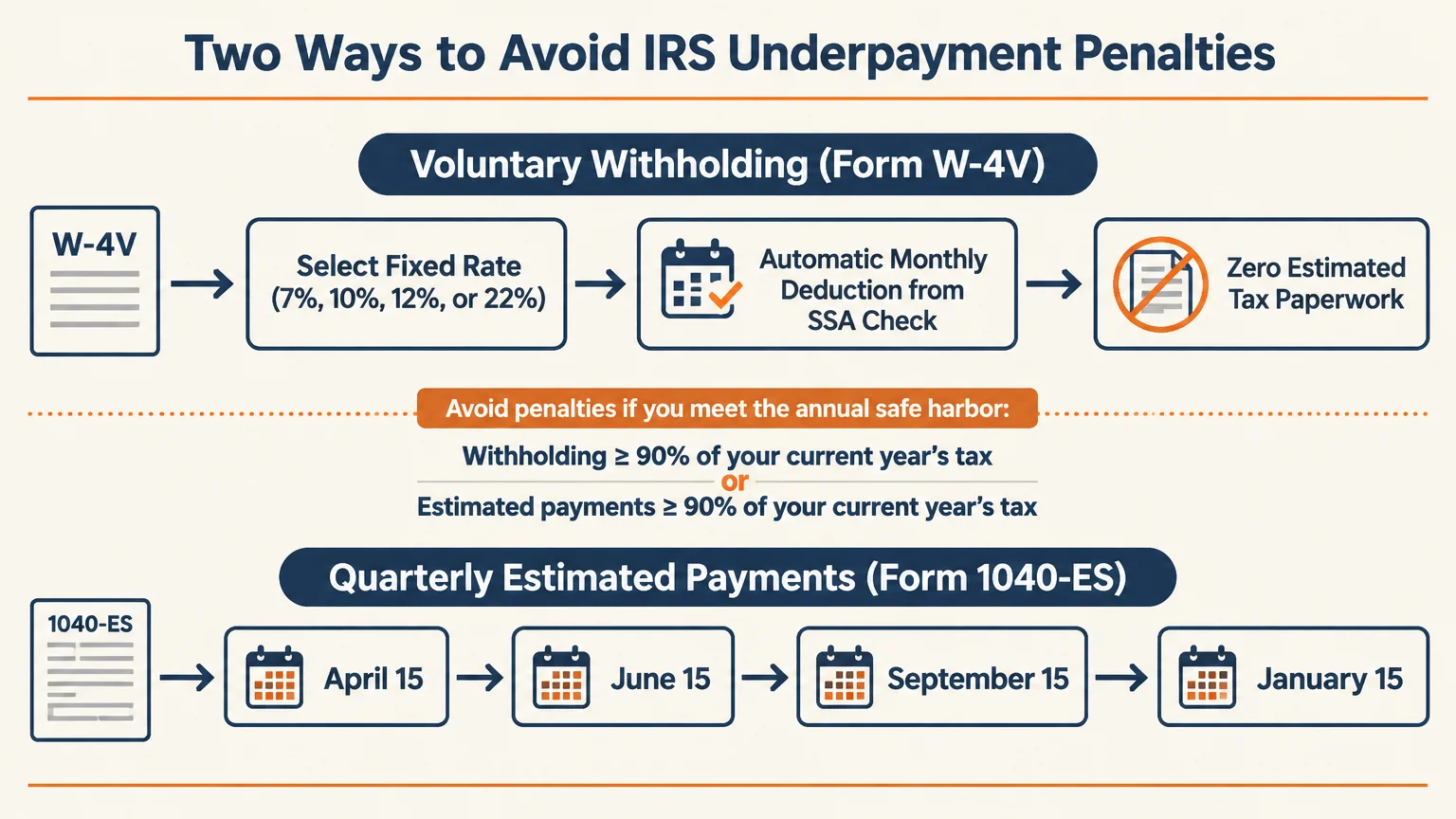
Unlike paycheck withholding at a traditional job, you cannot ask for a custom percentage or a flat dollar amount like $150 a month. Under Form W-4V rules, beneficiaries may choose only one of four fixed rates: 7%, 10%, 12%, or 22%.
Pick a Percentage That Matches Your Real Tax Bracket
Choosing between 7%, 10%, 12%, and 22% starts with estimating your marginal tax rate and how much other income you withdraw each year. If you owe just a modest amount from pension checks or part-time work, 7% or 10% often bridges the gap smoothly.
If substantial IRA withdrawals, dividends, or consulting income push your overall return into higher brackets, selecting 12% or 22% offers stronger protection. Remember that Form W-4V applies strictly to federal income taxes—nothing gets withheld for state income taxes.
You can also change your percentage or stop withholding completely whenever your lifestyle shifts. For instance, if you pause a big Roth conversion or turn 65 and unlock the new $6,000 deduction, dialing your rate down puts cash right back into your monthly budget.
Three Fast Ways to Update Your Withholding
One common mistake retirees make is mailing Form W-4V to the IRS. Always send your request directly to the Social Security Administration, never to the tax agency.
Today, you have three convenient ways to start, adjust, or stop withholding without turning the task into an afternoon headache. Pick whichever method feels easiest for your comfort level:
Option 1: Update online anytime. Log into your personal my Social Security account at SSA.gov/myaccount to view or modify your voluntary tax withholding rate from your kitchen table.
Option 2: Call by phone. Dial 1-800-772-1213—or TTY 1-800-325-0778—Monday through Friday between 8 a.m. and 7 p.m. to change your rate using verbal attestation, a phone option introduced in June 2024.
Option 3: Submit a paper form. Download and sign Form W-4V, then mail it or hand-deliver it to your local Social Security office if you prefer paper records or face-to-face service.
Taking twenty minutes to align your rate turns monthly budgeting into smooth sailing. You know exactly how much lands in your checking account each month, making it simple to plan trips, social dinners, and charitable gifts.
Lifestyle Idea #5: Use Smart Withholding Timing to Avoid IRS Penalties
Thoughtful retiree tax planning is about more than lowering your tax bill—it also protects you from needless underpayment penalties. Nobody wants to waste travel dollars on IRS interest charges simply because a quarterly deadline slipped past during a family cruise.
Under IRS Topic No. 306, you generally avoid an underpayment penalty if you owe less than $1,000 after subtracting withholding and credits. You also stay penalty-free if your payments cover at least 90% of your current year’s tax liability.
Alternatively, the safe harbor rule protects you if you pay 100% of the prior year’s total tax. That requirement rises to 110% if your prior-year Adjusted Gross Income exceeded $150,000—or $75,000 if married filing separately.
Here is a scheduling advantage many new retirees overlook when weighing Form W-4V against quarterly Form 1040-ES payments. Quarterly estimated payments count only on the specific date you send them to the Treasury.
By contrast, the IRS treats federal tax withholding—whether from Social Security, a pension, or an IRA distribution—as if you paid it evenly across all four quarters. Even if you raise your withholding late in the autumn, it helps cover shortfalls from earlier in the year.
Suppose you sold winning stocks in April or took an unexpected retirement account withdrawal in July for a family reunion. Increasing your withholding rate in October through Social Security or an IRA payout can rescue your safe harbor status without filing complex penalty worksheets.
Newly retired readers also get a helpful grace window from the IRS. Under Topic No. 306, the agency can waive an estimated tax underpayment penalty if you retired after reaching age 62—or became disabled—in the current or preceding tax year and had reasonable cause.
Automating taxes through withholding frees your calendar from quarterly payment reminders. You can head out for an extended RV trip or volunteer abroad without worrying about missing a September or January IRS deadline.

Lifestyle Idea #6: Factor In State Taxes and Encore Careers Before Adjusting Your Check
Federal rules only tell part of your retirement income story. Where you live and whether you keep earning a paycheck play major roles in your overall cash flow and withholding strategy.
Know Where Your State Stands on Benefit Taxes
Most states have already dropped state-level income taxes on Social Security, giving retirees welcome breathing room. Beginning in tax year 2026, West Virginia completed its multi-year phase-out and joined the ranks of states that fully exempt benefits.
That leaves just eight states taxing Social Security benefits in 2026: Colorado, Connecticut, Minnesota, Montana, New Mexico, Rhode Island, Utah, and Vermont. Even within those eight states, age-based or income-based exemptions protect many households from paying much—or anything—at the state level.
If you live in one of those eight states and exceed its exemption thresholds, remember that Form W-4V covers federal taxes only. You will need separate state estimated payments or state withholding on a pension or IRA withdrawal to cover that local bill.
Account for Encore Jobs and the Earnings Test
Many energetic retirees today trade full-time careers for part-time consulting, seasonal park work, teaching, or passion-driven small businesses. Earning extra income keeps your mind sharp and your social calendar full, though it affects Social Security in two ways.
First, wages raise your combined income, which can push a larger share of your benefits into taxable territory. Second, earned wages remain subject to payroll taxes—6.2% for Social Security up to $184,500 in 2026 and $192,300 in 2027, plus 1.45% for Medicare with no cap—even while you collect benefits.
If you work before reaching Full Retirement Age, which is 67 for anyone born in 1960 or later, watch the annual earnings-test limit. In 2026, Social Security withholds $1 in benefits for every $2 you earn above $24,480; that limit rises to $25,560 in 2027.
In the calendar year you reach Full Retirement Age, a higher threshold applies up until your birth month. The limit stands at $65,160 in 2026 and $67,920 in 2027, with $1 withheld for every $3 earned above the line.
Once you reach your Full Retirement Age month, the earnings test vanishes completely—you can earn as much as you like without reducing your benefit check. Factoring encore wages into your annual budget keeps your work life joyful and your tax plan crystal clear.
Lifestyle Idea #7: Turn Tax Planning into a Social, Stress-Free Ritual
Money conversations in retirement do not have to feel dry, intimidating, or lonely. Treating your annual withholding review as a shared social ritual makes financial organization far easier to stick with year after year.
Invite your spouse or a few close friends for a relaxed coffee-and-calendar morning every January after your COLA notice arrives. Comparing notes on local classes, travel plans, and verified tax updates turns paperwork into a motivating hour of goal-setting.
If you dislike wading through tax forms alone, tap into free, friendly community programs staffed by trained volunteers. The IRS sponsors Volunteer Income Tax Assistance and Tax Counseling for the Elderly—specifically designed for adults age 60 and older—which you can reach at 800-906-9887.
AARP Foundation Tax-Aide also provides free tax preparation help nationwide, reachable by phone at 888-227-7669 or online at AARP.org/TaxAide. Sitting down with a knowledgeable local volunteer gives you real answers tailored to your exact return without paying steep hourly fees.
When your withholding matches your real tax picture, financial worry fades into the background. You can say yes to last-minute concert tickets, weekend beach rentals, and generous birthday gifts for your grandkids with genuine peace of mind.

Putting It into Practice: Small Steps for Big Changes
You do not need an accounting degree to answer the withholding question for your household. Taking four simple steps this week settles the issue for the entire year ahead.
First, gather your most recent federal tax return alongside your current Social Security benefit statement. Having real figures in front of you eliminates guesswork right away.
Second, run the quick combined-income formula and check whether you meet the age-65-and-older rules for the $6,000 or $12,000 senior tax deduction. Pay special attention if you file separately or earn close to the $75,000 single or $150,000 joint phase-out thresholds.
Third, choose whether 0%, 7%, 10%, 12%, or 22% withholding aligns best with your total income and IRS safe harbor targets. Remember to account for state rules if you reside in one of the eight states still taxing benefits in 2026.
Fourth, log into your online Social Security account, call 1-800-772-1213, or mail Form W-4V to lock in your choice. Once you hit submit, celebrate crossing taxes off your list with a favorite dinner or a walk with friends.
Frequently Asked Questions
What if I am under 65 and feel anxious about losing money to taxes on a tight budget?
Early retirees ages 62 to 64 and younger disability recipients do not qualify for the new $6,000 senior deduction, so checking your combined income matters even more. If your total combined income stays under $25,000 single or $32,000 joint, you owe zero federal tax on benefits and can keep 100% of your check.
If your budget feels tight and you are unsure where you stand, call 800-906-9887 for free IRS Tax Counseling for the Elderly or contact AARP Foundation Tax-Aide. Getting a free second look removes anxiety before you make any withholding changes.
Can I ask the Social Security Administration to withhold a flat dollar amount like $100 a month?
No, Form W-4V allows only four exact percentage choices: 7%, 10%, 12%, or 22% of your monthly benefit. Custom percentages and flat dollar amounts are not permitted under current Social Security rules.
If none of those four percentages fits your target dollar amount, consider adjusting withholding on a pension or an IRA distribution instead. Most retirement plan custodians allow exact dollar withholding, which still counts as paid evenly across all four tax quarters.
If I move to another state for retirement, will my Form W-4V adjust automatically?
No, because Form W-4V handles federal income tax withholding exclusively and never sends money to state tax agencies. Moving from a state like West Virginia—which fully exempted benefits in 2026—to one of the eight states that still tax benefits requires separate state planning.
Always review local retiree exemptions before relocating so you know whether state estimated payments are necessary. Updating your address with the Social Security Administration also ensures all notices reach your new home promptly.
Is it better to withhold from my Social Security check or my IRA distributions?
Both options give you the same quarterly safe harbor timing advantage because the IRS treats all federal withholding as paid evenly throughout the year. Choosing Social Security withholding works well if you take irregular IRA withdrawals or prefer steady monthly automation.
Withholding from an IRA often works better when you take Required Minimum Distributions once a year and want a precise dollar amount withheld. Many retirees use a mix of both to keep monthly cash flow predictable and April tax filings effortless.
For resources on retirement living, travel, and finance, visit AARP. Official information on Social Security is available at SSA.gov. For travel advisories, consult the U.S. Department of State.
Disclaimer: This article provides lifestyle suggestions for informational purposes. Financial, legal, or travel decisions should be made in consultation with qualified professionals.