

Mastering your healthcare coverage can save you thousands of dollars and ensure smooth medical care in retirement. When you know the essential rules, you avoid costly coverage gaps and protect your hard-earned nest egg.
A national eHealth study revealed that eighty-seven percent of Americans failed a basic medicare test. Despite high confidence, most people stumble over enrollment deadlines, premium penalties, and unexpected out-of-pocket costs.
You can easily avoid these common pitfalls by learning how medicare explained clearly empowers your daily life. Here is your practical guide to understanding medicare basics and securing your retirement bliss.
Tip #1: Master the Alphabet Soup of Medicare Parts
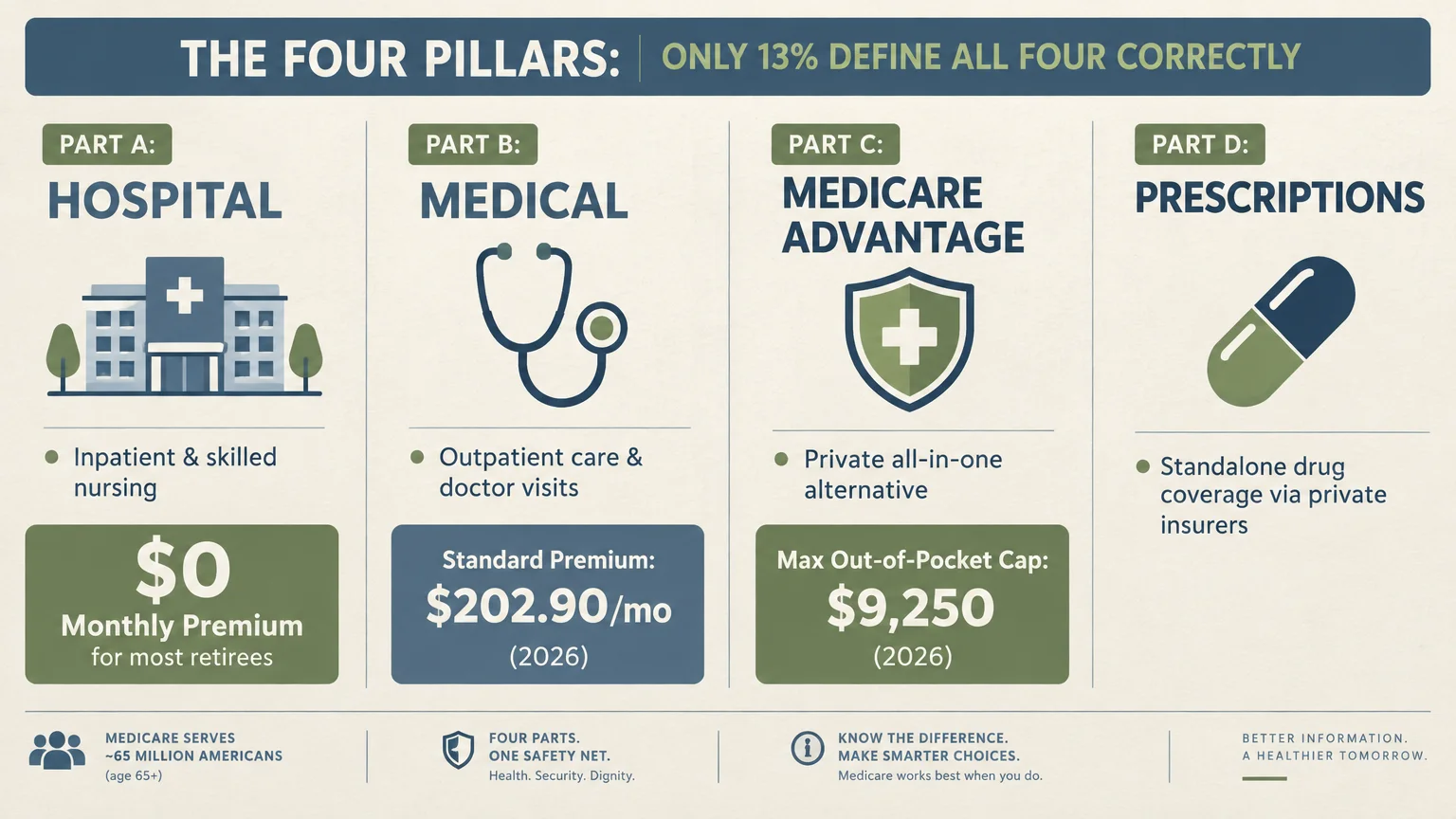
Navigating the various letters of Medicare often feels like deciphering a complex secret code. According to the eHealth Medicare Knowledge Gaps report, only thirteen percent of Americans can correctly define Parts A, B, C, and D.
That means eighty-seven percent of people fail this essential medicare quiz. Interestingly, nearly nine in ten older adults feel completely confident in their coverage knowledge right before taking the test.
Original Medicare consists of Part A and Part B, which the federal government manages directly. Part A covers inpatient hospital stays, skilled nursing facility care, and hospice support.
Most retirees pay zero dollars each month for Part A because they paid Medicare payroll taxes while working. Part B covers your outpatient medical care, doctor visits, diagnostic tests, and preventive screenings.
The standard monthly premium for Part B is $202.90 in 2026. This monthly premium is projected to adjust to $209.50 in 2027.
Understanding Private Medicare Options
Medicare Part C, commonly known as Medicare Advantage, offers an alternative private insurance pathway. These bundled private plans replace your Original Medicare and package hospital, medical, and usually drug coverage together.
Under federal regulations, every Medicare Advantage plan must cap your yearly financial risk. The maximum in-network out-of-pocket limit for Part C plans is $9,250 in 2026.
Medicare Part D delivers standalone prescription drug coverage through private insurance carriers. When you understand how these four distinct pieces fit together, you can design the ideal healthcare safety net.
Tip #2: Beware the Permanent Part B Penalty Trap
Delaying your medical enrollment can trigger severe financial consequences that last for life. The eHealth study found that eighty-eight percent of adults ages 55 to 64 do not know about the Part B penalty.
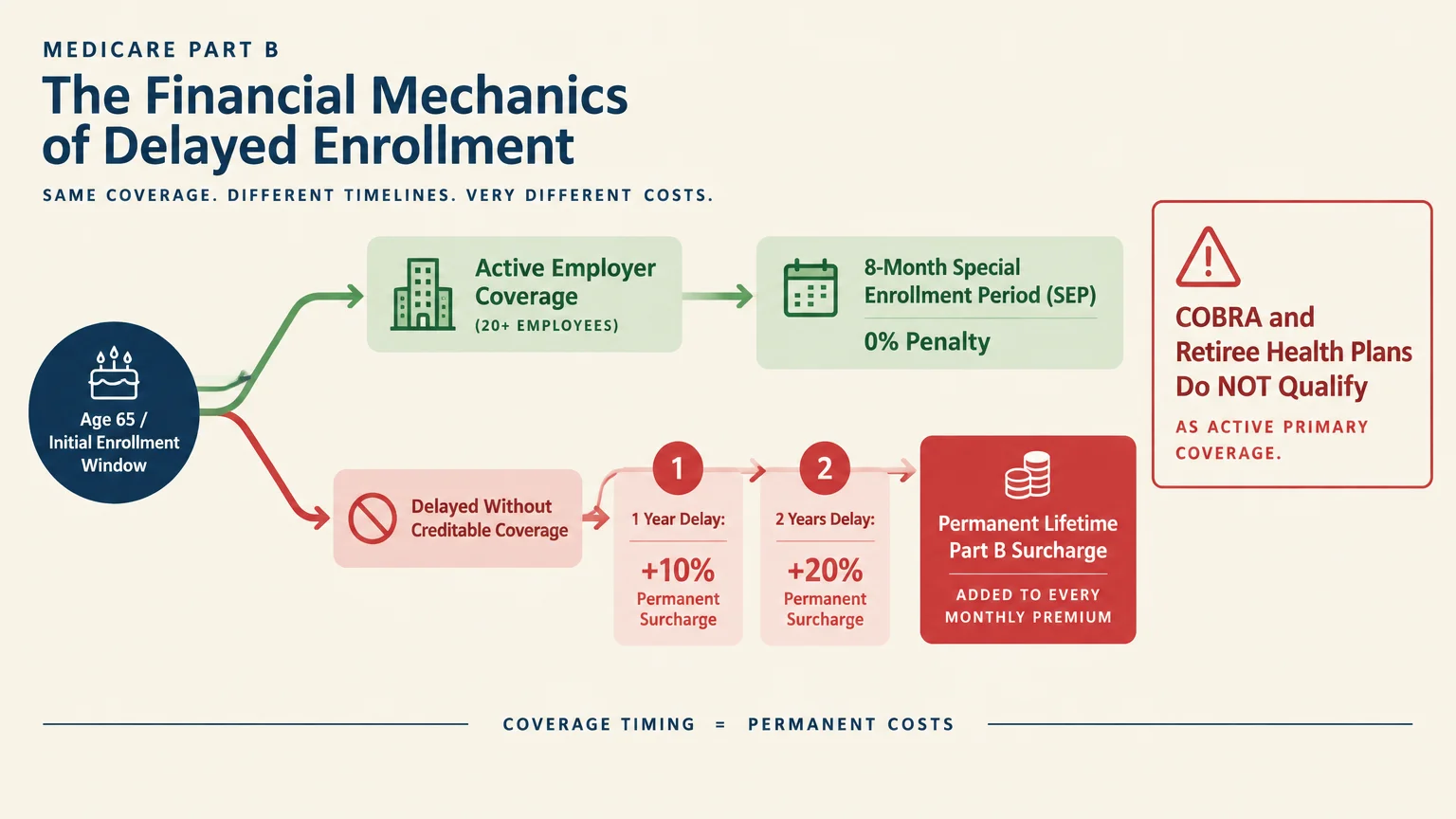
If you miss your initial enrollment window without qualifying group health insurance, the penalty accrues rapidly. The government adds a permanent ten percent surcharge for every full twelve-month period you delayed.
You must pay this extra surcharge on top of your standard monthly Part B premium every single month. If you delay enrollment for two full years, your monthly premium increases by twenty percent permanently.
This lifetime penalty never disappears, draining hundreds of dollars from your annual retirement budget. You can easily protect your savings by enrolling as soon as your initial eligibility begins.
Qualifying for Creditable Coverage
You can safely delay Part B enrollment if you or your spouse actively work and carry creditable employer coverage. The employer must employ at least twenty people for the coverage to qualify as primary insurance.
COBRA coverage and retiree health plans do not count as active employer insurance under federal guidelines. Leaving an employer plan triggers an eight-month Special Enrollment Period to sign up without penalty.
Confirm your coverage status in writing with your human resources department before your sixty-fifth birthday. This simple step keeps your monthly premiums low and eliminates costly administrative headaches.

Tip #3: Sidestep Lifetime Part D Drug Surcharges
Prescription medications represent a major expense for older adults, making drug coverage vital. Yet eighty percent of pre-Medicare adults remain unaware of the permanent Part D late enrollment penalty.
If you go sixty-three consecutive days or more without creditable drug coverage, Medicare assesses a monthly fee. The penalty equals one percent of the national base beneficiary premium for each uncovered month.
Medicare multiplies that percentage by the national base premium and adds it directly to your plan bill. Because this calculation recalculates annually, your penalty grows whenever national base premiums rise.
Even if you take no daily medications today, enrolling in a low-cost Part D plan preserves your rights. Doing so locks in continuous coverage and protects you from unforeseen prescription costs later.
Historic Drug Savings Under Current Law
Recent federal legislation has permanently transformed Medicare Part D coverage for the better. The frustrating coverage gap, widely known as the donut hole, is now officially and permanently eliminated.
Beneficiaries enjoy an annual out-of-pocket spending cap on covered medications of $2,100 in 2026. This cap adjusts to $2,400 in 2027, protecting you against runaway pharmaceutical costs.
Once you reach this annual spending ceiling, you pay zero dollars for covered drugs for the remainder of the calendar year. Furthermore, the maximum allowable Part D deductible is set at $615 in 2026 and rises to $700 in 2027.
Everyday maintenance medications also feature robust price protections that safeguard your budget. Covered insulin products are capped at $35 per month, while adult vaccines like shingles and RSV cost zero dollars out-of-pocket.

Tip #4: Guard Your Guaranteed-Issue Medigap Window
Medicare Supplement Insurance, or Medigap, helps pay the deductibles and coinsurance that Original Medicare leaves behind. Unfortunately, seventy-one percent of adults nearing retirement do not understand how Medigap enrollment rules operate.
Many people mistakenly assume they can buy a Medigap policy whenever they become sick. In reality, private insurance carriers can review your medical history and deny coverage outside your open window.
Your one-time Medigap Open Enrollment Period lasts exactly six months. This precious window begins automatically on the first day of the month you turn 65 and enroll in Part B.
During these six months, federal law grants you guaranteed-issue rights. Insurers must sell you any policy they offer without charging higher rates for pre-existing medical conditions.
The Danger of Medical Underwriting
If you apply for Medigap after this six-month period expires, insurers evaluate your comprehensive health records. Underwriters can legally charge substantially higher premiums, impose waiting periods, or decline your application completely.
A chronic condition like diabetes or heart disease could permanently prevent you from securing supplemental insurance. That is why planning your Medigap strategy before turning sixty-five remains one of your smartest financial moves.
Review standard plans like Plan G or Plan N to see how they match your anticipated healthcare needs. Securing your policy during the open window ensures reliable coverage regardless of how your health changes.
Tip #5: Recognize That Part A Deductibles Are Not Annual
One of the most persistent medicare myths involves the structure of hospital deductibles. Over eighty-five percent of quiz respondents incorrectly believe that the Part A deductible applies on an annual basis.
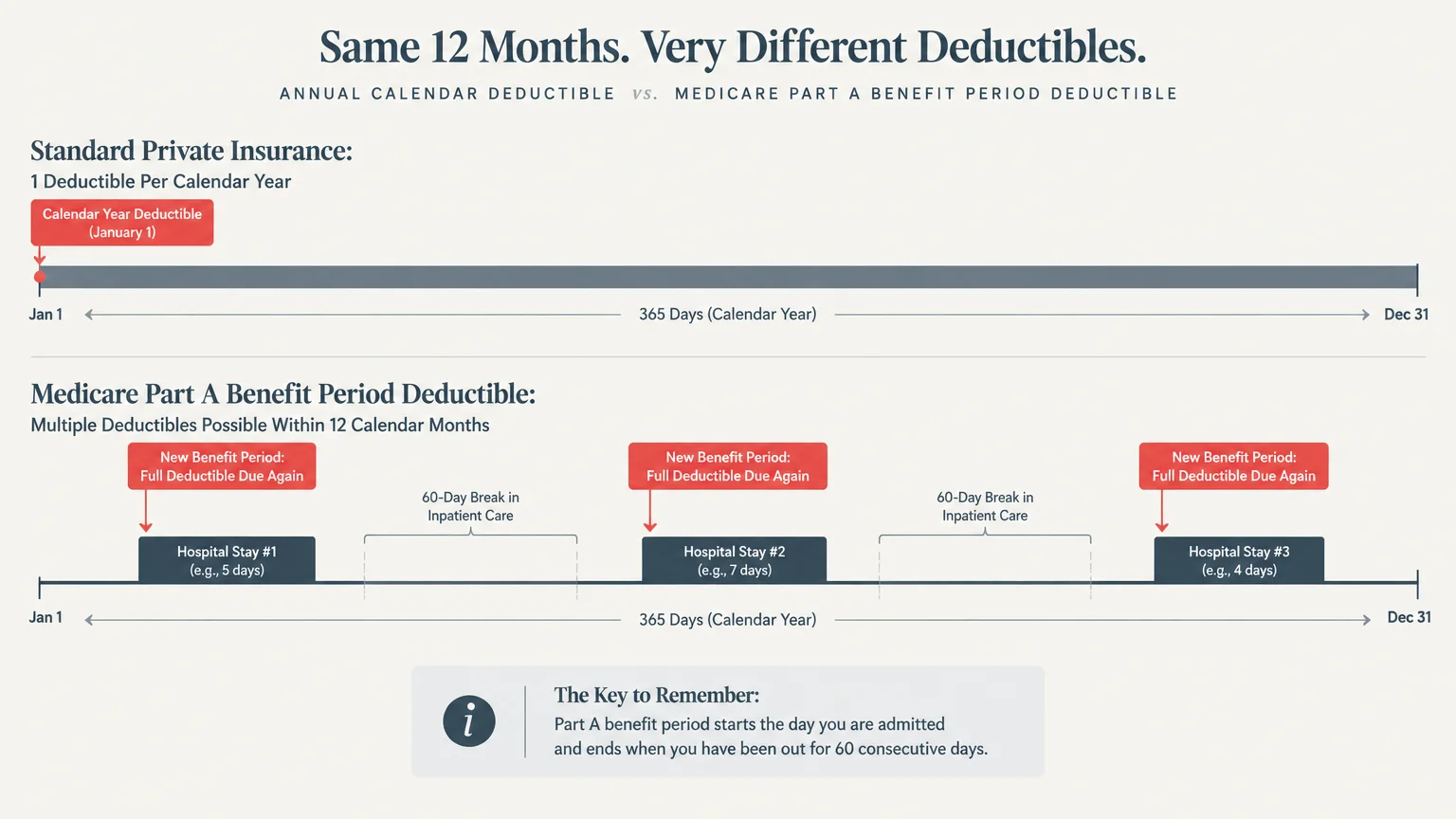
Under Original Medicare, you do not pay a single deductible for the entire calendar year. Instead, Part A charges an inpatient hospital deductible of $1,736 per benefit period in 2026.
A benefit period begins the day you enter a hospital or skilled nursing facility as an inpatient. It officially concludes only after you have lived sixty consecutive days without receiving inpatient hospital care.
If you leave the hospital and return sixty-one days later, a brand new benefit period begins immediately. You must pay another $1,736 deductible, meaning you could pay this substantial amount multiple times in a single year.
Hospital and Skilled Nursing Coinsurance Details
Hospital stays that extend beyond sixty days introduce heavy daily coinsurance fees that can rapidly escalate. For days one through sixty, you pay zero dollars in coinsurance after meeting your benefit period deductible.
For days 61 through 90, your inpatient hospital coinsurance costs $434 per day in 2026. Beyond day 90, you must use lifetime reserve days, which cost an eye-opening $868 per day.
Skilled nursing facility stays require careful tracking as well to avoid unexpected personal expenses. Medicare pays one hundred percent of skilled nursing costs for days one through twenty.
For days 21 through 100, you must pay $217 per day in skilled nursing coinsurance. After day 100, you pay all costs out of pocket, and Medicare never covers custodial nursing home care.

Tip #6: Protect Yourself From the Twenty Percent Coinsurance Gap
Original Medicare provides outstanding access to medical providers nationwide, but it contains a critical financial blind spot. Many retirees do not realize that Part B features no annual cap on your out-of-pocket medical expenses.
For outpatient services, you first satisfy the annual Part B deductible of $283 in 2026. This deductible is projected to rise modestly to $292 per year in 2027.
After meeting the deductible, Original Medicare pays eighty percent of approved medical charges. You remain personally responsible for the remaining twenty percent coinsurance with no ceiling whatsoever.
If you undergo a complex surgical procedure or receive expensive outpatient cancer therapy, that twenty percent can equal tens of thousands of dollars. Without supplementary protection, serious medical conditions can severely deplete your hard-earned retirement nest egg.
Bridging the Twenty Percent Coinsurance Gap
To shield yourself from unlimited financial exposure, you can choose between two main structural approaches. You can pair Original Medicare with a private Medigap policy, which pays that twenty percent coinsurance on your behalf.
Alternatively, you can choose a Medicare Advantage plan that integrates annual out-of-pocket safety caps. In 2026, the federal ceiling on in-network out-of-pocket expenses for Medicare Advantage stands at $9,250.
Evaluating your personal risk tolerance helps you choose the right balance of flexibility and cost certainty. Making an intentional choice guarantees that unexpected medical challenges will not jeopardize your financial security.
Tip #7: Plan Ahead for Income-Related IRMAA Surcharges
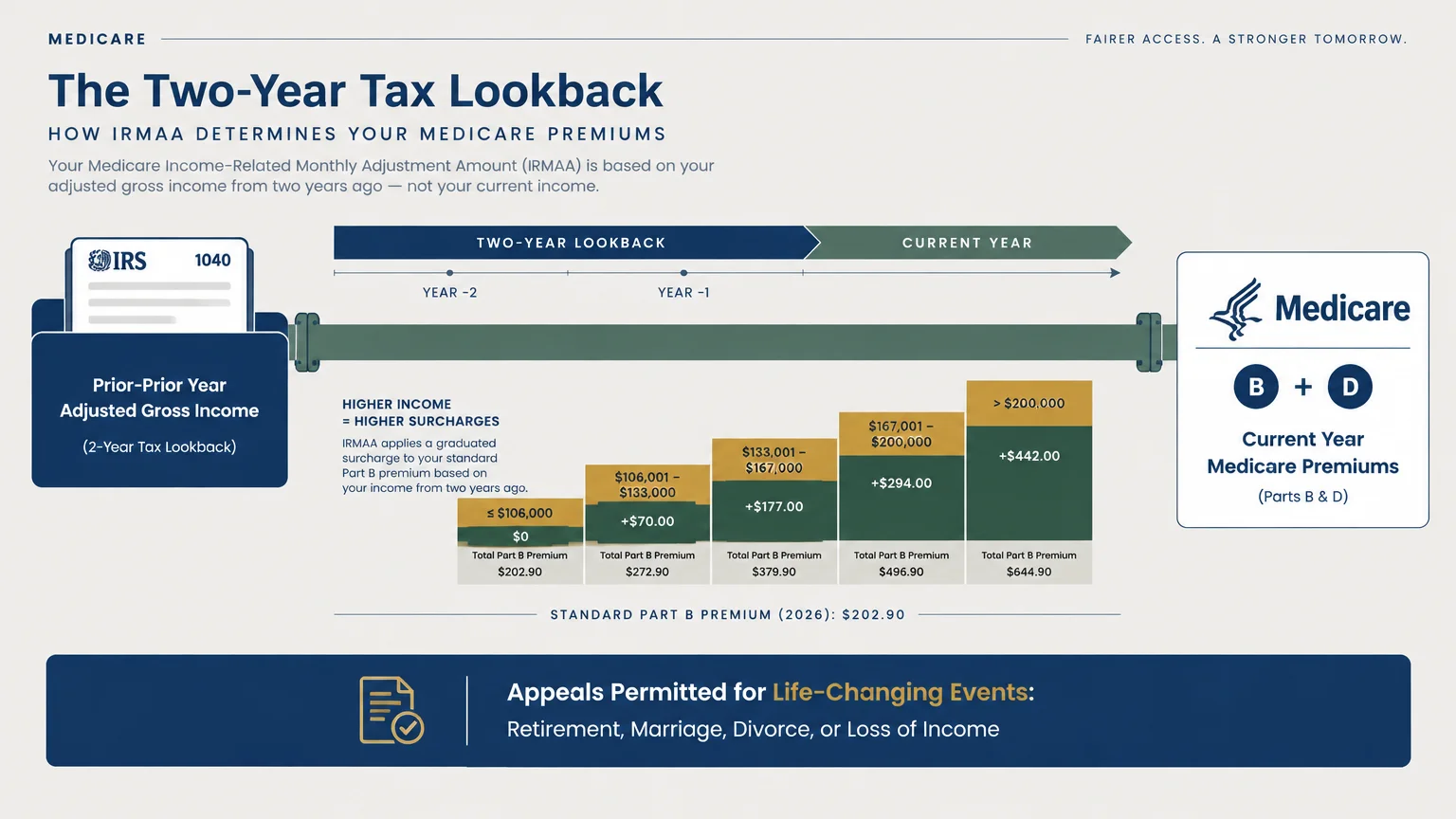
Many higher-earning retirees are shocked when their monthly Medicare bills arrive higher than expected. The Income-Related Monthly Adjustment Amount, known as IRMAA, adds extra surcharges to Part B and Part D premiums.
The Social Security Administration assesses IRMAA using your modified adjusted gross income from your tax return two years prior. In 2026, IRMAA thresholds begin at $109,000 for single tax filers and $218,000 for married couples filing jointly.
If your reported income from two years ago crosses these thresholds, you must pay tiered surcharges on your monthly coverage. This means a one-time financial event like selling property or executing a Roth conversion can trigger surcharges.
Carefully planning your taxable distributions in your early sixties can prevent you from crossing into higher surcharge brackets. Working alongside a trusted financial planner ensures your retirement income strategy remains highly tax-efficient.
Appealing Your IRMAA Determination
If your income dropped significantly since your tax return from two years ago, you do not have to accept the higher rate. The government allows you to appeal an IRMAA surcharge if you experienced a qualifying life-changing event.
Qualifying events include retirement, work reduction, marriage, divorce, or the death of an income-earning spouse. Selling personal investments or taking planned retirement withdrawals does not count as a valid reason for appeal.
To contest the surcharge, submit Form SSA-44 along with supporting documentation showing your current reduced income level. Many retirees successfully reduce their premiums back to standard rates by filing this straightforward appeal.
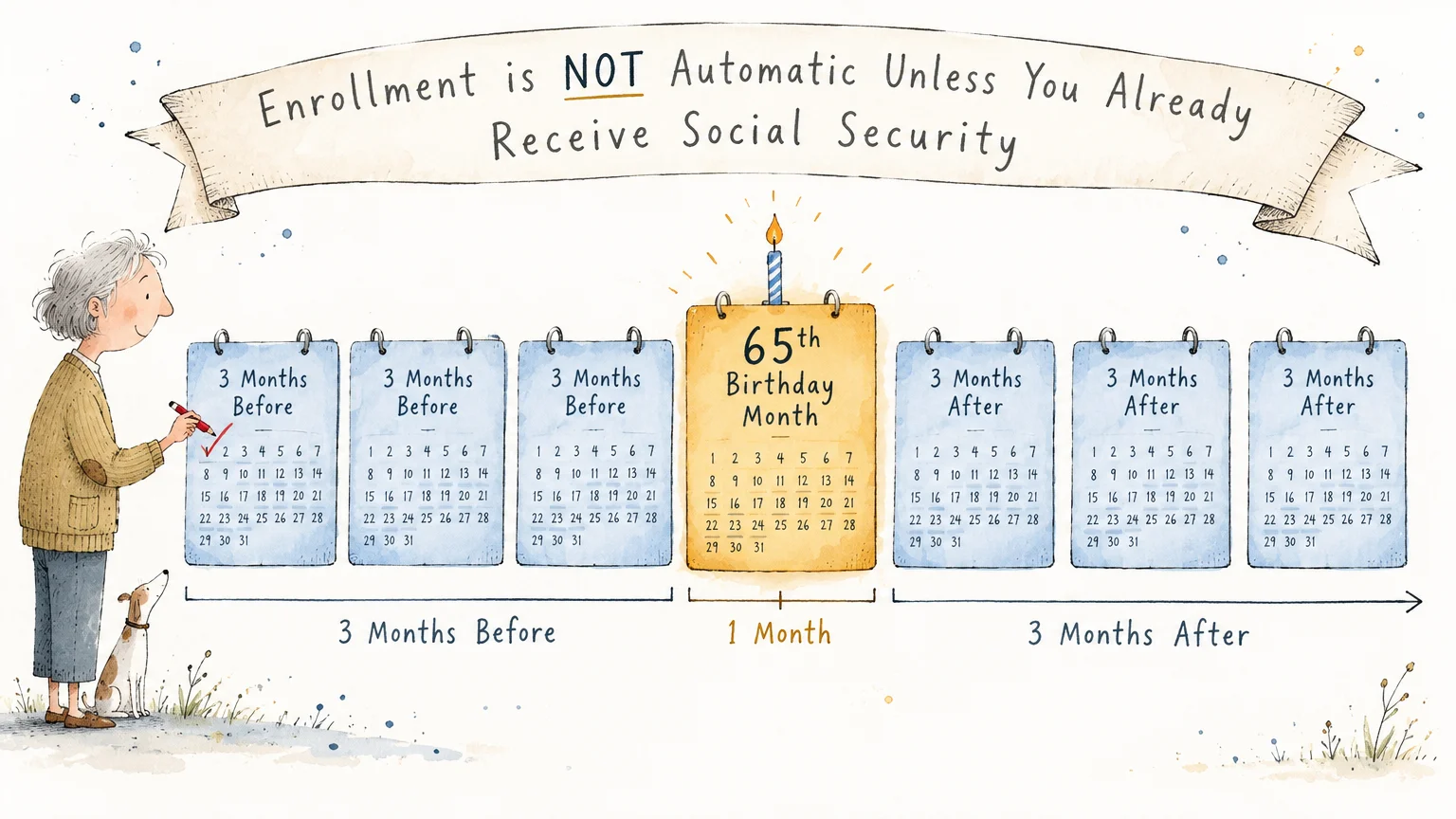
Tip #8: Know Your Critical Enrollment Deadlines and Automatic Myths
A widespread assumption among aging adults is that Medicare enrollment happens automatically on their sixty-fifth birthday. That assumption is true only for individuals who already receive Social Security retirement benefits.
You qualify for automatic enrollment only if you have collected Social Security for at least four months before turning 65. If you delayed Social Security benefits to maximize your payouts, you must take active steps to enroll yourself.
Your primary signing window is the Initial Enrollment Period, a dedicated seven-month timeline. This window spans three months before your birthday month, your sixty-fifth birthday month, and three months afterward.
Enrolling during the three months leading up to your birthday ensures your healthcare coverage activates on the first day of your birthday month. Waiting until your birthday month or later can delay your coverage start date and create stressful gaps.
Key Annual Enrollment Windows to Remember
Once you are enrolled in Medicare, specific annual periods allow you to review and adjust your coverage choices. The Annual Open Enrollment Period runs every fall from October 15 through December 7.
During this fall window, you can switch between Original Medicare and Medicare Advantage, or select a new Part D plan. Any coverage updates you choose take effect on January 1 of the following year.
If you enrolled in a Medicare Advantage plan and want to change your mind, another dedicated window exists. The Medicare Advantage Open Enrollment Period runs from January 1 through March 31 annually.
During this early-year window, you can switch to a different Medicare Advantage plan or return to Original Medicare. If you missed your initial signing window altogether, the General Enrollment Period runs from January 1 to March 31, with coverage starting the first of the following month.

The Takeaway: Living a More Blissful Retirement
Stepping into retirement should be an uplifting journey filled with joy, healthy adventures, and deep personal peace. Understanding the real facts behind Medicare frees you from confusing bureaucratic worry and unexpected financial surprises.
By mastering the four basic parts, you take complete ownership of your personal wellbeing and budget. You now possess the practical knowledge needed to avoid lifetime late penalties and costly coverage lapses.
Remember that healthcare planning is not a one-time chore, but an evolving part of your vibrant golden years. Take time each autumn to evaluate your medications, compare available plans, and verify network doctors.
When you feel confident in your medical safety net, you can focus on what truly matters in life. Embrace this exciting chapter knowing your health and retirement savings rest on a solid, informed foundation.
Frequently Asked Questions
What happens if I continue working past age 65?
If you work for an employer with twenty or more employees and have active group coverage, you can safely delay Part B. You will not face late enrollment penalties as long as your job-based health insurance remains creditable.
Once your employment or coverage ends, you qualify for an eight-month Special Enrollment Period to sign up. Always verify your plan’s creditable status with your benefits administrator before your sixty-fifth birthday.
Can I switch from Medicare Advantage back to Original Medicare?
Yes, you can drop your Medicare Advantage plan and return to Original Medicare during designated annual windows. The fall Annual Open Enrollment Period and the Medicare Advantage Open Enrollment Period both permit this change.
However, returning to Original Medicare does not guarantee you can purchase a Medigap supplement policy without medical underwriting. You may be required to pass health screenings unless you qualify for specific state or federal trial rights.
Does Medicare cover routine dental, vision, and hearing exams?
Original Medicare does not cover routine dental exams, cleanings, standard eyeglasses, contact lenses, or hearing aids. It only covers dental or vision care if it directly relates to an acute medical condition or emergency hospital treatment.
Many private Medicare Advantage plans include basic allowances for routine dental, vision, and hearing wellness services. If you choose Original Medicare, you can purchase separate standalone dental and vision insurance policies.
How do I qualify for premium-free Medicare Part A?
You qualify for premium-free Part A if you or your legal spouse paid Medicare payroll taxes for at least forty quarters. Forty quarters equals approximately ten full years of qualifying employment in the United States.
If you have between thirty and thirty-nine working quarters, you can purchase Part A for $311 per month in 2026. Beneficiaries with fewer than thirty quarters of work history pay the full monthly premium of $565 in 2026.
For a wide range of resources for older adults, visit AARP and the National Council on Aging (NCOA). Health information is available from the National Institute on Aging.
Disclaimer: This article is for informational and inspirational purposes only; it is not a substitute for professional medical, financial, or psychological advice. Please consult with a qualified expert for guidance tailored to your individual needs.