

Moving your retirement funds to a community financial cooperative can instantly eliminate unnecessary monthly maintenance charges. You keep more of your hard-earned money each month while enjoying superior customer care.
When you switch to a credit union, you step away from high-fee corporate banks. Instead, you enter an institution built entirely around serving your long-term financial security and personal peace of mind.
Exploring modern credit union perks helps you preserve your nest egg with absolute confidence. Discover how this simple banking shift can bring greater joy and financial wellness to your golden years.
Tip #1: Truly Free Checking and Lower Banking Fees
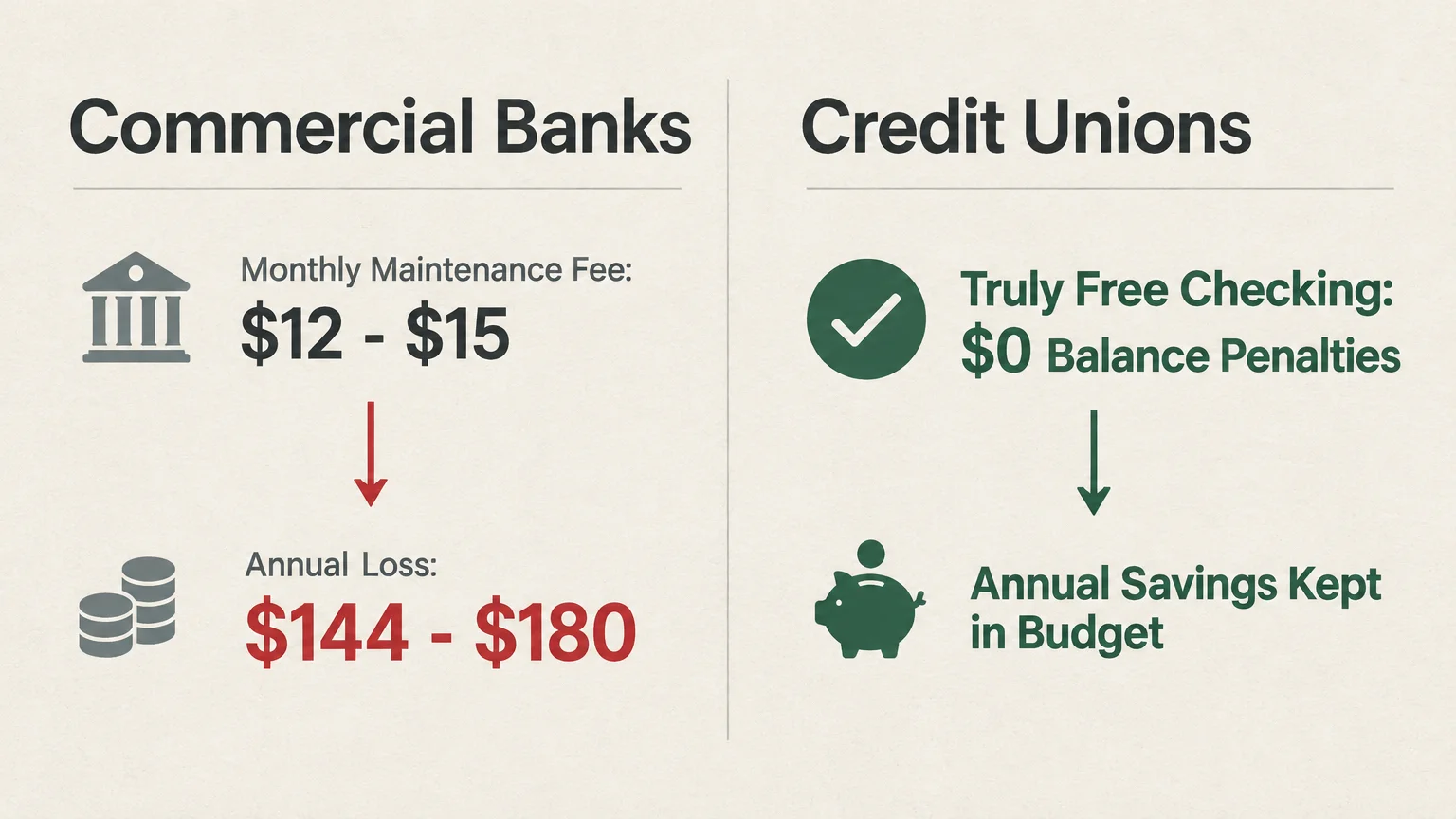
Commercial banks often charge monthly maintenance fees ranging from $12 to $15 just to keep an account active. Over a single year, these recurring expenses quietly siphon $144 to $180 away from your household budget.
Credit unions provide a refreshing alternative by offering truly free checking accounts without recurring balance penalties. You never have to worry about maintaining steep minimum balances just to avoid costly administrative charges.
Lower banking fees protect your hard-earned retirement nest egg. When you live on fixed pension or Social Security payments, preserving every single dollar gives you greater financial breathing room.
You will also encounter fewer administrative surprise fees for paper statements, balance inquiries, or routine customer service requests. Credit unions structure their everyday banking products to support your financial wellness rather than generate corporate revenue.
Many older adults discover that these eliminated fees add up to hundreds of dollars in annual savings. That extra cash can go toward dining out with friends or saving for holiday gifts.
By cutting out wasteful overhead, you retain total command over your daily finances. Financial peace of mind starts by stopping the steady drip of unnecessary bank fees.

Tip #2: Higher Yields on Share Certificates and Savings Accounts
Commercial institutions operate to maximize quarterly profits for outside stockholders. In contrast, credit unions operate as member-owned cooperatives that return excess earnings directly to you as member dividends.
Because of this cooperative model, savings accounts and Share Certificates consistently provide higher annual percentage yields than traditional bank products.
Data tracked by the National Credit Union Administration (NCUA) confirms this continuous dividend advantage. You will notice that credit union share certificates frequently outpace the national averages of big-box banks.
Even a modest percentage increase on your emergency fund or fixed-income reserves compounds meaningfully over time. You gain stronger returns without exposing your principal to volatile financial market swings.
These dependable earnings provide steady supplemental income throughout your retirement. You can ladder certificates of varying maturities to ensure regular cash flow while capturing higher available dividend rates.
Growing your cash safely lets you fund future travel plans and enjoy everyday retirement life with complete reassurance.
Your money works harder for you in an environment focused on cooperative prosperity rather than shareholder wealth.

Tip #3: Substantial Savings on Vehicle, Personal, and RV Loans
Many active retirees celebrate their golden years by purchasing a travel trailer, an RV, or a reliable new vehicle. Financing these purchases through a credit union can save you thousands of dollars in total interest.
Official NCUA comparative data shows that credit union auto and personal loan rates typically run 100 to 200 basis points lower than commercial bank rates. That translates to a full 1% to 2% interest reduction.
On a substantial purchase like a recreational vehicle or home remodeling loan, a 2% interest reduction saves hundreds of dollars each year. Those savings remain in your pocket rather than disappearing into commercial interest payments.
Furthermore, credit union loan officers assess your full financial picture rather than relying strictly on automated computer algorithms. They appreciate your lifetime credit history and work closely with you to establish comfortable monthly payment schedules.
Many institutions also offer flexible repayment schedules that align seamlessly with your monthly pension or Social Security disbursements. This personalized structuring helps prevent payment stress and supports healthy financial management.
You can embark on your cross-country road trips knowing you secured the most economical financing terms available.

Tip #4: Nationwide Convenience Through the CO-OP Shared Branch Network
A common hesitation retirees express about leaving a mega-bank is the fear of losing national branch access. Fortunately, credit unions solved this challenge through the cooperative CO-OP Shared Branch network.
This nationwide partnership links more than 5,600 participating credit union branches across all fifty states. You can walk into any member branch and conduct basic teller transactions exactly as you would at home.
You can deposit checks, withdraw cash, make loan payments, and transfer funds without paying guest transaction fees. The visiting branch teller accesses your home account securely in real time.
If you spend winters in warmer southern states as a “snowbird,” this shared network provides effortless banking convenience. You never have to close accounts or open temporary local bank relationships when you travel.
Visiting grandchildren across the country or exploring national parks never requires you to compromise your banking access. Friendly staff members at participating branches are ready to assist you wherever your journey leads.
Shared branching delivers the intimate charm of a neighborhood credit union alongside the geographic reach of a multinational conglomerate.

Tip #5: Expansive Surcharge-Free ATM Access Across the Country
Finding an ATM when you travel should never result in paying frustrating out-of-network terminal surcharges. As a credit union member, you gain access to the extensive CO-OP ATM network.
This network features more than 30,000 surcharge-free ATMs nationwide, surpassing the proprietary fleets of most commercial banking giants.
You can easily locate these fee-free terminals inside familiar everyday retail stores like Costco, Walgreens, and 7-Eleven. Withdrawing cash for the weekend farmers market or dining out remains quick and convenient.
Avoiding typical $3 to $5 out-of-network ATM penalties preserves your spending money for enjoyable outings. You keep full control over your day-to-day cash transactions wherever your adventures take you.
Mobile mapping apps provided by your institution make locating the nearest participating surcharge-free terminal simple and intuitive. You simply tap your smartphone screen to view nearby cash machines anywhere in America.
This broad ATM infrastructure ensures you never feel stranded or forced to pay fees just to access your own savings.
You enjoy effortless convenience while keeping your hard-earned dollars right where they belong.
Tip #6: Sensible Overdraft Protection and Minimized Penalty Fees
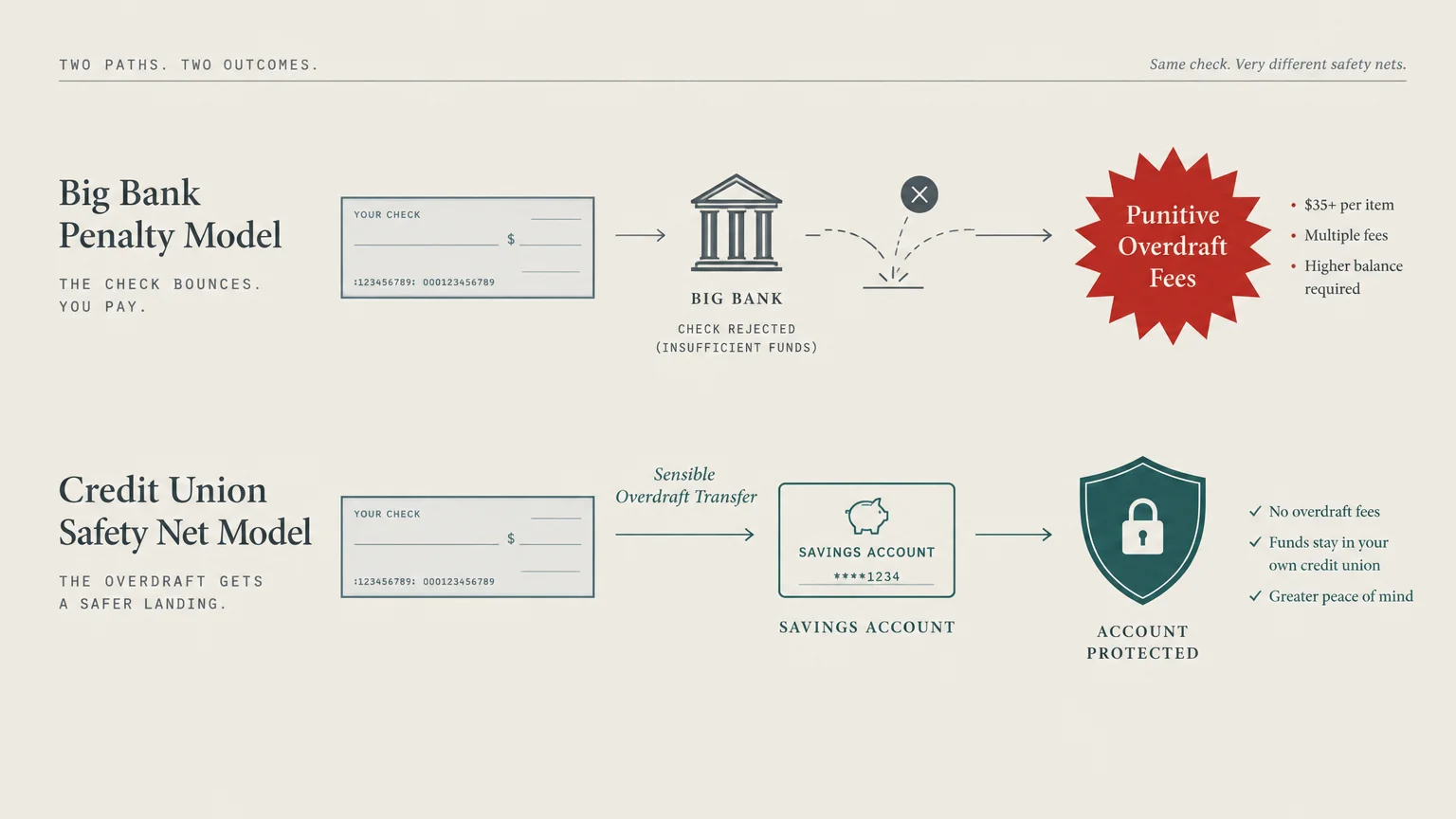
Missing a payment date or miscalculating an automatic utility debit should never lead to catastrophic penalties. Yet major commercial banks routinely charge punishing overdraft and non-sufficient fund fees averaging $25 to $35 per occurrence.
Credit unions adopt a far more compassionate and reasonable stance toward occasional administrative oversights. Penalty fees consistently average much lower—frequently between $20 and $28—while many modern credit union accounts charge $0.
In addition, credit unions routinely provide free or very low-cost overdraft transfer protection linked to your primary savings account. If an unexpected bill clears before your deposit arrives, money moves automatically without penalty.
This sensible safety net prevents small balance errors from cascading into costly financial headaches. You can manage your household finances with genuine confidence and far less stress.
Many institutions also offer opt-in text or email alerts to inform you before your balance dips too low. These proactive tools empower you to rectify balance mismatches before any fees occur.
Protecting your budget from aggressive penalty fees ensures your retirement income goes toward what truly matters to you.

Tip #7: Complimentary Everyday Services for Older Adults
Commercial institutions continually find new everyday banking services to monetize, from paper checks to basic notary stamps. Credit unions, by contrast, frequently offer valuable complimentary perks specifically designed for mature members.
Many credit unions provide free boxes of basic paper checks to members aged 55 or 60 and older. This small perk eliminates a persistent cost for seniors who prefer physical checks for paying household bills.
You also receive complimentary access to certified cashier’s checks and in-branch notary public services. These services simplify critical tasks when managing real estate transactions or updating your legal affairs.
Furthermore, many branches offer Medallion Signature Guarantees at no charge to established members. This specialized certification is vital when transferring mutual funds, handling stock certificates, or settling estate distributions.
Commercial banks often charge hefty fees or refuse to provide signature guarantees to ordinary account holders. Credit unions view these administrative services as natural extensions of cooperative member care.
Having these professional services available under one friendly roof saves you both time and substantial out-of-pocket expenses.

Tip #8: Complete Peace of Mind with Federal Deposit Insurance
Some retirees hesitate to switch financial institutions because they mistakenly believe credit unions lack federal safety guarantees. In reality, your savings enjoy identical federal protection to commercial bank deposits.
Federally chartered credit unions are backed by the National Credit Union Share Insurance Fund (NCUSIF). This independent federal insurance fund is managed directly by the National Credit Union Administration (NCUA).
Your deposits are insured up to $250,000 per share owner, per institution, across each separate account ownership category. This federal backing carries the exact full faith and credit of the United States government.
If you hold joint accounts, trust designations, or retirement accounts, your total coverage can easily exceed this baseline amount. You can organize your assets to protect substantial sums with complete security.
The NCUSIF maintains robust reserve ratios to safeguard deposits against unexpected economic turmoil. Not a single penny of insured savings has ever been lost by a member in an NCUA-insured credit union.
Knowing your life savings are safe from institutional failure lets you rest easy every single night.

Tip #9: Member-Owned Cooperative Culture and Personalized Care
The fundamental distinction in the credit union vs bank debate comes down to organizational ownership. When you join a credit union, you are not merely a customer; you are an equal voting owner.
Establishing your member-owner status requires only a nominal, refundable deposit known as a “par value share.” This deposit typically ranges from just $5 to $25 and stays safely in your savings account.
Because members elect the volunteer board of directors, the leadership answers to you rather than Wall Street analysts. This structural alignment shapes every policy, interaction, and community program the institution creates.
You will notice this difference immediately when you speak with branch representatives who treat you like a neighbor. They take the time to explain financial options without pushing high-commission financial products.
Many credit unions also provide free one-on-one financial wellness consultations to help you navigate estate planning, budgeting, or retirement cash flows. These dedicated counselors prioritize your long-term comfort and security.
You also support your local community, as credit unions reinvest deposits into neighborhood mortgages and small business development.
Experiencing genuine respect and warm personal attention makes your routine financial errands an uplifting part of your week.

The Takeaway: Living a More Blissful Retirement
Reaching your golden years represents an incredible milestone filled with freedom, leisure, and personal discovery. Managing your money during this chapter should bring peace of mind rather than unnecessary stress and unexpected fees.
Making the switch to a credit union is one of the simplest ways to streamline your monthly finances. You immediately access higher savings yields, lower borrowing rates, and compassionate customer service.
The collective strength of cooperative banking empowers you to preserve your wealth while supporting your community. You keep more money in your pocket to spend on family gatherings, travel, and rewarding passions.
As you weigh credit union benefits retirees enjoy, remember that taking charge of your finances creates enduring peace. Small changes in your banking habits yield magnificent rewards over decades of retirement bliss.
Take a moment today to explore the credit unions serving your local area or former employer group. Embracing this positive change will help you cultivate the vibrant, financially secure retirement you truly deserve.
Frequently Asked Questions
Is it difficult to qualify for membership at a credit union?
Qualifying for credit union membership is much simpler than most people think. While credit unions historically served specific employers or unions, modern field-of-membership rules are wide open.
Most institutions now welcome anyone living, working, worshiping, or attending school within defined geographic communities. Many also extend membership to family members of current account holders.
If you do not qualify through geographic location, many credit unions allow you to join through an affiliated non-profit association with a nominal donation.
How do credit unions compare to traditional banks regarding mobile and online banking?
Modern credit unions offer sophisticated online portals and mobile apps comparable to major national banks. You can deposit checks by smartphone, monitor balances, pay bills electronically, and transfer money with ease.
In fact, many credit unions partner with top-tier financial technology providers to deliver modern, secure digital experiences. You gain high-tech convenience without sacrificing high-touch customer care.
You can easily set up automated recurring transfers for monthly utility bills or retirement contributions. These seamless digital tools keep you in complete control from the comfort of home.
What happens to my credit union membership if I move to a different state?
Once you become a member of a credit union, you remain a member for life regardless of where you relocate. This guiding principle is often summarized as “once a member, always a member.”
Even if you move across the country, you can maintain your accounts without disruption. You can continue managing your finances via mobile banking, shared branches, and nationwide ATM networks.
You will never face account closures or penalties simply because your physical address changes in retirement.
Can I hold retirement accounts like IRAs at a credit union?
Yes, credit unions offer both Traditional and Roth Individual Retirement Accounts (IRAs) tailored to conservative retirement savers. These accounts often take the form of federally insured Share Certificates.
IRA deposits at federally insured credit unions receive separate NCUA insurance coverage up to $250,000 per member. This ensures your retirement nest egg remains completely shielded and steadily earns competitive dividends.
Financial specialists at your credit union can walk you through the transfer process step-by-step. They ensure your rollovers comply with all IRS regulations without creating unintended tax consequences.
For a wide range of resources for older adults, visit AARP and the National Council on Aging (NCOA). Health information is available from the National Institute on Aging.
Disclaimer: This article is for informational and inspirational purposes only. It is not a substitute for professional medical, financial, or psychological advice. Please consult with a qualified expert for guidance tailored to your individual needs.