

Navigating your Social Security benefits requires clear, accurate facts so you can maximize your retirement income and live with peace of mind. Unfortunately, pervasive misunderstandings clutter retirement planning, causing even seasoned financial advisors to repeat outdated advice that could cost you thousands of dollars. By separating social security facts vs fiction, you protect your hard-earned wealth and secure the comfortable lifestyle you deserve. Misunderstood social security rules often lead retirees to claim too early, delay unnecessarily, or pay unexpected federal taxes on their monthly benefits. Uncovering these common social security misconceptions empowers you to build a resilient financial plan tailored directly to your personal health, family situation, and lifelong aspirations.

Tip #1: Separate Fact from Fiction Regarding Social Security Solvency
One of the most persistent anxieties facing pre-retirees is the belief that Social Security will go completely broke before they can collect a single dime. Headline news frequently warns of impending fund exhaustion, leading many retirees to panic-claim their benefits at age 62 out of fear that the system will disappear. This widespread misconception causes millions of people to permanently slash their monthly income by up to 30% compared to waiting for their Full Retirement Age.
Understanding the actual mechanics of the system provides immense peace of mind. According to the Social Security Board of Trustees, the combined Old-Age and Survivors Insurance and Disability Insurance (OASDI) Trust Fund reserves are projected to become depleted around 2034, with the standalone retirement fund facing depletion around 2032 to 2033. However, depletion of the trust fund reserves does not mean the program shuts its doors; Social Security operates primarily as a pay-as-you-go system funded by current workers through Federal Insurance Contributions Act (FICA) taxes. Workers and employers each contribute 6.2% of wages up to the maximum taxable earnings limit of $184,500.
Even if Congress were to pass no legislation whatsoever between now and the depletion date, incoming payroll tax revenues would still cover approximately 77% to 83% of scheduled benefits. Furthermore, lawmakers historically enact bipartisan reforms—such as adjustments to the maximum wage base or gradual shifts in retirement ages—well before catastrophic shortfalls occur. When you analyze social security facts vs fiction, you see that the program will remain a reliable foundation for your golden years. Base your claiming timing on your health, lifestyle, and income needs rather than media-driven financial panic.
For a wide range of resources for older adults, visit AARP and the National Council on Aging (NCOA). Health information is available from the National Institute on Aging.

Tip #2: Understand How Working Before Full Retirement Age Affects Payouts
Many active seniors choose to consult, launch a small business, or work part-time during their early retirement years. However, a widespread myth claims that working while collecting Social Security permanently forfeits your benefit check if you earn over a strict threshold. This misunderstanding stems from a complete misinterpretation of the Social Security Earnings Test.
If you choose to claim benefits prior to reaching your Full Retirement Age—which is 67 for individuals born in 1960 or later—the Social Security Administration enforces an annual earnings limit. Under current guidelines, the earnings limit stands at $24,480. If your earned income from job wages or self-employment exceeds this limit, the Social Security Administration temporarily withholds $1 in benefits for every $2 earned above the threshold. During the specific calendar year in which you reach Full Retirement Age, a higher earnings limit of $65,160 applies, with $1 withheld for every $3 earned above the limit prior to the month of your birthday.
The vital truth that many financial advisors overlook is that withheld money is never permanently lost. These misunderstood social security rules simply act as an enforced savings vehicle. Once you attain your Full Retirement Age, the Social Security Administration automatically recalculates your monthly benefit upward; they credit back every single withheld dollar by increasing your baseline monthly check for the rest of your life. Working in early retirement keeps your mind sharp, keeps you socially connected, and ultimately enhances your future guaranteed lifetime income.
For comprehensive guidance on managing lifestyle changes and senior wellness, consultation with trusted organizations like National Council on Aging (NCOA) offers tailored support.
Tip #3: Recognize That Delaying Until Age 70 Isn’t Universal Best Practice
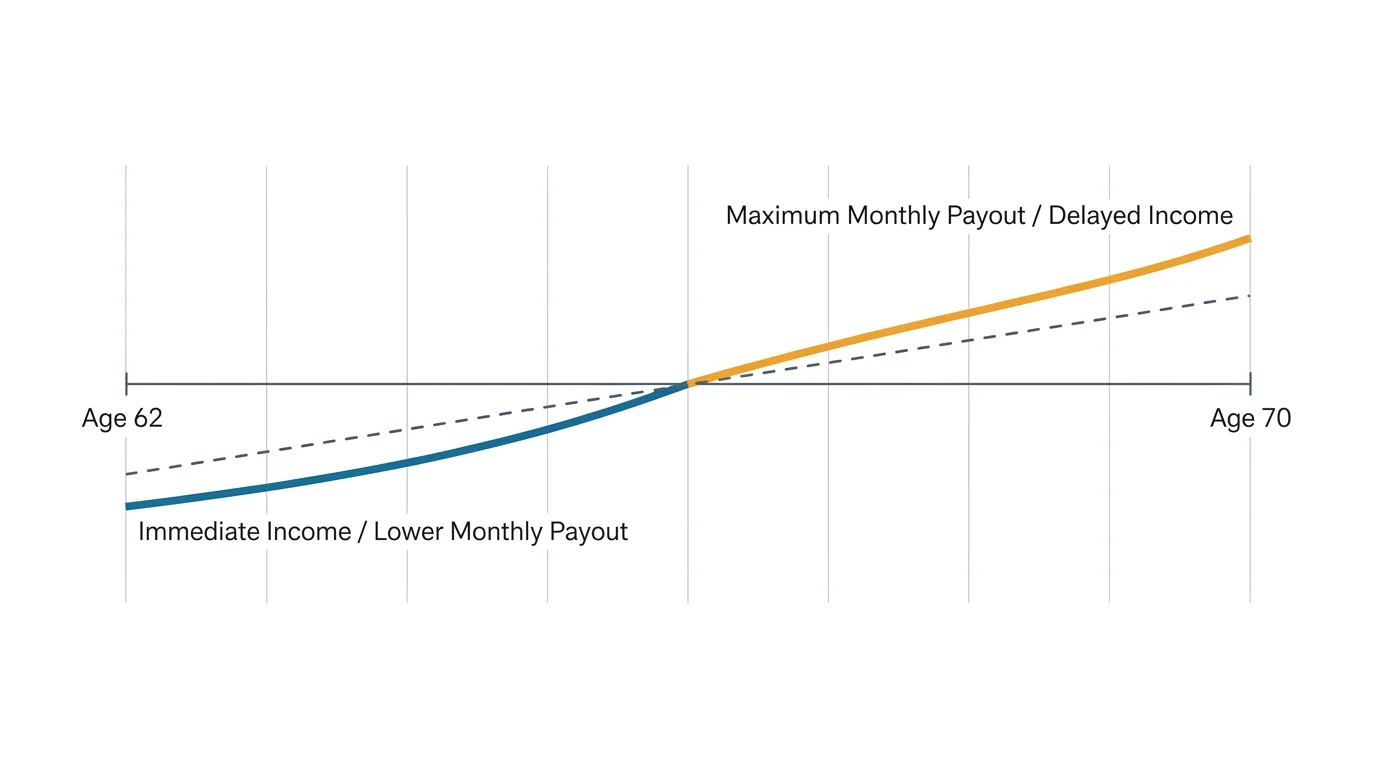
A standard piece of advice handed out by financial planners is to wait until age 70 to claim Social Security, no matter what. The mathematical logic seems sound at first glance: delaying your claim past your Full Retirement Age earns you Delayed Retirement Credits. These credits boost your payout by 8% per year until you turn 70, resulting in a maximum monthly check that is up to 24% higher than your Full Retirement Age amount.
However, blindly following this rule ignores your individual health status, family history, personal fulfillment, and immediate financial opportunities. Having social security myths debunked requires looking at the overall picture of your life rather than purely optimizing a single monthly check on paper. The breakeven age—the point where total cumulative dollars collected by waiting until age 70 overtake total cumulative dollars collected by claiming earlier at age 62 or 67—typically falls between age 78 and age 80.
If you experience health challenges in your early seventies, waiting until age 70 could mean leaving tens of thousands of dollars on the table that could have funded travel, home improvements, or quality time spent with grandchildren. Furthermore, claiming benefits earlier allows you to leave your investment portfolios intact during market dips, preserving capital for your long-term legacy. If you have personal health concerns or simply wish to enjoy an active lifestyle while your mobility is highest, claiming earlier at FRA or age 62 can be the smartest, most empowering decision you make.
Explore healthy aging facts and lifestyle recommendations provided by the National Institute on Aging to support your retirement decision-making.

Tip #4: Know Your True Ex-Spousal Benefit Rights
Navigating divorce involves complex financial reorganizations, yet many single seniors overlook one of the most lucrative benefits available to them: ex-spousal Social Security claims. Misunderstood social security rules lead thousands of eligible retirees to assume that claiming benefits based on an ex-spouse’s work record requires permission, causes awkward drama, or reduces the ex-spouse’s own benefit payment.
In reality, the rules surrounding ex-spousal claims are simple, clear, and non-intrusive. To qualify for ex-spousal benefits, you must meet four straightforward criteria:
First, your marriage must have lasted for at least 10 consecutive years. Second, you must currently be unmarried. Third, you must be at least 62 years old. Fourth, your ex-spouse must be entitled to Social Security retirement or disability benefits. If you qualify, you can receive up to 50% of your ex-spouse’s Full Retirement Age benefit amount if that amount is higher than your own personal work record benefit.
Crucially, claiming on an ex-spouse has zero effect on your ex-spouse’s monthly check or the benefits of their current partner. Furthermore, the Social Security Administration strictly protects your privacy. They do not notify your ex-spouse when you file a claim, nor do they require any authorization or contact with your former partner. Uncovering common social security misconceptions ensures that you claim every single dollar you earned through your years of marriage without hesitation or unnecessary stress.
Staying informed on updated policy changes through reliable channels like AARP helps protect your financial rights throughout your golden years.

Tip #5: Prepare for Federal Tax Impacts on Your Monthly Benefit
Many pre-retirees assume that Social Security checks arrive completely tax-free. Discovering that up to 85% of your benefits can be subject to federal income taxes comes as a jarring shock to unsuspecting retirees. When reviewing social security myths 2027 forecasts and current tax codes, managing taxation becomes an essential pillar of maintaining your retirement lifestyle.
The Internal Revenue Service calculates taxability based on a formula called your combined income. Combined income is calculated as your Adjusted Gross Income (AGI), plus non-taxable interest income, plus 50% of your total annual Social Security benefits. If your combined income crosses specific, unindexed thresholds, taxability kicks in:
For individual tax filers, a combined income between $25,000 and $34,000 makes up to 50% of your Social Security benefits subject to federal income tax. If your combined income exceeds $34,000, up to 85% becomes taxable. For married couples filing jointly, a combined income between $32,000 and $44,000 triggers up to 50% taxability, while income exceeding $44,000 exposes up to 85% of your benefits to taxation.
Because these tax thresholds were enacted in 1983 and 1993 without inflation adjustments, regular cost-of-living adjustments push more seniors into tax territory every year. Fortunately, strategic planning allows you to mitigate this tax trap. By executing Roth IRA conversions before claiming Social Security or managing withdrawals from taxable retirement accounts, you keep your combined income low and preserve your take-home pay.
For additional resources on senior financial planning and community assistance programs, visit the National Council on Aging (NCOA).

The Takeaway: Living a More Blissful Retirement
Retirement offers an unprecedented opportunity to embrace personal freedom, explore passion projects, and enjoy meaningful time with loved ones. Achieving financial peace of mind starts by clearing away confusing myths and mastering the real rules that govern your benefits. When you take control of your financial destiny, you replace fear with confidence and certainty.
Remember that Social Security is not a passive lottery ticket; it is a vital, dynamic tool designed to work alongside your personal savings and overall lifestyle goals. Whether you decide to work part-time, claim early to travel while your energy is highest, or coordinate ex-spousal benefits to maximize household income, your choices should serve your happiness. By staying informed, challenging generic advice, and acting on verified facts, you unlock the full potential of your golden years and step into a joyful, secure future.
Learn more about aging well and maintaining wellness through updates from the National Institute on Aging and AARP.
Frequently Asked Questions
How does my Full Retirement Age (FRA) affect my monthly benefit check?
Your Full Retirement Age (FRA) is the age at which you are entitled to receive 100% of your earned primary insurance benefit. For anyone born in 1960 or later, FRA is age 67. Claiming as early as age 62 permanently reduces your monthly check by up to 30%, whereas delaying past FRA earns you Delayed Retirement Credits of 8% per year up to age 70.
What happens if I continue working after I start collecting Social Security?
If you work while collecting benefits after reaching your Full Retirement Age, your earnings will not reduce your benefits regardless of how much you earn. If you work before reaching your FRA and earn more than the annual limit ($24,480 in 2026), the Social Security Administration temporarily withholds a portion of your benefits. However, those withheld funds are recalculated and added back to your monthly check starting at your FRA.
Can I collect Social Security on my ex-spouse’s record if they have not retired yet?
Yes, provided you meet the eligibility criteria: you were married for at least 10 consecutive years, you are currently unmarried, you are at least 62 years old, and you have been divorced for at least two continuous years. If those conditions are met, you can claim ex-spousal benefits even if your ex-spouse has not yet filed for their own benefits.
Are Social Security benefits automatically adjusted for inflation every year?
Yes, Social Security benefits include an annual Cost-of-Living Adjustment (COLA) calculated using the Consumer Price Index. These adjustments help preserve your purchasing power against rising prices, ensuring that your benefits keep pace with inflation throughout your retirement years.
Disclaimer: This article is for informational and inspirational purposes only. It is not a substitute for professional medical, financial, or psychological advice. Please consult with a qualified expert for guidance tailored to your individual needs.