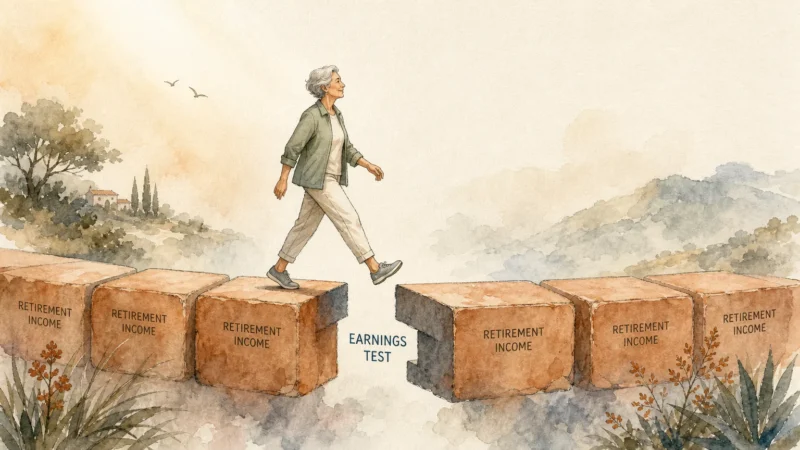

You can unlock tax-free income for your retirement by using the hidden Roth features inside your 401(k) plan today. Taking strategic action now protects your hard-earned nest egg from future tax hikes and costly penalties.
Recent legislative updates create unprecedented wealth-building opportunities for savers who are age 50 and older. Mastering these updated guidelines gives you total control over your financial destiny and your golden years.
Learning how to navigate these options before 2027 allows you to shelter thousands of extra dollars from the IRS. You deserve complete peace of mind as you prepare for an inspiring and joyful retirement.
Tip #1: Discover Your Plan’s Voluntary After-Tax Window
Many dedicated workers assume their retirement savings hit a ceiling once they reach the standard employee deferral limit. In reality, your workplace plan may contain a hidden doorway to substantial additional savings.
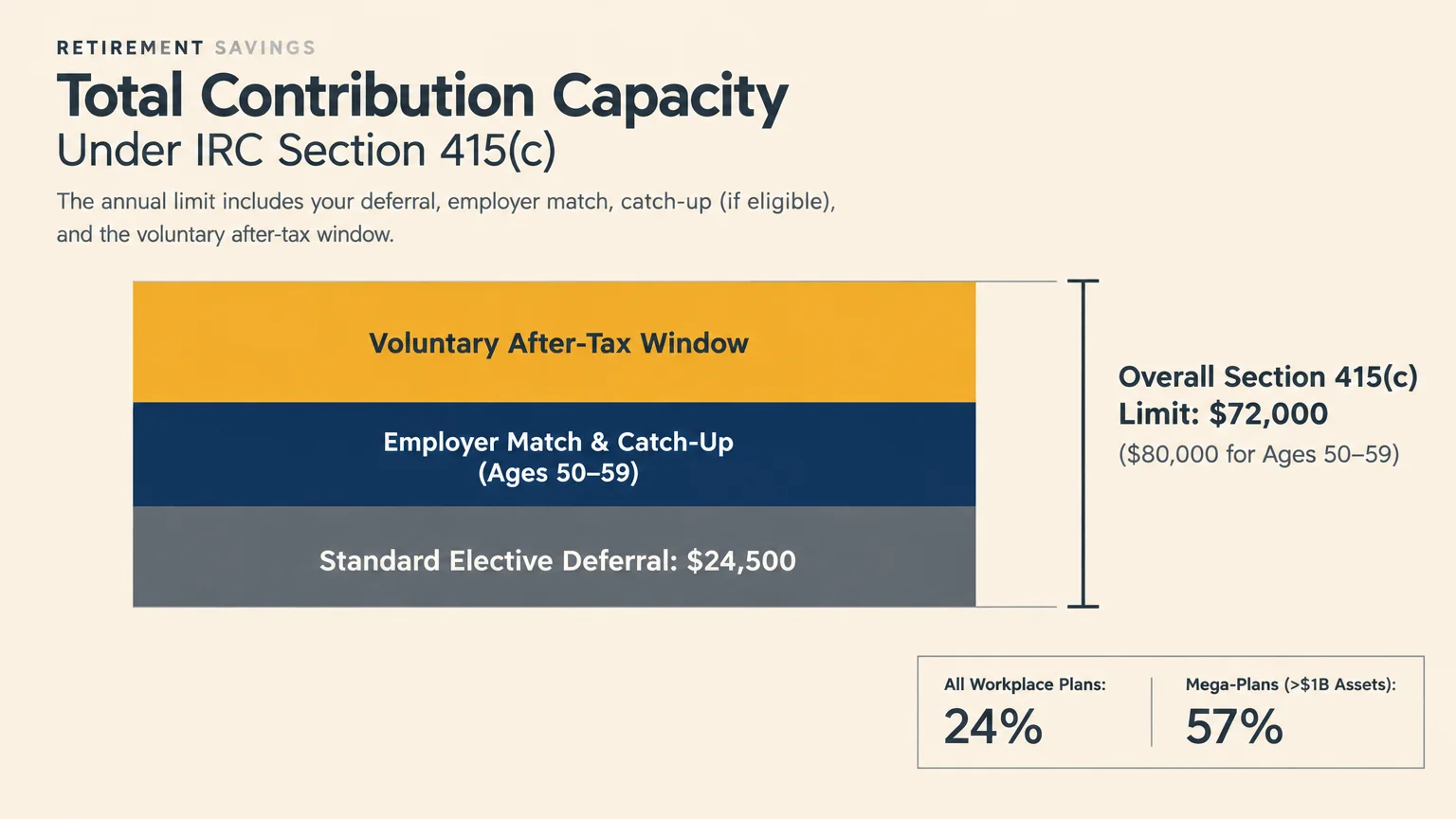
For 2026, the standard elective deferral limit is $24,500. This threshold represents the combined cap on your standard pre-tax and designated Roth contributions.
If you are age 50 or older, you can also contribute standard catch-up dollars. Yet even with catch-ups in place, you might possess room for significant extra savings.
A voluntary after-tax contribution option functions completely apart from traditional and Roth deferrals. This feature allows you to contribute personal earnings from your paycheck after ordinary income taxes have been deducted.
The IRS oversees these supplemental contributions under Internal Revenue Code Section 415(c). This specific section dictates the overall annual additions limit across all retirement account sources.
For 2026, the overall annual additions limit reaches an extraordinary $72,000. That massive sum encompasses your employee salary deferrals, employer matching contributions, and any voluntary after-tax dollars you contribute.
Catch-up contributions permit older participants to expand that total ceiling even further. Savers aged 50 to 59 can reach an aggregate contribution ceiling of $80,000 for the year.
Many participants never discover this powerful savings vehicle because employers rarely highlight it during open enrollment. Administrators often bury these crucial details inside dense, hundred-page plan documents.
Industry data reveals that approximately 24% of all workplace retirement plans offer voluntary after-tax contributions. Among mega-plans with over $1 billion in assets, roughly 57% include this valuable option.
You can uncover this opportunity by reviewing your Summary Plan Description or logging into your benefits portal. Checking your plan options today can reveal thousands of dollars in untapped savings capacity.
If your company provides this feature, you possess a rare and valuable wealth-building asset. You can supercharge your retirement readiness well beyond ordinary contribution boundaries.
Tip #2: Master the In-Plan Roth Conversion Strategy
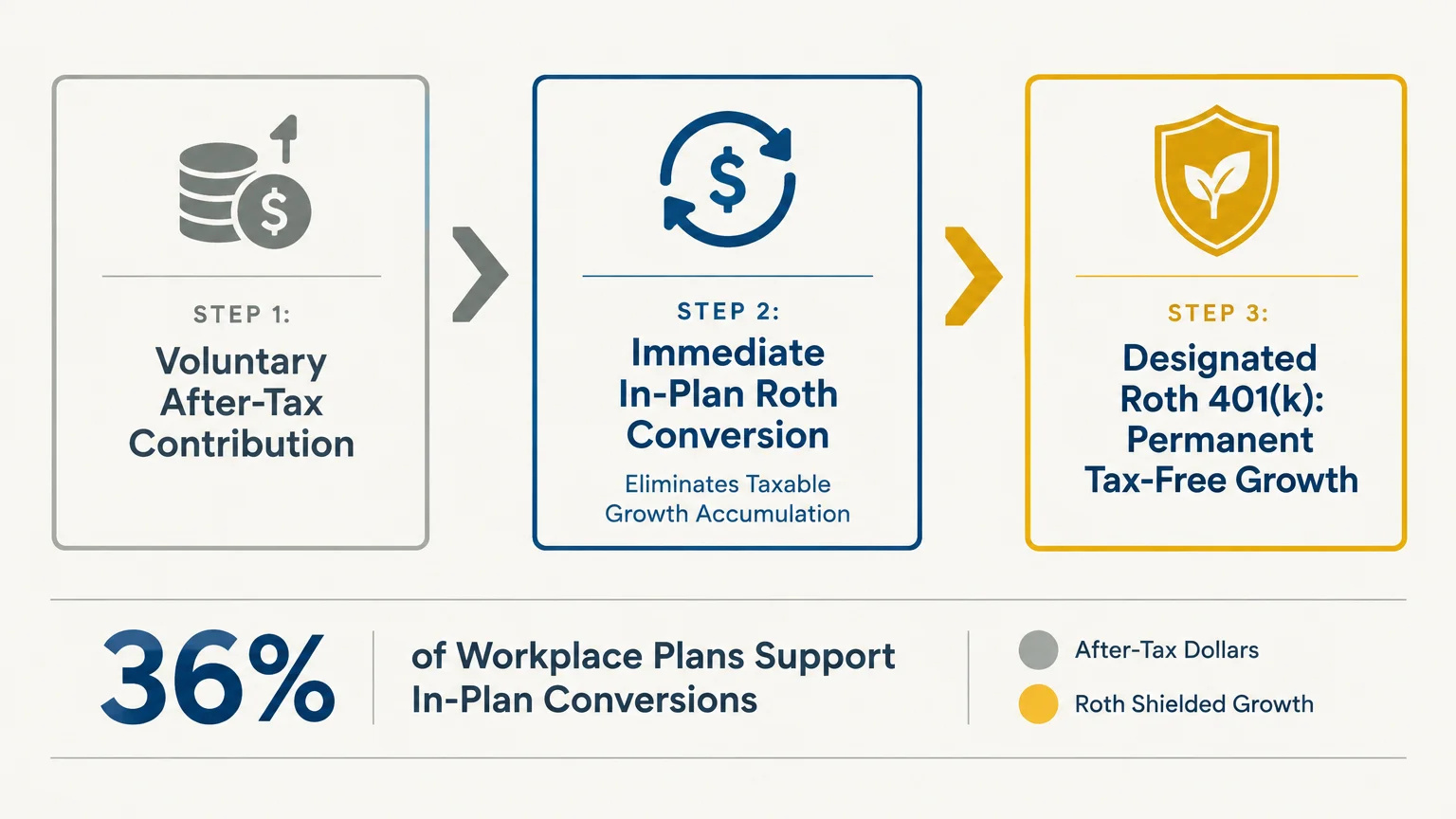
Depositing funds into an after-tax account marks only the opening step of an effective wealth strategy. You must take deliberate action to shield your investment growth from taxation.
If you leave after-tax dollars sitting in a conventional account, the accrued investment earnings eventually trigger taxes upon distribution. That taxable burden can significantly diminish your compounding growth over time.
You resolve this challenge by executing an in-plan roth conversion as soon as your contribution lands. This transaction moves your after-tax dollars directly into a designated Roth account within your plan.
Financial specialists commonly refer to this two-step process as the mega backdoor Roth strategy. It allows proactive savers to accumulate massive pools of tax-free capital every calendar year.
Industry statistics show that roughly 36% of workplace retirement plans now support in-plan conversions. Furthermore, about 10% of plans offer automated conversions that switch your funds instantly without paperwork.
Automating your conversions prevents after-tax deposits from generating taxable interest or dividends before they transfer. This automated approach keeps your annual tax reporting exceptionally straightforward and clean.
Direct contributions to a Roth IRA feature strict income phaseouts that disqualify many successful professionals. For 2026, single filers face an income phaseout between $153,000 and $168,000.
Married couples filing jointly experience phaseouts between $242,000 and $252,000 for standard Roth IRA deposits. Earning above these limits blocks you from making direct contributions entirely.
In pleasant contrast, an in-plan Roth conversion carries no income caps whatsoever. You can execute this maneuver regardless of how much income you take home during the year.
This unrestricted access makes the conversion strategy ideal for high-earning seniors aiming to fortify their nest egg. You convert your earnings into permanent, tax-exempt retirement income.
Speaking with your benefits coordinator provides the exact paperwork or online clicks necessary to initiate your conversions. Taking this simple step ensures maximum tax protection for your hard-earned dollars.

Tip #3: Maximize Your Super Catch-Up Limits Before Age 64
Older professionals enjoy remarkable opportunities to bolster their retirement portfolios as their working years wind down. The tax code provides special catch-up rules structured specifically for your stage of life.
For 2026, the standard catch-up contribution is $8,000 for workers aged 50 to 59. This allowance raises your personal employee deferral limit to $32,500 for the year.
The SECURE 2.0 Act introduced a groundbreaking super catch-up contribution for individuals aged 60 to 63. This provision recognizes that these specific years represent your final sprint toward a fulfilling retirement.
If you fall within this favored age bracket, your catch-up contribution limit jumps to $11,250 in 2026. This expanded limit replaces the standard $8,000 catch-up amount.
By capturing this enhanced allowance, you can defer up to $35,750 of your salary directly into your plan. That represents an astonishing level of tax-advantaged savings in a single year.
When combined with employer matching contributions, your total annual plan additions ceiling can reach $83,250. This creates an unparalleled environment for accelerating your wealth accumulation before retirement.
You must monitor your birthday with precision because this special super catch-up window remains temporary. The eligibility period closes permanently during the calendar year in which you reach age 64.
Once you enter the year you turn 64, your allowable catch-up contribution automatically reverts to $8,000. Acting decisively during your early sixties ensures you capitalize on every dollar available.
Directing these super catch-up dollars into your designated Roth account delivers extraordinary lifetime rewards. You build a deep reservoir of tax-exempt distributions that will sustain your golden years.
Contact your payroll department to confirm your contribution percentages align with these elevated limits. Adjusting your withholdings now guarantees you capture the full measure of this legislative benefit.

Tip #4: Navigate Mandatory Roth Catch-Up Rules Before 2027
Important changes to federal retirement laws require higher-earning workers to modify their savings strategies promptly. Understanding these shifting regulations prevents costly surprises and keeps your retirement plan on track.
Under Section 603 of the SECURE 2.0 Act, high earners must allocate their catch-up contributions to a Roth account. This mandate eliminates the traditional pre-tax deduction on catch-up dollars for affected employees.
This requirement applies to any worker whose prior-year FICA wages from their employer exceeded $150,000. You can easily verify this wage amount in Box 3 of your Form W-2.
The IRS established an initial transition period that permits employers to operate under reasonable, good-faith compliance guidelines. For 2026, administrators can also reference Medicare wages in Box 5 for operational ease.
However, final IRS regulations released in September 2025 formally take strict legal effect on January 1, 2027. Employers must enforce every technical requirement without flexibility once that firm date arrives.
A significant danger exists for high-earning workers whose workplace plans do not offer a designated Roth 401(k) option. If a plan lacks a Roth option, high earners cannot make any catch-up contributions whatsoever.
Fortunately, between 78% and 86% of workplace retirement plans currently offer a designated Roth feature. Plan sponsors continue adding Roth choices rapidly to protect their employees from losing catch-up privileges.
Structuring your roth contributions before 2027 guarantees that you preserve your contribution momentum without interruption. You avoid abrupt payroll adjustments while locking in long-term tax advantages for your golden years.
Check with your human resources team today to ensure your plan includes an active Roth election. Taking this proactive step gives you complete clarity as new federal rules take full effect.

Tip #5: Start Your Five-Year Aging Clock Before December 31, 2026
Receiving tax-free distributions from your Roth account requires meeting two essential conditions defined by the tax code. Understanding these rules ensures your retirement withdrawals remain completely exempt from IRS scrutiny.
First, you must reach age 59½ before withdrawing your investment earnings tax-free. Second, you must satisfy the statutory five-year aging rule.
The five-year clock begins running the moment you make your very first designated Roth contribution or conversion. It measures how long your funds have matured under tax-advantaged status.
Contributing or converting even a single dollar before December 31, 2026, activates your aging clock immediately. The IRS treats that transaction as occurring retroactively on January 1, 2026.
This retroactive tax rule provides an entire year of aging credit right from the start. You significantly accelerate your journey toward enjoying completely tax-free earnings in retirement.
Unlike Individual Retirement Accounts, workplace 401(k) plans enforce a strict calendar deadline of December 31 for each tax year. You cannot make retroactive workplace contributions during the spring tax season.
Missing the December 31 payroll cutoff delays your five-year qualification milestone by an entire twelve months. That preventable delay can restrict your financial flexibility during the early stages of retirement.
Initiating your first Roth contribution today guarantees that your five-year aging clock begins ticking immediately. You unlock complete financial freedom for your future distributions without unnecessary delay.
Even if you plan to save modest amounts initially, establishing that Roth foothold is vital. You set a powerful legal precedent that serves your wealth for decades to come.
Tip #6: Balance Roth vs Traditional 401(k) to Protect Your Income
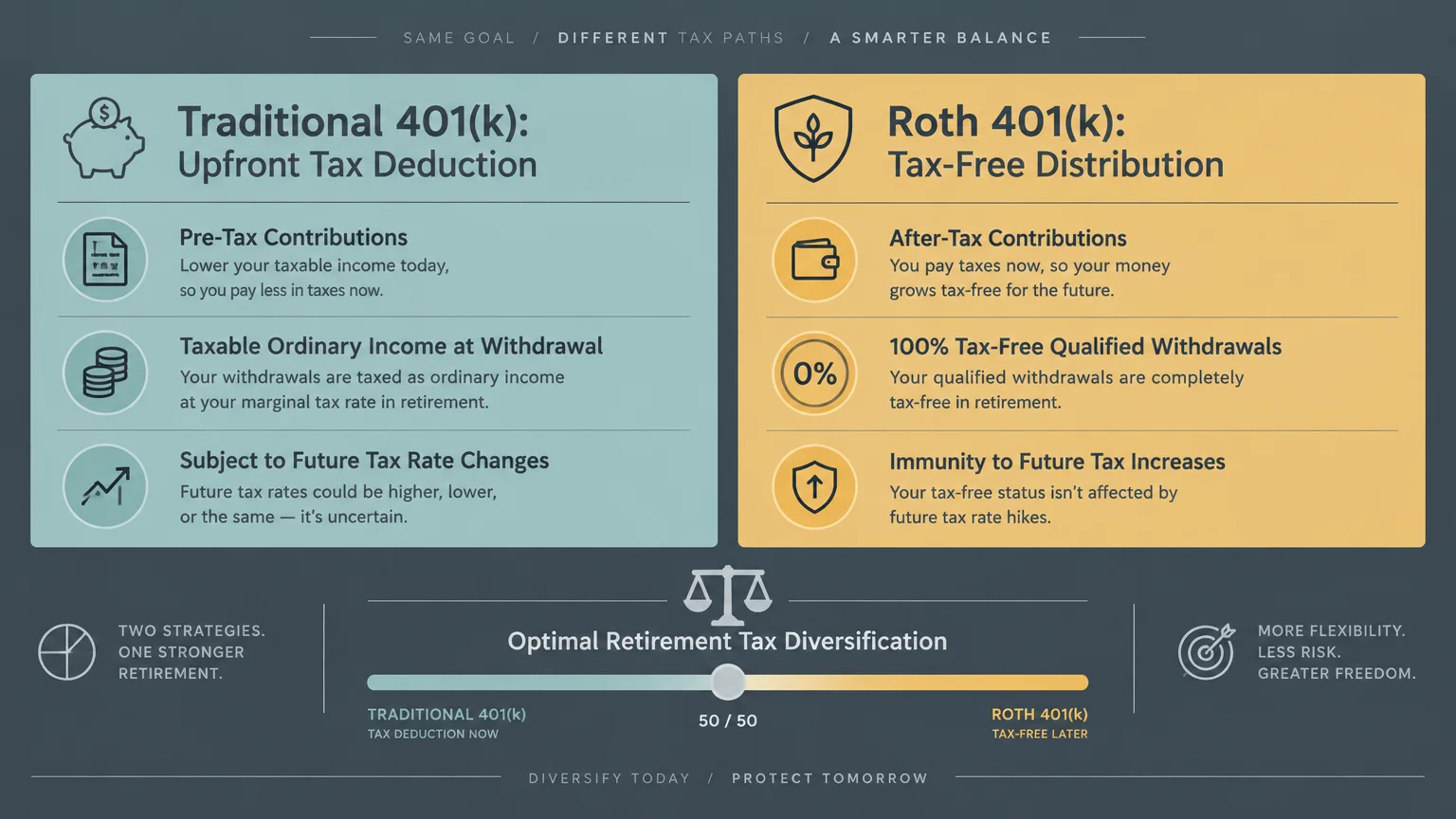
Evaluating roth vs traditional 401k accounts represents one of the most critical decisions in retirement planning. Building healthy balances across both account styles provides tremendous strategic flexibility as tax rates fluctuate.
Traditional 401(k) contributions lower your current taxable income by delivering an immediate upfront deduction. However, every single dollar you withdraw during retirement counts as ordinary taxable income.
Conversely, a designated roth 401k option utilizes after-tax dollars today to guarantee completely tax-free withdrawals later. You accept taxes today to eliminate all future taxation on your growth.
Relying solely on pre-tax accounts can generate significant tax complications during your golden years. Substantial taxable withdrawals can unexpectedly trigger taxation on your hard-earned Social Security benefits.
Up to 85% of your Social Security benefits become subject to federal taxation if your provisional income exceeds modest thresholds. Qualified Roth distributions never count toward this provisional income calculation.
Furthermore, hefty pre-tax withdrawals can trigger Medicare Part B and Part D premium surcharges known as IRMAA. These income-based surcharges substantially increase your annual healthcare expenses in retirement.
Maintaining a diversified mix of pre-tax and Roth assets lets you control your reported income each year. You can withdraw Roth funds to cover extra expenses without pushing yourself into higher tax brackets.
This balanced withdrawal strategy preserves your Social Security checks and keeps your Medicare costs manageable. You enjoy greater lifestyle freedom while keeping your tax obligations at an absolute minimum.

Tip #7: Enjoy Lifetime Freedom from Required Minimum Distributions
Traditional retirement accounts mandate that you begin taking annual distributions once you reach age 73 or 75. These mandatory withdrawals can push you into uncomfortably high tax brackets against your personal wishes.
The SECURE 2.0 Act introduced a tremendous rule change that permanently eliminated this worry for workplace Roth savers. Starting in 2024, designated Roth 401(k) accounts carry zero Required Minimum Distributions during your lifetime.
This legislative revision aligns workplace Roth accounts directly with standard Roth IRAs. You no longer need to roll your workplace balance into an external IRA just to avoid forced withdrawals.
Your nest egg can remain invested within your workplace plan, compounding tax-free for your entire lifetime. You maintain total command over when and how you spend your accumulated wealth.
If you hope to pass wealth to family members, this permanent exemption delivers exceptional estate planning benefits. Your designated heirs will inherit assets that continue to provide significant tax advantages.
Removing forced distributions provides remarkable comfort throughout your retirement years. You manage your money according to your personal lifestyle needs rather than rigid government schedules.
Knowing your money can compound untouched grants you true financial serenity. You can relax and savor your golden years with complete confidence in your financial foundation.
Tip #8: Avoid Costly Conversion Pitfalls and Protect Your Liquidity
Executing an advanced savings strategy requires careful attention to practical details. Avoiding common implementation mistakes protects your hard-earned capital and keeps your financial plan operating smoothly.
One frequent mistake involves contributing after-tax money but forgetting to execute the conversion immediately. Allowing after-tax dollars to sit unconverted generates taxable earnings that complicate your annual tax filings.
Setting up automated conversions through your benefits portal completely eliminates this risk. Your plan administrator transfers your after-tax contributions into Roth status before any taxable earnings accumulate.
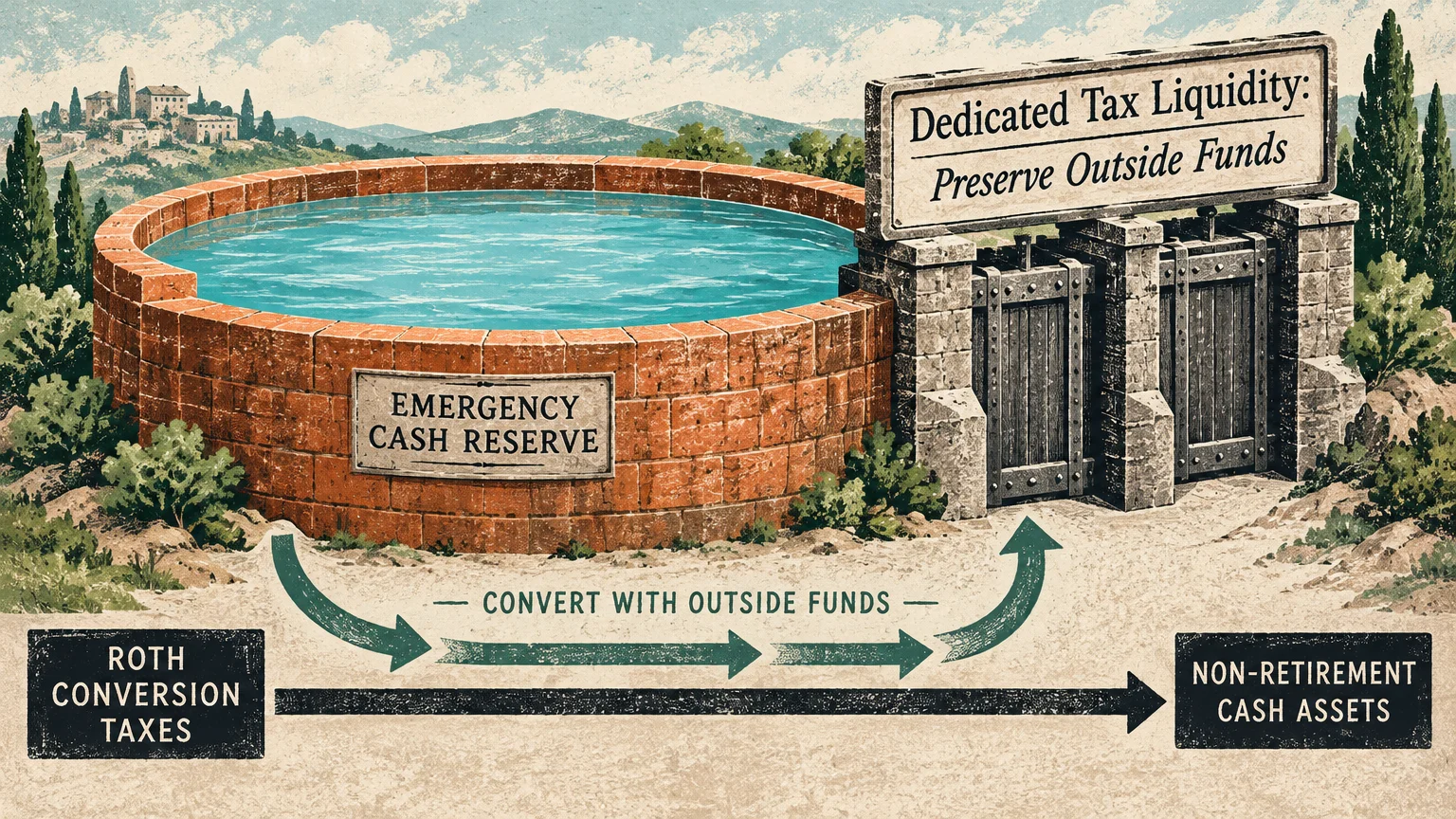
Another critical consideration involves maintaining sufficient liquid reserves outside of your retirement accounts. You must never commit funds to an after-tax conversion that you might need for near-term emergencies.
Ensure you maintain an accessible emergency fund in high-yield savings to cover unexpected medical bills or home repairs. Protecting your short-term liquidity prevents you from tapping retirement assets prematurely.
Additionally, coordinate with a qualified tax professional to evaluate any state income tax implications. While federal rules govern Roth conversions, state tax treatments can occasionally vary depending on where you reside.
Reviewing your overall retirement budget ensures you make after-tax contributions that align comfortably with your living expenses. A measured and consistent approach produces the most reliable long-term success.
Approaching this strategy with clear knowledge and careful planning allows you to maximize every available tax advantage. You build lasting wealth while protecting your daily financial comfort.

The Takeaway: Living a More Blissful Retirement
Your retirement represents an inspiring chapter filled with personal freedom, new passions, and cherished moments with loved ones. Achieving financial peace of mind forms the essential foundation for this joyful season of life.
Uncovering the hidden Roth possibilities within your 401(k) gives you unmatched command over your financial future. You insulate your hard-earned wealth from future tax increases while building an enduring source of income.
Take time this week to review your plan documents and discuss your options with your human resources department. Confirming whether your company supports after-tax contributions and in-plan conversions can dramatically reshape your financial trajectory.
Remember that strict regulations approach on January 1, 2027, making your immediate planning decisions crucial. Activating your five-year aging clock before December 31, 2026, guarantees you capture every legal advantage right away.
Balancing your pre-tax and Roth accounts preserves your Social Security benefits and minimizes your Medicare costs. This thoughtful approach ensures your wealth serves your personal goals rather than unnecessary taxes.
You have worked tirelessly for decades to establish your nest egg and prepare for your golden years. Utilizing these modern retirement provisions ensures your future remains vibrant, secure, and wonderfully fulfilling.
Frequently Asked Questions
What is the difference between a designated Roth 401(k) and voluntary after-tax contributions?
A designated Roth contribution falls directly within your standard elective deferral limit of $24,500 in 2026. These contributions grow tax-free, and all qualified distributions of principal and earnings remain completely exempt from income taxes.
Voluntary after-tax contributions allow you to deposit additional funds above your elective deferral limit up to the $72,000 total plan ceiling. However, you must convert these after-tax funds to Roth to prevent their earnings from becoming taxable.
How do I confirm whether my workplace plan allows an in-plan Roth conversion?
You can examine your Summary Plan Description or log into your online retirement benefits dashboard to review available transactions. Look specifically for options labeled in-plan Roth rollovers, in-plan conversions, or automated Roth conversions.
You can also contact your human resources department or plan administrator directly for personal guidance. Approximately 36% of plans offer conversions, and your administrator can provide the exact steps to enroll.
Does the $150,000 wage threshold for mandatory Roth catch-ups consider household income?
No, the $150,000 wage threshold looks strictly at your individual wages from the single employer sponsoring the retirement plan. Your spouse’s earnings, outside investments, and independent consulting income do not factor into this calculation.
The legal determination relies solely on the FICA wages recorded in Box 3 of your prior-year Form W-2. If your wages from that specific employer fall below $150,000, the mandatory Roth catch-up rule does not apply.
What happens if I withdraw funds before satisfying the five-year aging rule?
You can always withdraw your original after-tax contribution basis at any time without paying taxes or penalties. The IRS treats your original principal contributions as already taxed, granting you immediate access to those dollars.
However, withdrawing accumulated investment earnings before reaching age 59½ and completing the five-year aging period triggers income taxes. Waiting for your five-year timer to finish ensures your withdrawals remain completely tax-free.
For a wide range of resources for older adults, visit AARP and the National Council on Aging (NCOA). Health information is available from the National Institute on Aging.
Disclaimer: This article is for informational and inspirational purposes only. It is not a substitute for professional medical, financial, or psychological advice. Please consult with a qualified expert for guidance tailored to your individual needs.