

You do not have to choose between a rigid full-time career and sitting idle on the porch. Nearly a third of retirees today are working or open to flexible roles, fueling an energizing unretirement trend that blends extra income with daily purpose.
Whether you want to cushion your budget against rising prices or miss the camaraderie of coworkers, the best jobs after retirement let you set the pace. Most seniors prefer schedules under 20 hours a week, leaving plenty of room for travel and family.
Below, you will explore the four jobs retirees want most and learn how to turn your next chapter into a rewarding, balanced adventure.

Lifestyle Idea #1: Retail Roles for Steady Routine and Daily Connection
Retail claims the top spot among jobs retirees want, drawing 33% of seniors considering flexible work according to a March 2026 survey by Indeed Flex. You step into an environment that offers steady human connection without bringing stress home at night.
Half of retirees miss the daily social interaction of a workplace, and 39% miss the simple satisfaction of feeling productive. Greeting neighbors, helping shoppers find the right gift, or tending plants at a local nursery fulfills both needs effortlessly.
Women show especially strong interest in retail and hospitality roles, often balancing personal fulfillment with budget goals. Across the same Indeed Flex survey, 69% of retired women cited the rising cost of living as a primary motivator compared with 53% of men.
What You Can Expect to Earn and Schedule
According to U.S. Bureau of Labor Statistics (BLS) data from May 2025, the national median wage for retail salespersons stood at $17.03 per hour, or $35,560 annually for full-time retail sales workers. Cashiers earned a median of $32,880 per year.
Broader retail trade averages run even higher, reaching $26.55 per hour in October 2026 BLS payroll figures when specialty and supervisory roles are included. Roughly 550,600 openings are projected each year through 2035, giving you remarkable leverage to negotiate preferred hours.
Most part-time jobs for seniors in retail allow you to choose morning or mid-week shifts. You can avoid late Friday nights and crowded weekends while still enjoying employee discounts on items you already buy.
How to Land a Fun Retail Fit
Skip generic big-box applications and start with stores tied to your favorite hobbies. Bookshops, garden centers, craft suppliers, hardware stores, and specialty kitchen boutiques actively prize mature, patient staff who genuinely enjoy chatting with customers.
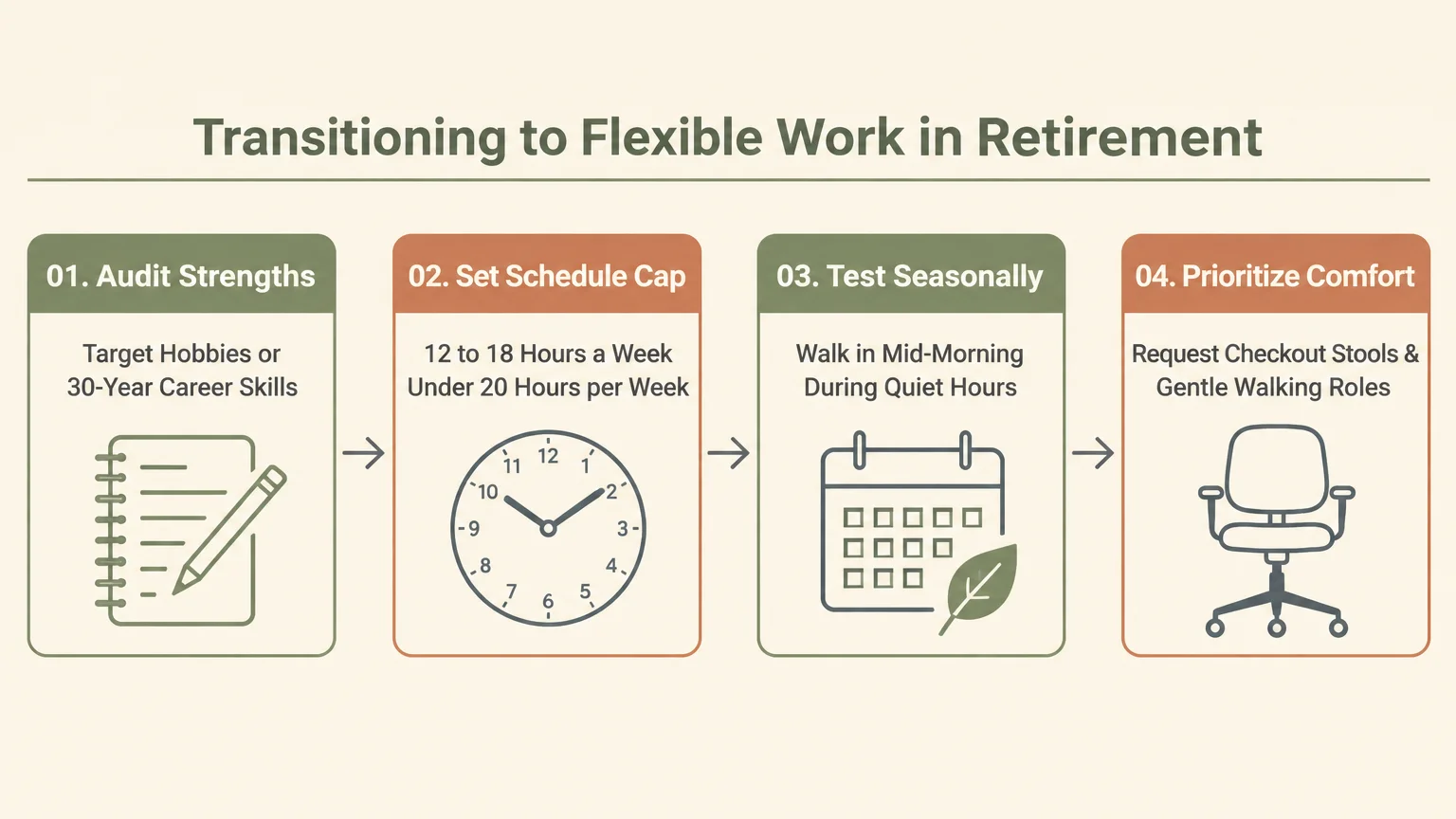
Walk in during quiet mid-morning hours with a crisp one-page summary of your reliability and customer-service strengths. Ask the store manager directly if they need dependable help for 12 to 18 hours a week.
Consider starting as a seasonal associate during spring gardening rushes or autumn holidays. Seasonal work lets you test the store culture, gauge the physical pace, and walk away gracefully or stay on permanently once the season wraps up.
Pay close attention to footwear and station comfort before accepting an offer. Many modern retailers allow stools at checkout counters or offer stock-room and fitting-room roles that keep walking gentle on your joints.

Lifestyle Idea #2: Freelance and Consulting Work Using Your Career Expertise
Close behind retail, freelance and consulting roles attract 30% of retirees seeking flexible work in the March 2026 Indeed Flex study. This path lets you turn decades of hard-won professional wisdom into high-margin, self-directed projects.
Instead of starting at the bottom of a new industry, you sell the exact judgment and problem-solving skills that took you thirty years to master. Men express particularly strong enthusiasm for consulting and advisory arrangements, though professionals of every background thrive here.
Flexibility drives much of the appeal for seniors eyeing remote and independent options. A March 2026 FlexJobs report found that Baby Boomers prioritize remote work options at 46%, work-life balance at 40%, and schedule autonomy at 32%.
Pay Benchmarks and Popular Fields
Consulting often yields the highest hourly return among the best jobs after retirement. BLS figures for October 2026 show private professional and business services averaging $46.25 per hour, comfortably above the $38.00 private nonfarm average and the May 2025 national median of $24.51.
Specific niches highlighted by FlexJobs and AARP in 2026 demonstrate how lucrative targeted skills remain. Accounting and finance roles carry a median annual pay benchmark of $81,680, while experienced administrative specialists reach $47,460.
Helping professions translate smoothly into part-time private practice or contract work as well. Career counselors earn a median of $31.32 per hour, and licensed psychologists command $45.34 per hour, letting you set your own client roster from home.
Even if your background lies in trades, logistics, teaching, or healthcare administration, smaller organizations constantly need fractional experts. Companies that cannot afford a full-time executive happily pay a seasoned retiree for ten hours of guidance each week.
Practical Ways to Get Started
Begin with your warmest network rather than cold-messaging strangers online. Reach out to former employers, industry vendors, and longtime clients to let them know you are available for short-term audits, training, or vacation coverage.
Define your scope clearly before agreeing to a project so freelance freedom does not morph back into a 40-hour grind. Quote flat project fees or capped weekly hours, and build buffer weeks into your calendar for family visits.
Remember that independent contractors handle both halves of federal payroll taxes. Self-employed workers pay 12.4% for Social Security up to the wage cap and 2.9% for Medicare, compared with 6.2% and 1.45% as a traditional W-2 employee.
Setting aside roughly a quarter to a third of each invoice in a dedicated savings account prevents April tax surprises. Keeping simple mileage and home-office records also helps trim your taxable net profit legally.

Lifestyle Idea #3: Hospitality Jobs for Short Shifts and Lively Environments
Hospitality ranks third among the jobs retirees want, capturing 23% of respondents in the March 2026 Indeed Flex survey. Hotels, restaurants, event venues, and cultural attractions thrive on the warmth and poise that older adults bring naturally.
If your home feels a little too quiet after leaving a bustling office, hospitality puts you back in the center of happy moments. You spend your shifts welcoming travelers, assisting wedding guests, or guiding museum visitors through new exhibits.
That sense of connection matters deeply to retirees returning to work. According to the 2026 Retirement Confidence Survey from EBRI and Greenwald Research, 91% of working retirees say they want to stay active and involved, while 85% simply enjoy working.
Where Seniors Shine in Hospitality
You do not have to carry heavy dinner trays at midnight to enjoy hospitality work. Think broadly about guest-facing spaces that value calm communication, local knowledge, and polished etiquette during comfortable daytime hours.
Boutique hotels and bed-and-breakfasts love hiring morning concierge hosts who recommend neighborhood restaurants and organize tours. Golf courses, marinas, botanical gardens, and historic estates regularly seek part-time ticket ambassadors, pro-shop attendants, and tour guides.
Concert halls, theater companies, and minor-league stadiums offer another creative twist on part-time jobs for seniors. Event ushers and VIP suite hosts work short four-hour shifts, enjoy vibrant crowds, and often catch world-class performances for free.
Local wineries, breweries, and specialty coffee roasters also welcome mature tasting-room hosts. Sharing stories about regional food and craft beverages turns a modest shift into an engaging social outing.
Tips for Choosing Comfortable Shifts
Ask detailed questions during your interview about shift lengths, standing requirements, and peak busy seasons. A four-hour matinee usher shift feels very different on your energy levels than an eight-hour banquet setup.
Check whether perks align with your lifestyle goals before signing on. Hotel chains frequently extend steep employee room discounts nationwide, turning a couple of shifts a week into affordable getaways with your spouse or grandkids.
If you travel during specific months, ask upfront about seasonal or per-diem event pools. Many stadiums and convention centers let you claim shifts online one week at a time, giving you complete control over your schedule.

Lifestyle Idea #4: Driver and Delivery Roles for Total Independence
Rounding out the top four, driver and delivery roles appeal to 20% of retirees in the March 2026 Indeed Flex survey. Whether you enjoy cruising quiet morning routes or chatting with airport passengers, driving delivers unmatched schedule independence.
Unlike retail or hospitality schedules posted two weeks in advance, many driving roles let you log in only when you feel like working. Rainy days, grandkids’ soccer games, and spontaneous lunch dates never require asking a supervisor for time off.
This autonomy helps explain why driving appeals to so many retirees heading back to work. When you control the start and stop buttons, work feels like a flexible hobby that happens to deposit extra cash every week.
Earnings and Options Beyond Rideshare
Pay varies significantly depending on the type of driving you choose. BLS October 2026 data shows transportation and warehousing roles averaging $32.74 per hour broadly, while earlier May 2023 BLS figures put driver and sales workers at a $17.03 median hourly wage.
Major rideshare and food-delivery apps offer fast onboarding if you already own a reliable, newer vehicle. Driving during morning airport runs or early-evening dinner hours lets you capture brisk demand while avoiding late-night crowds.
If you prefer using someone else’s vehicle instead of adding miles to your own car, explore local alternatives. Auto dealerships hire part-time shuttle drivers to transport service customers, and rental-car agencies pay retirees to move fleets between airport branches.
Medical courier networks, neighborhood pharmacies, and floral shops also hire steady part-time drivers for predictable daytime routes. School-bus driving remains another classic option, offering paid training, mid-day breaks, and summers off.
Smart Safety and Cost Checks Before You Drive
Call your auto insurer before taking your first paid passenger or delivery bag. Standard personal policies rarely cover commercial app activity, and adding a rideshare endorsement usually costs far less than facing a denied claim.
Calculate your true net earnings after fuel, tires, oil changes, and depreciation if you drive your personal vehicle. Tracking every business mile with a simple notebook or phone app lets you claim valuable tax deductions at filing time.
Protect your comfort by setting clear personal boundaries around daylight hours, package weights, and service zones. Sticking to familiar suburbs and mid-day windows keeps driving relaxing, safe, and genuinely enjoyable.
Putting It into Practice: Small Steps for Big Changes
Looking at the broader workforce shows just how normal returning to work has become. BLS data from May 2026 shows 19.1% of Americans age 65 and older participating in the labor force, with nearly 40% of employed seniors working part-time.
That momentum is projected to keep rising over the next decade. BLS projections from September 2026 estimate labor force participation among adults ages 65 to 74 will climb from 26.7% to 29.1% by 2035, while workers 75 and older grow from 8.5% to 10.1%.
Financial clarity motivates many of those decisions alongside lifestyle joy. Across Indeed Flex’s March 2026 survey, 63% cited the rising cost of living and 32% noted insufficient savings, while 46% described returning to work as both financial necessity and personal choice.
AARP Research updated in August 2026 similarly found that 6% of retirees had returned to work within the previous six months, with 48% pointing to economic need. Meanwhile, a December 2025 ResumeBuilder.com survey showed 58% of continuing older workers expect part-time schedules.
Those numbers carry an encouraging takeaway for you. Whether you crave extra travel money, inflation protection, or sharper daily structure, taking a few thoughtful steps before you apply protects your benefits and sets you up to win.
Check Your Social Security and Medicare Numbers First
Before accepting a job offer, verify how your age affects Social Security’s Retirement Earnings Test. For anyone born in 1960 or later, Full Retirement Age (FRA) is 67, while those born in 1959 reach FRA at 66 and 10 months.
If you already reached FRA, you face zero earnings limits and can earn any amount without reducing your monthly check. If you collect benefits before reaching FRA, however, annual limits apply during your working months.
In 2026, retirees under FRA all year can earn up to $24,480 ($2,040 per month) before Social Security withholds $1 in benefits for every $2 earned above the cap. That annual threshold rises to $25,560 ($2,130 per month) in 2027.
During the calendar year you actually reach FRA, a much higher threshold applies to months before your birthday milestone. You can earn up to $65,160 ($5,430 per month) in 2026, rising to $67,920 ($5,660 per month) in 2027, with $1 withheld per $3 over.
A special monthly rule also helps if you retire mid-year and return part-time right away. In your first year of retirement, you still receive full benefits for any whole month your wages stay at or below $2,040 (or $5,430 in your FRA year) without performing substantial self-employment services.
Withheld benefits are not lost forever, either. Once you hit FRA, Social Security recalculates your monthly benefit upward to credit back the months previously withheld, and higher-earning work years can even trigger an automatic increase.
Working again also adds Social Security credits if you need them. Earning $1,890 in 2026 ($1,970 in 2027) earns one credit up to four credits per year, with the Social Security wage cap set at $192,300 in 2027.
Keep Medicare rules on your radar as well, since Medicare eligibility begins at age 65 regardless of your Social Security FRA. Missing your seven-month Initial Enrollment Period without qualifying active-employer coverage can trigger permanent late penalties.
If a new job provides qualifying group health insurance and you later leave that role, you receive an eight-month Special Enrollment Period for Part B. Also remember to stop contributing to any Health Savings Account six months before enrolling in Medicare Part A due to retroactive look-back rules.
Take One Low-Pressure Step This Week
Start by sketching your ideal week on a blank sheet of paper before browsing a single job board. Block off your non-negotiable mornings, volunteer commitments, medical appointments, and family time first, then circle the remaining 10 to 20 hours.
Next, pick one category from the top four that sparks genuine curiosity. If you love sharing recommendations, explore local retail or concierge desks; if you prefer quiet autonomy, polish a consulting pitch or research daytime courier routes.
Update a concise one-page resume highlighting your last decade of relevant strengths, technical comfort, and dependability. Skip distant job dates from thirty years ago so hiring managers focus immediately on what you bring today.
Finally, talk openly with two people in your circle—a former colleague, a neighbor who already works part-time, or the manager of a favorite local shop. Many of the best jobs after retirement never reach public job boards and come straight through friendly word of mouth.
Frequently Asked Questions
Will returning to work permanently cut my Social Security benefits?
No, working after reaching Full Retirement Age never reduces your Social Security benefits regardless of how much you earn. If you work while collecting early before FRA, temporary withholdings apply above annual limits ($24,480 in 2026; $25,560 in 2027), and your benefit recalculates upward at FRA.
In fact, strong part-time earnings can sometimes raise your monthly check. If your new annual wages rank among your highest 35 years of indexed earnings, Social Security automatically adjusts your benefit upward.
How do I overcome rustiness or social anxiety after years out of the workforce?
Give yourself permission to start small with low-stakes, structured environments like seasonal retail, museum welcoming, or event ushering. Working just two short four-hour shifts a week lets you rebuild stamina and confidence without feeling overwhelmed.
Remind yourself that employers actively seek the calm judgment, punctuality, and people skills you built over decades. Most hiring managers view mature reliability as a rare superpower rather than worrying about minor technology gaps.
What if I have tight budget limits and cannot afford new training or equipment?
Focus on retail, hospitality, or employer-provided driving roles that include paid on-the-job training and require zero upfront investment. Legitimate employers never ask applicants to pay fees for background checks, training kits, or starter software.
If you lean toward freelance consulting, begin exclusively with skills, software, and equipment you already own. You can easily offer bookkeeping, tutoring, writing, or administrative support using a basic home computer and internet connection.
Can I find part-time jobs for seniors that accommodate snowbird travel or grandparenting?
Yes, seasonal businesses, remote consulting contracts, and app-based driving roles align naturally with travel-heavy lifestyles. Many retirees work busy spring or holiday seasons in one town and take three full months off for road trips or family visits.
Be transparent about upcoming trips during your interview so expectations match from day one. Retailers and hospitality venues near tourist hubs often love hiring reliable seasonal regulars who return every year.
For resources on retirement living, travel, and finance, visit AARP. Official information on Social Security is available at SSA.gov.
For travel advisories, consult the U.S. Department of State.
Disclaimer: This article provides lifestyle suggestions for informational purposes. Financial, legal, or travel decisions should be made in consultation with qualified professionals.