

The upcoming 3.6% Social Security raise can significantly strengthen your retirement cash flow if you prepare before the new year arrives. Taking specific financial steps right now ensures you keep more of that extra money in your pocket.
With average monthly checks climbing from $2,095 to $2,170, proactive planning turns an extra $75 per month into lasting peace of mind. A thoughtful strategy safeguards your wallet against higher Medicare premiums and unexpected tax surprises.
Here are ten empowering money moves to help you welcome your January Social Security check with complete confidence and optimism.
Tip #1: Review Your Medicare Plan Before the December 7 Deadline
Your Social Security check does not exist in a vacuum. Most retirees pay their Medicare Part B premiums directly out of their monthly benefits.
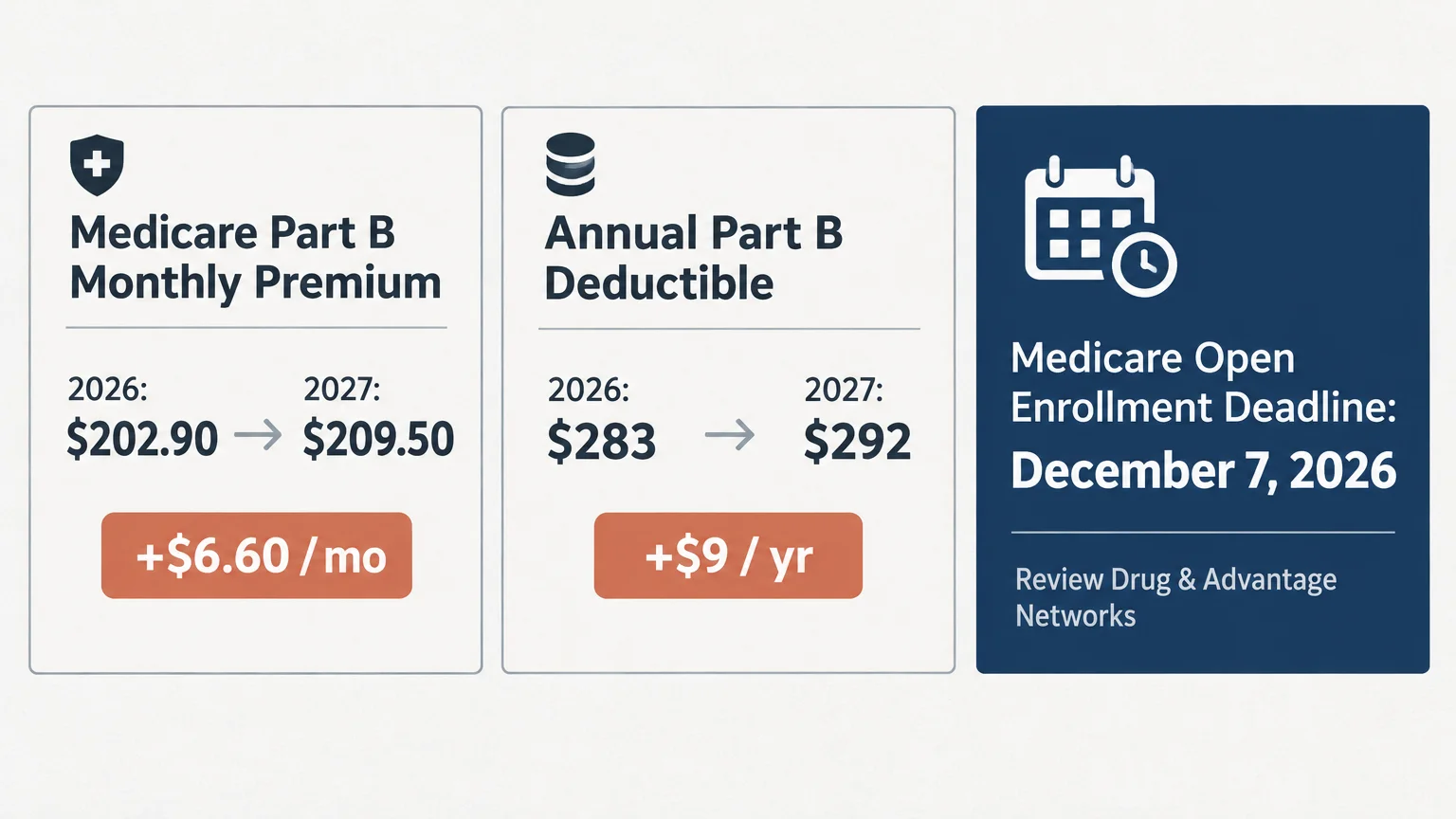
For 2027, the Medicare Board of Trustees projects that the standard Part B premium will rise by $6.60. That shifts your monthly cost from $202.90 in 2026 to $209.50 in 2027.
The annual Part B deductible will also increase, climbing from $283 to $292. This modest rise means a small slice of your upcoming raise goes directly toward healthcare expenses.
Fortunately, you have a crucial window to protect your cash flow. Medicare Open Enrollment closes on December 7, 2026.
Take this opportunity to compare prescription drug plans and Medicare Advantage options. Switching to a plan with lower copayments or smaller drug formularies can easily save you hundreds of dollars annually.
Check if your current doctors and preferred pharmacies remain in your network for 2027. Insurers frequently adjust provider directories, which can trigger unexpected out-of-pocket bills if you remain on autopilot.
Reviewing your coverage before December 7 ensures you keep the lion’s share of your new benefit boost. A quick policy checkup today creates lasting peace of mind all year long.
Taking control of your healthcare coverage gives your January raise room to breathe. When you reduce medical expenses, your monthly benefit increase can serve your personal lifestyle goals instead.

Tip #2: Set Up Your My Social Security Account by November 18
Knowing your exact numbers eliminates guesswork and empowers your budget. The Social Security Administration now provides fast, secure access to your individualized cost-of-living increase online.
To view your 2027 COLA notice ahead of time, create a my Social Security account. You must opt into paperless notices by November 18, 2026, to qualify for digital delivery.
Beneficiaries who complete this simple step can view their official 2027 benefit statement online in late November. That gives you weeks of advance notice before paper letters arrive in mailboxes throughout December.
Logging in lets you see your exact gross benefit alongside your precise Medicare Part B deduction. Having the true bottom-line figure helps you finalize your household spending plan before the holidays arrive.
Setting up your account also protects your identity from potential scammers. Claiming your official account prevents bad actors from attempting to register fraudulent details in your name.
Navigate to the official portal, verify your identity, and toggle your communications preferences to digital. This simple five-minute task provides immediate visibility into your upcoming financial bump.
Staying proactive gives you the upper hand when managing retirement cash flow. Checking your account confirms your mailing address and direct deposit banking instructions are completely accurate.
When you eliminate financial surprises, you step into retirement planning with clarity. Seeing your 2027 numbers early allows you to start the new year on steady footing.
Tip #3: Map Your Exact January Social Security Check Delivery Date
Timing matters when you are balancing monthly utility bills, mortgage payments, and discretionary spending. Your boosted benefit does not arrive on New Year’s Day for most beneficiaries.
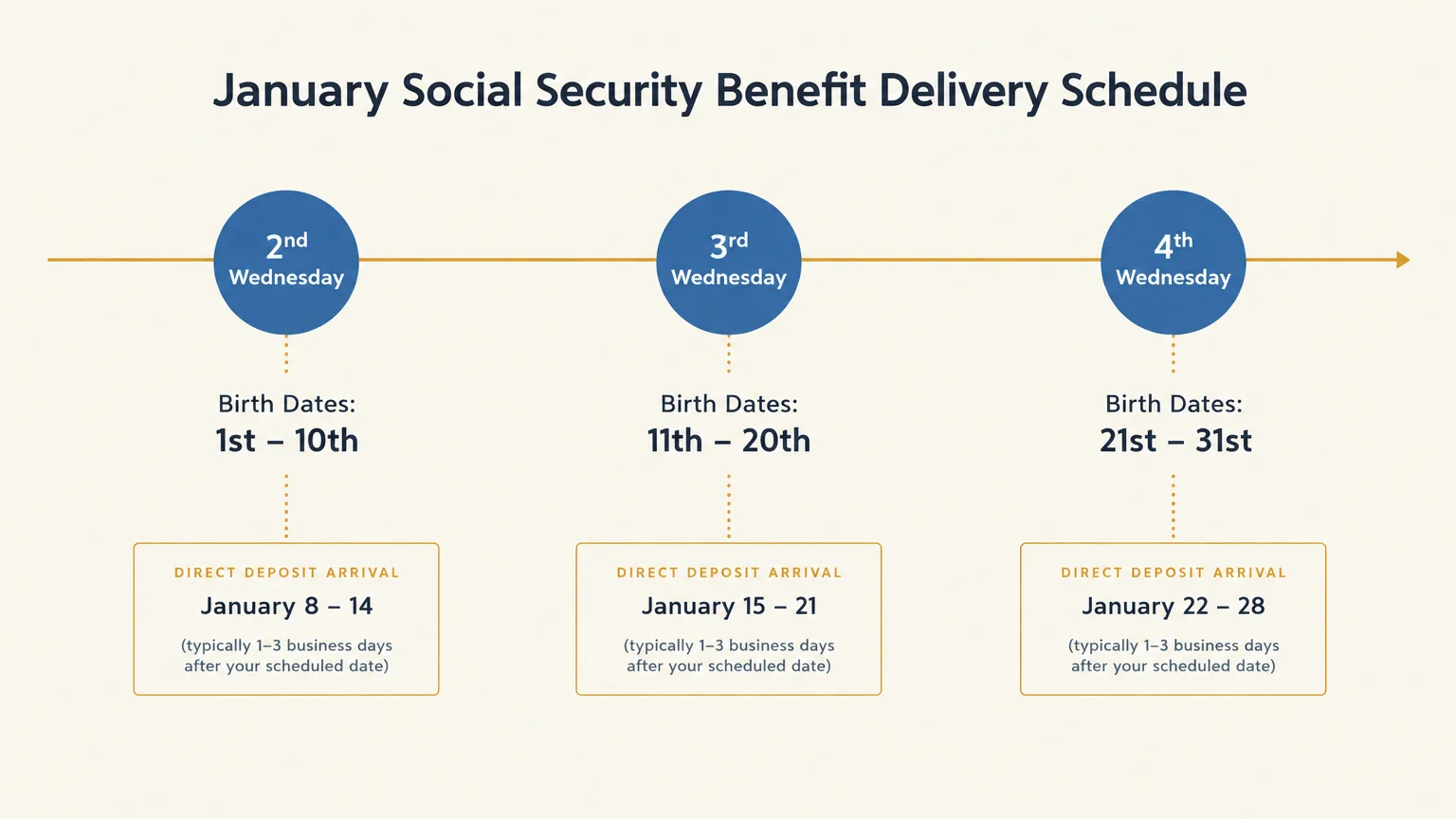
The Social Security Administration distributes recurring monthly benefits based on the date of your birth. Marking your calendar now prevents cash flow pinches during the post-holiday period.
Beneficiaries with birthdays falling between the 1st and the 10th receive their first boosted payment on January 13, 2027. This second Wednesday deposit delivers your first taste of the 3.6% COLA.
If your birthday lands between the 11th and the 20th, expect your funds on January 20, 2027. Retirees born between the 21st and the 31st will receive their checks on January 27, 2027.
A select group of recipients will actually see their larger payments arrive early. Supplemental Security Income recipients and those who filed before May 1997 receive checks on December 31, 2026.
Because January 1 is a federal holiday, the Treasury moves those disbursements forward into late December. Knowing your precise deposit schedule allows you to align automatic bill payments smoothly.
Scheduling your January expenses around these confirmed dates avoids costly overdraft fees. It ensures you maintain full command of your banking balance through the holiday season.
Review your calendar today and note when your January Social Security check lands. Predictable cash flow forms the bedrock of a tranquil, stress-free retirement.

Tip #4: Adjust Your Tax Withholding Using IRS Form W-4V
A larger Social Security raise brings wonderful relief, but it can also catch the eye of the IRS. Higher gross income sometimes pushes your overall earnings across critical federal tax thresholds.
Federal tax rules regarding Social Security benefits are not indexed to inflation. Up to 50% of your benefits become taxable if your combined income falls between $25,000 and $34,000 for single filers.
For married couples filing jointly, that 50% bracket applies between $32,000 and $44,000. Once your combined income exceeds $34,000 individually or $44,000 jointly, up to 85% of your benefits face taxation.
Combined income equals your adjusted gross income, plus nontaxable interest, plus half of your annual Social Security benefits. A 3.6% bump can easily tip you over these static edges.
You can prevent a stressful tax bill next April by submitting IRS Form W-4V. This voluntary withholding form instructs the Social Security Administration to withhold taxes directly from your monthly checks.
You can choose a flat withholding rate of 7%, 10%, 12%, or 22%. Electing a modest withholding amount spreads your tax obligations evenly across the entire twelve months of the year.
Submitting this form takes only a few minutes and saves you from writing a large check at tax time. You can download the document directly from the official IRS website.
Taking action today protects your savings from underpayment penalties. It keeps your tax affairs tidy so you can enjoy your golden years without nagging financial anxiety.

Tip #5: Optimize Your 2027 Senior Standard Deduction Strategy
Tax season does not have to be intimidating when you know how to leverage available deductions. Fortunately, the IRS provides substantial tax relief designed specifically for older Americans.
For the 2027 tax year, the baseline standard deduction climbs to $16,600 for single filers. Married couples filing a joint return enjoy a baseline standard deduction of $33,200.
Seniors aged 65 and older receive an additional standard deduction bump. Single seniors gain an extra $2,100 deduction, while married couples where both spouses are 65 or older receive an additional $3,400.
Furthermore, qualifying seniors can benefit from the temporary federal $6,000 per-person senior deduction. This provision remains active through 2028 for taxpayers with modified adjusted gross income at or below $75,000 for singles.
Married couples qualify for a combined $12,000 senior deduction if their joint income stays under $150,000. Together, these provisions create potential deductions of up to $24,700 for individuals and $48,600 for couples.
Understanding these generous deduction figures helps you calculate your true tax liability in advance. You can confidently claim every deduction you earned and shield your Social Security raise from excessive taxation.
These substantial deductions also offset taxable income generated by required minimum distributions from traditional retirement accounts. Planning ahead ensures your investment withdrawals remain as tax-efficient as possible.
Speak with a tax professional before year-end to verify your income levels qualify. Maximizing your write-offs lets you keep more money where it belongs: in your retirement nest egg.
Tip #6: Recalibrate Your Retirement Budget Around the True Net Raise
Getting an increase in your monthly benefit is cause for celebration. Across the country, approximately 72 million Social Security beneficiaries and 7.3 million SSI recipients will experience this 3.6% boost.
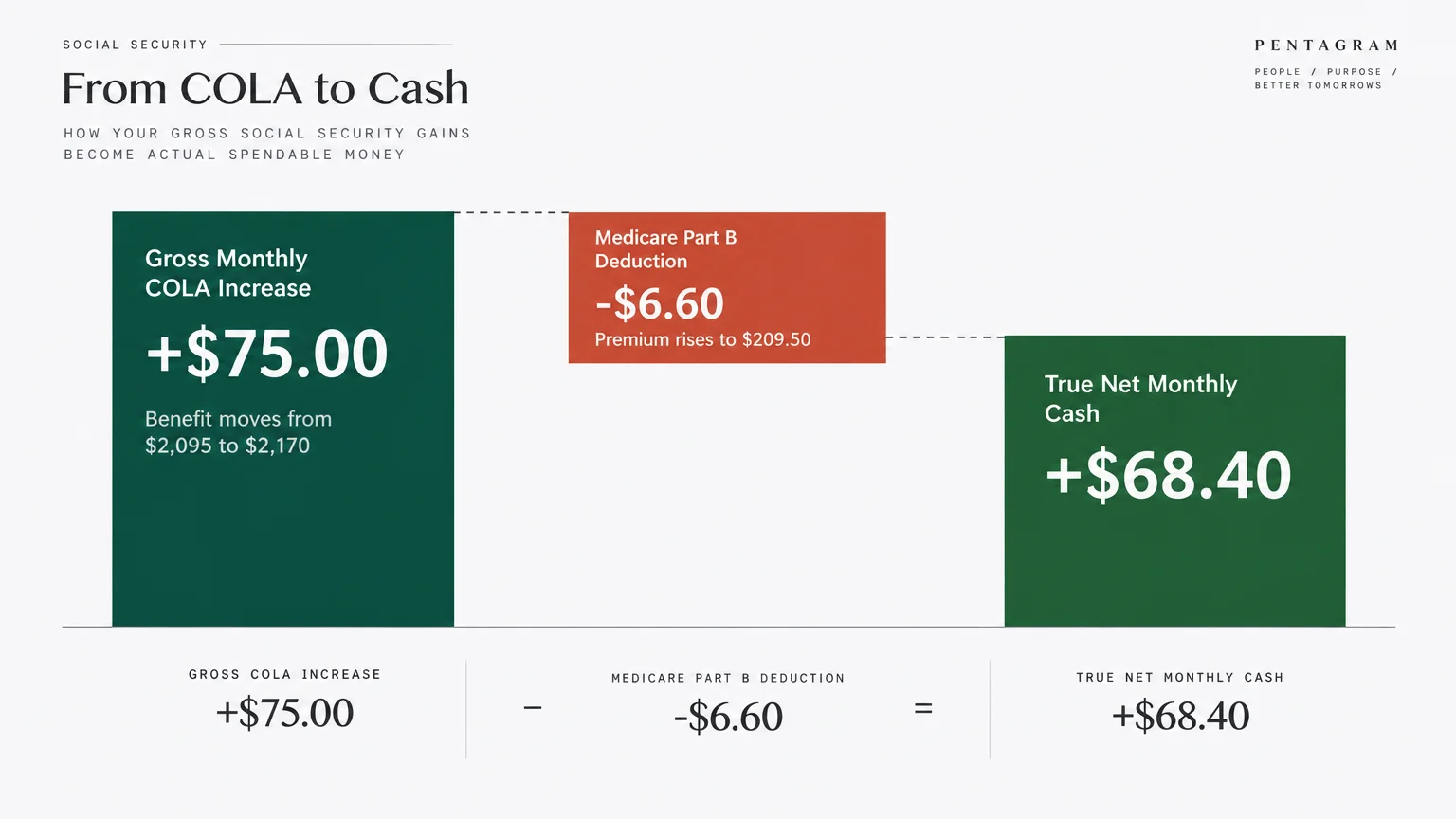
The average monthly retirement check will increase by roughly $75, climbing from $2,095 in 2026 to $2,170 in 2027. Over a full year, that represents approximately $900 in extra gross income.
However, you must build your spending plan around the net increase rather than the gross headline. As noted, Medicare Part B premiums are projected to rise by $6.60 per month.
Subtracting Medicare increases leaves you with a real-world net gain of around $68 per month on average. Factoring in this exact net amount prevents overestimating your discretionary spending room.
Dedicate this extra monthly sum with intentional purpose. Directing an extra $65 to $70 each month toward an emergency cash reserve creates a comforting safety cushion against unexpected home repairs.
Alternatively, you can earmark the raise to cover rising grocery prices or indulge in a fulfilling hobby. When you direct every dollar with clarity, you eliminate financial stress and enhance your daily happiness.
Look closely at recurring subscription services and utility bills to see where you can trim waste. Small adjustments combined with your new raise give you remarkable financial breathing room.
Spend an hour this week updating your retirement budgeting sheet with your actual net numbers. Intentional money moves before COLA payments begin guarantee that your hard-earned raise works for your dreams.
Tip #7: Check Your Working Retirement Earnings Limits
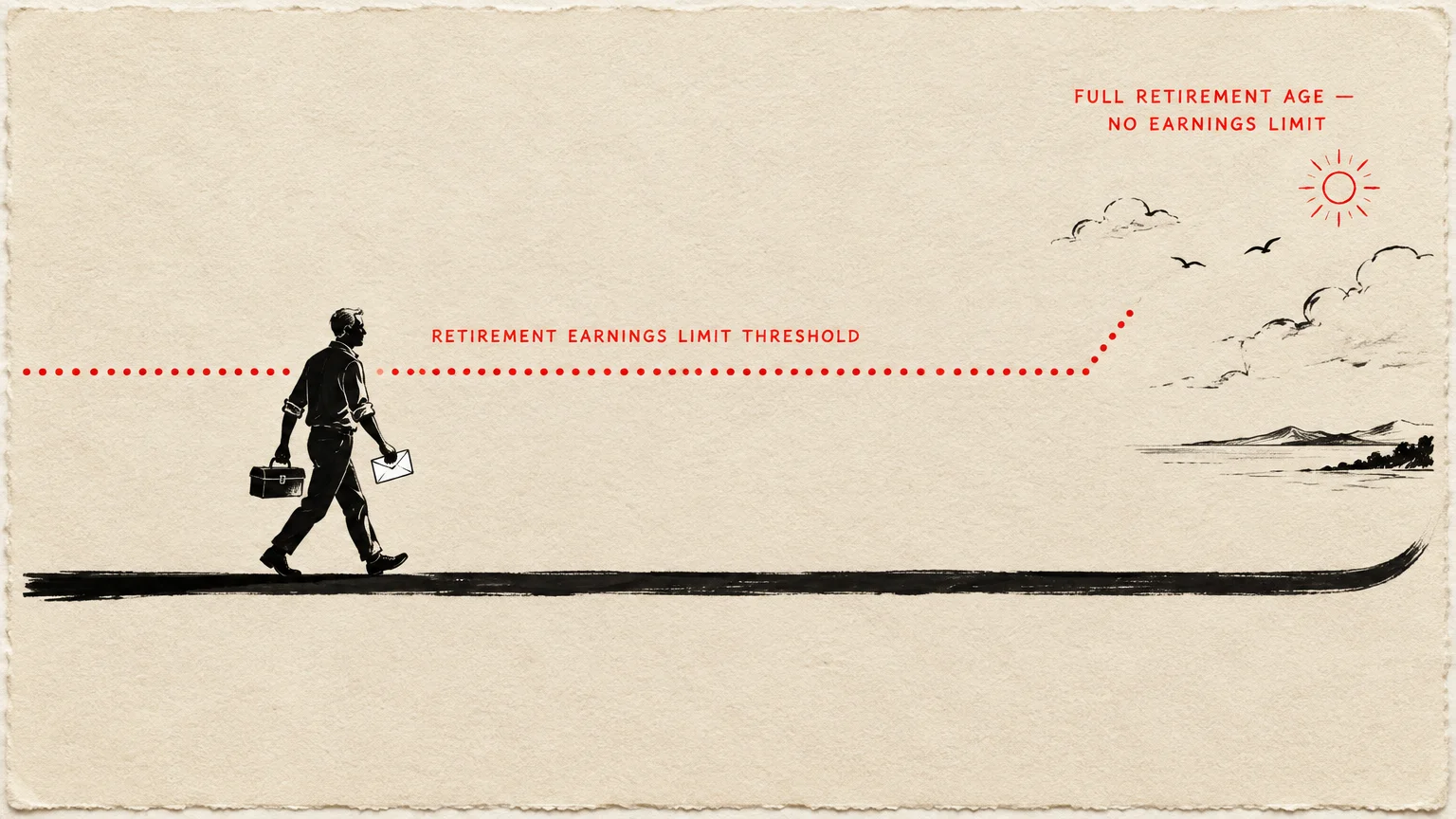
Many energetic seniors choose to remain active in the workforce while receiving Social Security benefits. If you earn wages before reaching full retirement age, you must monitor annual earnings caps.
Earning above the statutory limits can trigger temporary benefit withholdings by the Social Security Administration. Staying informed keeps your paycheck and your benefit checks working together seamlessly.
For 2027, the retirement earnings test limit for beneficiaries under full retirement age rises to $25,560. That equals $2,130 per month, up from $24,480 in 2026.
If your earnings exceed this $25,560 ceiling, the SSA temporarily withholds $1 of benefits for every $2 earned above the threshold. These withheld amounts are not lost forever, but they disrupt immediate income.
The rule is much more generous if you reach your full retirement age during 2027. In that milestone year, you can earn up to $67,920 prior to your birthday month, up from $65,160.
For earnings above $67,920, the agency withholds just $1 for every $3 earned. Once you reach your full retirement age, all earnings caps vanish completely with no benefit reductions.
Additionally, the maximum earnings subject to the Social Security payroll tax rises to $192,300 in 2027. Knowing these wage boundaries allows you to calibrate your consulting or part-time hours with complete precision.
Coordinate with your employer to pace your earnings if you want to avoid benefit withholding. Smart scheduling keeps your cash flow dependable throughout the entire year.

Tip #8: Maximize End-of-Year 2026 Retirement Contributions
If you are still earning income from employment or consulting, year-end offers a golden savings opportunity. Maxing out tax-advantaged accounts reduces your current taxable income and sets you up for long-term comfort.
Workers aged 50 and older have until December 31, 2026, to fully fund their workplace retirement plans. The 2026 base contribution limit stands at $24,500, with an allowable $8,000 catch-up contribution.
Eligible workers aged 60 through 63 receive a special incentive under recent tax law changes. They can make an enhanced “super catch-up” contribution of $11,250 instead of the standard catch-up amount.
You also have until April 15, 2027, to contribute toward your traditional or Roth Individual Retirement Accounts. For tax year 2026, the IRA limit is $7,500, plus an extra $1,100 catch-up for age 50+.
Looking ahead into 2027, actuarial projections place the 401(k) employee deferral limit at $25,500. Projections also point toward an $8,500 catch-up and an $11,750 super catch-up for workers aged 60 to 63.
Stashing pre-tax dollars into your retirement accounts lowers your adjusted gross income immediately. That lower income helps you avoid higher income-related Medicare surcharges, known as IRMAA, two years down the line.
Remember that Medicare uses a two-year lookback period, meaning 2027 IRMAA brackets evaluate your 2025 tax return. Keeping your adjusted gross income low protects your future healthcare costs.
Take a few minutes to adjust your payroll deductions before your final December paychecks process. Boosting your savings rate creates an enduring legacy of security and independence for your golden years.

Tip #9: Prepare for the New 2027 Federal Saver’s Match
Exciting retirement incentives are arriving with the new year that offer direct financial rewards. Beginning in 2027 under SECURE 2.0 legislation, a revamped federal program known as the Saver’s Match takes effect.
This innovative program replaces the traditional nonrefundable tax credit with a direct federal deposit into your retirement account. It provides lower-to-moderate-income working retirees an unmatched chance to gain free savings.
Eligible savers can receive a 50% federal matching contribution on up to $2,000 saved annually. That means the federal government could deposit up to $1,000 directly into your qualifying IRA or workplace plan.
Full match eligibility applies to individuals with modified adjusted gross income at or below $20,500. For married couples filing jointly, full eligibility applies up to $41,000.
The match phases out progressively as income rises, ending completely at $35,500 for singles and $71,000 for couples. This structure gives hardworking older adults an extraordinary return on their retirement deposits.
If you work a part-time job or run a small community business, plan to capture this match. Contributing a modest sum from your wages allows Uncle Sam to supercharge your retirement fund effortlessly.
This federal match does not count against your annual contribution limits, giving your balance an extra lift. It acts like a bonus grant dedicated purely to your long-term independence.
Review your expected 2027 taxable earnings now to see where you fall within these income ranges. Claiming every dollar of matching money strengthens your financial resilience for decades to come.

Tip #10: Plan Your 2027 Health Savings Account Strategy
Healthcare remains one of the largest budget considerations for older adults enjoying retirement. If you are 55 or older and not yet enrolled in Medicare, a Health Savings Account provides unbeatable benefits.
For 2027, the IRS announced that HSA contribution limits will rise to $4,500 for individuals with self-only coverage. The family coverage limit increases to $9,000.
Savers aged 55 and older can contribute an additional $1,000 catch-up contribution above those baseline maximums. This brings your total allowable tax-sheltered medical savings to $5,500 for single coverage.
HSA dollars offer a unique triple-tax advantage: contributions are tax-deductible, balances grow tax-free, and withdrawals for medical expenses are completely tax-exempt.
You can use these funds to cover prescription medications, dental work, vision care, and hearing aids. Building a robust healthcare cushion ensures routine medical bills never derail your leisure activities.
Be mindful of one critical transition rule as you approach age 65. You must stop contributing to an HSA six months prior to applying for Medicare Part A or Part B.
Making contributions while enrolled in Medicare leads to excise taxes and administrative headaches. Setting a calendar reminder six months before your 65th birthday keeps your accounts in pristine order.
Following this timing rule prevents unexpected retroactive tax penalties while keeping your medical accounts fully compliant. Coordinating your healthcare funds properly provides lasting peace of mind throughout your golden years.

The Takeaway: Living a More Blissful Retirement
A cost-of-living adjustment is more than just a routine percentage update on a government balance sheet. It is a well-deserved recognition of your lifelong contributions to our communities and economy.
By putting these ten strategic money moves into action today, you take control of your financial destiny. Proactive planning ensures that every dollar of your 3.6% raise provides tangible happiness and security.
Retirement is your time to explore passions, cherish loved ones, and savor each day with boundless enthusiasm. When your finances operate with orderly clarity, your spirit enjoys true freedom and vitality.
Small adjustments completed before the new year arrives ripple out into major lifestyle rewards. You deserve a future filled with calm mornings, joyful adventures, and financial resilience.
Welcome the coming year with excitement, knowing you have laid a rock-solid foundation for lasting prosperity. Celebrate your golden years with confidence, joy, and blissful contentment!
Frequently Asked Questions
When will I see the 2027 COLA increase reflected in my check?
Most beneficiaries will see the higher payments in January 2027 on their regular payment schedule. Birthdays falling between the 1st and 10th receive payments on January 13, 2027.
Birthdays from the 11th through the 20th receive deposits on January 20, 2027, while those born later receive funds January 27, 2027. SSI recipients receive their checks on December 31, 2026.
Why did my Social Security raise seem smaller than 3.6%?
Medicare Part B premiums are deducted directly from your monthly Social Security benefit checks. The projected $6.60 Part B premium increase for 2027 partially offsets your gross cost-of-living increase.
Additionally, if your higher gross benefit triggered higher voluntary or mandatory tax withholdings, your net take-home deposit will reflect those deductions. Check your personalized notice online for exact details.
How do I opt out of paper COLA notices?
Log into your personal my Social Security account before November 18, 2026. Navigate to your message center preferences and select the digital notice option to receive updates securely online.
Choosing paperless communication allows you to view your updated benefit rate in late November. It reduces postal delays and protects your sensitive financial data from physical mailbox theft.
Will the 2027 COLA increase push me into a higher tax bracket?
Because Social Security combined income thresholds are not adjusted for inflation, your raise could subject more benefits to taxation. Combined incomes over $25,000 for singles and $32,000 for married couples face partial taxation.
Submitting IRS Form W-4V to elect voluntary tax withholding prevents an unexpected tax bill when filing next year. Talk to your tax advisor to determine the ideal withholding percentage for your situation.
For a wide range of resources for older adults, visit AARP and the National Council on Aging (NCOA). Health information is available from the National Institute on Aging.
Disclaimer: This article is for informational and inspirational purposes only. It is not a substitute for professional medical, financial, or psychological advice. Please consult with a qualified expert for guidance tailored to your individual needs.